
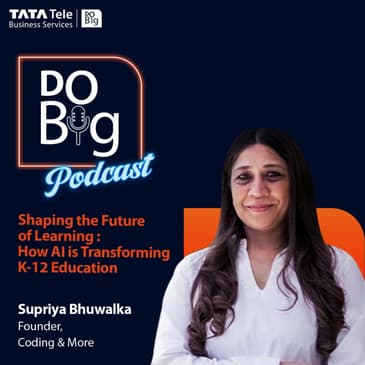

In this episode of Do Big Podcast, we explore the journey behind "Coding and More," an edtech company focused on K-12 students. Our guest Supriya Bhuwalka shares the inspiration, challenges, and lessons learned while establishing a platform dedicated to AI literacy. We dive deep into the AI4K12 '5 Big Ideas' framework and how they’re shaping classrooms today. Hear real success stories, understand the importance of ethical AI education, and discover the emerging AI trends that will transform the future of learning. Tune in to learn how "Coding and More" is preparing students for an AI-driven world.
[00:00:09] Welcome to another episode of the Do Big Podcast,
[00:00:12] where we spotlight the trailblazers and innovators shaping the future using technology.
[00:00:17] Today, we're diving into a critical topic that's reshaping the educational landscape in India –
[00:00:24] coding and AI literacy amongst young learners.
[00:00:28] Joining us today is Supriya Bhuwalka, founder of Coding & More,
[00:00:32] a pioneering organization dedicated to empowering the next generation with essential digital skills.
[00:00:39] In India, where over 250 million students are enrolled in schools,
[00:00:45] the integration of technology and education is no longer an option, it is a necessity.
[00:00:51] Despite the rapid growth of the tech sector, many students lack access to quality tech education,
[00:00:57] which is where coding and more steps in.
[00:01:00] Their mission is straightforward yet impactful – to make AI and coding education accessible,
[00:01:07] engaging and effective for K-12 students across diverse linguistic and cultural backgrounds.
[00:01:14] With a focus on building foundational skills like critical thinking and problem solving through coding,
[00:01:19] the company is addressing the gap in tech education that many young Indians face.
[00:01:25] Today, we'll explore how coding and more is not just teaching coding but fostering a generation of thinkers
[00:01:32] and innovators who are ready to tackle the challenges of tomorrow.
[00:01:36] But before we get started, I'd like to introduce my guest, Supriya.
[00:01:41] Supriya Bhuwalka, who is the founder of Coding & More,
[00:01:45] has started an all-women organization that helps upskill women
[00:01:49] and gives them opportunity to work flexiton and from home.
[00:01:54] Her work for AI literacy has also been presented and recognized by UNESCO.
[00:02:00] Her education is from Wellesley College USA, she's a double major in math and economics.
[00:02:06] She was invited to the prestigious Pre-Beta Kappa Honor Society
[00:02:10] and the Omicron Delta Economics Honor Society.
[00:02:13] In 2022, she collaborated with India AI to bring India's first AI literacy booklet for all.
[00:02:22] Welcome, Supriya, to the Doovic podcast. We're really eager to understand the space and detail with you.
[00:02:28] Thank you, Sheetal. I'm very excited to be here and speak about a topic that's really passionate to me.
[00:02:33] I'm so thrilled that somebody is really looking at students
[00:02:36] and not looking at coding from just the whole thing of,
[00:02:39] oh, there's four more on my child's national coding.
[00:02:44] When I was reading your website, I was so pleased to see that it was beyond coding
[00:02:50] and was really allowing kids to understand critical thinking because coding needs that
[00:02:55] but it can be applied to other aspects of their lives.
[00:02:59] So that's really nice to hear. So tell me what inspired you to start coding?
[00:03:05] So, Sheetal, I've always been in education.
[00:03:08] I used to help children who were aspiring to go study abroad
[00:03:12] and then I started a franchise for math and English. It's an international franchise
[00:03:18] and I was itching to do more and it was in 2017-2018 that I saw
[00:03:24] that coding is now accessible to younger children with low code, no code kind of environments.
[00:03:30] Coding is applied math and I'm a math person.
[00:03:33] So I said that this is something I need to explore
[00:03:36] and interestingly enough, I have a young daughter for whom I was looking for a coding class
[00:03:40] and I couldn't find quality teachers or a quality program
[00:03:44] and that's how coding and more was born.
[00:03:46] And with my heart also aligned to helping other women like me
[00:03:51] because it took me a long time to get into business by myself.
[00:03:55] I thought that coding and more could be that platform where I can help other women upskill
[00:03:58] and work on their own terms. So it was the two passions of mine,
[00:04:02] educating children and helping other women.
[00:04:05] That's fantastic. Tell me as an entrepreneur what were the initial challenges that you faced
[00:04:10] while setting up the company specifically when it is about children
[00:04:16] and it's also about upskilling women, right?
[00:04:19] So it was you almost picked up two challenges at the same time
[00:04:22] and so what were those challenges that you faced as an entrepreneur?
[00:04:26] So I think that fortunately because I had already forayed into running my own franchise
[00:04:33] I had learned the different aspects of a business as an entrepreneur
[00:04:37] but with coding and more the challenges that I faced were very intrinsic to the line.
[00:04:42] I started with coding but very quickly I pivoted to AI
[00:04:46] and this was in 2019, 2020 when people were not really aware of what AI is
[00:04:52] and so AI found it difficult to get parents to sign up.
[00:04:56] It was only the ones who were well-read.
[00:04:58] It was a self-selection sort of a thing who enrolled in our program.
[00:05:03] Being a math person, I'm not really from the tech side
[00:05:08] so I had a bit of an imposter syndrome that am I doing the right thing?
[00:05:12] Am I on the right track? Am I doing the right service?
[00:05:15] But really quickly, I think we started around in March
[00:05:20] and in October we were invited to have our children present their work
[00:05:25] in the World AI Competition and they had just done 8 or 10 classes
[00:05:29] and some of my children competed against Chinese children in the US
[00:05:33] and they won and I was like, I am validated.
[00:05:37] But the challenge was really spreading AI literacy in our community
[00:05:42] and getting teachers to believe that they could be upskilled
[00:05:45] because in order to do life teaching you need good quality teachers
[00:05:49] so I also had to chase people who I believe were good to say
[00:05:54] you know what, I'm going to teach you do this with me.
[00:05:57] Challenges are a part of life.
[00:05:59] And have the challenges kind of eased over the years?
[00:06:02] Have the challenges changed over the years?
[00:06:04] What are the new challenges now?
[00:06:06] Challenges have eased in the sense that with the JNAI tools
[00:06:11] you know now there is more awareness that yes, AI is important
[00:06:16] and you know I think people don't realize that AI though it is a technology
[00:06:21] it is really something which is an all-purpose tool that everyone needs to be aware of.
[00:06:27] So that self-selection is slowly dipping
[00:06:30] and we are having more people come in with a better understanding
[00:06:34] but the new challenges are how do you grow without losing the quality?
[00:06:40] You know, without losing the essence of the company which I am very mindful of
[00:06:44] that I'd rather you know do X and do it really well than do 10X
[00:06:48] and lose the mission of the company.
[00:06:52] That's interesting, we'll cover that in a bit but you know you've been doing
[00:06:57] you've introduced new frameworks, you've talked about the five big ideas of AI
[00:07:02] walk us through the framework and the five big ideas that you have
[00:07:07] and how they shape education for kids.
[00:07:10] You know I'm so glad Sheetal that you guys have done this research
[00:07:14] and know about the five big ideas.
[00:07:16] The five big ideas is a framework which has been designed by leading
[00:07:21] US professors from Carnegie Mellon MIT University of Florida
[00:07:26] This was done way back in 2017-2018
[00:07:31] and I was very fortunate that in my research I came across this framework
[00:07:35] and I aligned our curriculum to the five big ideas.
[00:07:38] What are these five big ideas? These five big ideas are perception,
[00:07:42] representation and reasoning, learning, social interaction and societal impact.
[00:07:50] What these mean is that how does a computer you know learn from the data
[00:07:56] that is collecting through the sensors, that's perception
[00:07:59] representation and reasoning is how does it extract meaning out of that information
[00:08:04] that it has gathered. Learning is that the computer is able to learn
[00:08:09] you know either through the examples given by us humans or through the patterns
[00:08:14] that they see in the data collected. Social interaction is the fact that
[00:08:18] these computers can interact with us what we call NLP or natural language processing
[00:08:21] the fact that we can talk to the machines in our language rather than
[00:08:25] having to learn their language which was coding and societal impact is
[00:08:29] essentially that this technology has a positive impact
[00:08:33] and a negative impact and it's important to cover both what we call AI ethics.
[00:08:38] So since our curriculum is aligned to these five big ideas
[00:08:42] it gives students a bird's eye view of the AI landscape which is not black and white
[00:08:48] it's very great and it helps them to become responsible consumers
[00:08:55] responsible creators of AI
[00:08:59] and it just makes them more mindful because today even if you're not in tech
[00:09:03] you're interacting with AI anytime you're on a connected device
[00:09:07] so I think that this five big ideas was a really broad framework
[00:09:12] which gives you a bird's eye view of the AI landscape.
[00:09:16] You know that's fascinating but how do you implement this five big ideas
[00:09:19] because you're teaching really young kids and then you are teaching older kids right
[00:09:23] some of these become very difficult concepts for younger kids
[00:09:28] especially when you think about bright and wrong ethics things like that
[00:09:33] so I just want to kind of get a sense of how you approach this for different age groups
[00:09:39] So can I tell you Sheetal to first share from my experience
[00:09:44] young children they already have a very strong sense of right and wrong
[00:09:50] so for them you don't even have to teach it
[00:09:52] you have to learn from them. I think over as we grow up
[00:09:56] I think we forget and our lines get blurred between right and wrong
[00:10:00] young children have their ethics really straight up
[00:10:02] so there is no issue but coming to the point of teaching really young children
[00:10:08] about AI through this landscape it's actually been a very rewarding journey
[00:10:13] because I myself had to learn all of this and then to be able to use language
[00:10:19] and analogies so that really young children as young as eight years
[00:10:22] can start learning about it and not only learn it
[00:10:25] but be able to apply it in different scenarios
[00:10:27] so here we were fortunate because today we have platforms
[00:10:31] which have been made for children visual platforms low code no code
[00:10:35] on which you can actually make projects you can actually train an AI model
[00:10:39] and deploy it in a coding environment
[00:10:41] so they are building prototypes of technologies that they are interacting with
[00:10:47] so to give you an example you know we all see facial recognition right
[00:10:51] even on our phone but the children are able to build that prototype
[00:10:55] and through that building of the project we teach them the theory behind it
[00:10:59] and the ethics behind it using language and analogies that they can relate to
[00:11:03] and as I grow older use more sophisticated language
[00:11:07] you go into more technicalities but you keep it visual
[00:11:11] so that nothing that they learn is ever extinct
[00:11:14] That's fascinating and I like that whole thing of children have a moral code
[00:11:17] which is much stronger than ours I think that's so true
[00:11:20] I want to understand this you spoke with that very early
[00:11:24] and the validation that you got out of the fact that your kids won an award
[00:11:29] right against other students
[00:11:31] I just want to understand share some success stories
[00:11:35] tell us what they did to have won that award
[00:11:38] whatever you feel like sharing in terms of when you have done this
[00:11:42] what comes out of it so just to go to sense
[00:11:45] So success means different things to different people
[00:11:48] being a young startup when you're growing organically
[00:11:54] you need credibility so credibility for us and success in that sense came
[00:11:58] by the recognition by the invitation by UNESCO
[00:12:02] to come and share our work on digital upskilling of women
[00:12:05] last year we were awarded by NASCOM
[00:12:08] the social change makers award which was again big validation of success
[00:12:12] with the work we are doing for AI skilling
[00:12:15] but for the children you know when I spoke about them winning that award
[00:12:20] in the World AI competition for youth it's a US based competition
[00:12:24] A very early on we had chosen the right framework the five big ideas
[00:12:30] so the children really understand deeply what AI means
[00:12:34] they understand the different technologies
[00:12:37] one of the students she was a 12 year old girl then
[00:12:43] she had made a waste aggregator where she trained an AI
[00:12:46] to be able to segregate waste whether it's biodegradable
[00:12:50] or recyclable or e-waste
[00:12:54] and this is not something that she had been taught
[00:12:58] she had been taught how to use computer vision to recognize images
[00:13:03] but because she was somebody who was passionate about environment
[00:13:06] she chose that same technology to make a waste aggregator
[00:13:10] my own daughter got four more because she saw that I was teaching these kids
[00:13:14] and I was not asking her to participate
[00:13:16] she is really into birds and nature
[00:13:19] and she was learning with us of course
[00:13:21] the last minute she said mom even I want to participate
[00:13:24] and I already have a project ready
[00:13:26] and she made one on endangered bird where she used the same technology
[00:13:29] but to train an AI to recognize endangered birds
[00:13:32] and I think that the fact that the children
[00:13:36] could actually apply the knowledge to something else
[00:13:40] and make a product a prototype of something that matters
[00:13:44] it's aligned to the UN SDGs got them those prices
[00:13:47] so for me that is success
[00:13:49] where every child of mine enjoys their learning
[00:13:52] and is able to transfer their learning to their own passion
[00:13:55] so that is generally success for us
[00:13:58] you're teaching the kids right
[00:14:00] how do the kids go back and teach parents
[00:14:04] or how do the parents get involved in something like this
[00:14:09] or do you also have programs for parents
[00:14:11] because there is always the sense of
[00:14:14] every time I do research
[00:14:17] older parents always say that keeping up
[00:14:19] with technology itself is a challenge
[00:14:22] and then keeping up with children who are way ahead of you in technology
[00:14:25] is an even larger challenge right
[00:14:28] now when you're equipping kids who are as young as eight and nine
[00:14:32] with AI and AI tools and AI frameworks
[00:14:36] how does it marry with what is happening at the home
[00:14:40] I know some of them are aware parents
[00:14:41] but what happens first is what I wanted to understand a little more
[00:14:45] it's such a great question
[00:14:47] I'm so surprised you asked me this
[00:14:49] so I realized very early on that this would be a challenge
[00:14:53] because when I would talk to parents who would call me up
[00:14:56] wanting to enroll the children
[00:14:58] first of all the mothers would say
[00:14:59] I don't understand tech
[00:15:01] can you talk to my husband and I would say
[00:15:03] look if you're eight year old you can do it so can you
[00:15:06] and at that point our classes are all online
[00:15:09] so I used to always tell my mothers
[00:15:12] when the child is having a class please sit there
[00:15:15] you'll also learn something and it's a lot of fun
[00:15:17] so A, I welcome them to sit and audit the class
[00:15:21] even if they don't want to do the coding part of it
[00:15:23] B, what I also started in our company
[00:15:26] was that after every class the teacher gives a feedback
[00:15:30] with the key vocabulary we never water down the vocabulary
[00:15:34] that we teach our children
[00:15:35] so that parents can then have a conversation with the child
[00:15:38] so this does two things
[00:15:40] one, the child gets an opportunity to share what he has learnt
[00:15:44] B, the parent gets a chance to actually
[00:15:48] learn something new without you know the child
[00:15:50] feeling that she's testing me but she's actually being supported
[00:15:54] but having said this not many parents
[00:15:57] once they trust you want to really upskill
[00:16:00] so that gap remains
[00:16:03] what interestingly happened is with the gen A.I. tools
[00:16:07] now people are realizing that they must upskill
[00:16:10] so now we have actually made a program for adults
[00:16:14] for non-tech adults to help them understand A.I.
[00:16:18] I would have ideally liked our children to teach
[00:16:20] but that's not really going down even though we have
[00:16:23] put in steps to do that
[00:16:25] okay, that's fascinating because I always find
[00:16:29] that you know it really helps when kids and parents
[00:16:32] can have conversations which are
[00:16:35] what I call what the kids really enjoy
[00:16:38] because inevitably they always seek at parents as those
[00:16:43] garden dinosaurs who never understand anything
[00:16:46] that they speak whether it's music, whether it's tech
[00:16:49] whatever it is so it's fascinating that you're kind of bridging
[00:16:52] this with the parents too
[00:16:54] when you talk you know A.I. and ethics is such a complex
[00:16:58] such a complex topic right
[00:17:03] there are so many things and that
[00:17:05] get questioned when you think about A.I. and ethics
[00:17:09] you've spoken about A.I. ethics
[00:17:11] and education A.I. and ethics at various platforms
[00:17:14] what is it that you would want to put out to the world over there
[00:17:19] like two or three things that you think the audiences must
[00:17:22] evaluate when you're thinking about A.I. ethics and education
[00:17:26] Shikil I think that A. first everyone should realize
[00:17:31] that A.I. literacy is so important for each and every one of us
[00:17:35] because you know A.I. is a very unique technology it's live
[00:17:39] you know it is learning in real time from us
[00:17:42] the predictions it makes is forming the decisions that we make
[00:17:48] it is forming the decisions that other people make on us
[00:17:51] and these are really important decisions whether it's legal, insurance, banking
[00:17:54] health etc everything and it's not a perfect technology
[00:17:57] so education is key where everybody should be A.I. literate
[00:18:01] A.I. ethics may sound scary and fancy and complex but it really isn't
[00:18:06] at coding and more we actually have an acronym for it first
[00:18:10] where we say that as a consumer you need to understand
[00:18:15] and advocate for fairness in technology
[00:18:17] what I mean by that is we all have biases
[00:18:21] if the technology is trained well representative of the different kinds of people
[00:18:26] it will be less biased and more fair
[00:18:28] inclusive meaning A.I. for first is when the technology is inclusive
[00:18:34] to all people whether you're deflect sick or whether you have a hearing
[00:18:37] or listening ability disability it's inclusive
[00:18:41] R is responsible or accountable where the A.I.
[00:18:45] you know it tells you why it has made those decisions
[00:18:47] you know it's accountable you know why you're getting a particular prediction
[00:18:50] safety is synonymous with privacy because A.I. comes with the data privacy issues
[00:18:56] though they are free there's a privacy issue so I think those are things that people should understand
[00:19:00] and T is transparency where if an A.I. is made for a particular reason
[00:19:05] it should be only for that and not any ulterior motives so to say
[00:19:09] so when we talk about A.I. ethics we want people to understand how this technology works
[00:19:15] so that they can advocate for their rights better because this technology is changing
[00:19:19] faster than governments can keep up faster than laws can be made
[00:19:23] so that's really important and we are very fortunate that we are being able to teach children
[00:19:28] who are the future of tomorrow so then they have the right A.I. ethics
[00:19:34] even though there is no law which is enforcing it
[00:19:37] I'm going to ask you a fun question to move away a little bit from what we've been speaking about
[00:19:42] I'm sure as teachers children ask questions which stump us right
[00:19:47] you share some of those fun questions that students have asked which your teachers are kind of stood back and said
[00:19:53] I didn't expect that
[00:19:55] oh my god there are so many of such questions and now I have to think of one
[00:20:04] you know more than being stumped I'm just amazed that because we talk about so much about bias with our students
[00:20:13] one time my kids were presenting to an international panel for a competition
[00:20:19] and some of the girls came back and said miss you talk about gender bias and this was a prestigious A.I. competition
[00:20:27] how come there was no woman on the panel you know judging us
[00:20:32] how are they asking us to you know tell us you know about A.I. ethics when they themselves are so biased
[00:20:39] with having an all white men judging panel
[00:20:42] and I was like valid point you know really valid
[00:20:45] and I was so surprised that they are actually looking at it practically and not theoretically right
[00:20:52] okay that's an interesting observation
[00:20:54] in fact that was going to be one of my questions saying how do you find the women
[00:20:58] because every time I speak on technology and by interview people they say there are very few women in technology
[00:21:06] and I'm just trying to figure out how do you find all of the teachers that you need who will come and teach with you
[00:21:12] how do you up skill women and how do you convert them if they're not from a tech background to get into something called A.I. and education right
[00:21:21] I'm sure there are barriers but I just want to get a sense of that
[00:21:25] so you know this is a challenge to be very honest
[00:21:28] and in my mind I truly believe that a good teacher is not one with the technical knowledge
[00:21:34] but one with the soft skills
[00:21:36] one who's patient kind and who can communicate really well and has a growth mindset
[00:21:41] because if you have to teach A.I. you have to have a growth mindset
[00:21:44] where you have to keep evolving with the changing technology
[00:21:48] and what I also have is a very interesting mantra
[00:21:51] birds of a feather flock together
[00:21:53] so if I find a good teacher or good teachers
[00:21:56] I ask them to get me their best friends their sisters etc
[00:22:00] you know because then they had the same sort of soft skills
[00:22:03] the technical part you know as I said if you have the mindset to learn
[00:22:07] we can teach you
[00:22:08] maybe it will take long with some
[00:22:10] but they all eventually learn
[00:22:12] and as far as what the technical students go
[00:22:15] because post 13 years of age they do need to have Python
[00:22:19] and data science knowledge
[00:22:20] so for that we look for women
[00:22:23] who are doing their masters in colleges and data science
[00:22:27] or I also have a few professors who are teaching in our universities
[00:22:31] so we wrote them in
[00:22:33] and then they are very collaborative
[00:22:34] they teach each other, they help each other
[00:22:36] so I don't feel alone in that sense
[00:22:39] Oh that's amazing
[00:22:40] and this is going to be my final question for you
[00:22:42] because I know that I could have a longer conversation
[00:22:44] but I'm going to keep this to the time we've agreed
[00:22:48] looking ahead
[00:22:49] what emerging trends in A.I. do you see as pivotal
[00:22:55] for you know the future of education
[00:22:57] this is again a very very great question
[00:23:01] you know as I said when we started
[00:23:03] it was more self-selection because people didn't understand A.I.
[00:23:07] but now with the GEN AI tools
[00:23:08] schools realize that children are using it
[00:23:12] so they from being worried and scared
[00:23:15] are now opening up to the fact
[00:23:17] that our teachers need to be upskilled
[00:23:19] so that they can learn this technology
[00:23:22] they can themselves become more productive
[00:23:24] they can teach the technology in a responsible manner
[00:23:28] to the students who are self-discovering it
[00:23:31] and then help the children be future ready
[00:23:34] and ethically ready
[00:23:36] so we have started you know doing this teacher training programs
[00:23:40] for schools where we are very fortunate
[00:23:43] that there are progressive schools
[00:23:44] who are willing to take this plunge
[00:23:46] because you know we know that this is just the beginning
[00:23:48] the technology is just going to become better
[00:23:50] and more powerful and you can see misinformation
[00:23:52] is another issue you know which is emerging
[00:23:55] so if we can educate our teachers to learn these tools
[00:24:00] and they can take it to the classrooms
[00:24:01] and simultaneously we can also reach out to the parents
[00:24:05] so all the three stakeholders are aligned
[00:24:08] and this is really the trend that I am seeing
[00:24:11] that now schools are opening up to the fact
[00:24:15] that education has to change
[00:24:17] they are re-looking at the definition of education
[00:24:20] they are re-looking at what work will be
[00:24:22] given that AI is here and to stay
[00:24:24] and a part of our lives
[00:24:25] so that's what we are sort of reading ourselves for
[00:24:30] and have started doing
[00:24:31] and they are getting a good response
[00:24:32] you know like teachers are happy
[00:24:33] because you also feel that when they get AI literate
[00:24:36] students they are able to empathize with the students
[00:24:39] and students say oh she gets me
[00:24:41] she is also at par, she is not a dinosaur
[00:24:44] So you are starting new curriculum of courses for others
[00:24:48] what are the other things that you are looking at doing
[00:24:51] at coding and more
[00:24:52] to make sure that coding and more is tapping into the new trends
[00:24:57] and you know staying ahead of the curve
[00:25:00] AI technology is changing really rapidly
[00:25:03] my educators and I consistently upskill
[00:25:06] and curate relevant content for our audience
[00:25:10] we were anyway ahead of the curve
[00:25:12] since we were one of the first AI educators
[00:25:15] for K-12 in 2020
[00:25:17] today too we remain relevant and ahead
[00:25:20] because we want to make a difference
[00:25:22] you know our students are using cutting edge technologies
[00:25:26] such as custom GPT, RAG for their projects
[00:25:30] our idea is to bridge the gap between academia
[00:25:34] and the workspace using the power of technology
[00:25:37] that's great my last one bit
[00:25:39] which is as more and more AI happens
[00:25:42] and more and more people integrate AI into it
[00:25:44] I just want to get a sense of
[00:25:46] do you teach, so currently what I
[00:25:49] is it more AI at a broader level
[00:25:53] and will you ever get down to saying AI
[00:25:56] let's say because I come from the world of research
[00:25:58] you would say AI in research versus AI in something else
[00:26:01] are you looking at segmenting AI further
[00:26:03] or is it always going to be a broad spectrum
[00:26:07] approach towards AI when you're teaching kids
[00:26:10] so you know I'm so glad you asked me this question
[00:26:14] when we teach AI
[00:26:16] we first start with foundational AI
[00:26:19] which is like looking at AI under the hood
[00:26:21] now we have gone into gen AI tools also
[00:26:24] and what we look at is
[00:26:27] we look at it as a lens of AI practitioners
[00:26:29] and AI specialists
[00:26:30] so you are in research
[00:26:33] so you're an AI practitioner
[00:26:34] you need to know AI for research
[00:26:36] so when we do AI in a broad way
[00:26:38] what we eventually do is funnel the people in
[00:26:41] or the children in to their speciality
[00:26:43] they understand the technology and they apply it
[00:26:46] to whatever they need to
[00:26:47] so we are already doing that
[00:26:49] in that sense and that's where their learning comes in
[00:26:53] when they can see that the same technology can be used for research
[00:26:55] can be used for conservation, can be used for law
[00:26:58] can be used for farming or for art
[00:27:00] but yes that's important to do that
[00:27:02] so that everybody can use it even though
[00:27:04] they're not a technologist
[00:27:06] that was my last question Supriya
[00:27:08] and I can't tell you how wonderful it was to have this conversation
[00:27:11] I don't even know where the time has flown
[00:27:13] in having this conversation with you
[00:27:15] thank you so much
[00:27:17] for being a part of the Dubic podcast
[00:27:20] we're thrilled, you know we're doing a lot in the edtech space
[00:27:23] so we thought we should bring more and more people like you
[00:27:26] to talk about technology in the space of education
[00:27:29] and you've just made it absolutely wonderful
[00:27:32] all the very best for the future
[00:27:34] and I hope putting in more growth from strength to strength
[00:27:37] pleasure having you with us here today
[00:27:39] thank you so much Sheetal, this was really a pleasure for me also
[00:27:42] thank you for tuning into the Dubic podcast
[00:27:45] a podcast that is dedicated to providing insights
[00:27:49] strategies and success stories
[00:27:51] of smart digital solutions for SMS
[00:27:54] we believe that behind every successful business
[00:27:57] there's a strong foundation of reliable and secure technology
[00:28:00] via digital connectivity, cloud infra, cloud apps
[00:28:04] collaboration tools or cybersecurity solutions
[00:28:06] in a rapidly evolving digital world
[00:28:10] where technology is key to progress
[00:28:11] Tata Tele business services stands at the forefront
[00:28:14] of digital transformation of SMS
[00:28:17] Tata Tele business services with their extensive
[00:28:19] experience and commitment to empowering businesses
[00:28:22] understands the unique needs of SMS
[00:28:26] whether it's scalable connectivity
[00:28:27] robust communication tools
[00:28:29] or tailored ICT solutions
[00:28:31] Tata Tele business services is here to propel your business forward
[00:28:35] Tata Tele business services is synonymous
[00:28:39] with innovation, reliability and transformative solutions
[00:28:42] so if you're ready to take your organization
[00:28:45] to new heights of success
[00:28:47] we encourage you to explore the transformative possibilities
[00:28:50] that Tata Tele business services has to offer
[00:28:53] our contact details are in the description below
[00:28:56] remember we're available major podcast platforms
[00:28:59] so if you enjoyed today's conversation
[00:29:02] subscribe to our podcast for future episodes
[00:29:05] which we promise will be packed with equally valuable insights
[00:29:08] on questions entrepreneurs face
[00:29:10] as they digitize and scale businesses
[00:29:12] with the help of technology
[00:29:14] don't forget to rate and review our podcast
[00:29:17] as well as share it with peers, colleagues
[00:29:19] and other entrepreneurs like yourself
[00:29:21] who will benefit from listening to it
[00:29:23] thank you for listening to us
[00:29:25] and until the next time
[00:29:26] keep embracing technology
[00:29:28] and may your business thrive in the digital era
[00:29:40] thank you for tuning in to the Doopik podcast
[00:29:43] a podcast that is dedicated to providing
[00:29:45] insights, strategies and success stories
[00:29:47] of smart digital solutions for SMS
[00:29:51] we believe that behind every successful business
[00:29:54] there's a strong foundation of reliable
[00:29:56] and secure technology
[00:29:58] via digital connectivity, cloud infra, cloud apps
[00:30:00] collaboration tools or cybersecurity solutions
[00:30:03] in a rapidly evolving digital world
[00:30:06] where technology is key to progress
[00:30:08] Tata Tele business services
[00:30:10] stands at the forefront of digital transformation
[00:30:12] of SMS
[00:30:13] Tata Tele business services
[00:30:15] with their extensive experience and commitment
[00:30:17] to empowering businesses
[00:30:19] understands the unique needs of SMS
[00:30:22] whether it's scalable connectivity
[00:30:24] robust communication tools
[00:30:26] or tailored ICT solutions
[00:30:28] Tata Tele business services
[00:30:30] is here to propel your business forward
[00:30:33] Tata Tele business services is synonymous
[00:30:35] with innovation, reliability
[00:30:37] and transformative solutions
[00:30:39] so if you're ready to take your organization
[00:30:42] to new heights of success
[00:30:44] we encourage you to explore the transformative possibilities
[00:30:47] that Tata Tele business services has to offer
[00:30:50] our contact details are in the description below
[00:30:53] remember we're available major podcast platforms
[00:30:56] so if you enjoyed today's conversation
[00:30:59] subscribe to our podcast for future episodes
[00:31:02] which we promise will be packed with equally valuable insights
[00:31:05] on questions entrepreneurs face
[00:31:07] as they digitize and scale businesses
[00:31:09] with the help of technology
[00:31:11] don't forget to rate and review our podcast
[00:31:14] as well as share it with peers, colleagues
[00:31:16] and other entrepreneurs like yourself
[00:31:18] who will benefit from listening to it
[00:31:20] thank you for listening to us
[00:31:22] and until the next time
[00:31:23] keep embracing technology
[00:31:25] and may your business thrive in the digital era