
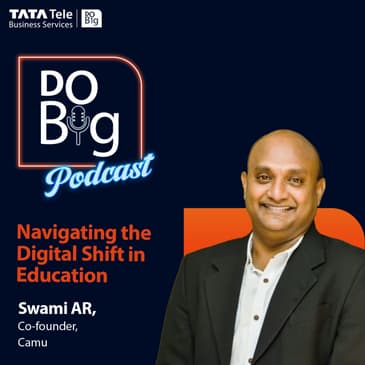

In this episode, we dive into the technology trends transforming the edtech industry, exploring the challenges educational institutions face in adopting new technologies and ensuring a seamless shift from traditional to digital learning.
Swami shares his vision for the future of education and the exciting possibilities the next decade holds for edtech.
[00:00:09] Welcome to another inspiring episode of the Do Big Podcast.
[00:00:13] I am your host Sheetal Jhoksi and today we are going to discuss the EdTech sector,
[00:00:19] an industry that's fundamentally altering the delivery and consumption of knowledge.
[00:00:24] But today the conversation comes with a twist.
[00:00:27] Just a couple of years ago in 2021, I'm sure all of you remember this,
[00:00:31] India was heralded as the potential EdTech capital of the world.
[00:00:35] However, the landscape has been shifted with a noticeable downturn
[00:00:39] and diminishing optimism amongst investors and EdTech companies alike.
[00:00:44] We are joined by the co-founder and CEO of a company that's crucial in providing
[00:00:49] the technological backbone for educational institutions,
[00:00:53] not just in India but also globally.
[00:00:56] I would like to welcome our guest, Ar Swami.
[00:01:00] And before we dive into this conversation with Swami,
[00:01:04] I thought here's a quick introduction for those of you who don't know Him.
[00:01:08] Swami has completed his MS from Wayne University, U.S.
[00:01:13] and started his career in the U.S., working for General Motors.
[00:01:17] He returned to India and joined ISOFT to build a robust healthcare solution
[00:01:22] for the NHS in the UK.
[00:01:25] Along with some of his colleagues from ISOFT,
[00:01:27] he started Camu in 2014.
[00:01:31] In the past decade, he has played a crucial role in early-stage
[00:01:35] implementations of Camu as well as making sure that it goes to
[00:01:39] four new countries outside of India.
[00:01:42] Swami is an engineer by qualification, a product manager by instinct,
[00:01:46] and he is a passionate storyteller, which I'm sure you will discover
[00:01:50] as we have this conversation with him.
[00:01:52] Swami is responsible for operations and strategic initiatives.
[00:01:57] He connects with academicians instantly on pedagogy and student success.
[00:02:02] His in-depth understanding of the domain helps him and Camu
[00:02:07] offer customized solutions to their customers.
[00:02:10] At a personal level, he is extremely passionate about farming.
[00:02:16] For the past few years, he has evolved a partnership
[00:02:19] with local farmers in a village to cultivate paddy,
[00:02:23] and he ended in converting over a thousand acres of barren lands
[00:02:26] to paddy fields. Swami, I want to know how this was done.
[00:02:30] He keeps himself fit, irrespective of the country he operates from.
[00:02:35] He never forgets to carry a pair of shoes for a run.
[00:02:39] And he believes that everyone, including students,
[00:02:43] must focus on paying attention to health and building a healthy lifestyle.
[00:02:49] Swami, between education, studying, fitness and creating paddy fields,
[00:02:59] what an exciting life.
[00:03:01] Welcome to the Dupik podcast.
[00:03:04] I am so looking forward to this conversation with you.
[00:03:07] Thank you, Shital.
[00:03:07] I look forward to this conversation and very happy to be here.
[00:03:13] Before I jump into the ed tech part of things,
[00:03:16] what's the connection between paddy fields running and education?
[00:03:20] I think it's just in the blood.
[00:03:22] It's always been passionate about farming farms
[00:03:27] and I've always liked to watch nature
[00:03:29] and always observed when I like to be in nature.
[00:03:34] So it's just been all along, I've been like that.
[00:03:38] And it did get an opportunity to do something very different
[00:03:42] in a place called Ramnadapuram, a very remote village.
[00:03:47] Doubt's tricking, there's hardly any rainfall there.
[00:03:50] One of the regions that's flagged as like the largest drought regions
[00:03:55] are top four or something like that.
[00:03:57] So there's no fresh water over there.
[00:03:59] So I always had, so I do have some of my own land over there.
[00:04:04] But then what do we do with this and stuff?
[00:04:06] And we're able to create a partnership with the local farmers
[00:04:10] and each taking different responsibilities
[00:04:13] and obviously finding different ways of converting.
[00:04:17] There are lots of challenges.
[00:04:18] I won't go into details of all of that.
[00:04:19] So once we were able to get a block of 100 acres of land converted,
[00:04:23] then everybody started doing that
[00:04:24] and over a thousand acres of land got converted from
[00:04:29] shrubs in barren land into paddy fields
[00:04:32] and I do make a visit now and then
[00:04:35] and it's very refreshing and very fulfilling when I visit there.
[00:04:40] That's fantastic.
[00:04:41] I'm sure that you've also implemented technology there
[00:04:44] but that's for another day.
[00:04:47] We've done another episode on Agri Tech
[00:04:50] and I'm sure our listeners would love to listen to that too.
[00:04:52] But it'd be fun to talk to you about Agri and Tech
[00:04:55] at some point in time in the future.
[00:04:57] But jumping into today's conversation, which is around EdTech,
[00:05:01] I just want to understand what are some of the technology trends
[00:05:06] that are currently shaping the educational or the EdTech industry?
[00:05:12] So obviously I got to start by saying artificial intelligence.
[00:05:17] It's in every field.
[00:05:18] It certainly is making a major impact on how things are going to be consumed
[00:05:24] in the future, how people will operate.
[00:05:29] Along with artificial intelligence, AR and VR, augmented reality
[00:05:33] and virtual reality, the content, it's a long shot
[00:05:36] but I think there's significant investments being made by many companies
[00:05:39] and where AI is today,
[00:05:42] whether there's an underlying platform which companies
[00:05:44] and individuals can consume to create content or create whatever they want to create.
[00:05:50] AR, VR will also be in the same stage as the near future.
[00:05:55] But what's more interesting today is the way in which the technology
[00:05:59] will aid in consumption of the content.
[00:06:03] And there are four things I would like to call out.
[00:06:05] Adaptive learning.
[00:06:06] It's happening today as we speak
[00:06:09] and those areas we can really feel the change now.
[00:06:13] We talk about AI, it's interesting.
[00:06:16] A lot of things are happening.
[00:06:18] It's not yet felt by the impacted users yet, but it's quickly, rapidly happening.
[00:06:23] But adaptive learning where traditionally we are given the same content
[00:06:29] students or any learner,
[00:06:31] given the same content and they study in groups,
[00:06:34] they study the same thing
[00:06:34] and that means you've completed and achieved certain outcomes.
[00:06:39] There are four interesting aspects that technology is offering now
[00:06:43] in the consumption of content which is being impacted by the learners right now.
[00:06:49] The first one is adaptive learning,
[00:06:53] where we're typically in a model, teaching and learning model
[00:06:56] where we learn in groups and it's the same content offered to everyone.
[00:07:00] You study the same thing, you get the same exam questions
[00:07:03] and you go through them.
[00:07:04] That's changing significantly.
[00:07:08] Depending upon how I perform, I take a test or I learn some content.
[00:07:12] Depending upon how I perform, the next set of content offered to me is different.
[00:07:16] The questions have been asked different.
[00:07:18] The skill level, am I at level four in this particular subject
[00:07:21] or level five or level six?
[00:07:23] That's making it quite interesting and that's really fine tuning
[00:07:27] teaching and learning to the learner.
[00:07:30] That's very interesting.
[00:07:31] That's a technology trend that I'm quite excited about
[00:07:35] and it's certainly impacting users.
[00:07:37] Along with it comes gamification to tell me how am I performing?
[00:07:41] The boundary between organized content in one particular website
[00:07:48] versus social media is blurring.
[00:07:50] It's all just coming together.
[00:07:52] Soon we'll see people consuming university content from Instagram
[00:07:58] and those boundaries are blurring
[00:08:01] and people just want to consume content,
[00:08:03] it doesn't matter what it is.
[00:08:05] With that comes mobile learning and being able to do a lot more on mobile.
[00:08:09] I think these are the technology trends that I'm excited about
[00:08:12] and I think we come across quite often these days
[00:08:15] and we feel it really will help the learners.
[00:08:19] One of the things that I'm very excited about
[00:08:21] and everybody tells me I'm wrong
[00:08:23] is with AR, AR, VR especially,
[00:08:27] and the metaverse is another space
[00:08:30] which everybody now says it's not happening anymore
[00:08:34] but that's a question for you.
[00:08:36] Is learning going to get into the metaverse at all
[00:08:38] or do you think that's too far out?
[00:08:41] It's still far out but I think it's definitely
[00:08:45] it's going to happen, that's my gut feel.
[00:08:48] There's investments go up and investments go down
[00:08:51] but then the reason is there are many things that need to come together.
[00:08:54] It's about the hardware, it's about the affordability of the hardware
[00:08:58] it's not that it can be done today right now
[00:09:01] but will my consumers invest and consume the content in that manner
[00:09:06] and is it practical? It's the only question.
[00:09:09] How we couldn't do many things while on a mobile phone
[00:09:12] 10 years back we were able to do, time will come.
[00:09:15] The technology is there, it's just about is it affordable?
[00:09:17] Is it practical to consume? That's what is evolving now.
[00:09:21] So I'm a believer, I believe it'll happen.
[00:09:23] I'm so happy to hear that.
[00:09:26] When you started on the journey with Cammy
[00:09:30] when you started Cammy, when you started off on the journey
[00:09:33] what was the thought process in working with educational institutions etc?
[00:09:42] Sure. So we were not, by no means experts in education
[00:09:47] an engineer and I've been in healthcare before this for 10 years
[00:09:51] but we built a system back in between 2004 to 2014, 10 years
[00:09:59] for healthcare, for the NHS in the UK
[00:10:02] one of the kind of organizations where
[00:10:05] we were able to build a cloud system where the word cloud did not exist
[00:10:09] and the concept of a patient being able to take a digital card
[00:10:16] and be able to take a card and be able to get their digital record
[00:10:19] in any healthcare organization.
[00:10:22] We thought that's quite interesting, why not in education?
[00:10:26] And these are education and healthcare are two very fundamental areas
[00:10:29] for any government, any country.
[00:10:32] Generally we know recession in healthcare and in education
[00:10:35] and that's because reason I say that is because it's so important
[00:10:37] to everyone, to every government, to every individual, to every citizen.
[00:10:41] So we thought we should be able to replicate that in the education field
[00:10:46] so we thought we should start, implement that education field
[00:10:50] and then came SAS and then came mobile, just made our lives easier
[00:10:54] and it's time to get started.
[00:10:56] And we built a SAS system where any, a Canvas and SAS solution
[00:11:00] where any institution, kindergarten to higher education
[00:11:02] we're primarily a higher education company
[00:11:04] but we do have a good categorical solution as well
[00:11:08] which started with that.
[00:11:10] Any institution, any country, any kind of a pedagogy
[00:11:12] any learning and teaching and learning methodology you want to follow
[00:11:17] you should be able to just create your account and get started
[00:11:20] and that was the motivation.
[00:11:22] So we had the experience in different field
[00:11:23] and as we did this we obviously had very good customers
[00:11:28] very good users who helped us also learn
[00:11:31] and understand education domain and built what we have built today.
[00:11:34] You know so you started a free pandemic right
[00:11:37] and educational institutions weren't really in the digital savviness
[00:11:42] levels that they are today.
[00:11:45] Everybody had to learn really quickly
[00:11:46] but I just want to understand how did Camu help institutions
[00:11:53] get onto their digital transformation journey?
[00:11:56] So before pre-pandemic it's been about five, six years
[00:12:00] pre-pandemic we were since 2014 right?
[00:12:04] Earlier it was all a lot of, it was a choice that they had to make
[00:12:08] it wasn't a mandate.
[00:12:10] If we need to meet somebody we had to go to the campus to meet them
[00:12:13] online meetings were never probably just never thought of
[00:12:17] if you want to do a demonstration you got to go there
[00:12:20] and find the project, connect your computer
[00:12:22] and go through all of those challenges
[00:12:23] and that's how we used to present
[00:12:27] and at that time it was a choice
[00:12:28] it was an investment that was considered
[00:12:32] not basic but something more advanced
[00:12:34] that's how the mindset was
[00:12:36] then the pandemic came in and everything was digital
[00:12:40] everything was online, the user base swelled
[00:12:43] and they already were using a number of other platforms
[00:12:49] for their day to day business
[00:12:50] so just adopting more of Camu was just natural for them
[00:12:56] because they had to use digital for everything
[00:13:00] so it all just sort of came together at that time
[00:13:03] but having said that after the pandemic
[00:13:05] it instilled a level of maturity
[00:13:07] it instilled a level of, it increased the skill levels
[00:13:11] of the user community to stay digital
[00:13:14] and we are, that's the benefit that we get today
[00:13:19] so they've gone through a change
[00:13:21] and then they sustained after that
[00:13:23] they retained the learnings
[00:13:24] and that's a very welcome change
[00:13:27] and that's really helping us to go further
[00:13:28] and that's very interesting
[00:13:30] because not only do you provide services
[00:13:32] for educational institutions
[00:13:34] you're also working with corporates
[00:13:36] for their learning requirements
[00:13:38] and their learning management systems
[00:13:40] and things like that
[00:13:41] what have you seen as a shift over there
[00:13:44] because this is creating something
[00:13:46] for an educational institution
[00:13:48] versus creating something for an organization
[00:13:50] what are the differences and the challenges
[00:13:53] so for us it's all sort of just, it's all bundled in
[00:13:56] because they have a solution that works for
[00:13:59] K to 12 corporate higher education
[00:14:01] but we are largely influenced by higher education
[00:14:03] the DNA is still, you know, it's higher education
[00:14:06] but some of the concepts are catching up
[00:14:09] you have lots of institutions, higher education institutions
[00:14:12] now targeting what they call the ODL online distance learning
[00:14:15] short term courses for the corporate learners
[00:14:18] so the boundaries are all sort of blurring now
[00:14:21] and we have many of our higher education institutions
[00:14:24] that are targeting the corporate learners
[00:14:27] and their models different
[00:14:28] it's not like you have semester one, semester two
[00:14:30] a bunch of 20 learners come in
[00:14:31] 30 learners register, you just start a course
[00:14:33] and it just goes on
[00:14:35] very flexible in academic planning
[00:14:37] because of the way in which we are developing this product
[00:14:40] we did not look at a particular market
[00:14:41] or particular segment
[00:14:42] we looked at teaching and learning in general
[00:14:44] looked at all different kinds of teachers
[00:14:46] and learners
[00:14:47] and administration that goes around that
[00:14:49] so we always had the flexibility in the system
[00:14:52] so for example in the modern economies
[00:14:54] the students choose what they want to study
[00:14:57] in which semester
[00:14:58] and they will choose the pace of learning
[00:15:01] and they will graduate when they want to
[00:15:04] something still unheard of in India
[00:15:07] our system supports both all these models
[00:15:11] so it's quite adaptive
[00:15:12] you can configure it how you want to configure it
[00:15:15] and be able to make it either
[00:15:18] offer 10 days courses, short term courses
[00:15:20] 30 day courses or a six months or a four year program
[00:15:24] so because of the way in which we've approached
[00:15:28] building the solution
[00:15:30] so we're able to cater to all these segments
[00:15:33] and while there's agility in the system
[00:15:36] what are the challenges that colleges
[00:15:39] and universities face
[00:15:41] when they have to adopt new technologies
[00:15:43] and let's not
[00:15:45] if you can focus on India for first
[00:15:47] and then get into the global space
[00:15:49] because India has very distinct challenges
[00:15:51] I believe from the rest of the world
[00:15:54] sure
[00:15:56] yeah I was also going to pretty much focus on India
[00:15:59] the challenge really is not in the tech
[00:16:02] it's not at all in the tech that's my view
[00:16:04] it's in the adaptation
[00:16:07] deciding what you want to do with tech
[00:16:09] we need to be very clear in the mind
[00:16:11] what are the policies and procedures that we have as a university
[00:16:15] what part of it do I want in IT
[00:16:19] then you form that opinion
[00:16:21] and then do you want to purchase a product
[00:16:23] do you want to license or subscribe to a product
[00:16:25] that will help you achieve that or do you want to build one
[00:16:28] the build versus buy
[00:16:30] then if you go with that thought process
[00:16:32] then it's quite clear what you want to do
[00:16:34] you think of your policies, procedures
[00:16:37] and what you want to automate
[00:16:38] we call that typically requirements
[00:16:40] software requirements and you decide that
[00:16:42] and then you issue that to several vendors
[00:16:45] or you put it in some public website
[00:16:47] and people can respond to it
[00:16:48] then there's clarity, the suppliers know what you want
[00:16:52] and the providers will know what you want
[00:16:53] and you know what they have
[00:16:55] and then it's quite balanced
[00:16:58] and everything that comes after that
[00:17:00] particularly the implementation
[00:17:02] and the lifecycle that follows
[00:17:04] is more predictable
[00:17:06] adaptation of this methodology
[00:17:08] having that thought process
[00:17:09] is my view is the single biggest challenge
[00:17:13] everyone will use an LMS
[00:17:14] they will take attendance
[00:17:16] they will do all of that
[00:17:18] I don't think there's any problem
[00:17:19] but instead what's probably happening
[00:17:22] is what is still happening
[00:17:25] people go for references
[00:17:26] they make a few phone calls
[00:17:27] send emails and check
[00:17:29] what are you using and is it working well for you
[00:17:33] and some people that they rely on
[00:17:37] and they trust may say yes or may say no
[00:17:39] and the decisions are made on that
[00:17:40] this has been typically the way in which
[00:17:42] the engagement is happening
[00:17:45] I feel that's the biggest challenge
[00:17:47] both for us and for the institutions
[00:17:50] then once you subscribe to the solution
[00:17:53] then you try to fit into the scheme of things
[00:17:56] you want to change it
[00:17:57] there's all kinds of challenges we face after that
[00:18:00] the tech itself I don't see a challenge
[00:18:03] the process of choosing
[00:18:04] and rolling adopting
[00:18:06] the tech I see that's where the improvements need to be made
[00:18:09] having said that
[00:18:11] higher education particularly after Covid has come a long way
[00:18:14] while it's not changed
[00:18:15] this method has not changed significantly
[00:18:18] but people start to understand
[00:18:19] what does it mean to change a standard software
[00:18:22] compared to five years back
[00:18:24] so it's evolving
[00:18:26] and I humbly believe we are playing a major role
[00:18:30] in how that should change
[00:18:32] who are we
[00:18:33] the final plus institutions that we work with
[00:18:35] and the many more that we are talking to
[00:18:37] we are sort of recommending certain standard methodologies
[00:18:40] deciding the policies, procedures up front
[00:18:43] sign it off
[00:18:44] be clear about what you want
[00:18:45] agree what you will implement in a software
[00:18:49] what you won't, what you will do manually
[00:18:52] decide all that up front, sign it up
[00:18:53] and then it makes it easy for everybody
[00:18:55] and we're seeing more and more institutions
[00:18:59] seeing that as a better way to do things
[00:19:01] and this is, we humbly believe we are
[00:19:04] creating a change here on how this engagement can happen
[00:19:08] that's interesting so it's really bringing clarity
[00:19:11] to the table which is a single biggest challenge
[00:19:14] and not really the execution
[00:19:17] absolutely, absolutely it's really that
[00:19:19] that clarity and
[00:19:20] being clear about what I want
[00:19:22] what I want to do with it
[00:19:23] where do you think
[00:19:25] or how do you think
[00:19:28] you know education institutions can ensure
[00:19:31] so one is the whole process that you're talking about
[00:19:34] but transitioning from traditional
[00:19:36] to digital learning right
[00:19:40] I understand this is more about the back end system
[00:19:43] I'm just trying to understand what
[00:19:45] other than the clarity and other than putting the processes in place
[00:19:48] is there anything else that educational institutions
[00:19:51] can do to make the transition for themselves
[00:19:54] easier? It's a mandate top down
[00:19:57] sometimes the management of institutions
[00:19:59] make those decisions that
[00:20:01] we need technology because
[00:20:03] of these 10 objectives that we want to achieve
[00:20:06] but then there has to be a mandate to see it through
[00:20:09] and it needs to sustain
[00:20:11] and there need to be people who have
[00:20:14] a job just to do that or they will
[00:20:17] be impacted if they don't make that happen
[00:20:21] it cannot be the supplier that does everything
[00:20:24] the software provider that does everything
[00:20:26] for the institution, for the institution to sustain
[00:20:29] in that implementation being totally focused
[00:20:32] we need all our records whether it's an attendance
[00:20:35] learning material
[00:20:38] all of the admissions processes, the graduations
[00:20:41] everything has to absolutely be online
[00:20:43] that mandate needs to come through
[00:20:46] otherwise each and every user has got their own objectives
[00:20:49] what they're busy with for the day and
[00:20:52] because they've just procured the service
[00:20:55] and they've been doing it in other ways
[00:20:58] they've been achieving the same thing
[00:20:59] it's easy for them to switch backwards
[00:21:01] and then who prevents that and how do you bring them forward
[00:21:05] and maybe for one user it's
[00:21:07] couple of extra steps in their day-to-day work
[00:21:11] but it brings a significant benefit to
[00:21:13] 1000 other users and maybe 10,000 more students
[00:21:16] those users need to realize that and they need to
[00:21:19] and it's best done when there's a clear mandate
[00:21:22] the objectives are explained to the end user
[00:21:24] why you do this, why are you doing this additional two steps
[00:21:26] and how others benefit
[00:21:28] I think that kind of mandate needs to be clear
[00:21:31] if there's an aspect of your question around
[00:21:34] training, technology and stuff I really don't believe
[00:21:37] there is who is not using something
[00:21:41] whether it's a new gadget
[00:21:44] new device who's not using it just takes
[00:21:47] I think I really don't think that's a problem
[00:21:51] training people on tech or on gadgets
[00:21:53] or on tech or on software I really don't think it's a problem
[00:21:56] if there's a mandate it will happen
[00:21:59] and typically how long does it take
[00:22:01] for an organization and institution
[00:22:04] to transition from traditional to digital
[00:22:08] how long does a project take, any project of yours
[00:22:12] should we say digital just trying to clarify
[00:22:15] we say digital to traditional to digital
[00:22:17] there are two aspects in this right
[00:22:20] there's the learning, teaching and learning content
[00:22:22] there's a lot of content available
[00:22:26] and then there is the administrative processes
[00:22:29] which is so critical to run the operations
[00:22:31] for administrative process that's our
[00:22:33] both we have a unified SIS and LMS solution
[00:22:36] the SIS is very core to how
[00:22:40] and the institutions as well
[00:22:42] typically an institution that's got really good data
[00:22:46] and have a reasonable
[00:22:48] not the level of clarity I was talking about
[00:22:50] but a reasonable amount of clarity on what they want to achieve
[00:22:54] a university of a size of say about 10,000 students
[00:22:57] in about 4 to 6 months we can
[00:22:59] take them to a digital administrative process
[00:23:04] that's possible
[00:23:05] the way teaching and learning works
[00:23:07] I don't think we can ever mandate that
[00:23:09] for example tell all the
[00:23:11] 500 professors working in a university
[00:23:13] you must have all your content online
[00:23:16] and I really don't think that's necessary
[00:23:18] you could be doing workshops
[00:23:20] you could be having students like in architecture schools
[00:23:22] attracting things physically
[00:23:26] whatever is relevant and whatever makes sense
[00:23:28] needs doing
[00:23:29] but whenever you need to augment that
[00:23:31] with digital content
[00:23:34] whether you're using some existing content
[00:23:37] you're trying to reuse that or you want to create your own
[00:23:40] it will only happen
[00:23:43] based on the need
[00:23:44] case-to-case basis
[00:23:46] so the way in which an institution
[00:23:48] the administrative process is quite clear
[00:23:50] are these 20 things now digital
[00:23:52] and is it all done, tick tick tick
[00:23:54] and you're done with it it's all done and dusted
[00:23:56] but with teaching and learning we should measure the outcomes
[00:23:59] I don't think we should measure how much of your content is digital
[00:24:02] right
[00:24:03] you can have one of your parameters could be
[00:24:06] how digital is my institution becoming
[00:24:09] but that's not to measure the outcome
[00:24:11] but that's to measure one of the parameters of the
[00:24:14] vision of the education institutions
[00:24:16] but we should be measuring learning outcomes
[00:24:19] and definitely when you measure those outcomes
[00:24:21] one of the questions students would be
[00:24:23] how interesting, how engaging
[00:24:24] how interesting is your prof
[00:24:27] you will get answers to those questions
[00:24:28] and the answers will not be favorable
[00:24:31] if you're going to be handing out things in a very traditional manner
[00:24:34] so it will automatically evolve
[00:24:36] so we should measure outcomes
[00:24:37] from a teaching learning perspective
[00:24:40] so globally institutions have been using
[00:24:44] tools such as yours for many many years right
[00:24:47] especially the larger ones
[00:24:49] I'm not talking about maybe the smaller ones
[00:24:51] but the larger institutions have been
[00:24:53] what happened in the learnings
[00:24:55] what happened in the improvements in your tools
[00:24:58] versus what is I don't know a global benchmark
[00:25:01] there's nothing like a global benchmark
[00:25:04] we believe we have done enough
[00:25:07] to be seen by a set of institutions
[00:25:10] as something we can adopt
[00:25:11] and we are quite grateful for that
[00:25:15] every bit of our product has been built
[00:25:18] based on the customers
[00:25:20] inputs, the institution's inputs
[00:25:24] having had 20 years of product
[00:25:26] enterprise product development expertise
[00:25:28] and I'm by nature a product manager
[00:25:32] how to use domain experts
[00:25:34] to give you the necessary information
[00:25:36] to build a tech platform
[00:25:39] or a software solution
[00:25:41] that's our expertise
[00:25:43] every bit of what we've done
[00:25:44] we've used domain experts from our customer organizations
[00:25:47] even the very first module that we rolled out
[00:25:49] there's been somebody who we partnered with
[00:25:52] and said we need inputs to build this software
[00:25:53] so users are the core
[00:25:56] and I don't think you can do anything in the lab
[00:25:58] or in an R&D center
[00:26:00] you can create some technology and stuff
[00:26:02] but we are a scammer software that enables
[00:26:05] digitization of processes
[00:26:06] teaching learning processes through the LMS
[00:26:08] and the administrative processes through the SIS
[00:26:10] so the user is the core
[00:26:12] everything has been built around the users
[00:26:14] but we don't do exactly what the user tells
[00:26:16] and then we'll fall behind the users
[00:26:18] so we need to have a view of where we want to go
[00:26:21] make sure the inputs are coming in from the users
[00:26:23] and we build something that's more
[00:26:25] leading the users forward
[00:26:27] so that's how we've approached
[00:26:29] developing our software
[00:26:30] and what makes Camu distinct
[00:26:33] as a product
[00:26:35] I'll go back to one of the comments you made
[00:26:38] India's got some very different challenges
[00:26:41] we've not seen
[00:26:43] a software solution
[00:26:45] I'm sure there is, we have not seen
[00:26:48] there may be some
[00:26:48] that operate with a good leadership position
[00:26:52] in India for the model
[00:26:54] that works in India
[00:26:56] for the
[00:26:58] 30 million, 35 million
[00:27:00] higher education
[00:27:02] students as well as several
[00:27:04] tens of millions of school going
[00:27:06] children to be able to work in this model
[00:27:09] as well as
[00:27:11] work in a modern economy
[00:27:12] like North America, like in Australia
[00:27:15] where the students use what they want to study
[00:27:18] and they're able to
[00:27:20] completely follow a different path
[00:27:22] what we are able to do is bring
[00:27:25] the best practices
[00:27:27] across the globe
[00:27:28] to our customer base and to many
[00:27:31] countries we're able to bring that
[00:27:33] I think that's why we are helping
[00:27:34] in a very practical sense
[00:27:37] I know I'm not talking about the technology here
[00:27:39] I'm talking about the process
[00:27:41] which is the end of the day
[00:27:42] that's what the institutions are trying to achieve
[00:27:45] but we're able to bring it through the software
[00:27:48] so if you look at each and every
[00:27:50] countries now got like in India we have
[00:27:52] the NAC, we have the MPA, we have the
[00:27:55] NIRF defining certain standards
[00:27:57] and where are these standards coming from
[00:27:59] these are coming from other global
[00:28:02] accrediting bodies
[00:28:03] and there's bodies like the Washington
[00:28:05] Accord which make recommendations
[00:28:07] and all of these sort of come together
[00:28:09] in different countries adopt these
[00:28:11] so we're sort of doing a very similar thing
[00:28:13] in tech
[00:28:16] I think that we are very grateful
[00:28:18] that we've been able to get customers
[00:28:20] we have done the necessary
[00:28:22] groundwork to be able to achieve that
[00:28:23] to have customers in different countries
[00:28:25] so we're able to bring this
[00:28:28] the best practices to our institutions
[00:28:30] so that's what we believe we do
[00:28:32] at the core of course
[00:28:34] there are many many tools
[00:28:35] and software tools
[00:28:37] and functions and features that we bring
[00:28:39] but I think it's far
[00:28:42] outweighed by the best practices
[00:28:43] we're able to bring to the customers
[00:28:45] when we started this conversation
[00:28:47] Swami you spoke about
[00:28:48] the fact that you were amongst the first guys to talk
[00:28:51] about the cloud but the cloud was not a conversation
[00:28:53] piece
[00:28:53] how important is
[00:28:56] cloud services
[00:28:58] for building products such as yours
[00:29:00] and for implementation of products such as yours
[00:29:02] in
[00:29:04] institutions
[00:29:05] it's impossible to do anything without the cloud
[00:29:08] it's just absolutely not possible to do anything
[00:29:11] so the cloud gives us
[00:29:12] earlier there used to be
[00:29:13] software which you install on a server
[00:29:15] I think long gone
[00:29:16] for those days and I don't know
[00:29:18] now our humble
[00:29:21] opinion
[00:29:22] we don't have any company that's starting to build
[00:29:24] products that get installed in a
[00:29:26] local server
[00:29:27] everything is in the cloud
[00:29:29] and we also have been one of the early movers
[00:29:32] and I don't think it's possible to do
[00:29:35] and all the education institutions
[00:29:36] that we work with
[00:29:37] even their local material, the content
[00:29:39] everything is getting
[00:29:41] uploaded into
[00:29:42] into cloud services
[00:29:43] so that it's accessible anytime
[00:29:45] anywhere by people who you authorize
[00:29:47] and it's secure and it's safer
[00:29:50] though that could be a myth that's
[00:29:52] a conversation for a different day
[00:29:53] people think it's a myth I think it's absolutely a fact
[00:29:56] it's safer in the cloud
[00:29:58] okay
[00:29:59] and
[00:30:01] just as final thoughts
[00:30:02] to this conversation
[00:30:04] what do you think is the future
[00:30:06] of technology in education
[00:30:11] the future
[00:30:11] I think it goes back
[00:30:14] relates back to your very
[00:30:16] first question
[00:30:17] we talked about AI
[00:30:19] those are the tools that are going to
[00:30:23] become
[00:30:24] take set a stage in the future
[00:30:26] but I'd like to
[00:30:28] highlight
[00:30:29] the real impact on the learner
[00:30:31] I feel
[00:30:33] I'm quite confident and I feel that
[00:30:35] organized learning
[00:30:37] and joint learning
[00:30:39] with a common curriculum
[00:30:41] is going to start it is already reducing
[00:30:43] reducing rapidly
[00:30:45] there will be a significant decline
[00:30:47] in that model
[00:30:48] as technology offers better
[00:30:51] ways of consuming the content
[00:30:52] the learner will be the decision maker
[00:30:55] the learner will decide
[00:30:57] what they want to learn
[00:30:59] how they want to learn
[00:31:01] when they want to learn and from whom
[00:31:03] they want to learn
[00:31:04] rather than I join
[00:31:06] a university and this is what I go through
[00:31:08] that change will happen
[00:31:10] and then I will string together everything
[00:31:12] that I know my skills, my knowledge
[00:31:14] and I will acquire a degree
[00:31:16] whenever I want to acquire the degree
[00:31:18] and if I need to acquire the degree
[00:31:20] employment people may look at your skills
[00:31:22] look at what you've achieved
[00:31:24] that could be more of more relevant
[00:31:26] to the employer rather than the degree certificate
[00:31:28] and there's one more aspect
[00:31:30] which I think is quite
[00:31:31] the academic bank of credits
[00:31:34] that the government is rolling out
[00:31:36] will help us actually measure that
[00:31:38] and authenticate that what skills are acquired
[00:31:40] what knowledge are acquired
[00:31:42] in the form of courses
[00:31:44] and what courses are completed
[00:31:46] it's available to any employer
[00:31:48] to anybody on what credentials
[00:31:50] that a particular citizen
[00:31:52] has got and then
[00:31:54] a lot of things will flow from there
[00:31:57] I think that's the impact
[00:31:58] that is likely to be created
[00:32:00] in the near future
[00:32:02] A very out of context
[00:32:31] question but very relevant to India is
[00:32:34] education institutions
[00:32:35] conducted exams efficiently
[00:32:37] yes we already are doing that
[00:32:38] we can proctor the exams
[00:32:41] we can conduct the exams on the campus
[00:32:44] completely automate end to end up to the stage
[00:32:46] everything from pre-exam
[00:32:48] post-exam during exam
[00:32:50] in all of that
[00:32:51] we believe we are already doing that
[00:32:53] in a significant method
[00:32:55] but what I would like to also share with you
[00:32:58] is the other
[00:33:00] thought process
[00:33:01] is that absolutely relevant
[00:33:03] are employers looking at the degree certificate
[00:33:05] to give somebody a job today
[00:33:07] what do those exams get you
[00:33:09] the exams finally get you a degree certificate
[00:33:11] if you just go back 2 minutes back
[00:33:13] what I was talking about
[00:33:14] employers are looking for skills
[00:33:15] what did you acquire
[00:33:17] what they want to learn
[00:33:20] and from whom they want to learn
[00:33:22] and if the employer gets confidence
[00:33:25] from what this learner has done
[00:33:28] is relevant
[00:33:29] and it makes sense to me
[00:33:31] that could be the tipping point
[00:33:32] that is really interesting
[00:33:35] because I do believe that as
[00:33:37] none of our skills are going to be relevant in the future
[00:33:39] we will all be up-skilling
[00:33:41] and re-skilling forever and ever
[00:33:43] as we grow
[00:33:44] very interesting point but
[00:33:45] I could have a debate with you on that itself
[00:33:49] but we leave that for another day
[00:33:51] thank you so much
[00:33:53] for joining me today
[00:33:55] and
[00:33:56] having this conversation
[00:33:58] any last thoughts
[00:34:00] on the future of the EdTech industry
[00:34:02] I know we have seen
[00:34:04] booms and busts
[00:34:05] and we see
[00:34:07] investing and not investing and all of that
[00:34:10] any final thoughts to share
[00:34:12] with our listeners
[00:34:13] yeah sure
[00:34:14] we believe in the marathons
[00:34:17] not in the short runs
[00:34:19] investors may come
[00:34:21] investors may not come
[00:34:22] and it may be
[00:34:24] bullish or bearish
[00:34:25] but EdTech is a very exciting field
[00:34:28] what we really are very excited about
[00:34:30] is the fact that it's still in nascent stages
[00:34:32] compared to banking
[00:34:34] insurance and automobile and manufacturing
[00:34:36] still nascent stages
[00:34:38] and it's very dynamic
[00:34:39] it's not so processor oriented like the other domains
[00:34:42] where you do many things
[00:34:44] and then you get output like in manufacturing
[00:34:46] here is all individuals, it's human
[00:34:48] you're dealing with human beings
[00:34:50] and you're delivering something to human beings
[00:34:51] so it's quite exciting and it can
[00:34:53] change and evolve dynamically
[00:34:55] and we're building tech for that
[00:34:57] and what's most exciting for me
[00:35:00] is almost all the interactions
[00:35:01] are with people and all kinds of
[00:35:04] people
[00:35:06] and that's quite exciting
[00:35:07] so very happy where we are
[00:35:09] we are in for the marathon and we are here for the long run
[00:35:13] Swami this was a fabulous conversation
[00:35:16] I know you're travelling
[00:35:17] and thank you so much for making the time
[00:35:19] to join us on the DUPIC podcast
[00:35:22] it's been our pleasure
[00:35:23] to have you here today
[00:35:25] Thank you Shital and thank you very much
[00:35:27] for having me on this podcast
[00:35:29] and hope what
[00:35:31] our information is shared is useful
[00:35:33] Thank you
[00:35:34] Thank you for tuning in to the DUPIC podcast
[00:35:37] a podcast that is dedicated
[00:35:39] to providing insights, strategies
[00:35:41] and success stories
[00:35:42] of smart digital solutions for SMS
[00:35:45] we believe that behind
[00:35:47] every successful business
[00:35:49] there's a strong foundation of reliable
[00:35:51] and secure technology
[00:35:52] via digital connectivity, cloud
[00:35:54] infrastructure, cloud apps, collaboration tools
[00:35:56] or cybersecurity solutions
[00:35:59] in a rapidly evolving digital world
[00:36:01] where technology is key to progress
[00:36:03] Tata Telebusiness Services
[00:36:05] stands at the forefront of digital transformation
[00:36:07] of SMS
[00:36:09] Tata Telebusiness Services
[00:36:10] with their extensive experience and commitment
[00:36:12] to empowering businesses
[00:36:14] understands the unique needs of SMS
[00:36:16] Whether it's scalable connectivity
[00:36:19] robust communication tools
[00:36:21] or tailored ICT solutions
[00:36:23] Tata Telebusiness Services
[00:36:25] is here to propel your business forward
[00:36:27] Tata Telebusiness Services
[00:36:29] is synonymous with innovation
[00:36:31] reliability and transformative solutions
[00:36:34] so if you're ready
[00:36:36] to take your organization
[00:36:37] to new heights of success
[00:36:38] we encourage you to explore
[00:36:40] the transformative possibilities
[00:36:42] that Tata Telebusiness Services has to offer
[00:36:44] our contact details
[00:36:46] are in the description below
[00:36:48] remember we're available major podcast platforms
[00:36:51] so if you enjoyed today's conversation
[00:36:53] subscribe to our podcast
[00:36:55] for future episodes which we promise
[00:36:57] will be packed with equally valuable
[00:36:59] insights on questions entrepreneurs face
[00:37:01] as they digitize
[00:37:03] and scale businesses with the help of technology
[00:37:05] don't forget
[00:37:07] to rate and review our podcast
[00:37:08] as well as share it with peers, colleagues
[00:37:11] and other entrepreneurs like yourself
[00:37:13] who will benefit from listening to it
[00:37:15] thank you for listening to us
[00:37:16] and until the next time
[00:37:18] keep embracing technology and may your business thrive
[00:37:21] in the digital era
[00:37:32] Thank you for tuning in
[00:37:33] to the Doopic Podcast
[00:37:34] a podcast that is dedicated
[00:37:36] to providing insights strategies
[00:37:38] and success stories of smart digital
[00:37:41] solutions for SMS
[00:37:42] we believe that behind
[00:37:44] every successful business
[00:37:46] there's a strong foundation of reliable
[00:37:48] and secure technology
[00:37:49] via digital connectivity, cloud infra
[00:37:52] cloud apps, collaboration tools
[00:37:53] or cybersecurity solutions
[00:37:56] in a rapidly evolving digital world
[00:37:58] where technology is key to progress
[00:38:00] Tata Telebusiness Services
[00:38:02] stands at the forefront of digital transformation
[00:38:04] of SMS
[00:38:06] Tata Telebusiness Services
[00:38:07] with their extensive experience and commitment
[00:38:09] to empowering businesses
[00:38:11] understands the unique needs of SMS
[00:38:13] whether it's scalable connectivity
[00:38:16] robust communication tools
[00:38:18] or tailored ICT solutions
[00:38:20] Tata Telebusiness Services
[00:38:22] is here to propel your business forward
[00:38:24] Tata Telebusiness Services
[00:38:27] is synonymous with innovation
[00:38:28] reliability and transformative solutions
[00:38:31] so if you're ready
[00:38:33] to take your organization
[00:38:34] to new heights of success
[00:38:35] we encourage you to explore
[00:38:38] the transformative possibilities
[00:38:39] that Tata Telebusiness Services has to offer
[00:38:42] our contact details
[00:38:43] are in the description below
[00:38:46] remember we're available major
[00:38:47] podcast platforms so if you enjoyed
[00:38:50] today's conversation
[00:38:51] subscribe to our podcast for future episodes
[00:38:54] which we promise will be packed with equally valuable
[00:38:56] insights on questions
[00:38:57] entrepreneurs face as they digitize
[00:39:00] and scale businesses with the help
[00:39:02] of technology
[00:39:04] don't forget to rate and review our podcast
[00:39:06] as well as share it with peers, colleagues
[00:39:08] and other entrepreneurs like yourself
[00:39:10] who will benefit from listening to it
[00:39:12] thank you for listening to us
[00:39:14] and until the next time
[00:39:15] keep embracing technology and may your business thrive
[00:39:18] in the digital era