
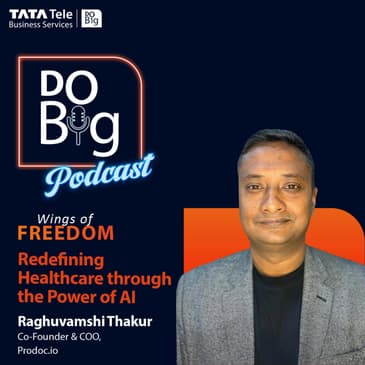

Join us as we explore the future of healthcare with Raghuvamshi Thakur, Co-founder of Prodoc.io. In this episode, we discuss the role of digital transformation in reshaping healthcare delivery in India and how Prodoc is using AI-powered tools to simplify medical terminology, offer data-driven care alternatives, and seamlessly connect patients to the right healthcare providers.
Join us for a deep dive into the future of personalized, AI-driven healthcare.
[00:00:09] Welcome to another episode of the Do Big Podcast where we dive into the transformative world
[00:00:15] of technology and healthcare. Today, we are focusing on the healthcare market which was
[00:00:20] valued at $110 billion in 2016 and is projected to skyrocket to $638 billion by next year.
[00:00:33] As of 2024, the healthcare sector is one of India's largest employers, engaging 7.5 million people
[00:00:41] and more. This growth is driven by a critical demand for healthcare professionals,
[00:00:48] a demand that is expected to double by 2030 both nationally and globally.
[00:00:54] This comes at a time when India faces a stark shortage of healthcare workers
[00:00:59] with just 1.7 nurses per thousand people and a doctor-to-patient ratio of one is to 1500.
[00:01:07] Amidst these challenges, we have companies like ProDoc stepping up to revolutionize patient care
[00:01:13] through data-driven solutions. ProDoc harnesses AI to personalize healthcare,
[00:01:20] making it accessible directly through patients' phones in their preferred languages.
[00:01:26] This no-app platform is not just enhancing convenience but is fundamentally transforming
[00:01:32] how medical care is delivered across diverse populations.
[00:01:37] Join us as we discuss with Raghu Vamsheed Hakur, the co-founder and CEO of ProDoc,
[00:01:43] how their innovations are setting the stage for a new era in healthcare.
[00:01:48] Aiming to make quality healthcare reachable for every Indian,
[00:01:53] let's explore how technology and foresight are paving the way for better health outcomes
[00:01:58] in one of the world's most dynamic healthcare landscapes, India.
[00:02:03] Raghu, welcome to the Dubic podcast. It's absolutely our pleasure to have you here today.
[00:02:09] Thank you, Shreeta likewise.
[00:02:12] So, Raghu, I'm not going to waste any time. I'm going to just jump into the conversation
[00:02:16] with you and what I want to really understand is, we've talked about the fact that
[00:02:22] there is challenges in Indian healthcare but at the same time there's so much happening
[00:02:27] as far as health tech is concerned and how digital is transforming healthcare.
[00:02:34] Want to understand how do you think digital transformation is impacting healthcare
[00:02:39] in India today? So, it's very interesting that we talk about digital health transformation
[00:02:51] but at the same time one of the primary beneficiary of that digital transformation which
[00:02:57] is patient is still pretty much residing in the same place where he was
[00:03:05] which I take it back. This is also not to say that we haven't made advancements.
[00:03:12] If you really see today the reason why our doctors mostly recommend tests before he jumps into a
[00:03:23] diagnosis is primarily because the medical tests have become so commoditized and
[00:03:33] the price point is so low that almost everybody can afford them right now.
[00:03:37] The doctor doesn't have to let's say build a probability without having a data.
[00:03:44] So, it's very data-driven decision making that doctors are doing today.
[00:03:50] Lot of AI already is impacting the radiology. So, there's lot of work that is going on
[00:03:58] primarily because of the AI ML advancements that have happened.
[00:04:02] If you really see inside the OT or inside the hospital a lot of digitalization that has
[00:04:09] happened again from HMS to HIS to a lot of information that's changed and
[00:04:15] lot of this digital transformation also rightly being driven by government agency.
[00:04:23] So, you must have heard of Abha Stack. You must have heard about AVTM that is going on right.
[00:04:29] So, lot of concrete effort is being made by the government to actually enable digitalization
[00:04:37] to the last mile right. This is not about digitalization at the
[00:04:42] metros or at the tier one level this is going to tier two and tier three.
[00:04:46] That's the impact that government is trying to have and I think the Abha Stack or the ABDM Stack
[00:04:54] will have the same impact what UPI had on. This is going to be a big transformation.
[00:05:02] It's not going to be easy. It's going to be difficult. We already see there are
[00:05:06] lot of challenges there but lot of this transformation will happen over time and
[00:05:10] we'll see lot of digitalization happening. Not only does it the ABDM not only triggers
[00:05:17] digitalization it also enables standardization of information and democratization of that
[00:05:23] information across healthcare entities right. So, this is a fantastic change that is happening.
[00:05:30] The reason why I said nothing has changed for patient is because you and me when we go to
[00:05:34] hospitals we get a bunch of documents which we don't understand right. The only thing that
[00:05:39] we walk out of which actually makes sense to us is the prescription right. And honestly that is not
[00:05:46] changed right that continues to be the same right. From product point of view our journey was very
[00:05:53] focused on patient and we said you know what we need to empower this patient with enough
[00:06:00] information that when he goes back he does not just know the medicine that he has to take
[00:06:04] even if he has let's say related questions he should be able to answer that he should be right.
[00:06:10] Now this doesn't sound like a big deal when you're going for let's say your regular check
[00:06:14] up or small issue that you might have right but when you actually look this in terms of
[00:06:20] cancer care or maternity or IVF or ortho related cases where the care journey itself is very
[00:06:28] long I personally have experienced this quite a bit that every time we would come back home
[00:06:34] there will always be a question that we would want to be answered but now because you're home
[00:06:40] and you don't have access to doctor you wouldn't be able to do that right. And we're primarily
[00:06:44] trying to fill that gap right so what we're really trying to do from a product point of
[00:06:49] view is build that digital care assistant that is available to you without even downloading
[00:06:57] an app and that's the incentive. So it's quite interesting because you're talking about patient
[00:07:02] care and it's about the family which is coming in and the patient who's coming in
[00:07:06] just you know I'm sure when you started this off one is personal experience and you do talk
[00:07:11] about that but what are those two or three critical areas where patients even today feel like
[00:07:20] I'm at a complete loss I don't know what I'm supposed to do right. Very good question right
[00:07:27] so if you take statistics and I like to I'll put up on this one part right one there's two very
[00:07:34] interesting statistics that we need to understand to understand how the health care has been
[00:07:40] evolving in India right. Seven out of ten in India today lack health literacy right what that means
[00:07:50] is that if you have a problem and let's say you have a specific problem and specific body part
[00:07:56] the patient is unable to diagnose or unable to identify the right doctor that he should be
[00:08:03] going right so he depends on a general practitioner or somebody to make that decision for him to
[00:08:09] actually go to the right. Okay and then the second statistics which is also very interesting is that
[00:08:16] way beyond the WHO standards India has one doctor for every 1500 people population right
[00:08:24] which means even if the doctor wanted to spend that effort to enable the patient with that
[00:08:31] health literacy she probably does not have that kind of bandwidth today just to circle back
[00:08:37] now to the question that you're asking right but two three things that patients and one very striking
[00:08:45] thing is that patients and doctors understand this well while the patient do not and I'll give a
[00:08:52] very good example there right that no two patients have the same journey we are two
[00:08:57] individuals and even though we might be going through the exact same problem we still
[00:09:03] may not be necessarily going to or will have the same remedial actions taken for us right good example
[00:09:10] is two women if they're going through a maternity cycle and they're in exact same trimester and
[00:09:16] maybe even matching dates they'll still be experiencing a completely different experience
[00:09:23] in terms of right why we understand that part lot of us as patients we always tend to think
[00:09:31] and compare ourselves with a treatment that somebody else has bought and then try to
[00:09:37] ask questions in that regard right and the example that I was trying to tell you was that my dad was
[00:09:42] diagnosed with cancer in 2020 right and to begin with it was right in the
[00:09:49] bang in the middle of pandemic so it made things worse but my dad would call up anybody
[00:09:55] who remotely had cancer without even trying to know what kind of cancer the other person have right
[00:10:01] this point was that it's one word and then it's just assumed that everything that they went through
[00:10:07] would probably right and that's one of the very big concern that there it exists
[00:10:13] that's almost two people going through a similar problem assumes that the solution is very
[00:10:18] which may not be the case right that's primarily what also drives the reason that
[00:10:25] personalization is a key to healthcare and that is why doctors play a very essential role right
[00:10:31] they ensure that that personalization is delivered to the patient in the right manner
[00:10:35] that's that's the primary key identifies us right the second thing that I've seen also is that
[00:10:41] a lot of people even today try to question the motive behind a lot of care recommendations right
[00:10:51] what I mean by that is let's say if I have a health issue and I go to a doctor
[00:10:56] doctor tells me a bunch of tests and in the back of my mind I am trying to reason oh but why
[00:11:02] so many right I'm trying see you think from a doctor's perspective he is thinking okay he might
[00:11:08] have ABC I'll get these tests done so I can rule out some of the options right but from a patient
[00:11:14] point of view because we are taught to be let's just skeptical and so we tend to try to judge
[00:11:22] something that we don't have enough knowledge about right we have we've made these two as a
[00:11:29] very fundamental core aspects of the product right now we want to encourage health literacy and
[00:11:35] we want to encourage people to ask questions so that we can really enable them with the answer
[00:11:40] that you'd like and so if I understand the health literacy part of it but when let's say if
[00:11:47] somebody wanted answers on how are these answers given because in today's day and age all of us
[00:11:53] seem to go to google to get our answers and web md uh to get our answers and things like that
[00:12:01] so how does pro doc give the answers to questions that patients have which is different
[00:12:07] from the classical thing of oh I have something with me google it which is the equivalent of your
[00:12:14] dad calling up anybody and everybody who had cancer to say hey tell me what can happen with cancer
[00:12:19] because that's what google will do if you don't have enough details it's going to throw up
[00:12:24] everything at you and of course we have the web mds and whatever equivalents of it that
[00:12:29] all consumers tend to go and you know then start self medicating blah blah blah I just want to
[00:12:34] understand what does pro doc do and how does it do it to help this aspect of patient care
[00:12:43] so this is also something so true right we all do we all do this right we all uh a blink of an eye
[00:12:50] put everything and very interestingly right uh tried yesterday a cousin of mine called
[00:12:57] called me thinking because I'm in health care he assumed that oh now I am as good as a doctor so
[00:13:03] he's making this call to me and he says that he's experiencing breathlessness or not because I'm
[00:13:11] feeling congested uh to breathe could it be related to the cholesterol and the issue that I had
[00:13:18] last month and I'm like first of all I'm not a doctor second they don't sound like the same thing
[00:13:24] he said no I just check youtube and it does say that it could be related I said yes
[00:13:29] if the youtube is saying that please go to a hospital first right rather than go to him but
[00:13:34] coming back to that point as to how we are making a difference right this is also what we
[00:13:40] have to understand she said that there has been considerable amount of work that has gone in
[00:13:46] to address this specific problem right lot of us are going on internet and reading things and
[00:13:52] the accuracy of the information is highly questionable right as part of product what we've
[00:13:58] done is we actually integrate with l l m's that are primarily designed for medical related
[00:14:06] okay right this ensures that the answers that we are giving are at least not taken from the
[00:14:15] internet or not with respect to then they're coming from well research sources and they're
[00:14:20] coming from any internet food right if you heard of google's med palm it's a again l m and
[00:14:28] it's very specific to health care and it does a fantastic job in replying to queries the second
[00:14:35] thing that we've also done is we have ensured that we never recommend a care treatment to the
[00:14:41] patients through this platform right what we are trying to do is we're trying to answer the
[00:14:45] question so you could as a patient I could go to pro doc and when I say pro doc again we enable
[00:14:52] all of this on whatsapp so this is just a whatsapp chat that you're having with somebody right
[00:14:56] so you could go to this number and then you could just ask simple questions for example
[00:15:03] from panchakarma treatments to surgery related question right we're not saying you should
[00:15:08] have a surgery what we are saying is how what would this mean right if you are a mother
[00:15:14] in your first trimester what is that you can experience right what is probable
[00:15:21] experience that people have if you have cough and cold what is the probability that you should
[00:15:28] probably see a pulmonary dentist or see a dental physician we're trying to help determine and educate
[00:15:36] but we still effectively trying to tell you that if you have a problem you should see a
[00:15:42] right doctor to get that treatment rather than actually suggesting a treatment right we and this is
[00:15:47] a regulation that has been followed across the industry that there are no care suggestions
[00:15:53] that are available on the platform we are only trying to educate and inform as to why a certain
[00:16:01] care journey could take a certain right for example if a doctor or the answer request you to do a
[00:16:09] particular blood test you could always put that blood test and say what is this blood test
[00:16:14] specifically for and then system will give you that information okay so it's really
[00:16:20] truly focused on healthcare awareness and information rather than anything descriptive
[00:16:28] that's what you're trying to do right 100 percent 100 percent and I think we are still far away
[00:16:35] from believing in AI to an extent where we could take care suggestions from it I think that
[00:16:41] would be incorrect okay and so when you talk about doing this how does this ability to get this knowledge
[00:16:49] and the ability to get this information how does that provide a more how does it improve the
[00:16:56] customer experience as far as healthcare is concerned because that's one of the things
[00:17:00] that you talk about 100 percent right so we've done two three things the one of the most fundamental
[00:17:09] thing that we have done is that we do not provide same set of information to everybody right so we
[00:17:17] have removed the the robots the bots in the middle and we're saying we if you and I asked
[00:17:24] that same question you would probably still get two different sets of answers and I'll tell you how
[00:17:31] right so what you've done is we've said that one system is provided to the hospital so the first
[00:17:38] thing that we do is we take the business related information and personalize the LLM journey
[00:17:44] based on that right so basically what we're doing is first thing is let the hospital come
[00:17:50] back to us so we take the business related information and build the know-how as part of the AI so now
[00:17:58] just to simplify it right basically now the AI knows oh this is the hospital I am an agent who
[00:18:05] is working for this hospital this hospital has so many doctors it has so much expertise these are
[00:18:10] the services that are available this is something that I know of right that's the layer one second
[00:18:16] thing that we do is we take every patient and then we say okay there is a patient journey that
[00:18:21] patient is going right so we identify what is that patient journey that patient is going so for in my
[00:18:27] dad's case it could have been a a biopsy report right and then a care treatment plan right
[00:18:34] so you know as a hospital they can just upload that biopsy report that care treatment plan
[00:18:39] and once they upload that information the system understands and then generates a curated plan
[00:18:46] as per the care recommendation that doctors give from a patient point of view what is happening is
[00:18:53] at every multiple intervals system intervenes and systems tries to educate and inform the
[00:19:01] patient about where he is in the care journey and what he can expect again a good example as
[00:19:08] in my dad's case he had to go through let's say 30 radiology cycles right at every week a system like
[00:19:16] this would actually then come back and say you know you finish the first week of radiology
[00:19:21] this is what you can expect you can expect these changes in the body this is normal
[00:19:27] this is not normal right and as a family we could ask questions which primarily we did but
[00:19:34] we did that one day in a week to a doctor and then if we had other questions we would just bottle
[00:19:40] that up we will keep it with us we write it down and we wait for the next appointment or
[00:19:45] you would call the hospital and then try to get to the doctor whenever is the idea is to ensure
[00:19:52] that enough information is available to patient one you educate the patient so that they ask more
[00:19:58] intelligent questions when they interact with the doctor right and they try to understand
[00:20:02] third thing is to actually provide the information in the language that the patient prefers
[00:20:08] that's another thing and then primarily focus on care adherence right tell them when is the next
[00:20:15] appointment right help them book that appointment get to the right doctor the idea is to build
[00:20:21] enough engagement which improves care adherence and it's scientifically proven that if you have
[00:20:27] right care adherence automatically the outcomes improve so that's the goal so does this mean
[00:20:34] that typically the patients who come to you or get on to the pro doc system are ones who are
[00:20:40] recommended by hospitals or from hospitals that you partnered with which I can any patient
[00:20:45] join the pro doc system today we don't even have that option of a patient coming on to
[00:20:52] so again let me take a step back right so pro doc is a b2b platform okay it's a platform that we
[00:21:00] offer to care providers that they can extend to their patients in the fashion that they believe
[00:21:06] would be most beneficial right so basically it's the hospital using the platform to identify
[00:21:15] the right patients who will benefit from the care engagement and then bringing them onto a
[00:21:20] platform and then working with them that actually brings me to the next point right there is so much
[00:21:26] of healthcare data or patient data which will be sitting both with the hospital and with you
[00:21:33] and today everybody talks about you know how health care and patient data is critical and
[00:21:39] there is so much of security and privacy conversations around it given that we're going
[00:21:44] into so much of digitization of health care how do you ensure that the security and privacy of
[00:21:52] patient data is maintained the regulatory standards are met with we don't have too many in this country
[00:22:00] today so just want to understand how do you manage that aspect from our point of view what
[00:22:14] proactive approach so what we built the system the system itself is a HIPAA compliant architecture
[00:22:22] so we already bring all the nuances all the security protocols that are necessary
[00:22:28] and they are compliant to a North American market so they are following a very mature
[00:22:35] law that was being in place for a while right what we also do is we ensure data encryption both
[00:22:43] when the data is when we store the data as well as when the data is in transit right
[00:22:48] we ensure encryption that both sides that also ensures that even if there is a data exchange
[00:22:55] that is happening it's always secure from a data security point of view I can tell you that
[00:23:00] irrespective of how much we do it's not enough the only way to ensure data security is to
[00:23:07] continuously keep revisiting that security apparatus and keep improving right and at this point of time
[00:23:16] that's what we do we continuously ensure that we are revisiting this at least the apparatus that's
[00:23:24] built inside and is the encryption based because of the utilization of whatsapp which is what your
[00:23:31] product is you know utilizing or is it over and above the whatsapp what's have encryptions
[00:23:37] whatsapp provides a level of encryption once the data is made available as part of the
[00:23:44] whatsapp ecosystem right but there is an ecosystem that exists where pro doc operates which is outside
[00:23:52] the ambit of whatsapp right so when I talk about data encryption both transit as well as
[00:23:58] fan still data I'm talking about the ambit of where pro doc exists and we work with google
[00:24:04] very closely to ensure that this happens the second part is where whatsapp comes in and they
[00:24:10] ensure the transit of the data right however there are a couple of very interesting things in the law
[00:24:16] right now it says the data has to be one a fiduciary responsibility has to be with the
[00:24:23] person who is maintaining the whole digital apparatus so we are in a way responsible for
[00:24:28] second is that it should be utilized for the reason for what it was collected right which is also
[00:24:35] very important because in our care the primarily we are the data that we are collecting is
[00:24:42] something to build as a long term memory because we think that our digital care assistance
[00:24:48] would be pretty useless as a device if it does not remember what the history of the patient
[00:24:56] to be continuously improving that but what we also do is we never keep the data itself we only
[00:25:04] keep the memorization of the data or summarization of the data with us and then try to not keep the
[00:25:09] digital copies of the data itself so that's interesting um you also on your website talk
[00:25:16] about a health GPT solution given that the whole world right now is speaking jenny and gpt's
[00:25:23] what is this health GPT solution that you're providing can you tell us so when so again the part of
[00:25:32] that health GPT solution is what you see in the health uh the primarily the product AI which is the
[00:25:39] engagement platform right the health GPT is the AI apparatus that is available in the backend
[00:25:46] and basically what we are doing is instead of providing a let's say a universal platform like
[00:25:54] bed balm we generate we create custom ai's for different care providers right for example if
[00:26:04] there's a hospital a and they're providing let's say a multi-speciality kind of information to their
[00:26:12] patients are providing that care to a patient when they take roadhog we actually built a custom
[00:26:19] gpt kind of solution for them which is available for the business and of course what's up plays a
[00:26:26] small part in enabling us to deliver that information to the patient right um what we also
[00:26:32] um let's say again the idea is that the generation part or the information that is generated
[00:26:40] as a response to a query is the job of the health GPT you could say and then the transfer of that
[00:26:48] information is what what's up comes up so you also earlier mentioned that in the language of the
[00:26:55] consumer so I let it slip then but I'm going to come back to it uh you said you know the
[00:26:59] information needs to go into the language that the consumer wants I just want to understand
[00:27:04] a little more is this many many languages of India is this currently key languages do you also use AI
[00:27:10] for translation uh of information into these languages how does that the ability to speak
[00:27:17] in the language of the customer has been one of the biggest bottlenecks for it to penetrate in
[00:27:25] Indian market right there are so many demographics um so many versions of the language itself right
[00:27:32] and it has been very difficult to do this when it comes to a predefined solutions like apps right
[00:27:40] one of the reasons why we thought that app was a very bad idea to go with was primarily because
[00:27:47] we think that an app ecosystem has limitations with respect to personalization and when you
[00:27:55] talk about personalization it can be personalized in terms of care it can be also personalized
[00:27:59] in terms of consumption of information right the mode of consumption itself so what we do today
[00:28:06] is we actually have it's a we use the language in which the conversation is initiated from the
[00:28:13] patient side to identify the language and then respond back and all of this is done through AI
[00:28:21] right the place where it gets interesting is that this does not just enable us to support
[00:28:28] local languages it also helps us to support languages which don't necessarily exist uh in the
[00:28:37] book right for example lot of us speak English right we type Hindi in English right amazingly today
[00:28:45] we have AI ecosystem that understands that can interpret that information even respond
[00:28:53] in the same response so that's really great what we also have done is we've realized that
[00:29:00] let's say the LLMs that are available out there are still lacking in the ability to support all
[00:29:06] languages so what we have done is we have cooked up our own secret source by bringing together
[00:29:13] two elements a language translation models and the LLMs so now what we can do is we can use
[00:29:21] the LLMs to generate the right answer and then use the language translation models to actually get
[00:29:26] to the customer in the language that they prefer right and that kind of brings the best mix of both
[00:29:32] yeah um you know language is quite tricky right especially when it comes to technical terms
[00:29:37] when it comes to healthcare not everything can be translated you know it's quite fascinating
[00:29:42] I was having a conversation yesterday with somebody and they said that there is no
[00:29:47] regional language equivalent of the term caregiver right think about it not in Hindi
[00:29:54] not in Gujarati and I speak three languages and I couldn't come up with the term uh in a
[00:30:00] regional language what happens in your case where there is a lot of technical language there's a
[00:30:06] lot of specific if I may use the word jargon which is health related um how does the whole
[00:30:14] translation piece work then again very interesting right you're you're right a lot of technical
[00:30:20] information cannot be translated into regional languages either the words don't exist or even
[00:30:28] if the word exists they're so complex that both you and I will have challenges uh understanding
[00:30:33] them right in our case one of the primary fundamental uh let's say designs that we have
[00:30:42] assumed to begin with is that the patient does not need technical information
[00:30:48] there is no point in giving an information to patient in technical terms that you'd probably
[00:30:55] not be able to appreciate right so the LLMs are already programmed to give a much dumbed down
[00:31:03] information that can be interpreted and exchanged in a more direct way right the other thing that
[00:31:11] you're also doing is you're also trying to keep the information limited right in the sense we're
[00:31:19] not trying to dump a large and that's where the WhatsApp is an excellent mechanism right
[00:31:25] you can't if you give somebody a paragraph on WhatsApp they're probably not needed right
[00:31:33] my boss used to say if you write me an email of more than 100 words you can take it from me
[00:31:38] that I'm not going to read it right so that's the same thing in WhatsApp right if you write
[00:31:44] something more than 40 words probably will never be right uh or unless it has like really uh great
[00:31:51] information so what we're trying to do is I am we understand that there is challenges in terms
[00:31:56] of language transmission lot of work is already being done by google and the open ai to actually
[00:32:04] support more and more languages right what LLMs are also smart enough to do is that they don't change the
[00:32:11] technical words like for example if you say ICU right even if you translate that information
[00:32:19] it will probably come back to you as ICU it wouldn't probably change through uh
[00:32:23] in the or without the version of that so that's what is helping us at this point of time I think
[00:32:29] the choice of the platform in which we're delivering the information and
[00:32:35] keeping the information constrained to the level which you and I can appreciate these are the two
[00:32:43] things which are helping us to filter most of these technical data out of the discussion yeah
[00:32:48] um you know this is so fascinating I could ask you so many more questions but I'm going to
[00:32:52] ask you the next uh interesting one which is where do you see the healthcare industry
[00:32:58] headed in the next five to ten years particularly when it comes to solutioning like the ones that you
[00:33:04] are doing right now probably is the most exciting time to be in IT right because the last 20 30 years
[00:33:15] or last four or five decades if you could take that right have been probably culminating to this
[00:33:22] point where we could have fairly intelligent systems right now I think in the next five years
[00:33:30] one of the biggest beneficiary of AI and the transformation that is happening today
[00:33:36] would be health education and building that health literacy part right that will definitely
[00:33:42] go along with there is second thing that I think which will also get severely impacted by this
[00:33:48] is the permutations and combinations that doctors have to do in their mind today
[00:33:55] to really get to the right solution a lot of that probably would be done by AI and
[00:34:02] it will become like a right assistant for a doctor right so the care assistance is going
[00:34:07] to grow multi-fold I don't think it's very far that you would never have to listen to an IVR
[00:34:16] ever you would never have to pick a one or a two or a language or a you'll never have to click a button
[00:34:22] you could probably just call and you could make you'd probably be able to make out that it's a
[00:34:30] robotic voice or it's like near human void but I can guarantee you that there would be no
[00:34:36] call waiting then you will never be able to get to a place where you're waiting just to get
[00:34:41] an appointment I think that appointment another interesting area that and we have been working
[00:34:47] quite a bit in that area as well is we're going to probably change the way the digitization
[00:34:54] itself is being looked upon today if you look at our doctor who's actually trying to digitize
[00:35:03] your health records while you are there talking to him right his biggest problem is that he
[00:35:09] has been taught for five years to maintain an eye contact with the patient make patient feel good
[00:35:15] make patient feel connected to you right the patient has to trust in what you're suggesting
[00:35:21] and at the same time you should be able to type and put that information down there
[00:35:27] right honestly this is an unreasonable expectation if you'd ask right so when we
[00:35:35] actually presented our first clinic management software to a close customer this is the first
[00:35:41] thing he said to us right he said this software is going to give me back my let's say the eye contact
[00:35:48] with the patient right I'll give you a gist of where we are what we're doing right our
[00:35:55] clean management software only has two options it has a start button and a stop button it's
[00:36:00] primarily doing recordings right so a doctor tends to go to a patient the patient is inside the
[00:36:07] clinic you can just say start and then you can just have that conversation that you want to
[00:36:12] have with the patient you can also write the entire prescription and give the prescription to
[00:36:17] the patient nothing changes once you're done you can go back and just say stop and when you
[00:36:22] stop the AI will take the entire conversation and does the entire case you summarize this
[00:36:28] prescription and we can do this in a lot of languages right the idea again is that a digitization
[00:36:41] finally can come to a place where it does not change the human behavior it helps the human
[00:36:48] behavior to continue to the way it was and you would still see everything happening in
[00:36:53] the back and I'll give you another example I'm sorry but I'll take another minute
[00:36:57] the same thing on the other side right 85% of the appointment bookings across the world
[00:37:04] I'm not saying about India across the world still happen through phone call
[00:37:08] which means every digital website every app every ecosystem that's built out there
[00:37:17] is still getting to 15% of the entire population now imagine in the next five years
[00:37:26] where a patient can just does not change anything for him he can just call and he doesn't even have
[00:37:33] to tell the name of the doctor anything he can just call and this you can do today on
[00:37:37] product where you can just go and leave a voice note saying I'm having a leg pain
[00:37:40] whom should I consult and the AI would identify the right orthopedic in the hospital
[00:37:46] and come back to you with the name of the number now all we have to do in the next coming
[00:37:51] year is to make sure that this is available on voice so UI and anybody else who would like
[00:37:58] can call a hospital just explain the problem get the information of the right doctor
[00:38:02] book an appointment with me down with that right so I think that is the biggest change that will
[00:38:07] happen in the next five years that nothing will change for the end consumers while everything
[00:38:13] will change in the back that's fascinating because we were just
[00:38:20] calling up a doctor for an appointment and the next the appointment we got was for I think
[00:38:25] some 7th September something like that and we're like we need the answers today not wait for 7th
[00:38:31] September it was quite bizarre but that's fascinating to hear where do you see the
[00:38:37] future of product so I product we've been through a two two and a half years of journey now
[00:38:44] we think that we finally have a product market we finally understand what a patient needs
[00:38:51] we also finally understand what the doctor needs right we are trying to balance that act
[00:38:57] and bring a solution that works we're very focused on the india market right now primarily
[00:39:05] because this is the most accessible market and everything that we do the impact is tenfold
[00:39:11] right especially for the patient right me and my co-founder we keep discussing this
[00:39:16] and one thing that we have realized in two and a half years is that any technology of breakthrough
[00:39:21] in healthcare is irrelevant if it does not impact the patient or it does not benefit
[00:39:26] the patient directly right so for pro doc the primarily focus in the next few years would
[00:39:33] be to actually become a trusted AI powered health assistant right something that sits on your phone
[00:39:44] that is something available as a number or an app or a whatsapp the shape or form does not matter
[00:39:51] the idea is that something that is there right next to you available to you and me
[00:39:57] and we should be able to primarily rely on this ecosystem to keep us healthy right
[00:40:04] there could be a lot of other elements whom we can bring together right right now we
[00:40:10] have primarily focused on the care provider and the patient but an insurer could be a great
[00:40:15] add to this whole your ecosystem because insurer is the one who is paying right at the end of
[00:40:21] the day and they have enough incentive to participate in this whole ecosystem so we are
[00:40:25] trying to see how we can grow the overall healthcare ecosystem but if you ask me from a
[00:40:31] pro doc point of view the two things that we want to do we want to first become a solution
[00:40:36] that is delivering value to the patient and at the same time helping this digitization
[00:40:43] of the overall ecosystem in a more seamless manner that's our primary goal secondary we
[00:40:49] actually want to go ahead and deliver the solution globally right while we think that
[00:40:54] impact can be greater at this level but entire southern hemisphere has the exact same problem that
[00:41:01] india has and i think we can deliver the similar solution and impact much larger population
[00:41:07] raghuv this is absolutely fascinating with a growing aging population of this country more
[00:41:13] than a younger population our demographics are definitely changing now more power to you
[00:41:20] and more success to pro doc in the future i hope you do exceedingly well and thank you once again
[00:41:27] for coming on to the dubic podcast and sharing with us all that you're doing to change the game
[00:41:33] as far as patient care is concerned thank you so much for your time it was an absolute pleasure
[00:41:38] chatting with you thank you she till likewise again thank you for having me thank you the
[00:41:44] dubic podcast for having us here thank you for tuning in to the dubic podcast a podcast that
[00:42:01] is dedicated to providing insights strategies and success stories of smart digital solutions for
[00:42:07] sms we believe that behind every successful business there's a strong foundation of reliable
[00:42:13] and secure technology via digital connectivity cloud infra cloud apps collaboration tools
[00:42:18] or cybersecurity solutions in a rapidly evolving digital world where technology is key to progress
[00:42:25] tata tele business services stands at the forefront of digital transformation of sms
[00:42:31] tata tele business services with their extensive experience and commitment to
[00:42:35] empowering businesses understands the unique needs of sms whether it's scalable connectivity
[00:42:41] robust communication tools or tailored ict solutions tata tele business services is here
[00:42:48] to propel your business forward tata tele business services is synonymous with innovation
[00:42:53] reliability and transformative solutions so if you're ready to take your organization to new
[00:42:59] heights of success we encourage you to explore the transformative possibilities that tata tele
[00:43:05] business services has to offer our contact details are in the description below remember
[00:43:11] we're available major podcast platforms so if you enjoyed today's conversation subscribe to
[00:43:17] our podcast for future episodes which we promise will be packed with equally valuable insights on
[00:43:22] questions entrepreneurs face as they digitize and scale businesses with the help of technology
[00:43:28] don't forget to rate and review our podcast as well as share it with peers colleagues
[00:43:33] and other entrepreneurs like yourself who will benefit from listening to it thank you for
[00:43:38] listening to us and until the next time keep embracing technology and may your business thrive
[00:43:43] in the digital world
[00:43:47] you