
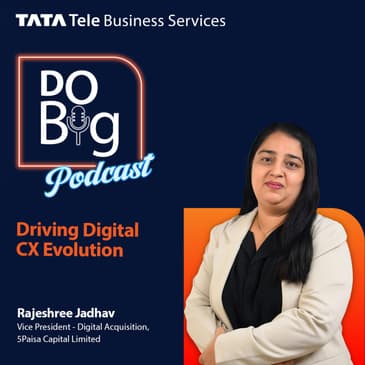

In this episode of the Do Big Podcast, we dive deep into the world of digital customer experience (CX) with Rajeshree Jadhav, Vice President of Digital Acquisition and Onboarding at 5Paisa Capital Limited.
Rajeshree explores the nuances of customer experience in the digital age, shares her insights on evolving customer expectations and technology, and discusses key metrics for measuring digital CX success.
Don't miss this episode packed with valuable insights to enhance your business's digital customer experience.
[00:00:00] Another episode of the Do Big Podcast. Today we have something and a topic which is really interesting for all of us. We all struggle with the entire customer experience journey, whether it is from the onboarding perspective to all the way having onboarded people to
[00:00:29] managing it after a person has become our customers and to make sure that they remain as royal customers with us. And that is always, always a challenge for all of us. Today we have with us Rajeshri Jada, Vice President, Digital Acquisition and onboarding, Piper Sarkapati Limited.
[00:00:49] Rajeshri Jada, if you have interacted with her, you will realize is an extremely effective professional when it comes to customer experience, operations, digital acquisition, customer satisfaction, vendor management, CRM management. And I say this with confidence because she has 25 plus years of
[00:01:07] experience doing all of this. She specialized in creating and implementing innovative solutions and business process re-engineering, requirements and systems analysis to increase efficiency, customer retention and customer satisfaction levels. Over the years, she has managed large teams of 400 plus people and she has extensive expertise in formulating processes,
[00:01:34] analyzing, documenting, validating and managing system requirements. If I had to manage a 400 member team, I would definitely know how difficult the task is. And without much ado, I'm going to jump into my conversation with Rajeshri Jada because I know each one of you
[00:01:50] has so much to learn from her. Welcome Rajeshri, it is so nice to have you on the Rubik podcast. Thank you so much, Sheetal for getting me here. Really excited to share my experience with all
[00:02:00] the listeners. That's fantastic Rajeshri. As you are aware, our listeners are typically MSMEs and they are all very keen to learn new things that are happening which may have been implemented by large companies, but also understanding them from that perspective of how
[00:02:16] they can implement these things within their own organizations. And so let me kind of start off with our first question for you. And my first question to you really is that you've done so much around customer experience, but how would you define customer experience in the
[00:02:35] digital world? And how does that differ from customer experience when you think of it from the traditional offline world, if I may call it that. Digital customer experience is nothing but the experience that the customer has with the company or the organization on digital platforms. Now
[00:02:54] digital platforms could be your site, the app, social media to a large extent, chat boards, etc. Now when we compare this to what the customer experience was in traditional, there are many physical aspects that come into play when it comes to the traditional
[00:03:11] customer experience. You know when you walk into a store or when you walk into a shop to buy anything, what you actually evaluate is what is the wait time? What is the ease of finding
[00:03:21] the items? How is the packaging? How are the payment methods? How long is the queue? Is the staff neat and clean? So all those aspects come into play when you actually walk into a store
[00:03:34] or a shop to buy something. That is how your customer experience is getting built. When it comes to the digital platforms, what does that get measured or how does the customer experience
[00:03:44] come into play over there is? What is the load time for the pages to load? What is the refresh time? How easy is it to navigate or search on the site or the app? It could be other things
[00:03:55] like how secured is the site or app. So customer experience is definitely different when it comes to digital compared to a traditional. So it's a part of the overall customer experience. So there are brands who would be involved into both of them. If I talk about lifestyle,
[00:04:13] if I talk about where site, I mean those brands, so they are into both these spaces. They do have their own app. So when it comes to them, they will have both these aspects playing for them, both these customer experiences that they'll have to measure on.
[00:04:27] But could be in isolation also. And so would this be true whether it is for shopping or for whether I'm investing in money or something else? Or would it differ if I was in different categories or different spaces? See when it comes to investment, when it is digital,
[00:04:45] the person is not sitting in front of you convincing how good or bad the product is. So whatever information that is available on the site or whatever information is available on the
[00:04:55] app has to be convincing enough that the user can directly make a decision and it's not dependent on someone to come and explain it to. Whereas on a physical world, if you're looking into, there is someone who's sitting there trying to convince you showing the product to you,
[00:05:09] probably, you know, or maybe showing a plan to you, has a direct contact with the user where he's in the position to convince the user or the buyer, which is not the case in a digital world.
[00:05:20] When you think about consumer expectations and, you know, and you talk about technology, both are constantly evolving because what happens with consumers is I experience something good in a completely different space. And then that becomes the benchmark across board, right?
[00:05:38] And all of us have faced it. So we were all okay with packages reaching a little later, a little early in a bad place, in a bad way. But Amazon came and redefined the expectation
[00:05:48] now that becomes kind of your benchmark, right? So same is the case with technology, right? I remember many, many years ago when Kingfisher Airlines was still there, you know, they had started doing the scanning and they were printing out boarding cards when you were
[00:06:04] standing in queue. And then everybody started fretting and saying, why is it that the other airlines are not doing that? And they kind of redefined what the consumer's expectations are. And so customer expectation is changing, technology is constantly evolving.
[00:06:20] How do you think MSMEs can stay agile and kind of, you know, adapt to their customers' experience strategies to keep pace with these changes? The key to this agility is to be customer centric, you know. If you keep customer
[00:06:38] in the center of everything, then everything falls in place. Instead of making products or designing products in silos, one has to go back to the customer to understand what is his expectations with you? What are his expectations with the brand or
[00:06:52] with the company or with the product? Okay, keep collecting these feedbacks, keep listening to the customers, keep listening to their complaints also. Only then you will be able to develop something which is exactly what the customer wants. So what you have to first do is
[00:07:08] create a lot of platform, create a lot of ways through which the customer can reach out to you in the first place. So if there is a feedback that the customer has to give you,
[00:07:18] there could be a message probably that could go out. It could be post completing a transaction on the site. It could be through a voice call, C-Side service. There are many, many things that you can do to collect these feedbacks. Now once these feedbacks have come to you,
[00:07:34] it is really, really important how do you actually use them? Okay, how do you actually listen to them, organize them in a way that it is actually delivering to the customer's expectation? Okay, once you have done it, you know, it doesn't even stop there. You know, once
[00:07:50] you've done those changes, you also have to go back to the customer. Let them know that basis your requirement, basis your expectation, basis your voice, we have done these changes. Okay, so that the user also feels that okay, his feedback, his voice was heard. Okay, see,
[00:08:08] customer is the best brand for you. I mean, he's the best influencer for you when it comes to you know, usability. If you do that, he also reaches out another 10 people saying that,
[00:08:18] okay, you know, I did this and they've changed his product because of me. You have to reach out, go out on the social media to advertise these things also, not necessarily saying that
[00:08:28] this customer suggested it, but just to say that, okay, this was the voice of far customers and we have made changes to the product or to the, you know, or to the site or to the app,
[00:08:42] basis customer feedback and this is out for you to use. And we still are open to it, you know, to take suggestions and feedback. If we keep doing this, I don't think there's
[00:08:52] anything different that needs to be done. Okay. But you have to keep doing it regularly. It cannot be a one time. And it's interesting because what you're saying is use the digital tools that
[00:09:02] are available to you to make sure that you're constantly listening to what the consumer has to say. And it's quite fascinating because I think that's one of the biggest flaws that
[00:09:13] I see in a lot of systems where you put in a message, you complain and nothing moves. And then you as a customer gets completely frustrated. I always tell people that a customer who gives you negative
[00:09:25] feedback is a good customer to have because at least the customer's involved. Right? The indifferent ones wouldn't be bothered. They wouldn't even tell you anything. And they'll just walk away and they'll become bad ambassadors for you. But the ones who complain you should listen to.
[00:09:41] 90 to 95% of the customers who actually leave, they don't even complain to you. Okay. So they don't even give you the opportunity to do anything. So that's big that number is. And that's exactly what I mean because as a researcher, I know that when somebody
[00:09:56] actually complains to you, it's because they feel for the brand and they have some emotional connect still with the brand. And when the brand doesn't listen to that, they're even more disappointed. And therefore they become actively the bad ambassadors for the brand. The indifferent
[00:10:12] ones don't do anything, but don't even necessarily bad mouth you. The involved ones are the ones you lose and do a lot of damage to brand image and to brand reputation. So it's quite fascinating.
[00:10:23] I didn't expect the number to be a 90%. I did expect it to be a 70 plus, but a 90 is really, on that front. When you're talking about experience and customer experience, and how does one define
[00:10:40] KPIs? And be then measure KPIs when you think about focusing on if you want to kind of measure the success of your digital customer experience initiatives. So different initiatives, different
[00:10:54] KPIs and measures or how does it work? See, overall, the key things that I, when I was a part of customer service, the things that I was looking at was first is my customer satisfaction score.
[00:11:09] What it does is it tells me that how satisfied your customers are with you. Okay, are you with you when I'm saying the brand with the company. The second most important KPI would
[00:11:21] be the NPS, which is your net promoter score. Okay, it actually tells you how willing is the customer to recommend you to someone and these NPS can be done at different transaction levels also. Small
[00:11:33] things like if a customer walks into an ATM to withdraw cash, a small thing like, you know, he would have called up the call center for something. These things can be measured at a transaction level. And then this question that okay basis this experience, would you
[00:11:47] recommend us to someone? And this is a very, very good tool to test a new product or a service also. If you ever would want to, you know, launch and then test it. I think it's a very,
[00:11:57] very good tool to do that. The third is that what is your first response time? Okay, when I'm saying a response time, it's not necessarily a resolution time. Response time is that as soon as the customer is reaching out to you for any query or complaint,
[00:12:12] how quickly can you go back to him and say that okay fine, we've owed you, give us some time to resolve and come back to you. Okay, at least do that so that he knows that okay,
[00:12:21] there is someone who's looking into my query or complaint and they would come back to me. So that is also very, very important because then the customer is all the time anxious saying that
[00:12:30] I don't know if my mail is reached or not. Are they working on it or not? And there are a lot of customers who interact through chat boards and you have your self-service platforms
[00:12:39] where you can just type in and send in your query. So you don't even know what has happened after that unless you have a ticket that gets generated over there. So that's an important thing. The other thing is that once you are measuring on a first response
[00:12:53] rate, what is then equally important is to look into the average resolution time also. Okay, you have told the customer that okay yes I've heard but that doesn't mean that you know there is no resolution time that you should be looking into. For every query
[00:13:08] there has to be defined that when I say that is a turnaround time of resolution. So what is that that is something that you can define as a company use. You can say that okay for small things like password, you can do it instantly for something like where
[00:13:22] ATM card needs to be dispatched. It will take three working days or something like that. But when you're actually doing that also see to it that you are you're adhering to those stats. Okay how many cases are such where it is breaching the tag that has been committed
[00:13:36] to the customer. So that's a very very important tool to look you know KPI to look into. Then lastly it is the customer churn or the retention rate. Okay how many customers are leaving you
[00:13:47] versus what you've acquired and what is the retention. So now there could you know as I mentioned earlier also there are many customers who don't even give you the opportunity to just walk out. You would not even know that they've started investing through someone else
[00:14:01] or trading through someone else you not even know that. Are there any early signals look into those trends so you should be looking into that. The second is that if the customer
[00:14:11] is calling you up or writing to you saying that I want to close my account. Okay how can you ensure that the retention there is really really high to the extent that the customer
[00:14:21] doesn't leave you. That is an important KPI to look into. There are a hundred customers who are calling you. One how much was your retention rate and what were the top issues because of which they were leaving you. And then work backwards and ensure that those issues are
[00:14:36] closed in a way that you don't have more customers who come in with the same issue or with the same concern. That actually leads me to a very interesting question. You know typically large organizations at least fall trap to this where people
[00:14:52] are working in silos. So customer satisfaction is somebody's job. It's not necessarily another person's job right and what tends to happen as a result of which is turn around times response times all of that start getting affected to a large extent. How can MSMEs kind of
[00:15:12] work around that because having worked in large organizations I know for a fact that you know especially when you talked about things like C-SAT scores or first response time. Now the
[00:15:23] first response time is very quick because it may be an automated email or it may be an automated piece right but that the next one which is the resolution time because it is dependent on somebody else and not necessarily on the customer you know management team or whatever
[00:15:39] starts to fall through the cracks. So what is it that MSMEs can do to make sure that they stay because agility is on their side. So what can they do to make sure that that happens?
[00:15:52] See I would not say that it is difficult or easy in a large organization versus to an MSME. It is it is how what your intent is. If the intent is correct you know if we know that as a company
[00:16:03] or as a group we have to ensure that the customers stay with us, customers continue to be with us. If that is the kind of approach it is easy to work on it because then what you do is that
[00:16:14] as a group you come together. So in one of the companies that I was working earlier we had created something like a service quality group. Now what does this group do is it assigns
[00:16:24] responsibility or accountability on the set of issues that are there and every issue or a pain point has a pod in itself. So this pod would have people from the product, it would have people
[00:16:35] from technology, it would have people from customer service and so on. So depending on what the issue is. Now when you create a pod there is each person there knows that what is their role
[00:16:47] into solving this okay. If you keep creating those pods and assign accountability there I don't think it is difficult to manage the tax and senior management you know it's a bigger
[00:16:59] role that senior management has to play into this saying that okay how is it possible that 10% of our customers for 10% of my customers the tax has been breached. If they start questioning those things
[00:17:11] then person who is at the bottom of the line he or she knows that I will be questioned on it, I better you know resolve it within time. It's interesting because escalation matrixes and things like that could be put into place saying that if somebody doesn't respond then
[00:17:26] the next level has to respond kind of a thing so it might be fascinating to do and today I think it can be automated right. If a particular person does not respond can it automatically go to the next
[00:17:38] level for response or do you think those are challenges still? So one is on the escalation matrix that okay if one person is not doing the job correctly, you know how do you keep
[00:17:47] escalating but the second part is that when I'm talking about pods it is you know a group taking the ownership for a certain case right that is very very very important you know that that is
[00:17:58] what every company needs to work on. All of last year or the last two years has been about JNAI and thanks to JNAI a lot of chatbots and virtual assistants and all of that that experience
[00:18:14] has got impacted quite significantly thanks to you know the generative AI coming into play what is the impact of chatbots and virtual assistants on the customer experience in recent years? See what it actually does is is in fact chatbots and virtual assistants have increased the efficiency
[00:18:32] to a large extent so what it does it it helps me to filter out all routine kind of a question which has routine answers or normal question what is my order status where is my ATM I've not so
[00:18:45] things like that where when you don't need a human voice you don't need a person who can listen to you and you know process your query or company so it frees the agents to handle more complex issues
[00:18:58] okay or you know which needs an emotional connect with the customer which needs more analysis to resolve the customers issue okay so in fact they have only complimented the overall experience
[00:19:10] you know somehow there is a there's a myth which says that it will heat away a lot of jobs you know chatbots and virtual assistants will heat away a lot of job which is not the case okay we need
[00:19:21] humans to solve bigger issues while the simpler ones can be handled by by chatbots and virtual assistants. So it's very interesting as a research I'm constantly talking to consumers right and one of the challenges that consumers have so yes I completely agree that while
[00:19:39] chatbots have done the job of enhancing productivity from a organization point of view right what is the improvement in productivity or efficiency from our consumer experience point of view because many many people will tell you that I go to the chatbot and then I'm ultimately
[00:20:00] after five minutes of doing some nonsensical chat I'm pushed on to you know customer service experience person and I've just wasted five minutes because a chatbot just doesn't get it so I'm just trying to understand how do organizations balance internal productivity
[00:20:16] and efficiency versus consumer experience and efficiency when you're using new technologies what has happened over this time is when chatbots started coming in you know when when people realized that okay there's so much of work that you can do in chatbots they have
[00:20:34] you know misused it to a large extent to say that okay he's up to channel which is not the case okay you will have to define journeys to say that okay this is what the chatbot
[00:20:44] is capable of this is what the chatbot will be able to answer and limited only to that you don't have to ensure that everything is being handled by chatbot I don't think we are using it correctly
[00:20:55] it has to be used correctly just to say that okay my 10% of the issues are related to status which I can manage it through chatbot or 20% of the cases are such where the customer is only to
[00:21:07] calling me only to find out okay has my ip i lot went happened so all for all those things even the customers are not expecting a agent to be there what they are expecting is is just an answer
[00:21:18] to say that okay I'm going to go here or maybe you know your your order has been executed or is it's on the way that's all the information that the customer wants either really doesn't want
[00:21:28] to speak to anyone but we are not using them you know efficiently we have we are doing it in a way to minimize cost which which is not the case so tell me if I was an MSME and I was going to start
[00:21:42] a customer experience piece and I was putting a chatbot or an assistant into place what kind of things would you advise an MSME to say hey listen do this first and do this next is there
[00:21:54] is there like a process note that they can operate with or is it that these are the fundamentals that you should look at before you kind of I know it's a long question but I'm just trying to get a sense
[00:22:04] of what are the critical things to look at if I may just ask that oh see one is that when you're saying that if a MSME has to start you don't even know what kind of questions that the customer
[00:22:15] is asking you right now chatbots and virtual assistants have to be trained what will you train them on if you don't have a history okay you will not be able to do that so to start with
[00:22:26] you should not be starting with a chatbot or a virtual assistant or something like that let the queries come in let the create a knowledge tool first to understand that okay what are the type
[00:22:37] of queries that are coming what is that the customer is asking me now basis this data analyze it in a way to say that okay these are the questions that an agent has to answer but
[00:22:47] these are very simple ones which I feel that can be handled by a chatbot you will have to analyze the data to use both these channels effectively okay to start with I would not suggest that you
[00:22:59] start with a chatbot okay because it's too early for you and here is where you would actually want to listen to the customer because you are new you would want to understand what the
[00:23:08] customer has to talk about it you would want to go through each and every call you would want to go through each and every email to understand that okay what is that he's asking me
[00:23:16] where am I failing what am I not doing correctly because only then the customer reaches out to you right otherwise why would he if he's happy with something why will he actually read out so just
[00:23:26] wait give the process some time let there be some learning which is there and then invest into chatbots because there's a lot of training that requires to be done for chatbots also it's not that he you know one question you put in and it will correctly answer because
[00:23:44] you know being Indians there is we have a peculiar problem of English also so while speaking in English there are a lot of Hindi words that the customer will use and it is vice versa also
[00:23:55] okay so it could be something like that right so you will have to train the chatbots to that extent and I've actually worked on it extensively for six months so I know what
[00:24:06] the pain there is you know while we feel it is very simple it needs a lot of work but it can eventually start minimizing your cost for sure so call center first chatbots later just want to
[00:24:20] understand when you think about call center management right call center management in itself is extremely challenging so if an msme was looking at setting up their own call center so like you
[00:24:31] said don't start a chatbot first through the call center piece your things first what advice would you give msme's when setting up call centers and call center management lot of time what happens is when
[00:24:43] a customer calls in every query that the customer calls in for is very unique or to a large extent unless it's something very repetitive you know that that keeping aside what happens in agents
[00:24:55] life is that there's a lot of information and all the information is in silos okay you have to ensure that there is a common knowledge tool where all this information is parked where all the
[00:25:06] updates are parked in a in a central what we call a source of truth has to be there for the agents to refer to if there is a product update that has come in it has to be there in the center
[00:25:16] you know in a central CRM any any new change that has happened any issue that is there if the customer is asking me an x question do I have an answer to that automate as much
[00:25:28] as you can create a common knowledge tool for the agents to refer so that one between two agents the answers are the same okay it shouldn't happen that for the same query there are different
[00:25:37] kinds of answers that shouldn't happen because that is how the experiences differ also so creating a common source of truth is very very important second there is a lot of backend information
[00:25:49] which are as I said trapped in silos okay if I if someone comes in and asks me okay that what is the interest rate for you know since I'm into markets I'll I'll refer to those things like you
[00:25:59] know what is your interest on mdf now all these information has to be available somewhere so I'm just coming back that knowledge tool is really really important that is the first thing that you
[00:26:08] start with so that you empower the agents with with all the information that they need second is that how do you motivate them because their jobs are very very monotonous okay I you know a call center agent has to answer at least 100 approximately 100 calls in a day
[00:26:25] you know it becomes very monotonous and at the same time they are on the forefront to for any voice that the customer has they have to go through a lot how do you ensure that they are
[00:26:35] motivated to come the next day start afresh and do it so lot of engagement activities need to be done RNRs have to be done you know you will have to keep mentioning that okay you
[00:26:45] know this person has received an appreciation today people standing up and clapping for them so those kind of engagement activities is something that you will have to keep doing all the time okay just to ensure that they they are you know they are motivated enough
[00:27:01] so let's say from a tech point of view right when you are setting up a call center is there back and technology or is there technology that you think is a great way so is there
[00:27:14] technology on which you should set up your call centers is there preferred technologies on which to set up your call centers are they you know large partners with whom you set up call centers
[00:27:23] how does one go about doing this entire process if you have to really set up a call center the two basic things that are required for you is one is a good CRM a CRM which can store
[00:27:36] all the interactions of the customer no matter through which channel it has come into okay so that when a customer member has called you maybe he had reached out to you through a chat
[00:27:45] earlier and now he's calling you so if you have a CRM which can store all this history it becomes easier for the customer for the agent to speak to the customer because every time
[00:27:56] the biggest frustration that a customer has this repetition you know every time I have to repeat my query every time I have to you know call you up for the same complaint you
[00:28:04] know why do I have to do that why can't you check it on yourself so you need a really really good CRM which can capture all these issues or all the calls or all the emails that the customer has
[00:28:15] written to you in a single platform for you to refer understand that what is going through all these interactions and then respond to the customers that is one the second is that you need a really really good dialer when I'm saying a dialer which is responsive enough
[00:28:30] to say that okay how many calls are there in a queue is it able to give you give the consumer or the customer the correct wait time to say that okay there are three calls in a view and Q and
[00:28:42] there could be it could lead to five minutes would you want a call back so these are the only two things that you actually need to start with okay and you know you've spoken about
[00:28:52] both call center and bots which is when you come into complaints resolution or you know I have queries resolution and things like that you've also spoken to me about through the journey right so
[00:29:03] websites how much time does it take to load etc how are people interacting all of this in the last couple of years has become extremely efficient because of the technology that has been coming right call center efficiency has like you said gone up tremendously because we've got better
[00:29:21] technology today what are those emerging technologies that you believe will revolutionize digital customer experience in the next few years see there are too much of data is available everywhere now AIS are capable of indexing and analyzing mountains of data and making decisions
[00:29:40] simpler for for the leaders or the cxos to use so that is one area that that AIS can really help you uh the second is personalization becomes very very simpler you know which the consumers
[00:29:52] want so that is on the AI base the second piece you know which which really really interests me is uh uh you know this this new technology which is the internet of things right you know uh what
[00:30:05] it has done is it has enabled uh you know devices home appliances cars and much more and they are all connected so we can now even you know see imagining uh you know sitting
[00:30:17] remotely and closing the door of your house we had not imagined this ever ever before but now there is a technology which is available for you to use as you can switch on your AC remotely you
[00:30:28] can you can uh you know preheat your ovens so that is a very very interesting thing that has come up and it will actually revolutionize the way customer experience is uh you know to a
[00:30:40] to a very very large extent and I'm you know as I'm saying this is just till the beginning there's a lot that both these technologies can do uh you know in the future so we're definitely
[00:30:51] looking forward to it great Rajesh this has been an absolutely wonderful conversation with you I know that you know all of us are looking forward to new technologies changing the way we interact with each other we interact with organizations the way we uh we get served and
[00:31:09] serviced right it's so important as consumers for us to constantly see an improvement in service and it's equally challenging for organizations to stay on top of the game because what they are doing is they're really trying to stay ahead of the curve uh compared with competition compared
[00:31:26] with other sectors etc so um I'm sure that our MSME listeners have learned a lot from you today and I'm sure that there is a lot more that they can look at when it comes to implementing
[00:31:40] customer experiences within their own organizations and categories thank you so much for your time and it was absolutely wonderful to have you on the Doobit podcast look forward to staying in
[00:31:52] touch and having you on board once again thanks so much Rajesh for your time thank you so much thanks thank you so much for having me thank you thank you for tuning in to the Doobit podcast a podcast that is dedicated to providing insights strategies and success stories
[00:32:09] of smart digital solutions for SMS we believe that behind every successful business there's a strong foundation of reliable and secure technology via digital connectivity cloud infra cloud apps collaboration tools or cybersecurity solutions in a rapidly evolving digital world
[00:32:28] where technology is key to progress Tata tele business services stands at the forefront of digital transformation of SMS Tata tele business services with their extensive experience and commitment to empowering businesses understands the unique needs of SMS whether it's scalable connectivity robust communication tools or tailored ICT solutions
[00:32:50] Tata tele business services is here to propel your business forward Tata tele business services is synonymous with innovation reliability and transformative solutions so if you're ready to take your organization to new heights of success we encourage you to
[00:33:07] explore the transformative possibilities that Tata tele business services has to offer our contact details are in the description below remember we're available major podcast platforms so if you enjoyed today's conversation subscribe to our podcast for future episodes which
[00:33:23] we promise will be packed with equally valuable insights on questions entrepreneurs face as they digitize and scale businesses with the help of technology don't forget to rate and review our podcast as well as share it with peers colleagues and other entrepreneurs like yourself
[00:33:40] who will benefit from listening to it thank you for listening to us and until the next time keep embracing technology and may your business thrive in the digital end