
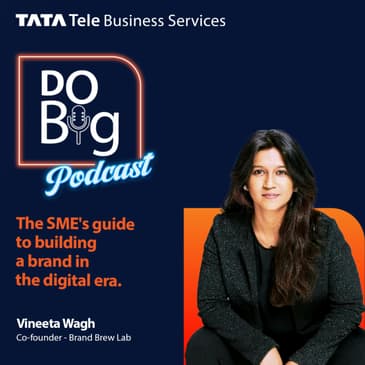

The digital era offers countless opportunities for SMEs to build a powerful brand, and on this episode of the Do Big Podcast, we have Vineeta Wagh, a Marketing Expert & Co-founder of Brand Brew Lab, who shares her insights on building a successful brand.
Learn how to craft a unique brand story, engage with your audience, and harness the power of digital tools to grow your business from Vineeta. Don't miss this insightful discussion!
[00:00:07] Welcome to another episode of the Do Big Podcast.
[00:00:13] In our series, we've been covering all kinds of interesting issues and
[00:00:18] questions that MSMEs have around various aspects of the business.
[00:00:22] Today, we're going to be addressing something which is very interesting,
[00:00:25] which is brand building and customer experience.
[00:00:28] We have with us, Vinita Wagh.
[00:00:31] Vinita Wagh is the co-founder of Brand Brew Lab,
[00:00:35] and she's also an independent marketing consultant.
[00:00:38] She's also a faculty lecturer with Upgrad.
[00:00:41] Vinita has more than 12 years of experience doing this,
[00:00:45] and I love the fact that she hasn't lost her love for both building brands
[00:00:50] and for storytelling over the last 12 years.
[00:00:52] She hasn't become jaded,
[00:00:54] and neither has she become cynical about this entire process.
[00:00:59] So Vinita, absolutely delightful to have you on this podcast
[00:01:03] and on this episode. Welcome.
[00:01:05] Thank you. Thank you so much, Shridil.
[00:01:07] Thank you guys for having me here,
[00:01:09] and I'd love to have this conversation,
[00:01:11] and I'm sure it's going to be a fun.
[00:01:13] Okay, great.
[00:01:14] And so, Vinita, I'm going to jump straight into the first question.
[00:01:17] And you know, you've played many roles in your career, right?
[00:01:21] 12 years, lots of things that you've done.
[00:01:23] Can you share three big learnings when it comes to brand building?
[00:01:28] Because I know when I started brand building,
[00:01:30] I don't even want to say how many years ago,
[00:01:32] it was very different from where it is in today's digital age.
[00:01:37] Just want to get a sense of what are your top three learnings
[00:01:39] when it comes to brand building.
[00:01:41] Sure. While you...
[00:01:43] I mean, I'll resonate more to that those days of brand building,
[00:01:48] and I still believe very strongly
[00:01:51] that brands are still built on great stories.
[00:01:55] Of course, there has to be a great product.
[00:01:57] You can't have a bad product and great storytelling,
[00:02:01] and still think that things will fall in place.
[00:02:03] But if I have to speak about three points,
[00:02:06] one is brand building, still, it doesn't happen overnight.
[00:02:11] It is a consistent effort of telling the same story,
[00:02:16] defining who you are telling your story to.
[00:02:19] So while we are in a digital age and everything is fast
[00:02:22] and you have to come up with ideas every day,
[00:02:24] the core still remains the same,
[00:02:26] that you need to stand for something.
[00:02:28] And it is going to take the difference that is there today
[00:02:33] and back then I feel is it is going to take some time
[00:02:36] for smaller brands to figure out what their story is.
[00:02:41] And it is going to take a lot of back-and-forth and research
[00:02:44] and understanding the market,
[00:02:46] because the market is so dynamic right now.
[00:02:48] It's changing every few days.
[00:02:50] So figuring out what your story is and what you stand for,
[00:02:55] that's one very important thing.
[00:02:57] Second thing is defining...
[00:02:59] When we say defining target audience,
[00:03:02] back then we used to have it from a demographic
[00:03:04] and a psychographic point of view.
[00:03:06] I think now there are better ways to dive in deeper
[00:03:10] and have personas so that when you're telling your story,
[00:03:15] you're customizing it to the kind of people you are telling it to.
[00:03:19] And I think we do have those tools
[00:03:21] and we do have a lot of skills right now to come to that story.
[00:03:26] That's the second thing.
[00:03:27] And the third thing is being absolutely mindful
[00:03:30] to figure out what your product market fit is.
[00:03:33] Especially today when we have so many brands
[00:03:37] and so many products coming in every day
[00:03:41] that I feel the consumers are in a way overwhelmed
[00:03:44] at the same time very well informed.
[00:03:48] So you can't have your way around with anything.
[00:03:51] You need to have a good product at the core of marketing
[00:03:55] and at the core of building a business.
[00:03:57] Because now when you're going out in the market
[00:04:00] people are going to read about you.
[00:04:02] They're going to research about you.
[00:04:03] They're going to...
[00:04:05] Now they know what to read on the labels, how to read it.
[00:04:08] So you have to be very mindful of the kind of product
[00:04:12] and the product market fit.
[00:04:13] That there's actually a need to be there.
[00:04:17] There needs to be a purpose.
[00:04:18] So that's very important.
[00:04:20] These are the three things that I would recommend brands to do
[00:04:23] and especially startups because it's now that you're getting into business
[00:04:29] you have to be sure where you are heading
[00:04:32] or it is very easy to get lost as a brand.
[00:04:34] So that's quite fascinating because you said brand building takes a long time
[00:04:39] and in today's day and age where everything is about here and now
[00:04:43] and ROI and not spending enough money.
[00:04:46] It's about measurement.
[00:04:48] Are you delivering all of that?
[00:04:49] So the good old days one took the time to build brands.
[00:04:53] But in today's day and age when there is so much pressure around deliverables
[00:04:59] more than anything else and you know measuring brand
[00:05:02] and what it stands for is a little difficult.
[00:05:05] How do you then tackle this whole long-term perspective
[00:05:09] over a short-term view which is the here and now view
[00:05:12] which a lot of brands and startups and even young entrepreneurs keep pushing.
[00:05:18] Yeah, I think the answer has to come from the founder.
[00:05:22] I work with so many founders and I have seen so many people.
[00:05:25] I've seen big organizations.
[00:05:26] I've seen medium organizations.
[00:05:28] Now I work with startups.
[00:05:30] I think it is very essential for the founder to understand how
[00:05:36] like the process of building a brand is slow one
[00:05:40] and you need to have that vision.
[00:05:42] Right, because if the leadership doesn't have that vision
[00:05:46] and I understand there's a lot of investor pressure.
[00:05:48] Like if you talk about if you talk to entrepreneurs
[00:05:50] and if you talk about talk to leaders, you will hear a lot about investors,
[00:05:54] pressures, ROI.
[00:05:56] But see if you look from a consumer point of view,
[00:05:59] we don't care about all those things.
[00:06:01] So we are just going to see which is the product which has great story,
[00:06:05] what is selling, what is the credibility, what is the quality.
[00:06:09] So it essentially lies with the founder to build that vision for the brand.
[00:06:15] Understand that you might if you're chasing numbers
[00:06:19] and if you're chasing sales, you can do it through digital marketing,
[00:06:23] growth marketing, performance marketing.
[00:06:25] But if your brand is not built and I have been saying this and a lot of people have,
[00:06:31] I feel now understood that performance marketing is great.
[00:06:35] You need it for your brand, but it can't go sustainably for a very long period of time.
[00:06:42] If you don't have a great story, you might have sales in the initial few days,
[00:06:47] months, it is going to reach a stagnation at some point of time.
[00:06:50] Because at the end of the day, it's how much money you put in,
[00:06:53] how much eyeballs you're getting and how much sales you're getting.
[00:06:57] There might not be a great story.
[00:06:59] There might not be a great credibility you're building.
[00:07:02] If you're just running behind numbers and the other things like customer experience,
[00:07:07] building credibility, having a connection with your customers,
[00:07:10] building that community, having a purpose as a brand, having Omni-Channel.
[00:07:14] There are so many other things also that are there in the picture
[00:07:18] that need to fit in properly for you to build a brand in a holistic manner.
[00:07:24] And I think that comes from a vision of a founder.
[00:07:27] And how do you think brand building can help MSN is?
[00:07:32] And what big thing?
[00:07:33] And I know this is a question asked of me, even on the research that I do.
[00:07:37] In the past it has been asked of me when I played the role of marketing,
[00:07:41] branding the product, or being a marketer myself.
[00:07:45] Can brands be built on small budgets?
[00:07:48] Because everyone thinks it needs a multi-chloro budget to build a brand.
[00:07:53] So I'll tell you one very classic situation that most of the time
[00:07:59] marketers are stuck with or even the founders.
[00:08:03] A little budget, you need sales, you have to do marketing,
[00:08:08] you have to do brand building.
[00:08:11] Traditionally, I'm sure you'll agree,
[00:08:13] brand building and marketing is only looked at as a money-sucking team.
[00:08:18] So I feel over the time, brand building has,
[00:08:23] the process might have changed a little bit, the importance hasn't.
[00:08:28] If you have just let's say 10 lakh or 15 lakh,
[00:08:32] whether you put it in building a great brand,
[00:08:34] which is creating awareness, having great brand identity,
[00:08:38] or should you just put it in digital performance marketing?
[00:08:42] And that is the catch-22 situation always with founders and marketers.
[00:08:46] And that's where marketers are also judged for that.
[00:08:50] Okay, how are you going to make money out of this small budget?
[00:08:54] But I think it has to be with social media coming in.
[00:08:57] The brand building ways have changed and I think, yes, brand.
[00:09:02] The answer is yes, brand can still be built on a smaller budget.
[00:09:06] You just have to be very strategic about it.
[00:09:09] If you look at these brands like let's say whole truth food,
[00:09:13] the brand initially was built with, even if I'm not a direct consumer of whole truth food,
[00:09:19] till now I feel I follow their content so religiously
[00:09:23] because that brand is built consistently through great credible content.
[00:09:30] That could be one way and purely through let's say social media.
[00:09:34] So with social media coming in,
[00:09:37] with different format of contents coming in,
[00:09:40] there are different ways you can build a brand in smaller budgets
[00:09:44] while not harming your digital marketing budget as well.
[00:09:48] It's just that brands have to be brave enough to take
[00:09:52] that decision of, okay, fine, I'm going to spend a little bit on digital
[00:09:58] and I'm going to spend consistently little bit over time on brand building
[00:10:04] because you might have a great brand story
[00:10:08] which you have not figured out yourself and you have not put it out there.
[00:10:12] So I might buy your product but I might not know as a consumer.
[00:10:16] I might buy it just because, okay, there's a price drop,
[00:10:18] there is a sale or I just want to try it.
[00:10:22] But I might not be your loyal customer throughout the lifetime
[00:10:26] because I don't know what you stand for.
[00:10:29] And I think as even Gen Zs today, if you look at them
[00:10:33] and they are the new target audience for a lot of brands,
[00:10:36] they are also being very aware of what kind of brands they are investing in.
[00:10:39] They are very aware of purpose driven brands.
[00:10:42] So all this is going to matter
[00:10:44] and you need to figure out your way of being or telling the story in a great way
[00:10:49] and also making sure that you are present in public through digital marketing.
[00:10:55] And typically, there's always this thing of how do I leverage technology
[00:11:01] or how do I leverage new innovations to create an engaging brand story
[00:11:08] which resonates with the target audience?
[00:11:11] And you very truly said that you remember good old days.
[00:11:13] You did use a personas but they were far more, how should I say,
[00:11:17] they were far wider in their definition than the way user personas are connected today.
[00:11:23] So I'm just trying to understand how can SMEs leverage technology
[00:11:29] to create and engage on a brand story that resonates with that target audience?
[00:11:34] I think more than technology, if you just step back,
[00:11:38] it is about knowing your customers well.
[00:11:40] And I think the benefit that smaller brands have is they can have a direct connection
[00:11:47] with their consumers and like the bigger brands where I can't talk to,
[00:11:50] let's say so many consumers or the consumer base that I have.
[00:11:54] As a small brand, even if you have like, let's say, 1000, 1500, 2000 customers,
[00:11:59] how much ever, you can talk to a significant amount of people to understand
[00:12:05] what exactly they are looking for, why did they buy the product?
[00:12:11] What is the... I was working with this one spice brand and we realized that
[00:12:15] there was this one particular spice that we were advertising.
[00:12:19] We were thinking of it just from one point of view.
[00:12:24] But when we spoke to customers, we realized so they're using it
[00:12:28] for their cocktails also, their mocktails also.
[00:12:31] And you would not think of a spice or seasoning from that point of view
[00:12:35] because you're also trained to think in a similar way.
[00:12:38] But you would be surprised at the different ways your consumers would be using your product,
[00:12:44] the different emotions that gets evoked in your consumer while using your product.
[00:12:51] And that can give you so much data and so much insight into what are the different stories
[00:12:58] that we underway. For example, I can tell you, we were working on a maternity brand.
[00:13:03] It was into... it is yet to launch but it is into the organic space.
[00:13:08] And if you look at the maternity web category in India today, it's very boring.
[00:13:13] It is not flattering. Women are already... So when we spoke to
[00:13:20] across 30, 35 women who fit into our character sketch of our target audience,
[00:13:28] we realized that they have so much going on in their mind in terms of their emotions
[00:13:34] and in terms of their struggle during that period. Clothing is the last thing that they want.
[00:13:39] They worry about.
[00:13:40] Yeah, worry about. And they don't want that particular thing to hamper their confidence
[00:13:46] furthermore. And just Google maternity where in India, you won't find anything that's flattering
[00:13:52] that builds confidence in you. So we're like, okay, that space is very empty and women really want
[00:14:00] because you're talking about these progressive women working who want to look a certain way,
[00:14:07] who want to believe that they want to carry themselves in a certain way.
[00:14:12] So when we spoke to them, we realized that, oh my God, this space is completely empty.
[00:14:17] Not a lot of brands are working in that segment. So when you speak to your customers, you can come
[00:14:24] and again, smaller brands have that advantage to go back to their customers and speak to them.
[00:14:29] And you will come back with so many stories. And then it is just about putting those stories
[00:14:35] beautifully out there through different technology, through different platforms,
[00:14:39] through different formats, WhatsApp marketing, the entire chatbots that are coming in.
[00:14:45] The technologies are going to keep coming and you just have to adapt to them. But I think again,
[00:14:51] the core remains the same. If you want great stories, you have to talk one on one to your
[00:14:56] customers and you will know you'll come up with things that you haven't even thought of
[00:15:00] as a marketing team or as founders for your brand.
[00:15:04] Yeah, Venita, I'm a researcher and I run a qualitative research company.
[00:15:08] I keep telling the world, customer first, you really don't know how your customers
[00:15:12] using your product till you go out there and ask them. I mean, it's happened to me so many times.
[00:15:18] You think that they've bought your product for a particular reason, but they've bought it for
[00:15:22] something completely different. I keep telling students, I teach saying that there is a reason
[00:15:29] why one needs to research consumers and not just numbers research. It's about having like
[00:15:36] conversations. To understand what really is triggering of that purchase and it's quite
[00:15:46] fascinating because if you do it across a life cycle or if you do it across the product-bind
[00:15:51] cycle, you land up with such interesting moments of truth which you'd never blend
[00:15:58] in your communication. That absolutely resonates with me.
[00:16:03] And I think that is one thing that these brands are missing out on because the pressure
[00:16:12] everything has to go out right now. Everything has to be done right now. While all that can
[00:16:16] happen, I think before you start a brand or while you are thinking of an idea, it's very
[00:16:22] important to understand that your idea needs to be checked first with the consumer, not with
[00:16:27] what you believe or what's there on the internet in terms of the primary research or anything.
[00:16:33] That's great to have, but I think diving deeper and understanding what's triggering a purchase,
[00:16:40] you will be really fascinated by the answers and surprised by the kind of data you get
[00:16:46] after talking. So, Choo, I was speaking to somebody on the startup community and I said
[00:16:51] one of the big questions that most founders must honestly answer to themselves is, does my product
[00:16:59] or my service have a role to play in my consumer's life? If you don't answer that question and you
[00:17:05] don't have a rock solid answer to that one, then you may have the best technology. You may be
[00:17:11] the brightest young kid around in the universe but because you're not addressing a concern
[00:17:20] or a need or something that the consumer says, hey, I must have this without this my life can't.
[00:17:27] You know again it comes back to so many brands like if you spend, I mean on an average people
[00:17:32] are spending two and a half hours on Instagram, I'm sure maybe the younger generation look at
[00:17:37] the content they're bombarded with every day. These days I remember the message, I don't
[00:17:42] remember the brand because there's so much happening on Instagram. I'm like, oh, I know
[00:17:47] the message was strong but I don't remember who is a person or which brand because so much happening.
[00:17:53] So it's very important to be consistently present and to do that you need to have some
[00:17:58] really convincing stories put out there and I'm sure as a researcher you would have gone through
[00:18:05] some really great insights that you wouldn't have thought. Oh, absolutely. Some amazing,
[00:18:10] fascinating things that come up when you really start talking to consumers and
[00:18:15] very often breaks everything that you had ever thought was the way you should think. It just
[00:18:22] shatters everything and you're saying, okay, I have to start off fresh and it's fascinating
[00:18:27] and then you'll end up with a product and a service which is absolutely brilliant at times
[00:18:31] because you've now gone back and done all of the fixes that you have to do. So while I get
[00:18:39] all of this, I just want to understand when you speak about the passion to help new age
[00:18:44] brands navigate the digital landscape. How can SME's implement a customer-centric approach
[00:18:52] in their business? So I know research is one part of it but how do you make that an ingrained
[00:18:59] process within the system rather than I did it when I started and now I'm done? How does it work?
[00:19:05] So consistent connection is the key for the smaller brands for this. Access to consumers
[00:19:13] is easy these days and I think if you are a purpose-driven brand and if you have the right
[00:19:20] kind of people in your team, it's very easy to talk to your consumers and be constantly in touch
[00:19:27] with them. Not annoyingly but yeah, constantly in touch with them to understand what they are
[00:19:33] feeling about your product, about your service. Today, the brand building with the help of
[00:19:40] community with the help of conversation has increased. So today it's very easy to be in touch
[00:19:47] with your consumers if you have the right kind of people, you can be constantly in touch with your
[00:19:51] consumers not annoyingly and giving them personalized experiences through your brand or as a brand
[00:19:58] because that's how people are going to remember you, that's how consumers are going to remember
[00:20:02] you. There is enough research and data out there that says that if you as a brand are more
[00:20:08] personalized in terms of not just your product but your content, your messaging, the way you reach
[00:20:13] out to people it is going to have a lasting impact on your customers. That's one. Second thing,
[00:20:20] building brands through community has become all-time big right now. So I am with a brand,
[00:20:27] helping a brand build its mental health community and trust me when we build that community on
[00:20:35] WhatsApp. I was so amazed to see that people have so much to talk about, people have so much trauma
[00:20:43] and people want to just have people around to speak about. Now are we selling products there? No,
[00:20:49] we're absolutely not selling. That's a community purely built to have conversations. Now when
[00:20:56] you have something so purpose driven, community based where you're not selling anything,
[00:21:02] I wouldn't even call it a support group but just a group where people can speak their heart out.
[00:21:07] And this is started by a brand which is in the space of creativity and art for mental health.
[00:21:15] So there is a purpose, there is a great product, the name of the brand is Twillow,
[00:21:19] you should check it out and then you have this community which remembers the brand more
[00:21:24] for the kind of things that they are doing. So being in constant touch and helping your
[00:21:30] consumers in some or the other way where you're not selling anything but you're giving them an
[00:21:35] experience which they can't forget. Now this is an example of personalized experience right,
[00:21:40] so that's another way where people remember the brand. Third thing is I last one month have
[00:21:47] been in the US and I'm just looking out for products and brands and how people shop here.
[00:21:52] The loyalty and the reward option here for brands, for bigger brands is so great because
[00:21:58] I'm seeing everyone going to a particular brand again and again because their loyalty and reward
[00:22:04] program is great which I haven't seen so much being used in our, I wouldn't say in our country but
[00:22:11] I haven't seen so many brands leveraging that. Now some brands are doing that but some brands
[00:22:16] are still trying to shuffle but in the beginning if you have a smaller set of customers and if
[00:22:21] you can identify a great loyalty or reward program that can help you with customer retention
[00:22:28] it is just easier for you to sort of build a connection with your customer at the initial
[00:22:34] phase and make sure that they stay with you for a long time. So that becomes another way to make
[00:22:39] sure that your customers are with you. So focusing on customer retention especially when your base
[00:22:44] is small, having that conversation with your customers every now and then to make sure
[00:22:49] that you're taking in the feedback or not just connecting with them, you're taking
[00:22:53] in the feedback, you're making sure your product changes and then building a community around it
[00:22:58] and building strong conversations around your brand, around your brand ethos what your brand
[00:23:04] believes in I think is a great way to pull customers and to make sure that you retain them
[00:23:09] in some or the other. Yes it's very fascinating about this whole loyalty piece right even there
[00:23:14] I think there's a massive change that brands need to bring in mindset right earlier it was
[00:23:21] about how is my customer loyal to me or not. I think the mindset needs to be have I done enough
[00:23:30] to earn that loyalty right because what tends to happen is people just assume oh if I give them
[00:23:36] points and if I do this that's enough they should be happy and give me their loyalty but
[00:23:41] there are so many options and there is so much that is happening in the world and I think
[00:23:45] brands need to go back and say have I done enough to earn that loyalty or am I not doing enough
[00:23:52] to earn that loyalty because today it's really about you having to you know it's exactly like
[00:23:59] respect used to happen at one point in time you respected someone because they were your elders
[00:24:04] today yes kids will tell you especially Gen Z will tell you have you earned my respect just
[00:24:09] because your older doesn't mean I will buy it for respect you right. That's a bank on an example
[00:24:14] I feel yes. You know and that's exactly what consumers are today saying what have you done
[00:24:21] to earn my loyalty yeah why should I give it to you yes it's not just about points and I think
[00:24:28] that's one of the key reasons why till we don't get out of the transactional space of CRM
[00:24:35] programs and loyalty we will not see the change it's really what are you are you aligned to their
[00:24:43] thoughts and interests I mean a Harley Davidson has done so many things to have the current status
[00:24:52] that it has right it can't it wasn't just about every time you buy a Harley you're going to get
[00:24:58] x number of points and therefore you can buy gear it isn't that and I think that's the
[00:25:03] mental shift that I think sometimes brands struggle with in terms of saying how do I earn loyalty not
[00:25:11] how do I get loyalty and you know what it is especially I very tricky and very difficult now
[00:25:18] because if I ask you which is the last brand that you remember you are absolutely loyal to
[00:25:24] and if I talk about all the new brands that have come in in last maybe five eight ten years
[00:25:30] there probably would be maybe one or two that you remember or you think of or maybe none for all
[00:25:37] that you know so it's so difficult and back in the day we were so loyal to certain even when it
[00:25:43] came to personal care food to all the shampoos and the kind of products we were using the fashion
[00:25:48] clothing everything there was a lot of brands that we were loyal to right now loyalty
[00:25:54] earning has become very difficult so brands have to put in a lot more effort like you rightly said
[00:26:00] not just in transactional sense but if you're listening to your customer if you're being there
[00:26:06] if you're understanding their needs if you are changing according to what they need
[00:26:11] and very classic example it's of course a legendary brand and a lot of us have heard about
[00:26:18] the case study for sure is a brand Stanley right and recently I did a piece on it where
[00:26:24] the brand has been there for 100 years never thought of catering to women it was a brand which
[00:26:29] was like macho and you know sturdy and strong made for men who are adventurous and until
[00:26:36] like three women came into picture and realized that this is a great product and
[00:26:41] they have a community of women who showed interest in their product and then the brand
[00:26:48] which never advertised to women never thought of having women as their target audience created an
[00:26:55] entire line of product just for women because they realized okay there is a great demand and a brand
[00:27:01] has changed its strategy after so many years that okay I can't pivot I can't tweak and I think
[00:27:08] that flexibility brands need to have and it'll only happen if you keep listening to your customers
[00:27:13] if you keep listening to what the need is of the market right and you have to be that slightly
[00:27:20] flexible especially in the initial time so while yes your brand should have a story
[00:27:26] your brand should stand for something you should be identifying your niche I think
[00:27:31] it can't be from day one it has to be going out understanding cost correcting trial and error
[00:27:38] and you might come to that maybe after a few months or maybe after a year
[00:27:42] also but you have to be that flexible to say that okay I'm going to build a brand
[00:27:49] that is consumer centric and that can only happen if I talk to my consumer if I talk to them
[00:27:57] on a deeper level and understand the insights that are there in the market.
[00:28:00] Absolutely I have I always have a credit card example on customer centricity and I
[00:28:06] keep saying that you know the world has changed where more and more women are owning credit cards to
[00:28:11] be and you know are transacting using credit cards and other things but the credit card programs
[00:28:19] still remain very very male centric so try redeeming your credit card points you never
[00:28:26] find anything for women other than of course gift vouchers which they think is the only thing
[00:28:30] women wanted life so I find that so amusing when I'm like women I've changed guys wake up
[00:28:39] yeah smell the coffee but so cute so moving to the next one right digital transformation while it
[00:28:47] has aided the whole brand building process and has aided the marketing process has also created
[00:28:53] a lot of changes from the consumer point of view right the consumer expectations are changing
[00:29:00] really really rapidly and what is happening is also that if I get extremely good let's say UI UX
[00:29:09] from one brand that becomes my expectation across board it's not about whether you're
[00:29:16] going to afford it can't afford it whether you're a big brand or a small brand whatever right so if
[00:29:21] I experience something which I think is absolutely a quality standard in one particular area then I
[00:29:29] start saying hey I should get the same in others too how should SMEs adapt to meet these new demands
[00:29:37] so things are very easy these days right if one brand can achieve it especially when you talk
[00:29:44] about UI UX or packaging or how your brand looks I don't think mediocrity is going to work
[00:29:50] there anymore because one your audience is like I said very well informed they're not stupid you
[00:29:59] can't fool them so if I'm seeing one brand for something I am checking 10 other brands doing
[00:30:06] the same thing right depending on what category you are playing which is an impulse buy or
[00:30:12] something that is more thought through for example personal care I would never buy
[00:30:16] from a brand that I don't know or I don't feel like it's coming across very sensible or knowledgeable
[00:30:22] or don't know what they are talking about I'll never buy a brand I'll never buy a product from a brand
[00:30:27] like that and I think consumers are becoming like that where they are researching they're going to
[00:30:32] 10 different marketplaces checking what people are saying or what works what doesn't work for
[00:30:37] a product at the same time the whole thing of okay if I'm owning this product this is an
[00:30:43] extension of my personality so I need to be either proud of owning it or it has to have some sort of
[00:30:51] show of worthiness and more importantly it needs to fit in what I need right so when it comes to
[00:31:00] think basic things like your website your packaging your brand logo your colors I think these are
[00:31:07] non-negotiables in building a brand it's it's not very expensive these days vis-a-vis back then
[00:31:15] when you had to spend lakhs of rupees in getting logo and brand identity made now there are a lot
[00:31:21] of options if you don't have that much of a budget there are ways in which you can work with
[00:31:26] freelancers you can work with smaller boutique agencies but you need that eye for things
[00:31:33] when it comes to packaging that comes to UI UX if your brand is let's say
[00:31:38] D2C brand your website experience cannot be bad you're like you have to monitor things like
[00:31:46] how many people are coming on your website where are they spending more time what are they consuming
[00:31:51] for example a lot of brands I have seen have great like they are great looking but their checkout
[00:31:58] experience is so bad right that I immediately drop in there like I am like I don't want to
[00:32:04] fill in these details again and again and give you the same thing I don't want to waste my time
[00:32:09] because faster like everything is faster for example customer care I like there are brands
[00:32:16] which do not have like a direct line to the customer care or there is no way that I can
[00:32:22] talk to people it becomes very difficult so even after sales for brands have become so important
[00:32:29] that is one of the biggest things in customer retention so there are small small things and
[00:32:36] actually a list of things that come goes under the non-negotiable when it comes to building
[00:32:41] brands and it's very easy to do these days so even if it takes a little bit of time
[00:32:48] brands need to spend that much time to build that to build an identity to build a story
[00:32:52] the identities aligned to your story your product marketing has become big right initially it was
[00:32:57] brand and brand story now you have brand brand story you have product product stories every
[00:33:04] product has a story and how you tell that story beautifully makes a difference right I do give
[00:33:09] an example of Whole Tooth Food yes one second is also I think 82 East as a personal care
[00:33:16] brand of course the pick up at the corner is there so people know that brand but if you just
[00:33:20] leave that part aside I feel the way the stories are being told for every product and the niche
[00:33:26] that has been found in terms of how personal care products and mental health can be you know tied
[00:33:32] up together no one thought of it like that before while there are so many brands but this brand
[00:33:38] has owned that niche so well so it becomes very important for brands to make sure that these things
[00:33:46] are done not in a mediocre way you have to understand that you can't fool your customers and
[00:33:51] you you have to be at a certain level as a brand especially the premium brands I mean
[00:33:57] the brands which are must see I feel still can have their way out but if you are in a premium
[00:34:02] segment you can't ignore these things like your identity your website experience your packaging
[00:34:08] your customer experience your after sale service this has to be the core of your brand so to conclude
[00:34:15] I'm going to ask you this is my final question if an MSM you're an SME is on their journey
[00:34:22] to building brands and to creating amazing customer experiences in this entire digital space
[00:34:31] what would your one or two pieces of advice be how should they start off what should they
[00:34:37] look at for sure one is basically the way we started this conversation please go back and
[00:34:45] understand your product market fit and your consumers whatever you are building your customers
[00:34:51] actually need it is there any way to pivot the entire product basis what your customers need
[00:34:58] that's one thing that's very important and especially for someone who's just about to start
[00:35:03] the business when brands are in the middle of the journey and then they have to make changes
[00:35:08] it's slightly difficult but someone who's starting the business has that time and can put that much
[00:35:15] effort in understanding that will help them long term so that's very important because you're
[00:35:20] looking at your brand not for like three months six months three years five years looking at
[00:35:26] building a brand over time and if you do this study at the very beginning it's going to help
[00:35:31] you build a very consistent and impactful brand that's one second thing content I feel
[00:35:39] as a for brands which don't have a lot of budget you can still build a great brand through content
[00:35:45] organic and inorganic I would feel because I have seen so many small brands that people are
[00:35:53] using only because you know they have come across as a great brand with great knowledge
[00:36:00] authority and of course good looking brands which have great brand identity great story and stuff
[00:36:05] like that so you can leverage content to build your brand and content the way we used to look at it
[00:36:12] marketers would know there are content pillars okay you have to build content under these three
[00:36:18] four five pillars but I think one of the interesting ways that I think I have figured out
[00:36:24] how to build content is what you want your customers to feel after they see your content
[00:36:30] what is the feeling that you want to leave them with and those feelings can be multiple right you
[00:36:35] want to make them feel empowered you want to make them feel that they have learned something new
[00:36:41] you want to make them feel that they are not alone or you want to make them feel that
[00:36:47] they are beautiful or they are healthy or they are fit or whatever so I think people need to start
[00:36:54] looking at content in terms of how they're making their consumers feel in order to build a connection
[00:37:01] and build a brand so if we do that little change in our content strategy that's going
[00:37:06] to help brands along the way. Great Venita thank you so much I know you are doing this
[00:37:12] conversation with me from many many miles away from India so thank you once again for joining me
[00:37:18] on this I'm sure this is going to set a lot of MSMEs on the right path to their brand building
[00:37:25] journey and thank you so much for sharing all of this with us it was an absolute pleasure
[00:37:29] having you on the Dhuvik podcast and we hope that we can bring you in again some time soon.
[00:37:36] Thank you so much Sheetha it was lovely having this conversation and it's always great to
[00:37:41] have someone across the table who understands and can contribute so much to what you are saying
[00:37:47] it's an it was an insightful conversation. Thank you. Thank you for tuning in to the Dhuvik podcast
[00:37:54] a podcast that is dedicated to providing insights strategies and success stories
[00:37:59] of smart digital solutions for SMS we believe that behind every successful business there's
[00:38:06] a strong foundation of reliable and secure technology via digital connectivity cloud
[00:38:11] infra cloud apps collaboration tools or cybersecurity solutions in a rapidly evolving digital world
[00:38:18] where technology is key to progress Tata tele business services stands at the forefront
[00:38:23] of digital transformation of SMS Tata tele business services with their extensive
[00:38:28] experience and commitment to empowering businesses understands the unique needs of SMS
[00:38:34] whether it's scalable connectivity robust communication tools or tailored ICT solutions
[00:38:40] Tata tele business services is here to propel your business forward
[00:38:44] Tata tele business services is synonymous with innovation reliability and transformative
[00:38:50] solutions so if you're ready to take your organization to new heights of success
[00:38:55] we encourage you to explore the transformative possibilities that Tata tele business services
[00:39:00] has to offer our contact details are in the description below remember we're available
[00:39:06] major podcast platforms so if you enjoyed today's conversation subscribe to our
[00:39:11] podcast for future episodes which we promise will be packed with equally valuable insights on
[00:39:16] questions entrepreneurs face as they digitize and scale businesses with the help of technology
[00:39:23] don't forget to rate and review our podcast as well as share it with peers colleagues
[00:39:27] and other entrepreneurs like yourself who will benefit from listening to it
[00:39:32] thank you for listening to us and until the next time keep embracing technology
[00:39:36] and may your business thrive in the digital end