
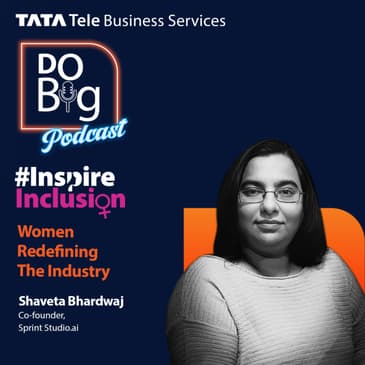

Welcome to another episode of Do Big Podcast. In this Episode, Shaveta Bhardwaj takes us on a captivating journey through her entrepreneurial endeavors, sharing invaluable insights, navigating challenges, and celebrating triumphs along the way. Shaveta sheds light on the transformative power of technology, from groundbreaking innovations to strategic implementations. Discover how technology serves as a catalyst for success in today's ever-evolving business landscape.
Tune in to the podcast now to get insights from Shaveta's journey and gain a deeper understanding of how technology can propel your business forward.
[00:00:00] Welcome to another episode of The Do Big Podcast. And today we have with us a lady who has
[00:00:17] marriage research with technology and I'm super excited given that I come from the world
[00:00:22] of research to have this conversation with her. We have with us with Abhardh Vaj, co-founder
[00:00:28] and CEO, Sprint Studio AI. And Shweta, welcome to this show. It's an absolute pleasure having
[00:00:34] you here. Very excited, Shaitar, and pleasure to be here. Shweta, I'm going to jump straight into
[00:00:40] the conversation and you know you are Sprint Studio AI and you are a part of the Google Accelerator
[00:00:45] Program, which I think all of us women very often look forward to being a part of. Can you share
[00:00:52] some key insights from your experience in the program and how it has influenced your journey
[00:00:59] as an entrepreneur? Shaitar, it's always a pleasure to talk about it. So let me start by first
[00:01:06] talking about widespread studio.air happened and how we landed that Google for startup Accelerator.
[00:01:13] Right? Yeah, I come from the knowledge industry and one of the most important part of our job is
[00:01:20] to connect organizations and companies to their customers and consumers. Right? Now the systems that
[00:01:27] have been built around us are to digitize the entire experience, just about touches the upper
[00:01:34] strata of the consumers. Right? 6% 10% of the consumers who we reach digitally today. Right? And
[00:01:42] you know often the question is asked, key what next? Okay? And what was the rest of the consumers?
[00:01:49] So COVID happened in each industry. It took multiple industries, right? And I thought it was wow
[00:01:56] a big opportunity and a big moment where industries were transformed many did but unfortunately for
[00:02:03] the research one it just slipped through the cracks. The transformation just didn't happen. Right
[00:02:08] for me. Yeah. And that's where you know, I sat up and said I don't want to be part of this
[00:02:15] conveyor belt at all. Okay? And when I don't want to be part of this conveyor belt, it really
[00:02:21] meant that I wanted to reimagine the way research is done, the way research is experienced by
[00:02:29] clients, people who are looking for insights etc and that's where the birth of Sprint Studio.air
[00:02:36] really happened. Each of the words have a meaning. Sprint for speech, studio for creativity and AI
[00:02:42] is really embedding tech. And like you said, right? It's a marrying of research which is a service
[00:02:49] industry with technology and that's where the birth really happened. Idea is not breakthrough,
[00:02:55] right? It is very intuitive. So when we were applying for Google for startup accelerator,
[00:03:02] one of the things that did happen was the response that we caught from the teams who were interviewing us.
[00:03:11] So Google for startup accelerator actually goes to like four rounds of intensive screening
[00:03:17] of startups. Right? This was the first cohort of women founders that they were putting together
[00:03:24] in India. So to be part of this cohort, the top 20 startups coming from research industry which
[00:03:30] is not you know, seem to be the biggest breakthrough in the world, right? Was validation for us.
[00:03:39] Okay, it was it was a huge recognition for us to really call out the fact that what we were doing
[00:03:47] was right. We were on a right path. There was a great market and product fit that was validated
[00:03:56] through their entire process and our journey at GFSA. Right? What did GFSA do for us? Right? I mean,
[00:04:05] why was it so important in every person that I meet? I often advise them to go apply for an
[00:04:12] accelerator and no don't wait for your perfect solution, apply as early as possible because it
[00:04:18] truly accelerates your journey. Right? And when I say that it truly accelerates your journey,
[00:04:26] it comes from a fact that you know, in a service industry that I'm sitting in,
[00:04:30] I started to think about productization. Okay? And what productization does is it gives you scale,
[00:04:38] it gives you a very different platform to play on a very different business model thinking that
[00:04:44] comes in. Right? So some of the pivotal points that happened was right after, you know we made it
[00:04:52] Google for start-up accelerator. We got visibility to we got recognition, three we got respect. Okay?
[00:05:01] On that platform that was offered by Google themselves, we actually ended up getting access to
[00:05:11] you know mentors from across fields okay, whether they were you know helping us in the tech discovery
[00:05:21] whether they were helping us in UI UX designing or simply challenging our business models. Okay?
[00:05:28] And they weren't at the bootcamp, I was challenged on my business model right and I sat back and
[00:05:35] thought through what I need to do next. So a journey that I would have covered say in four years or
[00:05:41] maybe five years, you know in a normal course I think I covered in five months and that put me
[00:05:51] on a very different path. And today I don't call myself just a research agency, I call myself as
[00:05:57] a representative of RESTEC which is about you know democratizing say customer's entity right not
[00:06:07] just for large organizations but anybody who needs it today. Everybody needs to listen to their
[00:06:13] customers and they need to know what to do next and that's where what we are building is going to
[00:06:21] touch whenever in Shalah. Shweta you know as typically I remember a couple of years back till Jenny
[00:06:31] I happened and even before that every time when there was a talk about AI people would talk about
[00:06:36] saying things like oh you know creativity is not going to get impacted or research for example
[00:06:43] was not supposed to get impacted and things like that. And I just want to understand where do you see
[00:06:49] the landscape changing for consumer research with you? Oh there is a massive shift sheath which
[00:06:56] is happening in research. Correct. So let's let me start by saying you know you don't adapt
[00:07:03] technology to survive but you should adapt technology to thrive now. Okay and that holds so
[00:07:11] true for research right absolutely. And I will break it down into three parts for you okay and where
[00:07:18] the development is happening and I have a whole lot of favorite a set of startups who are doing
[00:07:24] massive massive upbringing, massive change in this area. This tech, this AI and this Jenny AI right?
[00:07:32] Now when you look at tech today what can it solve for? What are a real life problems when it comes
[00:07:39] to research right. It can solve for speed, it can solve for quality and it can solve for cost
[00:07:46] right. Something that didn't come together at any point in time only technology can enable that
[00:07:53] today. Now for example product or the app that we have built to solve for this brings together
[00:08:02] concept of micro communities. It's a my communities is not a new concept right? Correct. But bringing it
[00:08:08] together on a platform to deliver a seamless journey to the consumer on the other side was very
[00:08:18] very critical for us in what we were building okay till today yeah the consumer had a very transactional
[00:08:28] relationship with research. They came in they did you know an interaction for two hours they
[00:08:34] went away they didn't know what was really going to happen with their feedback etc. What we are
[00:08:39] creating for example through tech and many others who are operating in a very similar space
[00:08:46] is creating a two way interaction with consumers which means better engagement or you can bring in
[00:08:54] design thinking which means you can do iterative research. You can have asynchronous always on
[00:09:02] platform which means nobody is knocking at a consumer door or interrupting them at their busiest
[00:09:08] time and they can come and answer at any given point in time during the day when they have the 15
[00:09:14] minutes to release it down and think through what they want to share. So stories and consumer
[00:09:20] stories and conversations have been enabled by research in a very very different manner through
[00:09:27] technology and it is delightful because you now can collaborate with consumers unlike saying
[00:09:32] you are moving away from it. I'll go back to some of the triggers that happened along the time
[00:09:42] is I remember a client from Shadi.com called me up and said that he the research form or the
[00:09:49] survey form that my customers are getting from you are dated it's taking them back by 10 years
[00:09:57] look at my UI and always felt the research was in the space of catch up with technology and there's
[00:10:04] so much more that's happened and we're just not keeping pace with that right today that's
[00:10:09] possible to do with so much available you know with us. So that's the first part of it right which is
[00:10:17] technology has us connect technology helps us deliver a far better experiential you know a space
[00:10:26] to consumers clients and assess researchers. Now coming to AI once you know you've collected the data
[00:10:35] which means that you know tech is kicked in AI helps you fuel automation and gives you real time
[00:10:45] access to data which is what a whole lot of clients or organization in this hyper innovation space
[00:10:55] are aiming to do can I get insights faster again going back to an example where you know my client
[00:11:03] that book my show once told me that ideas get generated in a week and research gets delivered in
[00:11:10] how can you collapse it down it's not fair and that's where automation real-time reporting
[00:11:18] makes a whole lot of difference in terms of guiding decisions and helping clients stay ahead.
[00:11:25] There is a lot of innovation that is happening in this particular space and you will see a lot
[00:11:30] of platforms that are getting developed to solve for this particular problem. The third leg which
[00:11:36] is coming in through you know Gen AI okay there's a lot of progress that has happened
[00:11:44] you know in the last one year or so it's been shabby right. One it has made you know startups like
[00:11:53] us which would have taken say a few years to you know wait and get the automation in place
[00:12:01] with open AI with you know open source you're able to build text tags and solve for things in
[00:12:09] months so for example you know we are creating a query system along with automation it's just
[00:12:17] been six months and we are almost ready with a beta version 2 roller now that is an experience that
[00:12:25] none of us had in the past and that I think is is a space that is extremely delightful
[00:12:33] and helps us you know literally keep imagining and now it is like the speed of imagination by which
[00:12:42] you can bring in technology. That's really interesting because you know we're doing some research
[00:12:48] right now and we are using platforms exactly to do what you've said right we connected with consumers
[00:12:53] and we asked them to do things over five days at a time that is convenient to them all of that
[00:12:58] so you're absolutely right it really really does help the two-way process and then you can have
[00:13:03] conversations on that and you know a lot of the involvement comes in. When you think about
[00:13:10] just AI as a buzz you know currently it's still while a lot of people are using it etc but
[00:13:17] it still has what I call buzzword status not necessarily in research but first say
[00:13:23] do you think a lot of Vietnamese still think that it is jargonistic and find it difficult to wrap
[00:13:30] their heads around AI so it's very interesting right the word that comes to my mind when I think about
[00:13:38] how ever SMAs or decode AI at this particular point in time is curiosity okay
[00:13:46] the storm call LM literally touched everybody you know everybody is talking about it and
[00:13:54] you know it's not restricted to you know you can't even say it's restricted to one sector versus
[00:13:59] the other it's touched everyone okay now it has in my view resulted in one or two things okay
[00:14:07] one is I want to know more okay two is I don't want to be left behind so I want to do something with
[00:14:15] and that I think is a very big trigger to get people started there are of course barriers that come
[00:14:22] down the line but what I want to do is talk about some of these cohorts of MSMEs that have met
[00:14:28] what thinking very very actively about AI in their lives and AI to create business use cases right now
[00:14:40] an MSME that you may not think about will think about AI is for example a guy into nuts and
[00:14:46] bold space okay and I'm talking to him spontaneously you know the first thing when I asked you what
[00:14:52] chance he talks about AI okay and I was like wow I mean how is this guy thinking and imagining
[00:14:59] about AI application within his own business he has an office in ex you know in Mumbai and then
[00:15:06] somewhere a manufacturing unit and how is he really thinking about right his idea of AI was to
[00:15:14] actually solve a real life problem she did you know so imagine what he told me was that I have a
[00:15:21] raw material which is where I you know my capital input really goes it right can AI looking at the
[00:15:29] design of the product tell me if I can save on raw material that I need to invest on upfront
[00:15:37] now that's a huge application for him in terms of efficiency cost saving and finally profits
[00:15:44] now that's what you know blew me away right saying that you know when it comes to you know
[00:15:49] deciding on capital investment, inventing management or even taking order bookings right small
[00:15:57] retail spaces right we're talking about automated auto bookings coming into them these are very
[00:16:04] specific applications of AI but I see them as nuggets of building tech application in many many
[00:16:14] different ways so there is a very active cohort which is at this point in time or thinking about
[00:16:21] but is it at a surface level or a level below that my sense is it's at a level below that
[00:16:29] not at a level where they've gotten into exploration and are ready to you know apply that in their
[00:16:36] businesses right away so the challenge really is how do you get them to a space where they can start
[00:16:44] thinking about technology and AI very very actively in terms of application into their businesses
[00:16:51] and when we talk about them embracing rights of one is this whole fear of missing out and that
[00:16:56] has happened across board I think a lot of organizations where MSME and otherwise have gotten into
[00:17:02] this whole space thing I have to bring an AI into the organization how can we do it etc but
[00:17:09] from your experience if you had to kind of talk about where how where to begin what should they
[00:17:16] consider when they are embracing AI to stay competitive I think it's not easy okay this part
[00:17:23] is definitely not easy for any organization to get started with I mean you know when we really
[00:17:30] look at digital transformation right for any organization I think there are two big issues that
[00:17:39] come in forefront one is discoverability of the right solution and the application I feel that
[00:17:48] a business owner or an organization does know where the gaps really exist in terms of
[00:17:56] solve that is required right but where they get stuck up and the time taken to solve for that
[00:18:02] is around discovering what should I apply so you know when you spoke about the fact that there are
[00:18:10] a lot of them they have interest in it but there is a lot of them got onto this whole bandwagon
[00:18:15] because of four more because you couldn't be seen as being left behind but if you really had to
[00:18:20] adopt you know AI or digital into the system then where what are the strategies what should they
[00:18:28] be doing what are the first steps that's very interesting yeah in terms of adopting technology and AI
[00:18:38] for your organization I think the first hurdle that comes by is the issue of discoverability right
[00:18:48] for the right solution an application to solve your problem the next one that kicks in is efforts
[00:18:55] that it takes to implement it right at both places what you need is a technical guidance for example
[00:19:05] us right we had to solve for a lot of ML issues we had to solve for a lot of you know applications in
[00:19:13] this or the app that we had built and the other platform for automation had very different problems
[00:19:20] so we were tapping into Google specialist calling out specific use cases for example digitizing for
[00:19:27] the rural so we spoke to somebody who gave us her experience and in half an hour you know what you
[00:19:35] should not be doing and the spaces that you should be able to pursue now that is the kind of access
[00:19:43] organizations today do not have and those are the access points that need to be created for them
[00:19:50] and tech partners I think they play a very very important role the second thing that's very important
[00:19:59] in a well I discovered even with you know MSMEs who had a very strong AI based applications themselves
[00:20:10] right for not well worst with the entire landscape that exists today see the tech innovation is
[00:20:19] moving at very high speed how many of us know enough about the solutions now taking the case of this
[00:20:26] particular MSME that I was talking to they had tapped into a local vendor for their cloud services
[00:20:35] because they didn't know a branded and a secure space was available in a similar cost to them
[00:20:43] so that awareness that access to check of what is available to me as MSME is also lacking right
[00:20:54] so socializing for example as an outcome use cases where MSME equally has access to
[00:21:04] tech solutions the solutions have been democratized for them as well is a space which is blank at this
[00:21:13] point in time for many and therefore you know that they want to but they can is not really happening
[00:21:22] and the space is very interesting they can but they don't know they can right which is so true and
[00:21:30] that was going to be my next question that not everybody manages to get access to google startup
[00:21:35] accelerator right if you are an MSME who is not in that space what are the kind of things that they
[00:21:45] should do to be able to educate themselves inform themselves better you know get into understanding
[00:21:54] space better you know what do you think is going to happen or should happen with them what should they
[00:21:59] do I think the first point is they need to be very clear about what they're going to solve for
[00:22:05] and then I've seen many of them you know kind of get access to technology and discover the right
[00:22:14] technology through their own pure groups but what doesn't come in easy as the effort you put
[00:22:23] in terms of informing yourself in terms of what is available and taking the next step to discover
[00:22:29] further because even today you may not have access to accelerators but you have so much available
[00:22:38] through tech partners whether it is started telly google amazon they happy to invite you over and
[00:22:45] tell you what is available and how can you simply even improve your performance improves the
[00:22:51] performance of your app in there is an innovation hub okay if I was to tell you or ask you a question
[00:22:59] she tell how many apps get listed on google play store every year take a guess take a while guess
[00:23:06] couple of thousands eight lakh what yes it is eight lakh and that's exactly what my mentor at google
[00:23:16] asked me that gives you the size of a people who are actively thinking about on tech isn't it right
[00:23:24] and that's where the massiveness really exists so the msma will innovate they will solve
[00:23:31] and the scale will come through the larger organization and that's been the way it is right
[00:23:36] but that is where we need to start looking at the size of this sector is very different what we're
[00:23:45] looking at is just the tip of the iceberg there is so much beneath that I give you a very small
[00:23:50] example or yours back I was part of a jury with Mahendra trucks right there was this lady who had
[00:23:59] built an app to manage the load system two way right no accelerator nothing she was just solving
[00:24:08] problem an app built in Tamil Nadu executed brilliant so people are finding ways to solve for problems
[00:24:16] they just need the right access in terms of where to go forums networks to actually fuel that it's all
[00:24:24] there just that it needs a catalyst given that you come from a research background what trends have
[00:24:32] you noticed in the digital adoption journey of small and micro you know enterprises digital journeys
[00:24:41] are very interesting there is amazing openness to solve for everyday problems okay they will not
[00:24:51] be using the most predictive tool the most fancier of tool available today but this solving them
[00:24:58] through you know tools that they understand right so for example whether it is people management
[00:25:05] right or whether it is audio management whether it is inventory management whether it is client
[00:25:11] meetings across geographies whether it is reminders you know which comes in through RFQs
[00:25:17] whether it is you know invoicing data there is a whole lethura of you know areas where MSMEs
[00:25:28] they have found their jugat tech applications which are rather simplistic if we can you know take
[00:25:35] them into a space where they can solve for it in a very structured manner apply the right technology
[00:25:44] it will be an inflection point in my view they're ready okay they're ready but not yet there
[00:25:51] okay and as we wrap this conversation because I know we can go on forever but as we wrap this
[00:25:58] conversation with you if you had to give one piece of advice okay for our listeners to understand
[00:26:04] their market and gather in sites you know from existing customers to understand new markets etc to
[00:26:11] boost their growth what would that advice this is one of my favorite spaces because you know when
[00:26:18] we talk about products superiority we talk about functional superiority mind you anybody can copy it
[00:26:26] right your competition can come copy it overnight what your competition cannot copy is your
[00:26:34] emotional connect with your consumers and customers and that can come in only if you're obsessed
[00:26:42] and I really mean it when you're obsessed about your consumers and customers so rather than an
[00:26:48] advice I actually want to ask everybody a question are you listening to your customers and feeling
[00:26:55] their problems every day if you're not then start doing it today because that's going to give you
[00:27:01] the long run that's going to give you this sustainability that's going to help you thrive in this
[00:27:07] competitive environment nothing else. Shratham that was a wonderful answer thank you very much I
[00:27:13] think everybody and there are enough large companies and CEOs who keep talking about the fact that
[00:27:20] you need to be obsessed about your customers Amazon what being one of them but it's absolutely
[00:27:26] fantastic to have you on this do big podcast and you know I was such a wonderfully insightful
[00:27:32] conversation with you thank you so much for giving us your time and being with us here today.
[00:27:38] Thank you pleasure was by
[00:27:39] Thank you for tuning in to the do big podcast a podcast that is dedicated to providing insights
[00:27:47] strategies and success stories of smart digital solutions for essence. We believe that behind every
[00:27:54] successful business there's a strong foundation of reliable and security technology be a digital
[00:27:59] connectivity cloud infrastructure cloud apps collaboration tools or cybersecurity solutions
[00:28:05] in a rapidly evolving digital world where technology is key to progress Tata Tele
[00:28:10] Business Services stands at the forefront of digital transformation of SMEs Tata Tele Business
[00:28:16] Services with their extensive experience and commitment to empowering businesses understands
[00:28:21] the unique needs of SMEs whether it's scalable connectivity robust communication tools or
[00:28:27] tailored ICT solutions Tata Tele Business Services is here to propel your business forward
[00:28:34] Tata Tele Business Services is synonymous with innovation reliability and transformative
[00:28:39] solutions so if you're ready to take your organization to new heights of success we encourage you
[00:28:46] to explore the transformative possibilities that Tata Tele Business Services has to offer
[00:28:51] our contact details are in the description below remember we're available major podcast
[00:28:58] so if you enjoyed today's conversation subscribe to our podcast for future episodes which we
[00:29:03] promise will be packed with equally valuable insights on questions entrepreneurs face as they
[00:29:08] digitize and scale businesses with the help of technology don't forget to rate and review
[00:29:14] our podcast as well as share it with peers colleagues and other entrepreneurs like yourself who will
[00:29:19] benefit from listening to it thank you for listening to us and until the next time keep embracing
[00:29:25] technology and may your business thrive in the digital end