
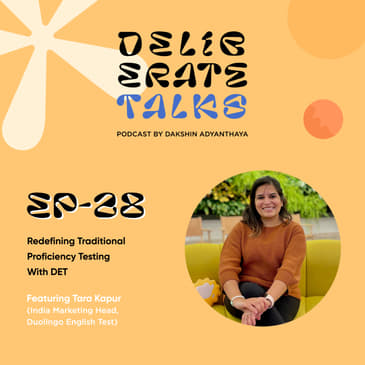

Duolingo English Test is setting global language proficiency standards and Tara Kapur, the Head of Marketing at DET, shares how they are exploring marketing strategies to help fulfil more study abroad dreams in India.
Watch the full episode on youtube.com/@pixelatedegg
Follow Tara Kapur:
LinkedIn: https://www.linkedin.com/in/tara-kapur/
Instagram: https://www.instagram.com/tara.kapur/
Follow Dakshin Adyanthaya:
LinkedIn: https://www.linkedin.com/in/dakshin-adyanthaya/
Instagram: https://www.instagram.com/dakshinadyanthaya/
Twitter: https://twitter.com/upsidedakshin/
Follow Pixelated Egg:
LinkedIn: https://www.linkedin.com/company/pixelated-egg/
Website: www.pixelatedegg.com/
#Learning #EnglishLearning #podcast #technology #Edtech #podcasting #marketing #DET #Duolingo #LanguageLearning
See omnystudio.com/listener for privacy information.
[00:00:00] This is the table for two edition of the Deliberate Talks podcast and I'm your host, Dakshin Adyanthaya
[00:00:05] welcoming you to an advancing linguistic domain that can take you to places for professional
[00:00:10] and personal developments.
[00:00:12] So get ready to stay ahead of the knowledge curve beyond the conventional methods of English
[00:00:17] learning with none other than Thara Kapoor.
[00:00:20] Thara is the head of marketing for dual-ingual English test in India and apart from this
[00:00:25] she is an award-winning marketer with an illustrious career across roles at Netflix,
[00:00:30] Vice Media and more.
[00:00:32] In our conversation today with Thara we uncover the upgrades in language assessment, exploring
[00:00:37] how new methods are reforming the way we learn, teach and evaluate language skills in a global
[00:00:43] context.
[00:00:44] All this in more with Thara right after this quick intro.
[00:00:52] This is the Deliberate Talks weekly podcast powered by the pixelated egg digital ventures.
[00:01:04] And we're back.
[00:01:05] Hello Thara welcome to the Deliberate Talks podcast.
[00:01:08] Hi, that's nice to meet you.
[00:01:10] Super excited to host you how are you doing?
[00:01:13] Doing good, hectic week but been good so far.
[00:01:17] Okay, I'll keep it as light as possible and let's have fun as much as possible.
[00:01:22] And before we get into our incredible dialogue and language learning and assessment, we
[00:01:27] start the show with a thought starter conversation and I want to begin with asking you why are
[00:01:33] English teachers in school always the strictest of the lot and did you encounter one of
[00:01:38] them?
[00:01:39] Actually for me was a bit of the opposite.
[00:01:42] My English teacher was actually my favorite teacher which is probably why I sort of went
[00:01:46] down this path.
[00:01:47] So post school, I actually studied English honors as my major and that was because I actually
[00:01:52] had a great English teacher which I guess is a little contrary to what you were saying but
[00:01:58] for me I was terrified of my math teacher and I still am semi terrified of math so I guess
[00:02:05] it just depends on school to school.
[00:02:08] Okay then, as soon as we are all set for a round of questions let's begin with asking
[00:02:13] about dual-ingual English test, the DET.
[00:02:17] Now the dual-ingual language report highlighted that English remained to be one of the most
[00:02:22] popular languages to study across the world.
[00:02:25] So talk us through what is DET, the target audience primarily signing up for the English
[00:02:31] test in India and how many of them are actually serious and casual learners and what's their
[00:02:35] objective for trying this out?
[00:02:38] Great question and I'm glad you highlighted the distinction between the language app and
[00:02:42] the DET.
[00:02:43] And I think the interesting part is one is obviously it's one, the app is for language
[00:02:48] learning and the DET is a high-stakes proficiency test but I think that also signals difference
[00:02:53] in behavior in terms of learning versus testing right?
[00:02:56] When it comes to learning behavior varies and for some people you are trying to learn
[00:03:02] to improve your standing in society so you know you speak a different regional language
[00:03:07] you're trying to learn English because it can help you get a better job no matter what
[00:03:11] strata of society you are in.
[00:03:13] For some people you are learning it casually just to be able to you know learn a new language
[00:03:17] and have fun but when it comes to testing testing is a lot more high-stakes because typically
[00:03:24] when people take an English proficiency test it's to study abroad and the audience that
[00:03:28] we have that takes the DET is primarily an audience that's looking to experience life
[00:03:33] in another country through higher education.
[00:03:36] So there are obviously different personas and different people you know think about your
[00:03:40] friend's circle right?
[00:03:41] And think about your friends that have studied abroad or the ones that have gone abroad
[00:03:45] from their undergrad or college right they're different kind of brackets.
[00:03:49] Yeah so some people go and study abroad because they just wanted experience another culture
[00:03:55] and they want to sort of be in a multicultural global ecosystem they want to learn they want
[00:04:00] to work they want to expand their horizons.
[00:04:02] Some people go abroad for better opportunity right so they want better jobs they want
[00:04:08] to eventually migrate to another country and they want to change the quality of life that
[00:04:11] they're living in India on higher incomes and migration is a very big motivator for
[00:04:16] a lot of Indians looking to study abroad and then there's brackets off you know so we see
[00:04:21] STEM aspirants actually looking to study abroad a lot because you know they're great engineering
[00:04:27] schools abroad there's talent there's so much talent that exists in India and they want
[00:04:32] to open up those opportunities from a job perspective.
[00:04:35] So you see a lot of engineers and students like that end up going to colleges in the US because
[00:04:39] it's so hyper competitive in India.
[00:04:42] So yeah just some different profiles that we see when it comes to testing right and honestly
[00:04:47] how difficult is this?
[00:04:50] Absolutely I mean this is just one part of the study abroad journey right so there's so
[00:04:55] much that students have to go through and this test is just one part in that entire ecosystem
[00:05:01] and a very pivotal life changing moment for them so super difficult absolutely.
[00:05:07] Right how's the program structured now if I have to ask that preparation for study abroad
[00:05:14] or job we see a lot of people preparing themselves for English test the spoken English and the
[00:05:18] return English aspect of it.
[00:05:20] How difficult is this part for them in terms of how much time do they need to give themselves
[00:05:25] to prepare for something?
[00:05:27] So honestly it varies you know the idea of English proficiency test is to just test your
[00:05:33] standard of English so what we've tried to do with the DT is make it as stress free
[00:05:38] as possible.
[00:05:39] So the idea of the test is it's intuitive it's not a test that you need you know like
[00:05:44] it tests your standard of English at where you're at it's not something that you have to prep
[00:05:48] for right so we have practiced tests on the website that lets you experience what the
[00:05:53] test is like.
[00:05:55] It's actually this number was so surprising to me that there's just about 10% of the Indian
[00:05:59] population that is actually fluent at English which was a surprisingly small number for me
[00:06:04] in terms of what I thought right I thought was a much higher number and even if you even
[00:06:08] if you buffer that and take it at 20%.
[00:06:11] That's a very large number that isn't speaking English at a fluency level to be able to
[00:06:16] learn and educate themselves at universities abroad right so the reason that these proficiency
[00:06:22] test exist is so that students can actually learn in that language when they go abroad
[00:06:27] and they're hitting the benchmark because all of these courses are taught in English.
[00:06:32] So that's the idea behind it but the reason these tests exist is not for you to prepare
[00:06:36] and pass the idea is for it to test what your level of English is at right so the way
[00:06:43] the DT works is it's an adaptive test where the questions get harder depending on your
[00:06:49] skill right so it's intuitive and that's a good idea.
[00:06:52] That manner and sort of progresses it's a lot more stress free as an experience right so
[00:06:57] the questions kind of appear in ways that are a little more conversational they feel a
[00:07:01] lot more real world in terms of how that plays out when you go to university.
[00:07:06] So what we've tried to do is make this test not a test that you have to prep for but a
[00:07:10] test that actually looks at your standard of English and we have unlimited free practice
[00:07:16] tests on our website so people can experience what the user interface is like they go to
[00:07:21] the process of taking a digital test and they understand that a little better so the
[00:07:26] ideas I ultimately you shouldn't prepare for it it should be testing what your English
[00:07:30] standard is at what for those who want to be prepared because we know a lot of Indian
[00:07:34] students want to be prepared you have the practice test to be able to do that.
[00:07:38] Right and it's a great point to touch upon the fluency bit which you spoke about and also
[00:07:43] passing the tests you know maybe an indirect correlation to the whole aspect but we learn
[00:07:48] English in school in college we pass and we don't really necessarily feel the need of it
[00:07:54] to extensively prepare ourselves for exams abroad many self learn when it comes to preparing
[00:08:00] themselves and then in the course of time don't hear these study abroad mandatory exams.
[00:08:06] What do you think is a missing puzzle in you know from a school level program or a college level
[00:08:11] program that they have to come all the way here few years later to understand that the fluency
[00:08:18] of English is not that great what do you think is the missing puzzle.
[00:08:20] I mean I think the core challenge is just access right the there's so many barriers when it comes
[00:08:26] to education and that segregation between the haves and the have-nots just becomes bigger and
[00:08:31] bigger because of those barriers right and you see it so rampant in Indian society across the
[00:08:37] board and obviously that has a role to play when it comes to education right and I think that's one
[00:08:43] part and one of the big motivators for me to join a company like Doolingos it's so mission driven
[00:08:47] in terms of making high quality education accessible and I think you know even with all of the
[00:08:54] blurry lines around eddek I think that's ultimately what eddek is trying to do is make better quality
[00:08:59] education accessible to the masses you know and the challenge comes in when every company is not
[00:09:06] necessarily as mission driven right so the reason that I feel like Doolingos does this well
[00:09:10] is because the core mission of the company is to make world class education accessible
[00:09:15] to everyone and to make it free right so even if you see the language app majority of the programs
[00:09:21] are you know like that you can learn a very high quality of language learning at a very high standard
[00:09:27] for free you know you do have the ads and you have some of those things that come into play but the
[00:09:31] ideas that the quality of education is high you know so I think that's the part that makes the
[00:09:38] difference is how much access to somebody has to these tools to be able to get themselves to a certain
[00:09:44] level of society right so just because you're stuck in one part of India doesn't mean that you
[00:09:50] shouldn't have access to the best English teacher out there right and with eddek you're kind of
[00:09:55] being able to blur those lines so I just hope that you know this is an industry that continues
[00:09:59] to grow and people see value in it because access to quality education I think is what causes those
[00:10:06] blurry lines that you were talking about right so also then in that case would at some point of time
[00:10:12] you would consider this d et to be an important part of also colleges and schools currently in
[00:10:20] India also at some point of time just in case also you know this needs to be integrated at some
[00:10:25] point in a university level as well here I don't think it would be a man I mean it could happen
[00:10:31] for sure I mean there are certain places where people want or they require that level of like
[00:10:37] they want to test to kind of prove that English standard you sort of see it happening with certain
[00:10:43] corporates as well right so certain companies ask students to go through tests which could be
[00:10:48] English proficiency tests as well to see what their standard is they do this in other countries like
[00:10:53] I know a lot of companies in Vietnam do this because you know these are just entry level requirements
[00:10:58] for certain companies but where we're at right now is focusing more on study abroad just because
[00:11:04] our acceptance is really strong with universities abroad right now we haven't necessarily focused on
[00:11:10] Indian universities because a lot of them look at your high school you know degree or your
[00:11:16] 10th 12th mark sheets and they see that as a strong enough standard right it might evolve but
[00:11:22] currently it has been right so we'd have to then work a lot with government schools you know
[00:11:27] education ministries to be able to create that but what your thing is is accurate it could happen
[00:11:33] right like the idea of the DT is it's a benchmark and it's a standard of proficiency and you know
[00:11:39] once something becomes a standard of proficiency you can see a lot of adoption happening even in
[00:11:45] areas that we haven't been focusing on for the time being right and it is a beautiful conversation
[00:11:50] because as early as you start this adoption it leads to a better preparation for study abroad as well
[00:11:57] you know yeah it's just thought that's it but I think it beautifully sings in regardless of that
[00:12:02] but yes coming to your marketing bit of this whole thing it must be a challenge for sure you
[00:12:07] know there's a large portion of youngsters whose parents or surroundings must have already a
[00:12:12] notion about online tests and maybe to a certain extent even the lack of understanding of what
[00:12:17] DED really does so how is the platform or the brand trying to reach out to this audience where
[00:12:22] the marketing effort is yeah great question and you've hit the nail on the head that's the biggest
[00:12:27] challenge that we have in the market is the lack of brand awareness because we're taking on
[00:12:32] you know traditional companies that have been around for decades and have you know followed a very
[00:12:36] old system of testing in the past right but when it comes to education and when it comes to study
[00:12:41] abroad which is this really high stakes period in somebody's life they don't want to go with something
[00:12:48] they don't trust right and you don't trust a brand that you don't know right so what we've realized
[00:12:53] with the DT is that the students that know us trust us they have a great experience we have
[00:12:59] amazing recommendations from students that have gone through the process but a very large portion
[00:13:04] don't take the DT because they don't know it exists so what we're trying to do from a marketing
[00:13:09] perspective is do exactly what you were saying increased brand awareness and there are multiple
[00:13:13] ways that you do that right like we're trying to take a full funnel marketing approach towards building
[00:13:18] out our campaigns but at the top of the funnel is the brand awareness portion right so we're trying to
[00:13:24] see how we can leverage a little bit of the fun really social digital angle of dualingo as a brand
[00:13:30] because we have this massive global brand that people love but also bring in the seriousness
[00:13:36] of high stakes testing right but some examples of how that's manifested for us is we did a really
[00:13:41] interesting marketing partnership with the movie Dunki right where you know it's so rare that you
[00:13:46] have a movie that's actually talking about the provisions of the testing space and some of the
[00:13:50] challenges that we've voice around it and we use this as an opportunity for us to do something
[00:13:55] larger scale where you know we had a sound bite from Tapsee Panu we were able to create ads that
[00:14:00] we pushed across YouTube we were integrated across you know some of the other movie promotions
[00:14:06] that Red Chilies was running and then obviously had an influencer and promotional angle around it
[00:14:11] that was one example for campaign that we've run in the market besides that you know creating
[00:14:16] strong testimonial content from students that have taken the D's DT helps build trust so showcasing
[00:14:22] success stories of students who have taken the DT and gotten into great universities abroad we're
[00:14:27] trying to create as much content around that as possible you know we obviously have a digital social
[00:14:32] media first strategy because that's where our students are most of them are online we don't need to
[00:14:37] be running TV ads to drive that awareness and then you know a lot of focus on PR press and events
[00:14:43] on ground at colleges so that's more of our evergreen stuff but you will see campaigns like the
[00:14:48] Dunki example happen on and off to create those braddo and spikes right you did mention about
[00:14:54] testimonials now you know successful attempts in an online tests are great but how does your
[00:15:00] product incorporate feedback from test takers in the ongoing development and refinement of the
[00:15:06] English test set for those who don't successfully complete it how are you able to come back again
[00:15:12] and probably take the test. No great point and I think for us a lot of it is on rules education so
[00:15:18] what we realize in a lot of countries is students don't understand that digital testing also has
[00:15:25] strict rules and that you can't just break the rules and expect to get a score right so we're
[00:15:31] doing a lot to make sure that students are aware of what they're doing and what's causing them
[00:15:36] to get in valid scores right so a lot of education around how to take a digital test is something
[00:15:42] we're working on we work also very closely with counselors and agents in the market to help with
[00:15:47] that education so that students understand the consequences if they try to cheat they understand
[00:15:52] even if somebody's not trying to cheat there you know they're breaking a rule without realizing it
[00:15:56] making sure they understand what those potential rule breaks could be because ultimately
[00:16:01] we also want the success of our students and through rule education I think is one and aspect
[00:16:06] of it the other part which you were talking about in terms of adapting the product is for students
[00:16:11] the one part that they come to us is we want the DT to accept it more widely right so right now we're
[00:16:17] accepted by 5000 plus institutions across the world which is a high number but that's obviously not
[00:16:22] universally accepted yet and we're getting there we're working on it we're just a lot newer as a
[00:16:26] product but for us to get accepted we need to work with universities to adapt the test based
[00:16:32] on their feedback right so that more universities won't accept us and then we're able to service
[00:16:37] students better and what we do is every year we have an annual update to the test based on feedback
[00:16:43] that we get from universities and other stakeholders who are involved in testing including we have a
[00:16:49] student advisory board um who are previous testicles who also have input into what we do or give us
[00:16:55] feedback on that entire experience and it's very rare to have a test update so rapidly we update our
[00:17:03] test every year we're in the phase of updating our test currently right so April 2nd is when you
[00:17:08] see the new version of our test running we've already been running some communication around that
[00:17:13] but this helps us improve our product this helps us make a more secure test this helps us drive
[00:17:18] up acceptance and then ultimately it helps testicles have more opportunities when it comes to
[00:17:24] proficiency testing choices right and it's been almost a year and a half for you in the system as well
[00:17:30] yes yes it has it's amazing stories as a positive outcome of the English test and that makes you
[00:17:38] really feel good at the end of the day yeah I love this question it's it's it's about my
[00:17:43] favorites um and I think for me it is to meet testicles like actual students who you know when I
[00:17:50] speak about this it gives me goosebumps because you're actually seeing something transformative
[00:17:54] happen for students right and like I told you Doolingo is mission driven so yes we do want to
[00:17:58] make money by selling our test but we want to make sure our test is as affordable as possible
[00:18:03] which it is it's a fraction of cost of our competitors but through that we're able to also provide
[00:18:10] a lot of test waivers for folks that need it right so we run an access program which recruits
[00:18:18] 20 to 25 gifted refugee students from around the world who are put into a program where
[00:18:27] not only do they get DT waivers but we provide us a college counselor who helps them with their
[00:18:33] application process we work with them to get accepted into top schools to get their visas because
[00:18:39] you know they're they have refugee status which makes it very difficult for them to do this on their
[00:18:43] own we're running our second cohort right now starting recruitment for the third
[00:18:48] a very large cohort of those students live in India so I've gotten to meet some of our refugee
[00:18:54] students who are from Afghanistan who are Rohingya refugees and I've seen some of them get placed
[00:19:00] in universities like Georgetown and you know when you see that transformative journey you hear their
[00:19:04] stories you see how intelligent they are and you know you're really like hey these students are
[00:19:10] going to change the world and we've played a small role in that journey so for me meeting these
[00:19:14] these access scholars has been one of the biggest highlights but beyond the access scholars there's
[00:19:20] so many students like this right I met a student recently who was talking to us about how initially
[00:19:26] he didn't consider studying abroad because just taking a proficiency test was such a barrier right
[00:19:32] and it sounds silly because you're like this proficiency test is such a small part of that
[00:19:36] journey but when you heard his story where it was like he was only getting an appointment at a city
[00:19:42] that was miles away on a certain date tickets to fly there was so expensive it was going to take him
[00:19:48] five days to take a train you know this entire process was like when you started hearing how the
[00:19:53] numbers started adding up he was like even if I get a scholarship to go to the university my proficiency
[00:19:58] test is ultimately gonna cost me lakhs of rupees so it just felt like a no like it felt like something
[00:20:03] that was an absolutely impossible dream and then I came across the DT which I could take from my
[00:20:09] house I could take it at a much lower cost and suddenly that open opportunities for me and this
[00:20:15] is a scholarship student who's gotten into a great university right so to hear someone say that
[00:20:20] where you're like wow I didn't realize that just the test could be such a great facilitator I think
[00:20:25] was really motivates you to do this job so these are just some examples I have tons of them in terms
[00:20:30] of student stories but but really inspired by the testicles that I meet fabulous I'm like that
[00:20:36] really makes you go back home and get great sleep and wake up fresh next day to ensure that there's
[00:20:44] a new dream which is fulfilled as well so it's a great feeling now you know there's another aspect of
[00:20:51] it maybe it's a struggle for the for the boomers in millennials maybe but you know the language
[00:20:58] aspect keeps evolving right now adulis has introduced co-langs based on series and fan communities
[00:21:06] you have the anime languages featured in us great courses the game of thrones language comes
[00:21:13] in yeah a stucco's that's lovely it's lovely to see co-langs come into existence but one of
[00:21:19] the generational connozations is millennials trying to understand the gencies lingo and eventually
[00:21:27] should pass to the gen alpha lingo as well imagine someone comes to you Thara and says
[00:21:34] tfw when I hear you speak your English is it is it's laughs so hard and he was
[00:21:40] wondering what is this right or this is not this is not something that I'm used to listening on
[00:21:46] a daily basis now you know when we talk about students abroad and study abroad we're also talking
[00:21:52] about this generation which is going to go there and get used to a new set of lingo altogether how's
[00:21:58] that preparation coming into the picture like how do I really try to understand what the gen z or
[00:22:03] the gen alpha lingo is so that's an great question and and I think the tragedy of it is that it makes
[00:22:11] me just feel old which I hate feeling but but I think you know when I hear like I usually feel
[00:22:17] like you know as macros you sometimes feel like you're a lot closer to the the current generation
[00:22:22] other folks you know from other generations but ultimately I mean that's not how I can
[00:22:27] worsen life and you know I would unfortunately be opening up urban dictionary and checking that
[00:22:31] but I think for us there's two parts to it right so from a social media and a marketing perspective
[00:22:38] we try and bring slang into our communication because we want to sort of relate to our consumer
[00:22:44] but obviously we need to do it at limitation because of what our product is and that's the second part
[00:22:48] of it right when it comes to testing and when it comes to high stakes proficiency it's about how
[00:22:53] you would communicate a little more formally because the idea of this is how you would communicate in
[00:22:59] university or how you would communicate in a working environment and you're definitely not saying
[00:23:04] that slaps to your boss right or your university professor right so I think that's the difference is
[00:23:11] where where when it comes to social media where we try to be a peer to students where still a guiding
[00:23:17] peer so we're still giving them a perspective and we're still sort of trying to help them out so it's
[00:23:21] like almost like a mentor of sorts but we're not unrelatable where like an old uncle trying to talk
[00:23:27] to a student right so I think those are the parts where we're trying to meet a middle ground when
[00:23:31] it comes to slang but when it comes to testing it has to be proper English and when I say proper
[00:23:37] English it doesn't have to be high brow it can be conversational but it can't be slang that's
[00:23:43] the difference when it comes to proficiency testing right is yes certain parlance can pass but
[00:23:49] like the words that you were using will definitely not work well when it comes to high stakes testing
[00:23:55] right but you might have seen it on the language app we have fun with sentences we sort of give
[00:23:59] people ways they can say silly things and have fun and that's a little bit of what we try to
[00:24:04] lean in on the DT as well when it comes to social media and some of the content we're promoting but
[00:24:09] it's a fine line because of what the product is itself which is a high stakes okay great that
[00:24:15] leaves a lot for us to self-learn as well but it's an ongoing learning and I think the best teachers
[00:24:21] to that is the generation itself and we got to get adopted too I just want to do a different language
[00:24:27] because then I'll have to learn something else great stuff that we come to the end of the first
[00:24:33] on the questions time to move from the questions on DET to RFT which means the rapid fire test
[00:24:41] and some quick fire I hate rapid fire questions but I'll go for it so quick fire is coming at you
[00:24:48] so we ready for this in 60 seconds as a person marketing the product tell me three reasons why
[00:24:55] DET is the future of language assessment or universities abroad I mean I think it is the future
[00:25:01] just because it's a digital test it's affordable I can go on about this for a while so it's affordable
[00:25:06] it's you know accessible so just the fact that you can take it from anywhere anytime
[00:25:11] it's built for students so it's built keeping us students preferences in mind in terms of convenience
[00:25:17] in terms of affordability access all of that so those are the top three things that I think makes
[00:25:22] DT the future having a digital test is an o-brainer to me having to go to a test center is super
[00:25:28] arcade and that needs to be the evolution as we progress right okay in 50 seconds your collaboration
[00:25:34] with the film donkey that you mentioned what's the favorite part of the collab and which is
[00:25:39] that one brand you want to collaborate in the near future favorite part which is personal is obviously
[00:25:44] meeting Characan I think he's amazing I always have one of the few actors that I'm a definite fan
[00:25:49] of so big highlight besides that I think being able to marry entertainment marketing with
[00:25:55] education marketing right it's kind of like bringing back my past experience at Netflix and
[00:25:59] marrying it through the DT and to me that was a really cool moment of being able to bring two
[00:26:04] skillsets together and promote our product so really enjoy that yeah and which is that one product
[00:26:09] that you want to collaborate in the future with Dueling Go itself you know I think there's a lot of
[00:26:14] scope for the DT and Dueling Go to do a lot more together and I think I mean we will make it happen
[00:26:18] but figuring out the right opportunity because right now our personalities are quite different
[00:26:22] as brands but building that awareness I think of both products would be a collaboration I love
[00:26:27] super okay in 40 seconds and people spoke to you only using emojis for a whole day what would
[00:26:33] your day look like it's really normal actually I mean I communicate a lot with memes so I don't
[00:26:38] think it would be too hard to communicate with just emojis so I think I'm okay with the emoji world
[00:26:44] if it was Gen Z slang words might might be a lot harder but emojis are easy to understand
[00:26:50] right okay super in 30 seconds three personal tips for people who want to improve their spoken
[00:26:56] English read and watch movies in English even if you don't do that regularly would be one the
[00:27:03] second would be to actually practice right so like use the DT practice test use the language learning
[00:27:10] app just to practice on a regular basis and speak more in English if you don't speak at home right
[00:27:16] so find a friend family member who you can have long conversations with in English and I think
[00:27:21] with these three you'd be great okay in 20 seconds one language you're learning currently and
[00:27:26] one you want to learn later this year currently learning Spanish I have a 300 and something something
[00:27:33] no 400 and something days streak I've lost count but I have a good streak and I would love to learn
[00:27:39] either Korean or Japanese but the lettering I think is what's hard for me but would love to learn
[00:27:44] mostly okay and in 10 seconds your favorite English word these days my favorite English word this
[00:27:51] is hard I'm missing out I'm breaking this rule I don't know I don't know I don't know
[00:27:58] you don't know as the answer let's make it as that super fabulous stuff that are with that we
[00:28:04] come to the end of today's episode this was really really fun and it's really great to know what goes
[00:28:10] on into building an effective product and more importantly you know market it effectively right
[00:28:16] and I thoroughly enjoyed hosting you I hope you had a good time with this show.
[00:28:19] Yeah this was great except for that last rapid fire question which I told you I hate because I
[00:28:22] always formal somewhere so it had to happen I thought I was doing a good job until the last one
[00:28:28] but but thank you for having me and I hope this was interesting for you absolutely absolutely thank
[00:28:34] you so much and wishing you nothing but the best that run super and with that we come to the end
[00:28:38] of today's episode don't forget to subscribe to all the audio and video channels of the deliberate
[00:28:43] talks and pixelated additional ventures join me next week for a table 4 1 edition until then
[00:28:49] be curious we adventure is and never stop learning cheers
[00:29:08] you