
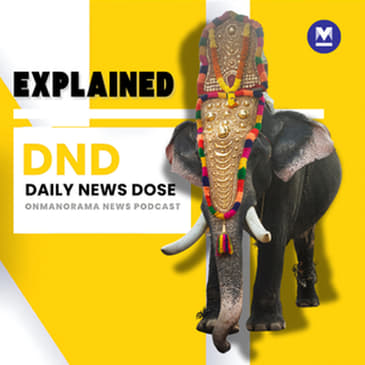

In this episode of Daily News Dose Explained, we explore the Kerala High Court’s recent efforts to address the treatment of elephants in temple festivals. With new guidelines set to be drafted, the court aims to reduce the cruelty associated with the parading of elephants. Join us as we unpack this pivotal moment for both elephants and Kerala’s rich cultural heritage. Narrated by AI and brought to you by Onmanorama.
See omnystudio.com/listener for privacy information.
[00:00:00] The future of elephants in Kerala festivals, will the High Court take a stand? Welcome to another
[00:00:04] special episode of D&D Explained, narrated by AI, where we dive deep into the stories that matter.
[00:00:18] Today, we are focusing on a subject that holds both cultural significance and ethical concern,
[00:00:22] the use of elephants in Kerala's temple festivals. In a tradition that spans centuries,
[00:00:28] elephants have been an integral part of Kerala's vibrant celebrations,
[00:00:31] paraded with grandeur during temple festivals and religious functions.
[00:00:34] But, as concerns grow over animal welfare, the Kerala High Court is now taking steps to address
[00:00:40] the potential cruelty involved in this practice. Recently, a division bench led by Justice A.K.
[00:00:46] Jashankaran Nambihar and Justice Gopinath P. expressed serious concern over the treatment of these majestic
[00:00:51] animals. Reports from Live Law reveal that the court is set to draft new guidelines on November 4,
[00:00:57] guidelines that could reshape the way elephants are treated during festivals.
[00:01:00] The core issue here is not the tradition itself, but the conditions under which these animals are
[00:01:05] made to participate. During a court session, the judges highlighted the distressing practice of
[00:01:10] binding elephants' feet for long hours, comparing it to the unbearable experience of forcing a human
[00:01:15] to stand in one place with their feet tied. The court made it clear that this is a form of cruelty
[00:01:20] that cannot be ignored. These guidelines come in response to a series of writ petitions aimed at
[00:01:25] protecting the welfare of captive elephants. The court has outlined key measures that must be followed,
[00:01:31] ensuring that elephants are given adequate rest between festival appearances, providing enough
[00:01:35] space to avoid overcrowding during parades, and guaranteeing sufficient food and facilities for
[00:01:40] their care. With all stakeholders, including elephant owners, NGOs, and temple committees,
[00:01:46] preparing to submit their input, one big question looms, will these guidelines mark the beginning of the
[00:01:51] end for the age-old tradition of parading elephants at festivals? Or will they serve to reform the
[00:01:56] practice in a way that balances tradition with compassion? As we await the final outcome,
[00:02:01] this case highlights the growing tension between cultural heritage and modern ethical standards.
[00:02:06] Will the Kerala High Court's intervention set a new precedent for how animals are treated during
[00:02:10] festivals, not just in Kerala, but across the country? The new guidelines are expected to come
[00:02:15] into effect just in time for the next festival season, and their impact could be profound,
[00:02:20] not just for the elephants, but for the future of Kerala's celebrated traditions.
[00:02:24] That brings us to the end of this episode. Thank you for listening to this special episode of D&D
[00:02:29] Explained, scripted from news reported by On Manorama and narrated by AIA. For more updates on
[00:02:35] important news stories, follow www.onmanorama.com, and don't forget to join us again for the daily
[00:02:41] evening news update.