
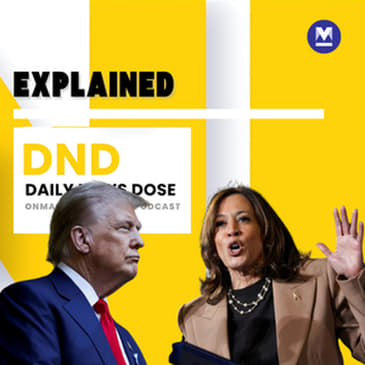

In this episode of DND Explained, we break down one of the most puzzling aspects of the US presidential election—how a candidate can win the presidency without securing the most votes. As the 2024 election approaches, we explore the intricacies of the Electoral College, its impact on past elections, and why the popular vote doesn’t always determine the winner. Tune in to understand the mechanics behind America’s unique election system and what it means for the upcoming race.
See omnystudio.com/listener for privacy information.
[00:00:00] Welcome to DND Explained, a special edition of Daily News Dose, narrated by AI. In today's episode, we're unraveling a quirk of the US political system, where the candidate who gets the most votes might not actually win the presidency. It's a system that has baffled many, and shaped the course of history more than once.
[00:00:28] On November 5, the United States will choose its 47th president. It's a pivotal election, as it has always been in a country with such global influence. The 2024 race sees former President Donald Trump aiming for a comeback after his defeat in 2020, and Vice President Kamala Harris stepping in as the Democratic nominee after President Joe Biden unexpectedly dropped out.
[00:00:51] Despite being a contest between two familiar political parties, there's an unusual aspect to the US presidential race, one that often leaves people asking, how can someone lose even after getting more votes?
[00:01:03] That's where the Electoral College comes in, a unique feature of the American democratic process.
[00:01:09] While most democracies, like India, follow a straightforward system where the candidate with the most votes wins, the US election doesn't work that way.
[00:01:17] Instead, it's a multi-step process designed to give every state a say, but with an interesting twist, votes don't always directly translate to victory.
[00:01:27] Here's how it works. The people vote in November, but they're technically not voting for a president.
[00:01:33] They're choosing electors, who will vote on their behalf in the Electoral College.
[00:01:37] There are 538 electors in total, and the magic number any presidential candidate needs to win is 270.
[00:01:45] Each state gets a certain number of electoral votes based on its population, and, with a few exceptions, the candidate who wins a state's popular vote takes all of that state's electoral votes.
[00:01:56] So, what's the catch?
[00:01:58] Well, a candidate could win the popular vote by a large margin in a few states, but lose narrowly in others, and still lose the election overall because of the way electoral votes are distributed.
[00:02:09] This happened as recently as 2016, when Hillary Clinton won nearly 3 million more votes than Donald Trump, but lost the election because Trump won key states with more electoral votes.
[00:02:19] This isn't just a rare quirk. It has happened five times in U.S. history, in 1824, 1876, 1888, 2000, and 2016.
[00:02:30] Each time, it sparked debate over whether the electoral college system should be reformed or replaced, yet it remains in place today.
[00:02:37] The argument in favor is that it ensures smaller states still have a voice, balancing the interests of different parts of the country.
[00:02:45] But critics argue that it undermines the principle of, one person, one vote, and can lead to undemocratic outcomes.
[00:02:52] So, how does this all play out in 2024?
[00:02:56] Could we see another case where the candidate who wins the most votes still doesn't win the election?
[00:03:01] As Trump and Harris battle it out, all eyes are on key swing states that could determine the final outcome.
[00:03:07] It's a tense and unpredictable process, and one that keeps the world watching.
[00:03:12] Thank you for joining us on this episode of DND Explained, scripted from Ragesh G.'s report and narrated by AICU next time.
[00:03:19] For more stories that break down complex issues, visit us at www.onmanorama.com, and don't forget to check out the regular evening edition of DND to know the top news of the day.
[00:03:31] Stay informed, stay engaged.