

What compelled such large number of people to migrate to the cities in the first place?
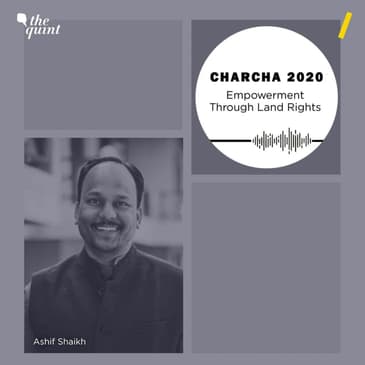
Ashif Shaikh, founder of Jan Sahas a community-based organisation, founded in 2000 to protect human rights of socially excluded communities talks about his work on land and property rights for the rural masses.
Music: Big Bang Fuzz
Learn more about your ad choices. Visit megaphone.fm/adchoices
[00:00:00] You are listening to the Quint's podcast.
[00:00:13] The Quint and the Nudge brings to you Charcha 2020, a platform for India's development
[00:00:18] sector to come together and engage on the most pressing human development challenges
[00:00:24] on the issues of gender, policy, law, climate change, social development and much more.
[00:00:36] The recent exodus of migrant workers that we witnessed in the initial days of the lockdown
[00:00:41] is closely linked to land and property rights.
[00:00:46] What compelled such large number of people to migrate to the cities in the first place?
[00:00:51] A majority of the rural population is still landless.
[00:00:55] And can anybody hope to empower citizens without land, property and safe housing?
[00:01:00] Ashif Sheikh, founder of Jansahas, a community-based organization founded in 2000 to protect human
[00:01:06] rights of socially excluded communities, talks about his work on land and property rights
[00:01:12] for the rural masses.
[00:01:21] Good morning everyone.
[00:01:22] We are very excited today to have the founder of Jansahas, civil society organization
[00:01:29] working at the grassroots with some of the most marginalized communities such as migrant
[00:01:34] workers, caste-based sex workers, women tribals, Dalits and empowering them through land, through
[00:01:43] access to better benefits.
[00:01:45] And Ashif who is the founder will take us through his journey today.
[00:01:49] Ashif, you are here and we are very happy to hear your opinion.
[00:02:03] So basically I speak Hindi and English mixed.
[00:02:17] So basically what we are going to discuss today is about land rights, land and property rights.
[00:02:25] And if you see the current context in the country which is currently in the state, especially
[00:02:30] migrant workers, so if you see in India we have 140 million migrant workers and if we
[00:02:44] will add the number of their family members also then one third of India's population
[00:02:50] is dependent on the migrant workers or their livelihood.
[00:02:55] So like this issue is not very small issue, it's a huge issue but particularly in last
[00:03:03] like one and half month.
[00:03:05] When we have seen this on TV or in newspapers or in social media then maybe we have understood
[00:03:15] what migrants issues are and in the last two decades if we look at it in a very
[00:03:22] different way, people have gone from rural India to urban India.
[00:03:25] Like they have migrated especially seasonal migration issue that people take about 6 months
[00:03:33] from year to 9 months to go to cities to work and their efforts are that they get
[00:03:41] employment there so that they can raise their families.
[00:03:44] But in this whole context if we look at the migration in last two decades in such
[00:03:49] a way that migration has taken place from rural area to urban area, why is that?
[00:03:52] And basically the biggest question is that the unequal distribution of land or resources
[00:04:00] is a very big reason or a very big contributor to increase the interstate migration or seasonal
[00:04:07] migration.
[00:04:09] And why is that?
[00:04:11] So if we look at the population of our country, there are about 70% of the population
[00:04:18] like according to 2011 census 70% of the population lives in rural area and if we look at it
[00:04:27] there are about 10 crores of households who have no land, they don't have much land
[00:04:33] and the 10 crore households who don't have any land, the people living in them are about 49 crores.
[00:04:40] So again, our country has a large part of the population of almost one third of the population
[00:04:47] who don't have any kind of land or any kind of property.
[00:04:50] So they have less land or property and they have to arrange their livelihoods.
[00:04:56] So obviously in rural area it's very difficult for the family, particularly for the landless
[00:05:02] family to survive or to get any kind of decent livelihood.
[00:05:07] Because if you want to live a decent life in the village and land is not only a means of
[00:05:17] the livelihood but it's also connected to the dignity, to the social respect of the rural families.
[00:05:25] So I think that both these issues, like migration and land issue are connected
[00:05:32] to each other and if we work on land or property rights in the village and if land or property rights
[00:05:40] is insured then I think this inequality and the forceful distress or migration can be stopped.
[00:05:48] And I think that if people start going back to the village on a large scale,
[00:05:52] there will be an imbalance in the village because these 14 crore people who used to
[00:05:59] live their livelihoods and earn from the cities and live their lives and their families.
[00:06:05] They have to arrange their livelihoods in the village.
[00:06:09] If people are going back to the cities on a large scale, then that's a big issue.
[00:06:14] Another problem is that the demand for workers or labour is very high because we saw
[00:06:21] in the last two weeks that many states are trying to prevent migrant workers from going to the village
[00:06:26] and they are in the cities. And if they are in the cities, then the biggest problem will be
[00:06:31] that the people who are facing problems now, they had one thing in their own self but another problem
[00:06:39] is that if they are not going to the village, then the workers' requirements
[00:06:45] cannot be fulfilled. So the most loss in both these situations is the rural distress community
[00:06:51] and the migrant community. So there is very little demand in the village,
[00:06:56] there is a lot of supply, so that's why there will be post-labor cases.
[00:07:00] Low wages will have to work for people. And in cities where there is a lot of demand
[00:07:04] and there is very little supply, people might have to overtime there.
[00:07:08] You must have seen that in the last few days, many states have made amendments
[00:07:15] particularly in the context of working hours. Some states already increased the working hours
[00:07:21] from 8 hours to 12 hours. So those kinds of issues are going to affect us.
[00:07:27] If we look at the draft national land reform policy of 2013, it has been said clearly that
[00:07:35] if we have communities living in the villages, if they want to give us a decent livelihood,
[00:07:41] then we will have to work on the effective and equal land distribution.
[00:07:47] And if we can ensure that, then the communities living in the villages
[00:07:51] can give them a livelihood with dignity. But this unequal distribution is a big problem
[00:07:59] and it is only about the forest area, the revenue land.
[00:08:03] And when we talk about revenue land, you must have seen that in the last few days
[00:08:08] many states have distributed land. Particularly if we take the example of Madhya Pradesh.
[00:08:14] So Madhya Pradesh government initiated a land distribution for the Dalit and Adivasi community
[00:08:19] in year 2000 to 2003. And they basically distributed about 6 lakh acre land to 3.4 lakh Dalit and
[00:08:29] Adivasi families. But actually, the distribution completed on the paper.
[00:08:36] But when you go to the village and see what has happened there,
[00:08:39] the distribution has not been able to be done effectively. Because of the effective mechanism
[00:08:46] from the government side that no system was working there, so that people could get land.
[00:08:52] And I feel that many states have done very positive examples.
[00:08:57] Like many states have identified particular social groups. For example,
[00:09:02] the released bonded labour which women had started doing manual squenging work
[00:09:06] which has come out of the work of manual squenging.
[00:09:09] The communities were in the caste based commercial sexual exploitation.
[00:09:13] So from such groups or trafficking victims or atrocities,
[00:09:18] the communities which were distributed land, I think that is a very powerful strategy
[00:09:23] that we can give them dignity and respect through land distribution.
[00:09:30] But at the same time, we can contribute to their livelihood.
[00:09:37] This mechanism is available to land properly.
[00:09:39] So I think these are some things that have happened in the last years
[00:09:42] which we needed to do more effectively like lagu.
[00:09:46] In which we have failed on a level.
[00:09:50] This failure, we often feel that it is just a failure of the government,
[00:09:54] the state government or a particular agency.
[00:09:59] But if we look at the experience of the last 1.5 months,
[00:10:03] I think it is a huge failure of our society.
[00:10:06] Because the people who had come from the villages
[00:10:10] who had no land and they should have got the rights on the land
[00:10:15] but they couldn't get it and because of that they came to the city for their daily bread.
[00:10:19] And in the last years, like if someone asks me who is the migrant worker,
[00:10:25] I will say that the nation builder is a migrant worker.
[00:10:29] He has created this country and built this nation.
[00:10:33] The schools where our children go, they will be made largely by the migrant workers.
[00:10:37] The hospitals we use for health services, they are made by the migrant workers.
[00:10:42] The highways we use, the roads we use and most importantly,
[00:10:46] the homes we live in, the community or social group has made those homes.
[00:10:51] But in the last years, what we have done with them as a society,
[00:10:56] that was not right.
[00:10:57] When I interviewed many migrant workers a month ago on the phone,
[00:11:03] they said that when they left Delhi, in NCR, in Noida, in Gurgaon or in Faridabad,
[00:11:09] when they were working and after the lockdown, they started coming back to their village.
[00:11:13] So they faced a lot of discrimination because communities are recognizing
[00:11:19] you are trying to spread the coronavirus.
[00:11:33] Because most of the people in the current scenario,
[00:11:37] they are saying that the main issue is food security.
[00:11:41] Many people are saying the issue is about the water or like the shelter
[00:11:44] or transportation of the migrant worker.
[00:11:46] But I think the first issue that should be discussed and worked on is about their dignity,
[00:11:54] their respect.
[00:11:56] The people who have built this nation, they are not able to give them dignity.
[00:12:02] And it is a very simple thing that we should have given them.
[00:12:06] So the second question that we have is,
[00:12:08] when there are redistribution programs, land redistribution programs,
[00:12:14] what should be the roadmap for that?
[00:12:16] And which state has done a good job on this already?
[00:12:19] I think there have been many states working on this.
[00:12:24] But if we try to see the best practices, where there is a strategy,
[00:12:31] I will not go to that strategy or how well or correctly used or implemented policy.
[00:12:38] But I would like to say that whatever programs have come,
[00:12:43] particularly as I told you that the Madhya Pradesh government
[00:12:46] did land distribution or the Puj-Dash was done in Rajasthan or Kerala before,
[00:12:51] so with all these programs we can see where it has been tried that
[00:12:55] the most excluded, the most vulnerable,
[00:12:59] how can you ensure land rights?
[00:13:01] Where the policies are seen from the elements,
[00:13:05] that should be seen from my point of view.
[00:13:06] Because it is very clear to us that who are the most vulnerable in our communities or in our society.
[00:13:13] For example, if you see that there are about 10 lakhs of manual screening families in the country
[00:13:17] who are liberated or who are working right now.
[00:13:19] If you see that there are many communities in our ten states
[00:13:23] which are still in the caste-based commercial sexual exploitation,
[00:13:26] we can identify them.
[00:13:28] In many states, in the recent or months of practice,
[00:13:32] in post-labour practice, and they have come out of that work.
[00:13:36] So, if we identify them with social groups,
[00:13:40] and the caste-economic censuses in 2011,
[00:13:45] we have clearly identified these communities.
[00:13:49] So, the next step is that after identification,
[00:13:52] how can all these entitlements or land property rights be done,
[00:13:57] how can ownership be reached to them?
[00:14:03] One more question is that,
[00:14:07] what do you think the Swimitva scheme that has been launched
[00:14:11] how can we use it so that the disadvantaged communities
[00:14:17] are excluded when land or property mapping is at the village level?
[00:14:22] What do you think can be changed from the Swimitva scheme?
[00:14:26] I think the biggest challenge we have seen in land
[00:14:32] is that even now, if you go to the village and try to see in a district
[00:14:38] how land records are.
[00:14:40] The biggest challenge there is that the records are not properly available.
[00:14:45] When we met many families, we have worked with about 2 lakh families across North India
[00:14:52] who have land ownership papers.
[00:14:58] But if you see if they have got the rights or not,
[00:15:01] then many types of issues arise.
[00:15:03] Like, some places have papers available but they are not positioned.
[00:15:07] We have seen that some places have gone to position
[00:15:11] but they have not been able to measure land.
[00:15:14] So, I think it is very intensive to work on land records
[00:15:17] and how can we increase the public disclosure?
[00:15:20] Because today, this is not just about land,
[00:15:23] there are many issues where you will see problems related to public disclosure.
[00:15:28] But I think that if public disclosure can be in every Panchayat,
[00:15:31] who has the ownership of land, how many lands,
[00:15:35] whose name is the land actually,
[00:15:36] and if we can do this disclosure,
[00:15:38] then I think we can solve a one-fourth problem there.
[00:15:42] So, the biggest issue is how to use technology for disclosure
[00:15:47] and how can we increase the public disclosure in the village
[00:15:51] and how can we work on the record?
[00:15:54] If these things happen,
[00:15:55] then maybe we will be able to reach out to more people easily.
[00:16:02] Ashif Ji, our time is about to end.
[00:16:06] So, the session is about to end in a minute.
[00:16:10] So, if you have something to say at the end,
[00:16:13] and you have seen what challenges we will face,
[00:16:17] and which challenges will come much later in the COVID crisis,
[00:16:20] so if you say something in a minute,
[00:16:23] then we will end this session.
[00:16:27] I would like to say two things at the end.
[00:16:30] First, when we design our programs in boxes,
[00:16:35] particularly not-for-profit organizations,
[00:16:38] the current situation has exposed many of our hidden problems
[00:16:44] or challenges.
[00:16:46] Like when I started my migrant worker issue,
[00:16:49] or the challenges that will come in the next few years
[00:16:53] related to livelihoods,
[00:16:54] so whenever we are designing our programs,
[00:16:56] then how can we make a comprehensive program
[00:16:59] where land or other issues,
[00:17:01] issues of livelihoods or migration,
[00:17:04] are combined to create a comprehensive program.
[00:17:07] That was what I wanted to say.
[00:17:09] And secondly, people often think that
[00:17:11] this work is for its responsibility.
[00:17:14] It is a different work,
[00:17:16] its responsibility to civil society or not-for-profit.
[00:17:18] And this problem of solving it is the problem of society.
[00:17:23] In the current context,
[00:17:25] this is also a myth.
[00:17:27] When you try to shift your responsibility,
[00:17:30] that it is not my responsibility,
[00:17:32] it is someone else's responsibility.
[00:17:33] But I think that at present,
[00:17:35] we are talking about any issue,
[00:17:37] whether it is the issue of livelihoods,
[00:17:38] agriculture, land, or migration,
[00:17:42] we need to make a collective effort.
[00:17:45] And we can make any program in a large scale.
[00:17:48] Because a lot of times,
[00:17:49] the biggest challenge in not-for-profit is
[00:17:51] that we can do a lot of work in two villages.
[00:17:55] Maybe when we have to do 200 villages,
[00:17:56] or 2000 villages, or 2 lakh villages,
[00:17:58] then maybe we cannot do that work
[00:18:02] with the same quality.
[00:18:03] In terms of land,
[00:18:04] I think that we need a lot of scale,
[00:18:06] which we should do.
[00:18:07] I will finish my talk here.
[00:18:11] Thank you.
[00:18:12] Thank you very much, Ashok.
[00:18:13] You shared your journey with us,
[00:18:16] and shared your try.
[00:18:17] So, we will end this session here.