
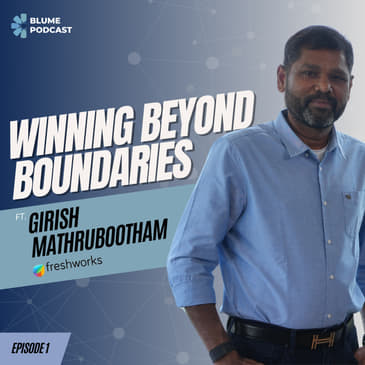

Guest: Girish Mathrubootham, Founder and Executive Chairman of Freshworks Host: Karthik Reddy, Co-founder of Blume Ventures
This episode provides deep insights into building a global SaaS company from India, scaling a startup to a public company, and the future of SaaS with AI. Girish Mathrubootham shares his journey from Chennai to NASDAQ, embodying the spirit of "Winning Beyond Boundaries."
Key Topics:
- Girish's background, including his admiration for Superstar Rajinikanth and early entrepreneurial experiences
- The founding story of Freshworks (originally Freshdesk), inspired by a customer service experience
- Building a global SaaS company from Chennai, India, and overcoming cultural barriers
- Freshworks' journey from startup to NASDAQ-listed company, including key funding rounds
- Critical decisions in Freshworks' growth: inbound business model, multi-product strategy, enterprise sales
- Hiring strategies and talent development at different company stages, from campus recruitment to executive hires
- Experience in becoming and running a public company, likened to a "big fat Indian wedding"
- The impact of AI on SaaS and Girish's decision to focus on AI as Executive Chairman
- The growth of the Indian SaaS ecosystem and initiatives like SaaSBoomi to create a "product nation"
- Girish's involvement in Together Fund and supporting the next generation of SaaS founders
- Freshworks' culture and the emergence of a "Freshworks mafia" in the startup ecosystem
- Girish's venture into sports with FC Madras, expanding his influence beyond tech
The episode showcases how Girish Mathrubootham and Freshworks have put India on the global SaaS map, achieving a successful IPO on NASDAQ and creating a blueprint for other Indian SaaS startups. It highlights the importance of "Winning Beyond Boundaries" in building world-class products from India and nurturing the SaaS ecosystem through initiatives like SaaSBoomi.
PS- Special thanks to Ultrahuman for gifting their cutting-edge rings to our guests and to IDFC First Bank for being our annual partner.
Links: Blume podcast transcripts: https://blume.vc/podcasts/blume-podcast
Spotify: https://open.spotify.com/show/227rW4Ee4ob6wRT8U7pJ8s?si=9e43c6b4c7d54ea0
YouTube: https://www.youtube.com/@BlumeVenturesIN/
Timestamps:
0:00 - Introduction of Girish Mathrubootham and Freshworks
2:38 - Girish talks about his love for Superstar Rajinikanth
5:55 - Early days and college friendships that backed Girish's ventures
7:31 - Girish's journey at Zoho (AdventNet) and becoming a product manager
11:57 - Origins of building global products from India
13:20 - The idea and impetus for starting Freshworks
16:23 - Early challenges in building a global company from Chennai
18:47 - Disruptive business model of Freshworks
26:55 - Getting funded by Accel and Tiger Global
36:58 - Key pivotal decisions in Freshworks' journey
39:30 - Going multi-product and choosing what to build
45:33 - Hiring and talent strategies at different stages
52:20 - Experience of becoming a public company
57:48 - Girish's decision to move to Executive Chairman role and focus on AI
1:10:52 - Motivations behind SaaSBoomi and Together Fund
1:15:43 - Pride in seeing the "Freshworks mafia"
1:16:30 - Rapid fire questions
[00:00:00] I had never built a company per se, right? I had not managed all the other aspects.
[00:00:04] So, I know how to build product. So we thought, okay, let's jump in, try it one more time.
[00:00:08] I think my plan B was, okay, if I fail, I wanted to join a bigger company like, say, IBM or Google
[00:00:16] or Oracle because probably then I can travel in business class. So.
[00:00:36] Today we have with us a founder whose journey truly embodies the spirit of our theme
[00:00:40] for this year's podcast series, Winning Beyond Boundaries. Girish Mathrubootham, or G as he's
[00:00:46] fondly called by everyone who loves him, is the founder and executive chairman of Freshworks,
[00:00:51] a leading provider of modern SaaS solutions. For SaaS entrepreneurs in India, he's no
[00:00:56] less than a rock star, he's like the taleva of startups. He's an icon who's put India's name
[00:01:01] on the global SaaS map. He's grown Freshworks from its humble beginnings in Chennai to
[00:01:05] a NASDAQ listed company valued at over 4 billion, operations span across multiple countries.
[00:01:11] What sets Girish apart is his ability to transcend geographic and cultural boundaries,
[00:01:15] building a company that resonates with customers globally while staying true to its roots in good
[00:01:20] old Chennai, which also happens to be my hometown. But Girish's boundary breaking spirit doesn't
[00:01:25] stop there. He's ventured into the world of sports by pumping considerable dollars into youth
[00:01:29] football club FC Madras further expanding his life beyond realms of tech. He has also started
[00:01:35] the Together Fund with Shubham and Manav and the fund actively invests in young SaaS startups.
[00:01:40] With a unique blend of entrepreneurial grit, a global mindset and a passion for innovation,
[00:01:45] Girish Mathrubootham has truly carved a path as a boundary defying leader.
[00:01:49] His insights and experiences will inspire us to learn what it takes to win beyond boundaries
[00:01:54] from India. Welcome to the podcast Girish. Lovely to have you. I thought we'll start
[00:02:00] with people understanding who you are from your history of growing up. And of course,
[00:02:06] maybe the best way to introduce you is like your undying love for superstar Rajnikant.
[00:02:13] And there's a lot I'm sure to growing up but he influenced you right from the beginning.
[00:02:19] It was it a love that you found later when you became a college student.
[00:02:23] So just wanted to get a flavor for someone who even made it into your IPO documentation.
[00:02:28] And you had a tribute to him there as well. So what is it about him and what is our appeal out
[00:02:35] here? And I'm sure you've met him many times as well. First of all, thanks for having me on the
[00:02:39] show, Karthik. And so I think talking about the Oliver superstar, I don't think anyone
[00:02:47] can actually answer why they love him because there are millions of fans. But I would say
[00:02:54] the my love and respect for him really, really changed in 2011. Actually,
[00:03:03] year after starting Freshworks. So I've been his fan and watched a lot of his movies like millions
[00:03:09] of others and been to the first day of first shows. But what actually we all witnessed in
[00:03:15] 2011 when unfortunately he had a medical condition, he had to go to Singapore and
[00:03:19] it was a serious medical treatment. I was moved by the emotional outpour of the fans,
[00:03:30] like so many fans offering prayers at temples. And then he came back and actually thank the
[00:03:39] fans that their prayers are what brought him back. So the thought in my mind was,
[00:03:44] like how can one man like be living in the hearts of so many millions of people,
[00:03:50] what an impact that he has. So the respect for that is what truly turned me into,
[00:03:59] I would say a devotee, his devotee. So and I think I'll actually tell you my previous CMO
[00:04:09] of Freshworks, David Thompson. When he came to India, he asked me like he does not know who's
[00:04:16] Opus Aris at that time. So he asked me, who's a bigger star? Shah Rukh Khan or Rajnik Khan?
[00:04:21] So and I told him, Shah Rukh Khan is a star. Rajnik Khan is an emotion. I think
[00:04:26] I remember this line. Is it a very similar emotion when you look at what Dhoni has done
[00:04:32] partly because he's a hometown boy here in Chennai, but is it related to?
[00:04:39] I think both of them as leaders carry a lot of common traits, which all of us as leaders can
[00:04:47] learn from. Not letting success get into your head, the way you treat people,
[00:04:52] staying humble after all the accomplishment that you have made, like homegrown talent,
[00:04:59] but global successes. Like look at Japan, where superstar has such a huge massive fan following.
[00:05:08] In fact, I was going to reference that little tidbit as well that he has this massive following
[00:05:15] in Japan and that also fits into our theme for today, which is like winning beyond boundaries.
[00:05:20] And some of our stars have done that, build global brands much before Bollywood and
[00:05:24] some parts of it made them popular. Take us through maybe your college days and your
[00:05:31] formative days. And we've done a bunch of research and little tidbits here and there.
[00:05:36] You had your college friends first back to you, Ravi and Rajesh. I think Rajesh did
[00:05:42] still add fresh works perhaps. What makes someone, and it's not uncommon, but
[00:05:49] what makes someone believe in you and what drove these friendships?
[00:05:54] So I think the college friendships that happened in India are probably the best things
[00:06:00] about college itself. And I actually say all my education started after college, so
[00:06:04] I think the friendships are what I treasured for life. And the backstory to specifically Raj and
[00:06:11] Ravi is they backed my first venture too and I lost money. This was in 2001 when I was moving back
[00:06:20] from the US to start a training company in India. They had each invested a few lakhs and
[00:06:26] I had to shut down that business because ID training in 2001 after the dot-com bust never
[00:06:31] really picked up, so I joined regular employment. And so it was like I had it in my mind that
[00:06:38] someday I have to repay the debt and it was equity though, but in my mind it was always the
[00:06:44] moral responsibility. Yeah, I understand the emotions. Yeah, and so when I started fresh desk,
[00:06:50] like fresh works were started as fresh desk. So I actually approached them saying do it again
[00:06:54] and this time we'll make it worth the while. Awesome. And you talked about your startup
[00:07:03] failure. Is that what led you to thinking about you should go and figure out a job
[00:07:08] where you can learn more like what is the beginning of that? I think when you joined Zohar it was still
[00:07:13] AdventNet and you're known in the ecosystem for being this amazing product person. Where did
[00:07:20] those skills get honed and I know you did sales as well so trying to understand that journey of
[00:07:25] what made Girish confident of I know there's a backstory to fresh works, but what is the
[00:07:30] training for that? See, I think there are two important I would say lessons from life
[00:07:39] or one is a lesson, one is an experiential learning. So before during my training days,
[00:07:46] so before my 2001 venture failed, I actually had a successful training business in 98-99.
[00:07:53] I was teaching Java and you remember those days during the dot-com boom, like if you could
[00:08:01] spell Java on your resume you are hired. So I think the business was booming and successful
[00:08:07] and when I say booming at a much smaller scale I was just doing it as a self think of it as
[00:08:12] earning some money. Good lifestyle business. So but what I realized was when everybody
[00:08:18] wanted something it is easier to grow a business in 2001 when the macro turned when again when I say
[00:08:24] macro after the dot-com burst when jobs were not there at the end of the training course
[00:08:29] that lesson of riding a wave is what I learned. So I was riding the Java wave in 98-99
[00:08:38] that wave had vanished so there was and even though I probably was better in
[00:08:43] Java, better equipped with training etc but it didn't matter. So riding a wave was the important
[00:08:49] lesson that I picked up there. So specifically I think coming to my experience at Zoho, I think
[00:08:55] there is one pivotal experiential learning say I joined Zoho when they were at Vendett as a
[00:09:04] pre-sales engineer and because of my training background I spoke to the team and said
[00:09:09] I will also take up training. So I traveled in the initial years to do customer trainings.
[00:09:14] So after one such trip I came and spoke to my boss at that time Kumar Vembu who's also my mentor.
[00:09:20] So I told him hey I got this feedback from a reseller in Korea like why are we not building
[00:09:26] enterprise products in network management because we were selling developer OEM developer
[00:09:30] products we had a platform. So Kumar actually turned the table on me and said okay sure good
[00:09:36] idea why don't you build it. I did not know at that time that the company had already tried twice
[00:09:41] and failed he didn't tell me that so but they also had the idea so the interest aligned so they thought
[00:09:47] okay why don't we give him a choice. So I was also running product marketing for a year and I
[00:09:53] was getting frustrated with marketing so when I pitched this idea to Kumar he actually introduced
[00:09:57] the concept of a product manager to me. I did not know what the term product manager meant
[00:10:02] so he took me out for a chai and actually said Girish you know what the problem is you're an
[00:10:07] authoritative person marketing is a consultative job so that is why you're facing all this frustration
[00:10:13] so why don't you actually become a product manager and build the product. So I didn't even think
[00:10:18] about it I said okay because I wanted to try something new and then I went and googled
[00:10:23] job responsibilities of a product manager that's how I'm an accidental product manager
[00:10:27] but I think when I started exploring more I fell in love the most important thing that happened was
[00:10:36] what we today celebrate as India says global from India I think the foundational work for that
[00:10:44] happened then see when at that time even at Zoho product management was in the US
[00:10:49] product marketing was in the US India was predominantly an R&D tech engineering and QA
[00:10:55] center even design was kind of split between India and US so I think so I said okay let's do
[00:11:05] everything from India again most of it was trial and error I stumbled upon a google adwords account
[00:11:10] that somebody had created and put $50 in so I thought okay why don't we try bidding on the keywords
[00:11:15] and every day we would get so many more and it is all on-prem software so downloadable
[00:11:20] software but we'll get so many leads and it was like you pump in more money you'll just
[00:11:25] get even more leads so and we put an online trial so we actually did everything from product
[00:11:31] management to marketing to software development support sales everything from Chennai right so
[00:11:38] the the genesis of the origins of building global products from India and actually
[00:11:44] figuring out that inbound engine what we call as inbound engine and uh uh desk based selling
[00:11:50] desk selling all of this was hand built by trial and error in those days that there was a
[00:11:59] if you read the book the world is flat it starts off by saying how India made all these investments
[00:12:04] in lease lines where so we had a lease line connection phone was available so we thought
[00:12:09] we'll start selling and supporting so it was just a discovery of available resources
[00:12:14] and trying to figure out a model which today is a blue one book yeah and I think
[00:12:21] while you get a lot of credit for that now what what gave you the courage
[00:12:26] to finish that piece of your history on how Freshworks got started I know that a couple
[00:12:31] of stories there's one around you seeing some news item on hack news about zen desk there's
[00:12:36] another about how your TV experience in the US I think I've heard it from you like it's
[00:12:43] it's always a combination of things but you know what gives you know back then the courage for someone
[00:12:49] to say you know I think I can stake out on my own I can build a product company I know you made
[00:12:56] sass popular but for a very long time investors didn't have anybody even covering sass maybe there
[00:13:02] are three four of us in India between two up to 2015 now it's of course hot and and sass boom is
[00:13:09] become a revolution but back then what was it just the experience which gave you enough
[00:13:15] air cover to say that I can do this and a set of problems that you saw
[00:13:20] so I think it's a combination of factors first of all let's talk about the two stories right
[00:13:25] so one is about how did I get the idea for what product I wanted to build so that's the
[00:13:30] moving from us a broken TV a shipping company broke my TV I contacted them online
[00:13:37] tried calling and emailing them they wouldn't actually process the insurance claim so that story
[00:13:43] has been told a thousand times so I don't want to bore our audience with that but the long story
[00:13:47] short is when I wrote shared my experiences online in a forum the community started engaging
[00:13:54] the president of the company came and apologized and next day money was in the bank so I realized
[00:13:58] the power of online taking on like customer support moving online so it was like a paradigm
[00:14:06] shift because when you call call center yeah it's a the user does not have any power over the company
[00:14:11] but when the same problem goes online brand reputation takes a hit this was the this was
[00:14:17] 2009 and 10 right 2010 February exactly when I shared my experience so Twitter wasn't big
[00:14:22] Facebook wasn't big for customer service or anything so so I think I could sense that
[00:14:27] hey something is changing in the world of customer service where the power dynamics
[00:14:32] is shifting back to the customer so that's where the idea of hey is there something we could build
[00:14:38] to leverage that right that's the idea for the product but the actual impetus to start the
[00:14:42] company or the slap on the face came when I read that hacker news article on Zendesk increasing
[00:14:47] their prices by 300% users revolting so this was a casual hacker news article that I was reading
[00:14:55] after lunch and I was thinking somebody had commented that hey just shows how somebody
[00:14:59] can come and build the right product and take all the market away I went and spoke to my friend and
[00:15:05] and said hey we should work on this idea and customer service because there seems to be an opening
[00:15:10] so that was the push to actually jump into action but the idea was formed a few months ago
[00:15:17] when I was thinking about my experience and you know it's now coming into the early
[00:15:22] fresh work days you know just coincidentally when I read this about your company being
[00:15:28] incorporated October 13th there was a strange memory that I think we also incorporate round
[00:15:33] then so actually had someone check this last night we were incorporated October 12th 2010
[00:15:38] the same so bloom was born around the same week but you know and I think experiences are similar
[00:15:44] but you know bloom stories also been told a lot of times but I'd love for people to understand
[00:15:49] you know the talent pool just wasn't there like and this was the biggest challenge
[00:15:53] going 15 years back right so what and we have the privilege of working with two three of the first
[00:16:00] ten people that you put together now in an atomic work or other you know startups that
[00:16:05] we're funded and so we hear great stories but like how did how did you kind of you know think that
[00:16:12] sitting in Chennai you can build this you know this marketing sales oriented engineering
[00:16:17] oriented company that can build a global product from here so so before I actually answer that I will
[00:16:24] also add on to the last question because I said it's a combination of factors yeah so
[00:16:29] so I wasn't dreaming big of building a billion dollar company or a unicorn from Chennai so
[00:16:35] I think there was also another factor contributing to that right so I had moved to the US
[00:16:41] for one and a half years and then moved back to Chennai so by that time there were new
[00:16:46] product managers so I was more like a overseeing multiple products and I was kind of getting bored
[00:16:52] right so like I'm not I'm like you know that I'm a product manager at heart so I like rolling up my
[00:16:58] sleeves and actually working on product when I moved to the US I missed the people working
[00:17:02] with teams on a daily basis so but when I came back that environment for me to jump back and
[00:17:07] build product was not there and I was looking at the rise of SAS being adopt SAS adoption
[00:17:14] growing and so and I was running on on-premise software so that was also a reason why like
[00:17:23] okay what am I doing heading being the head of an on-premise software company or division
[00:17:29] when there is so much happening in the world of SAS so maybe it's time to think about doing
[00:17:35] something so that that each was also there but I think things came together so when I decided
[00:17:41] to start I think and I'd say this to other founders that there is a lot of overloaded meaning in
[00:17:50] what Steve Jobs said stay hungry stay foolish right we all enjoyed as a nice copy nice marketing line
[00:17:57] but after 14 years of fresh works I can tell you how much depth is there is in meaning of that
[00:18:04] stay foolish means and stay hungry means because if I knew everything that I know today
[00:18:08] I probably wouldn't even have started fresh ones right so I think it was just done on impulse that
[00:18:14] hey we have done we have built so many products and taken many of these products to millions of
[00:18:20] dollars of revenue so why don't we not just try doing it one more time right I had never built a
[00:18:25] company per se right I have not managed all the other aspects so I know how to build product
[00:18:30] so we thought okay let's jump in try it one more time I think my plan B was okay if I fail
[00:18:36] maybe I'll go and I wanted to join a bigger company like say IBM or Google or Oracle because
[00:18:43] probably then I can travel in business class so
[00:18:47] sir that is awesome most honest answers that you get from Girish now I think the other
[00:18:55] element of this is you know when when you want to build an international business
[00:19:02] how do you sort of and this is what I want to drive home a lot this season in the podcast as well
[00:19:10] this inherently there seems to be some sort of a complex like I won't give it a tag but
[00:19:16] you know can we compete with the best of the best in the US and they're local they understand
[00:19:22] their market we don't have this cultural nuances that an American would have naturally right
[00:19:29] again sitting out of determined to build a company out of Chennai how do you ensure that all of that
[00:19:35] falls in place on day one so there are two sets of attributes one is you know there's a story
[00:19:40] about you saying doesn't matter what what the first office looked like what the chairs looked
[00:19:45] like but everyone had to have the best machines right because you can't compete globally without
[00:19:49] that second is how does that that the set of people attune to the fact that they're
[00:19:56] they're an American company for all practical purposes sitting out of here because it's important I
[00:20:01] think we've had not so many great success stories of you know founders being or continuing to stay in
[00:20:08] the Indian mindset and that actually curbs the ability to become a great global company but again
[00:20:14] you were one of the first out of the gate so curious what lessons there are for on 20 years
[00:20:19] see there are two important aspects that you touched upon one is around
[00:20:25] not spending on furniture but spending on max let's talk about that first and then I'll come to
[00:20:30] winning globally yeah see I think this is also a lesson from my mentor and boss kumar
[00:20:36] bamboo right so meaning what happened at zoho we were we were living through that journey right
[00:20:43] so how do you be frugal in aspects that don't actually directly add value like
[00:20:50] where do you put your office yeah so real estate what's the point in being in a swanky
[00:20:57] building and paying rent through the roof when you're a startup who's trying to earn money right
[00:21:02] so so we wanted to but if it's impacting the quality of the final product then those are
[00:21:09] areas where you want to spend so this is the these are things that we have always followed
[00:21:14] even at fc madras if you can look at this so everything that you see the pitch the hybrid
[00:21:19] pitch is world-class right the hostels are functional yeah it'd be good but so I think
[00:21:24] that is a mindset that every founder should know where you spend and where use
[00:21:31] have a value mindset or a frugality mindset right so yeah do not compromise on the because
[00:21:38] the product has to be world-class right so the office in the early days can be a garage we all
[00:21:45] know that every startup in the valley also uses that so I think that's important now coming to
[00:21:51] the other aspect of the question how do you compete globally right see this is where I think
[00:21:57] we have to truly understand go one level deeper and understand the business model
[00:22:03] right so the true disruption that we had with fresh works is we have a very disruptive business
[00:22:11] model to the traditional enterprise software companies so what is a typical enterprise software
[00:22:18] business model you start in a country most probably us you are building for larger companies
[00:22:24] so you go you hire a sales team and you go and meet and sell to customers and when you
[00:22:29] meet and sell to customers face to face there are these cultural nuances you have to talk about
[00:22:33] baseball you have to talk about whether and like it's very hard to do that right yeah but what if
[00:22:43] the customer is not talking to you but is experiencing the product so our business
[00:22:49] model disruption at fresh works was all about going with an inbound acquisition model long
[00:22:56] before the terms plg became popular so we actually were doing that so in fact when we had for 100
[00:23:04] customers for fresh works I had never met any of the first 100 customers in person the first customer
[00:23:09] or prospect who I met was actually deep kalra because I wanted to meet deep so I said I'll come
[00:23:14] and meet right so the important lesson here is our model was not a sales heavy model and
[00:23:22] but in an enterprise model if you start in India you first will have to go and
[00:23:25] sell to India customers if you start in Australia you'll have to start and meet
[00:23:28] win in Australia that's a traditional model so what we had in right from the early days when we
[00:23:33] had seven customers they came from four different continents and people come online we drive traffic
[00:23:38] to the website we make the experience super easy they actually experience the product before
[00:23:45] speaking to a person and today in the valley even if you speak to any valley company
[00:23:51] you're probably speaking to an Indian or an Indian accent so that's not a problem today but I think
[00:23:57] if the product is world-class the customers know that's what matters for them so and we used
[00:24:03] an affordable price intuitive easy to use product and a full featured product as a combination
[00:24:12] to get the wall from the customer before even they speak to somebody now in this journey
[00:24:16] you've gone through 14 years as that formula held tight as you've developed multiple products or
[00:24:24] alternatively given that you've seen enough founders who've come for advice is there
[00:24:30] I understand the SAS playbook very well now from how you described it but when it comes to
[00:24:35] enterprise software is there any tips that you've picked up which can help founders because
[00:24:40] a lot of companies try doing enterprise software it's not easy so one maybe they should move
[00:24:45] their backsides to whichever market they're selling in but beyond that what else can work for
[00:24:51] I think at Freshworks we added a mid-market enterprise sales motion over the years like
[00:25:00] somewhere after 2016 is when we hired our first VP of sales in the US so I think today we have
[00:25:07] a good mix of enterprise and SMB customers I think but it's an important and also what has changed
[00:25:16] in the last decade I would say compared to like if you take 2010 to say 20 sorry 2000 to 2010 or
[00:25:25] 15 the number of SMBs adopting technology or buying software I think now in the last 10 years
[00:25:32] I would say thanks to SAS and thanks to even COVID acceleration I think everybody is now adopting
[00:25:40] technology so the SMB market has actually expanded and exploded so enterprise always been big we know
[00:25:47] that if you take the enterprise share of the software market that's always traditionally
[00:25:51] been big but what we are witnessing now and you can see companies who are selling to SMBs
[00:25:57] whether it's a Monday or a HubSpot or you can see a lot more companies actually
[00:26:03] winning there right and that so we have gone from our SMB we have that that is still a dominant
[00:26:09] portion of our business but we also have added on this so I think it's important for founders to
[00:26:16] early on pick one motion because I will also add that having these two motions is quite
[00:26:22] challenging and we have multi products also we can talk about that later but but early in our journey
[00:26:30] that question like can we build a billion dollar company by focusing only on inbound and SMB
[00:26:35] the answer at that point of time seemed to be who it's hard because churn is higher in SMB
[00:26:40] but I would actually say now that because so much adoption has started to happen that it is
[00:26:47] possible and it has been demonstrated by other companies that you can build like a billion
[00:26:52] dollar revenue company just focused on SMB also just to touch a little bit about all this requires
[00:26:59] somebody to take a chance on you right capital capital capital and I know this you know story
[00:27:05] of shaker getting started from axel giving you that small first check at seed but you know
[00:27:10] outside of that again shaker was relatively new I remember meeting him before he formally took
[00:27:15] on the role at axel we were a part of like one small saturday thinking group and he was early
[00:27:22] as well I know I know he was tentatively taking these bets and it was very weak as an ecosystem
[00:27:28] beyond that maybe next is little bit but and then suddenly leaf excel comes and takes a sass
[00:27:33] bet in India right from tiger and while the model was well established in the US
[00:27:40] I'm sure it wasn't simply them taking a courageous bet out here it had to be
[00:27:44] something to do with Grishamath Rathodam right so what is that what is that again magic sauce that
[00:27:49] or ability to sell a vision or a story that got you to those those initial funding grounds because
[00:27:56] that was important to build this dream out see I think this story probably played out in less
[00:28:05] than a year right like from the axel funding to the tiger funding probably six months eight
[00:28:10] months so and there is a lot of cascading effects of different things that happen like the butterfly
[00:28:16] effect so I think and it's an interesting story so I'll tell this so first how did we get into
[00:28:24] axel right so we were building product we were probably a few months away from even a beta
[00:28:32] release I was the CEO who was sitting and doing all the other things and I was building product
[00:28:38] but I also was trying to generate I do some marketing I was writing a blog post so one of the
[00:28:45] blog post that I wrote was we were participating in an app sumo contest where there was a $50,000
[00:28:51] AWS credits or something was the price so we thought okay and you had to write a post on how
[00:28:56] your startup is a lean startup so I thought okay let me try and compete in that contest so I wrote
[00:29:01] a blog post which was very famous even today how I how a simple comment on hacker news made me quit
[00:29:08] my comfortable job and start the startup and I posted this on hacker news it went viral this was
[00:29:14] on March 28th sorry March 18th 2011 now in that blog post I had thanked venture hacks for helping
[00:29:24] me create a pitch deck and things like that so this is a Neville Ravi Khan who founder of venture
[00:29:32] hacks and Angel list so he saw that came and thanked me and said hey by the way we have Angel list
[00:29:39] and we don't have Indian company so would you can I introduce you to can you list on the
[00:29:45] platform and I will send intros to investors for India so we are actually fresh works the first
[00:29:50] Indian startup to be listed on Angel list okay but we are not funded through Angel list
[00:29:56] so Neville sent a bunch of introductions a few others are also sent a bunch of introduction
[00:30:01] so Anand Daniel from Axel had seen that post and he gets an intro from Neville so he reaches out
[00:30:06] to me and then I send him the pitch deck and it was World Cup season Anand was busy with
[00:30:12] probably cricket so there was like two three weeks of silence suddenly out of the blue I get
[00:30:18] email back after the World Cup saying sorry I dropped the ball on this Girish can we talk
[00:30:24] and then I pitched on and then he takes me to shaker and then a pitch to shaker so
[00:30:29] so how the Axel funding happened I actually asked shaker later because when Axel when shaker
[00:30:34] gave me a term sheet like he visited our garage office he was the one who made the comment
[00:30:39] that your furniture is all cheap but your developers have max so that caught his eye
[00:30:45] but the more interesting thing he said was because I asked him later on where I was
[00:30:51] giving sending him startups with half a million dollar revenue he invested in us when we had
[00:30:55] $2,000 of monthly recurring revenue I asked him how did you bet on fresh works when we had $2,000
[00:31:00] revenue while you are passing companies with half a million so he said Girish your $2,000
[00:31:05] revenue comes from 70 different customers all SMB customers globally so product market fit
[00:31:12] is established there is no risk there's no product market fit risk there's only execution risk
[00:31:17] and that I am comfortable taking the other company that you sent with half a million dollar
[00:31:21] 60% or 80% of revenues coming from one customer who where the founder used to work before
[00:31:27] so that revenue goes away the so I don't know if the product market fit is there or not so
[00:31:32] so that was an interesting thing right and then what happened two more things right so
[00:31:38] the rip off or not event happened like basically there's another famous story
[00:31:42] so we were announcing our Axel funding and we get attacked by a competitor and we are responding
[00:31:47] on the blog post that goes viral legendary story so multiple investors reach out to me
[00:31:52] and then I didn't want to see I just got the Axel money in the bank I didn't want to pitch but
[00:31:57] one investor actually said hey why don't you fly to Mumbai we will pay for the flight ticket
[00:32:02] I called shaker and said hey they're saying they'll pay for the flight ticket should I go
[00:32:06] just to establish relationship is what they said shaker said go and meet but don't take the
[00:32:11] flight ticket from them right so I went and pitched and they were very
[00:32:17] like they wanted to do the deal right so they were so when I was pitching they said
[00:32:23] Girish we know that you are right now at 200 customers we know you can get to
[00:32:26] 2000 customers and 20,000 customers that's not a problem valuation is what you want and so on
[00:32:30] but then but when they actually made an offer they said can we do a 30% markup since you
[00:32:36] actually raised only in October right so I said see I look at Freshworks as a valley company
[00:32:42] I know how Zendesk and desk.com raised their rounds so I don't want money now but if I'm
[00:32:48] doing my next round I need a 3x multiple not a 30% markup so yeah and then they
[00:32:53] kept up being like making me slightly better offer but I wasn't comfortable so then
[00:32:58] again venture hacks had a good advice saying always fundraise in parallel so I
[00:33:02] decided okay if there is interest let me find how much interest is there so I reached out to all
[00:33:07] the investors who had passed in the previous round because now we had by that time January 2012
[00:33:14] I think we had around 10,000 dollars of monthly recurring revenue and 200 plus customers and so
[00:33:23] I met eight VCs in one week so in Santivi VCR of Mariel.
[00:33:31] So and five of them were engaged one of them was Lee Ficksel and that is also that's why
[00:33:37] I call it a butterfly effect so Lee Ficksel who usually never comes to Chennai was in Chennai
[00:33:43] that week he was making the investment in Karat Lane who was on your podcast earlier
[00:33:49] so I didn't know Karat Lane or Mithun at that point of time we became friends because after
[00:33:55] because of the Tiger Enforcement but he was there and usually I make sure every investor
[00:34:00] comes to our office but Lee said I'm busy can you come and meet me at the hotel and
[00:34:04] so I went to Crown Plaza Hotel with my iPad and pitched him the story and
[00:34:10] pitch went very well my story went well and but I was meeting VCs every day the next
[00:34:17] day evening Lee called and he told me one thing Girish the numbers don't make any sense you're very
[00:34:25] very early for us as a fund but I'm making the bet on you yeah you have seen the scale and
[00:34:33] if you are okay here are the terms we can skip the term sheet and start due diligence
[00:34:39] that's the speed it see he moved while the others were still negotiating offer they
[00:34:43] sent a few analysts and asked me for a five-year projection with excel sheets
[00:34:46] like I'm just three months old as a company how will I have a five-year projection and cash flow
[00:34:50] projection so on right so so I think I could see an investor who's aggressive who believes in me
[00:34:58] and that's how it is I decided to take on Lee no I think had the pleasure of working with Lee
[00:35:04] on a few investments in that first five years tent and then we still keep in touch I say
[00:35:08] hello when I'm in New York the amazing guy and I keep saying this to his discomfort that actually
[00:35:16] in one of my investor letters that literally wrote a tribute to him on how he's single-handedly
[00:35:21] kind of accelerated the ecosystem a bit I think if he was missing in the ecosystem from 2011 to 15
[00:35:27] it would have been a couple of years slower yeah I get that sense right because he forced
[00:35:30] everybody to be on their toes right and people would say what is Lee up to but I think and
[00:35:35] and he's repeatedly told me I think even perhaps about you that comes down to people bet sometimes
[00:35:41] and that gives him the courage to play a little earlier yeah and actually what most people don't
[00:35:47] know is Freshworks was his first SaaS investment Tigers first SaaS investment and at that time we
[00:35:56] were the smallest check that he had ever invested the whole round was five million and so they put
[00:36:01] in 3.5 at that time amazing amazing so like moving to the scaling now like you know how
[00:36:09] the whole idea of whether this can be a NASDAQ listed company I'm sure that 10 12 year journey
[00:36:17] basically had like a lot of fundamental I mean a lot of decisions you must make thousands of
[00:36:22] decisions and that's what CEO founders get paid for to make those decisions any sort of
[00:36:28] you know favorite you know pivotal moments where you said this is what made the Freshworks 22 IPO
[00:36:36] happen what would those be if anything and like and how do you also maybe a little bit about
[00:36:42] your framework around how do you help how do you sort of help yourself make those decisions right
[00:36:48] you like have an advisory you know group that you bounce these off or you go with your gut
[00:36:53] intuition just trying to understand the mind of a solid on you know see I think if I look back at
[00:37:00] the Freshworks journey there are actually three pivotal decisions right the first one was picking
[00:37:06] the inbound business model and going global without trying to go and sell in India or sell in one
[00:37:13] market so that really opened up a huge market for us and and that is something that I've
[00:37:21] experienced in and have built in the past and so we know that
[00:37:26] and what the nuance that is not easily visible to the casual observed room the outside is
[00:37:32] it looks like we are always competing in red ocean markets but how do you spot
[00:37:38] pockets of blue ocean inside a red ocean that's something we can probably talk about later
[00:37:43] but that's important in the decision making framework of where we want to play right
[00:37:48] so but we pick this broad competitive markets but the market is global so going inbound and having a
[00:37:56] global market from day one is the first pivotal decision going multi-product was the second and
[00:38:05] and we went multi-product when things were pretty early and going good and and that's my advice
[00:38:11] to founders so if you want to build a second and third product you have to do it when
[00:38:13] things are going good yeah because when things are tough you're going to be asked to cut costs
[00:38:19] there will be any there won't be any bandwidth or resources left to actually start building right so
[00:38:23] so when one of your products is taking off and doing well you have to make some bets
[00:38:28] experimental bets on your second and third build so the product manager has to be worrying about
[00:38:33] revenue that's going to come three years down the line the sales person can should be worrying
[00:38:36] about the revenue that's coming in the next quarter right so both are important so that was
[00:38:41] the second important and then third was the decision to actually overlay a field enterprise motion on
[00:38:49] top of an inbound motion that was working again in the context of the time at that time when the
[00:38:55] decision was being made I think it helped us because all these three shaped the IPO story
[00:39:03] at NASDAQ where hey it's not a one product company the time is huge they are already
[00:39:08] at scale at two different markets and they're working on other products they have enterprise
[00:39:13] customers see wall street also likes till very recently they love enterprise software companies
[00:39:18] more than SMB company so so they have success in enterprise so the foundational elements for
[00:39:24] a successful IPO were actually shaped by these three decisions that were taken at different
[00:39:29] points of time just one sort of counter caveat on that that when you thought about and I'm
[00:39:36] guessing the multi-product strategy meant you wanted to shed the old name of fresh desk and
[00:39:41] move to fresh works so I don't know whether the naming thing had to something to do with
[00:39:46] and then when you think about multi-product do you feel like in a lot of businesses even the
[00:39:52] biggest guys were listed right the articles in the sales force of the world eventually if
[00:39:57] you want to build a legendary long-term company it isn't it inevitable that the
[00:40:02] market sizing opportunities of each segment that you play in on each product that you play in
[00:40:07] force you to start thinking about adjacencies either through acquisition or building your own
[00:40:11] products how do you how do you know it's time as you said one is when you have the resources
[00:40:17] start thinking in that direction but were there any natural triggers is it always
[00:40:21] listening to the customer of the market first I'm sure you didn't start building products
[00:40:25] randomly right yeah see again this is a multi-layered question there are many flavors right so
[00:40:33] okay let's start with the first aspect right should a startup do only one product or
[00:40:43] multiple products and when is the right time to do yeah every large company has multiple products
[00:40:49] but in the US they probably get to 100 200 million before they even think of the second product
[00:40:56] now is it a function of what is what is the driving function that I think it's scarcity
[00:41:03] of development resources so the cost of an experiment for a startup in India is actually
[00:41:10] much much lower experiment and that's important you're not see I'm not saying you're blitz scaling
[00:41:16] and throwing the entire business and burning millions for us and the cost of an experiment was
[00:41:19] okay five or six developers nine months to 12 months less than 300 k to 500 k so that was
[00:41:25] the cost of an experiment to see whether something flies or not right so in fact before we launched
[00:41:33] our second product we actually built one and shut it down in 2012 also right because that didn't
[00:41:39] make sense at the time so that that's one aspect of it again because it's a very
[00:41:43] controversial question so second thing is we went multi-product because ours is a business model
[00:41:51] disruption story and it is SMB so I am in the business of like see I'm not going whale hunting
[00:41:57] I'm actually catching a lot of fish so I could in my I looked at my role at Freshworks in
[00:42:03] the early years as like a VC so I have these two or three bets I am replicating a model
[00:42:08] and I can create another team which is so there's a Shad Services team in HR and IT and finance
[00:42:15] but the product team and this sales team and the engineering team are different
[00:42:20] but they are exactly replicating the model which is our unique differentiator like going
[00:42:25] inbound so the keyword based online search how do you capture the search so I know that
[00:42:30] we have the opportunity so how do I because for me to get to that high growth numbers
[00:42:36] I cannot use an I could not use an SMB business with the inbound with the churn characteristics
[00:42:42] I cannot get a 200% 300% growth the Freshworks went from 1 million to 5 million to 15 to 34 to
[00:42:49] 56 right so that journey was not possible with only one product so because we knew that existed
[00:42:57] our business model differentiation or disruption I can replicate that so that's one of the reason
[00:43:01] the third aspect is how will I choose to build I'm a big fan of a book that I read during my
[00:43:07] college days from Ram Charan where he says every business is a growth business the fundamental
[00:43:13] takeaway for me from the book was there are two ways to grow your business one you can take
[00:43:19] your existing feature set and try and go to a different market segment to a different
[00:43:24] customer set or you can go to your existing customers and give them more of more features
[00:43:31] of what you don't already so and they showed how companies like GE actually did both and I think
[00:43:38] that lesson stuck so if you look at what we have done so Freshdesk started with ticketing
[00:43:44] email ticketing self-service portal knowledge base so we took that to FreshService for internal
[00:43:50] help desk for IT and then built later on built more for what IT needed but this was the
[00:43:54] first flip right and then if you look at for the same customer fresh chat fresh caller for a customer
[00:44:01] support customer we look at what are the other tools that they're being okay you're already my
[00:44:06] customer and you are we are the works like the system of record platform for you so why should I
[00:44:12] give the opportunity for somebody else to build a small standalone tool so we start
[00:44:17] building more features for the same customer so this has been the yeah so I think
[00:44:23] shifting gears a little I feel like the other challenge I am seeing in some of our younger
[00:44:29] startups is how do you the two levels of challenges one is when you're building
[00:44:36] a strong long-term culture which you need to become a public company and beyond
[00:44:41] I know you've used a cricket analogy once talking about how you would pick younger talent
[00:44:47] and then groom them there so two parts that question we've seen a lot of companies actually
[00:44:52] in our portfolio when they're building for a new segment new type of talent I think it's
[00:44:58] inevitable playbook they accidentally go and try and figure out a lot more fresher talent
[00:45:03] because you can influence it you can groom it in a certain way and there's no easy
[00:45:07] hiring ground now that you're a very large company and then you have to start thinking
[00:45:11] about the US now you're picking up lateral talent and you're trying to bring them into the
[00:45:16] context of how fresh work is built over this decade a very contrasting set of hiring and cultural
[00:45:21] challenges how does the founder deal with these I mean it goes back to like theme here being
[00:45:27] how do you build global businesses as you know this young man from Chennai or from Bombay or
[00:45:32] from Noida setting the context of the early years is talent simply did not exist like if I was
[00:45:39] trying to I was trying to hire my first marketing person for Freshworks in 2011 so
[00:45:47] it was incredibly hard to find somebody who had done software marketing globally from India right so
[00:45:56] but if I go to the valley I could actually hire nine different disciplines of SaaS marketing
[00:46:02] like inbound marketing customer advocacy marketing digital marketing field marketing so
[00:46:07] nine disciplines of SaaS marketing in the US so that's the that's the level of talent sophistication
[00:46:15] sophistication in the US versus finding somebody who had done so what do you do in that context so
[00:46:20] the secret sauce for our hiring again my big life lesson comes from a book called first break all
[00:46:27] the rules by Marcus Bingham so this is a book about people like how as somebody so the core
[00:46:34] takeaways two or three takeaways from the book one is you have to learn to differentiate between
[00:46:40] skills knowledge and talent so skills are easily teachable and learnable knowledge there is factual
[00:46:46] knowledge and there is experiential knowledge factual knowledge again easily teachable like skills
[00:46:50] is programming in Java is a skill right or using Adobe Photoshop is skill factual knowledge
[00:46:56] sunrises in the east or its heart in Chennai these are all facts experiential knowledge
[00:47:00] a retailer knowing how can I place my merchandise at a particular spot so that it will people will
[00:47:07] add it on to their basket right so it comes from experience but over time some of the
[00:47:11] experiential knowledge can become best practice talent is not teachable it's something you're
[00:47:16] born with right and how do you how do you identify talent when you talk about certain
[00:47:22] topics your mind opens up like a eight lane highway and ideas flow when you talk about
[00:47:26] certain other topics like to me if you talk about databases or version control systems my
[00:47:30] mind will close right so people are naturally interested in certain things and talent when
[00:47:36] I say talent I boil it down to really core traits like are you an unorganized creative
[00:47:45] person or are you a very organized regimental person are you very articulate and enjoy
[00:47:53] talking to people or are you like introverted would rather not speak right so do you have empathy
[00:47:59] can you think on your feet so I boil it down to these basic character is so the first break all the
[00:48:05] rules basically the biggest takeaway was you cannot put in what God intentionally left out
[00:48:11] okay so and now you overlay the context of India now we have a country where if you go
[00:48:19] to call campus hiring everybody is doing be a computer science this year I am seeing there are
[00:48:24] 10 different computer science and AI B-tex in every university right so everybody wants to do
[00:48:31] be a computer science but they're all different people they're not built for programming jobs
[00:48:35] at Freshworks or TCS they're not but they're doing it because their parents are telling them
[00:48:39] to do it right job orientation yeah so now what we did was we actually went for campus hiring
[00:48:46] hmm and really used this learning that I don't care about your degree I want to find what your
[00:48:53] talent is so if I'm hiring for customer support I need to find the person with empathy and patience
[00:48:59] and and I if I'm hiring for pre-sales I need to find the person who can teach me new things
[00:49:04] who can think on their feet when I adjust the audience level if I'm hiring for sales
[00:49:08] I will talk to you about multiple topics you have to make the conversation interesting
[00:49:12] you have to be shameless I'll ask you to sing or dance you have to do that right so
[00:49:16] these are natural traits I don't care whether you're a biotech engineer or a beta
[00:49:20] computer engineer so if I know this is who you are then I can put you in that role
[00:49:26] and then groom you into that all this is now baked into your sort of interview process yes
[00:49:32] for pressure hiring yes and and then the other end of the spectrum the other end of spectrum
[00:49:38] see now see one see all of this can work as a startup and we are learning by doing right
[00:49:44] there is a cost to learning by doing you will make mistakes so people have to understand
[00:49:48] learning by doing entails here it basically means you will make mistakes and you have to learn
[00:49:53] otherwise how will you learn just minimize the cost of the yeah so when you're a startup
[00:49:56] going from zero to one or one to 50 or 50 to 100 or 100 200 and when you're VC funded
[00:50:01] VC money is very forgiving you can make these mistakes and correct now now let's talk about
[00:50:06] the journey that we are on right like when we went public we are at 300 million revenue right so
[00:50:11] from 300 million I want to go to 3 billion or 5 billion revenue right yeah now how do I do that
[00:50:15] now that that brings two different set of questions so we are a public company
[00:50:20] so public company comes with its own set of requirements so for a CC complaints I cannot hire
[00:50:26] somebody in Bangalore and say we learn by doing stuff because one mistake can kill you right
[00:50:30] our global tax right we have a global tax expert we like there is a whole organization
[00:50:35] that is needed to support a public company yeah so when you need to know there are certain roles where
[00:50:42] learning by doing is simply not worth it are acceptable so that's when you definitely want to
[00:50:48] hire people who have been there and then second when you want to scale access to the talent pool
[00:50:55] now we were doing a lot of this because we didn't have access to it now with fresh works being
[00:51:00] in the US and being in Europe and we have access to the talent pool would I be better off hiring
[00:51:07] somebody who has seen their scale who has taken companies from 200 million to 2 billion multiple
[00:51:11] times like the playbooks that they have seen like if we have access to the talent then that's
[00:51:18] the right strategy at this point of time because as a point again learning by doing may not be
[00:51:25] the best strategy when you have access to them and coming to I mean I know you you jokingly I
[00:51:33] don't know whether you put on Twitter or I heard from you but you had this analogy about everyone's
[00:51:37] clamoring for my IPO but it's like a big big fat Indian wedding where everyone comes for the party
[00:51:42] and then I'm the one who's married to the company for another 10 15 years how does it feel
[00:51:48] after the Nasdaq IPO and and I know you're going through your own journey but personally what is
[00:51:53] the most transformative aspect of becoming a post-public company because I think it's becoming
[00:51:58] important both in the context of Indian companies trying to go public here and while people might
[00:52:05] aspire not enough have gone public in on Nasdaq and you only know that emotion but what has
[00:52:12] changed in you per se as a founder how do you have to think about this transition from
[00:52:17] being venture funded to a public company see I use this analogy of
[00:52:24] IPO being the wedding and being a public company see I think that analogy fits perfectly and I'll
[00:52:30] explain how right so see every C funded company is like a bachelor who can party and have fun
[00:52:37] and then you can do a lot of things right a public company is like at some point we realize
[00:52:42] that okay I've had a great life as a bachelor now it's time to settle down become responsible
[00:52:46] start a family and then you go into marriage right so now jokes apart being a public company
[00:52:53] and being in marriage the responsibility is an important thing right there can be great
[00:53:01] things accomplished in a family or in a public company even you understand the responsibility
[00:53:08] day to day you may have good times you may have bad times all of us go through that right like
[00:53:14] it's not really I don't think anybody who's been in marriage can say I've had every day of my life
[00:53:22] was bliss right so I think public companies like that so the narrative a lot of people tend to
[00:53:28] focus on only the the hardship part of it the true rewards of being a public company
[00:53:36] comes from the learnings and every quarter we learn so much by actually listening to investors on how
[00:53:46] they are looking at the company outside in and what does that mean it actually helps us prioritize
[00:53:53] really what is important for the company over the long term also yeah so it see when you this
[00:53:59] is again like when you look at it from the surface you only focus on the general narrative
[00:54:03] general narrative yes being a public company requires a lot more governance a lot more transparency
[00:54:09] and compliance so there is a lot of work to be done but that is the world standard right so if you
[00:54:15] really look at truly the companies that have created massive wealth generation for wealth
[00:54:19] creation for so many people like you take the microsofts and the amazons and the google's
[00:54:23] of the world if that is the gold standard what why are people doing it right see if the
[00:54:29] if the general narrative is a public company is hard why do you want to do that then there
[00:54:34] should be no public company that's right who are the companies that we so so then you have to ask
[00:54:38] the question why are smart people doing it again and again and again yeah so number one
[00:54:42] that's the only way to create a massive wealth creating machine for decades right if you're a
[00:54:48] private company with just yeah so it stops that is number one number two is as the company
[00:54:55] scales right and I have an analogy with fitness also right see when you are eating your you have
[00:55:03] unhealthy eating habits right and you're not paying attention to what you're eating you end up becoming
[00:55:08] unhealthy right and that analogy can happen to many VC funded startups because you're loading a lot
[00:55:12] of money and you're spending a lot of money without knowing what you're getting for it so you
[00:55:17] actually end up being very unhealthy right the number one responsibility for a public company
[00:55:23] CEO is capital allocation so every quarter you actually on every year you have to review hey how
[00:55:30] is the capital being used where am I deploying it and what am I getting for it what are the best
[00:55:35] places where I can actually invest more and grow faster what are some of the places that I should
[00:55:40] probably get out of there may be examples of maybe sometimes we have to take maybe take bad calls
[00:55:48] because we didn't understand the true long-term potential thing but mostly this is good
[00:55:51] like in fitness right yeah if you cut your carbs you can become fit if you exercise daily so I think
[00:55:57] that is very very true if you really and my transformation the last two years two and a
[00:56:02] few years as a public company CEO was when I started looking at it as a learning opportunity
[00:56:08] because I fundamentally believe when smart people are doing something I want to understand
[00:56:11] why are they doing it so if I just focus on the difficulties I will not learn that
[00:56:16] so I want to focus on what is the goodness of being a public company and then I understand that
[00:56:22] okay with so many investors when they're looking at from the outside what are they looking at
[00:56:26] what moves the needle for the company now we know when I when we listen carefully and talk to
[00:56:30] enough investors now we know how to do this it's still hard but if you focus on the learning
[00:56:37] that's what I did I think it's fantastic no lovely lovely answer and I know when we plan the
[00:56:43] interview the news was not out now the news is out you've decided to sort of move away from the
[00:56:52] CEO title per se and be executive chairman now and I remember reading somebody must have asked you and
[00:57:01] we picked that press quote up where you say that when fresh work started you you sense something
[00:57:07] magical beginning to happen in the SAS enabled world and now you feel that moment in AI is
[00:57:12] there and there's a new you're a product guy you love that I get that sense sometimes after 1314 years
[00:57:18] that love for investing is somehow consumed by organization building after spending 14 years
[00:57:24] so is that the trigger is that the motivation to go back to like saying I want fresh works to
[00:57:31] look like a very different company on the back of a AI first world five ten years from now
[00:57:37] and I want to chart out that path and and have a you know somebody who's been there done that
[00:57:42] build out the public company on a steady path while I look at the future is that is that yes
[00:57:49] I've said this publicly see okay today there is nobody who's going to argue that AI is going
[00:57:54] to be super disruptive five years ago six years ago we asked this question 2016 we asked
[00:57:59] the question what can kill fresh works the answer was AI we started investing in Freddie AI
[00:58:04] but after the chart GPT demo we are all blown away by the potential of AI right now I've told
[00:58:10] this at fresh works I've told this at SAS Bumi and I've told this at Together Fun right AI is the
[00:58:15] future and the world is going to go through a massive transformation phase now if I look at
[00:58:20] my role at fresh works I again ask I can hold on to the CEO title if I had wanted to right
[00:58:25] but the point is where can I add value long term true long term values and I told you
[00:58:32] about listening to investors right so when what is the market perception of
[00:58:37] investors towards fresh works so they want to know is fresh works going to be impacted by AI
[00:58:43] disrupted customer service being disrupted by AI is the talk of the town yeah is fresh
[00:58:47] works going to be neutral or is fresh was going to be like a beneficiary of AI right
[00:58:51] now we have to demonstrate that if customer service is going to get automated by AI somebody
[00:58:56] has to build the AI technology and we have been working on that for five years and
[00:58:59] we know what needs to be done and we have to build it sell it and show the numbers so
[00:59:06] if I look at what will I enjoy doing and we talked about riding a wave riding the Java
[00:59:11] wave and riding the SAS wave so the AI wave is a monster wave I said that it's as Bumi
[00:59:16] I definitely think this is the right moment personally for me to enjoy riding the AI wave
[00:59:22] I should try meaning whether we're riding away with whether you're successful or not
[00:59:25] you'll know after writing it but the thrill is in writing the way of the surfboard and
[00:59:29] yeah and go so that's what I'm doing and it also is the best use of my time from a long-term
[00:59:35] valuation of fresh works so that's the reason so I think you know the fresh work story I think
[00:59:43] is now folklore it's almost like you know it's the foundation and we're building beyond that and
[00:59:50] we'll come to SAS Bumi but the SAS ecosystem as a whole is just like erupted right and
[00:59:56] it's a Cambrian explosion of sorts right so it keeps growing with every three four five years
[01:00:02] it's inevitable but people wouldn't have guessed the pace or the scale like when I come to SAS
[01:00:07] Bumi I'm just blown away by the scale but from your lens and you've said you know it's the
[01:00:13] right time for founders to build tech products in India what are the what if you double click
[01:00:19] on that what what makes you confident that it is easier to build that and what is your what is
[01:00:27] like if you had to put like a goal out there what would you want to dream for Indian SAS in the
[01:00:34] global market ten years down the line what would that dream be so I'm glad you use the word
[01:00:41] dream because this explosion of SAS that you're seeing it all started as a dream right so see
[01:00:50] I'll start with I think 2015 or 16 when we were looking at hey let's plug into an ecosystem
[01:01:00] and there was no ecosystem right so and I was talking to Avinash who was a diaspora
[01:01:07] at the time and we said okay let's just call a bunch of founders and host what we called as an
[01:01:16] unconference in Chennai so we did an unconference in Chennai I remember yeah we just called it
[01:01:21] SAS X originally yes and we said okay there were 40 attendees these were all companies who
[01:01:30] were building global products from India in SAS and Freshworks was the biggest company at
[01:01:37] the time with 5 million renews with cross 5 million and everybody else was smaller than that and
[01:01:43] so we said okay there is no ecosystem why don't we actually create one
[01:01:48] so that's the genesis of SAS Bumi right so the dream was India as a product nation
[01:01:53] so many people have this dream like so NASCOMM created a product council I
[01:01:58] spirit was started with that thing I think it's inevitable and it's the natural next step
[01:02:05] for India's soft power evolution because we all know the success we've had with IT services
[01:02:11] so with IT services we had not just Indian companies like Infosys with Protecia but also
[01:02:17] global majors like IBM Max insurer cap Germany they employ more people in India some of the
[01:02:24] others right and that is the first step then because of the talent available here
[01:02:30] you also have all the global product majors to talk about Microsoft Google Sales for Service now
[01:02:35] everybody has an India office we have people who are working in those companies who actually have
[01:02:40] built products global products right so that talent pool is there and then we have companies like
[01:02:45] Freshworks and so many others and Flipkart and Ola where we have built both B2B and B2C
[01:02:51] products and again like we are now our talent is grown right like people who joined us
[01:02:58] Freshers today they are leaders in many SaaS companies so I think availability of the talent pool
[01:03:05] is the number one factor the aspirational middle class the demographic advantage that India has
[01:03:12] capital is not a constraint anymore government is super favorable and steady for policy and
[01:03:20] and most importantly the SaaS SaaS was the wave and now AI being another wave like see India is the
[01:03:30] second largest contributor to AI ML repositories on GitHub that we have the second largest number of
[01:03:36] developers after China US is third after India right in terms of the volume of quantity
[01:03:43] of AI talent available so I think SaaS and AI actually are providing this opportunity for
[01:03:53] transforming India as a product nation right so and that is going to happen it's inevitable
[01:03:59] and and so this started as a dream so the in fact our original event in Ice Spirit was called
[01:04:04] Product Nation yes and that's how I got connected into that ecosystem and that's how we
[01:04:09] did SaaS Bumi so at our IPO when I introduced Avinash we spoke about India as a product nation
[01:04:15] now this is an important milestone event I think today that is the moment that all of us in the
[01:04:21] community should actually engage together on where how do we play our role in being a catalyst
[01:04:30] towards this transformation that's already happening this is going to be the decade of
[01:04:33] India as a product nation so I think now where do we see ourselves by 2030 I think we will be creating
[01:04:45] like there are many numbers out there like it could be 500 billion or a trillion dollars worth of
[01:04:51] value and yeah and maybe 50 billion dollars of revenue right so so we'll have to figure out
[01:04:58] the exact numbers but okay the numbers can be off a little bit but but in the scale should
[01:05:03] the tsunami of startups is happening in not just the metros like you will be amazed like when we do
[01:05:09] the SaaS Bumi events in tier two tier three towns like the number of founders we are seeing the
[01:05:15] excitement even if you just do a social people coming there with excitement wanting to learn I
[01:05:20] think this is a start up from all these places so so I think we are we are living the dream
[01:05:26] awesome that I know as a public company you can't put numbers to your own market cap but I
[01:05:32] think broadly the direction I heard from you was if IT services could do it that's a great yardstick
[01:05:38] we should create that kind of revenue and the multiple on that so we create 50 billion dollars
[01:05:42] of revenue inevitably you should get 500 billion or a trillion dollars of like value and market
[01:05:47] cap create so that's that that's a great starting point for the for the continuation of the dream
[01:05:54] and and apart from SaaS Bumi of course which you've been you know someone who's grounded it in Chennai
[01:06:02] clearly there are other dreams of Grish that are playing out today one is this wonderful
[01:06:07] setting that you facilitated this morning FC Madras I'm sure people would love to know
[01:06:14] what the back story of you know why football slash soccer why did you know you why did
[01:06:20] this dream how did come to life and I'm sure that's an episode by itself but very quickly if
[01:06:27] the audience can know what drove passion for FC Madras sure so I think I'm not a soccer player
[01:06:37] myself right I played very casually at school so I'm also a fan of soccer but not a player and
[01:06:45] so my sons used to play very briefly so they're not into soccer anymore but I think there was
[01:06:52] one incident when I was taking my son for a recreational soccer weekend program so I saw
[01:07:02] like almost 80 kids playing in a field soccer in a football field in Adyar in Chennai
[01:07:09] and they were playing on a it was like a mud field yeah and it was like subdivided into smaller
[01:07:16] areas and the kids were having fun obviously but it was dust all around the parents were sitting
[01:07:23] and waiting by in the benches and so the love for the sport and the talent was visible
[01:07:30] the lack of infrastructure was also clearly visible right and when I used to travel for work
[01:07:36] the same scenario in like scenes play out in a very different manner in the US yeah where
[01:07:43] the weather is like very cold so the soccer fields are empty or you may I've many times seen a dad and
[01:07:49] a kid just practice scoring goals so that they don't have they have the fields but many days
[01:07:57] they don't have 22 players to fill the field right so so I think this disparity was striking in
[01:08:03] my mind so when I saw that and thanks to Freshworks and I was able to make some money
[01:08:09] and I always felt that the purpose of money is to serve society and the inspiration also came a
[01:08:17] part of the inspiration also came where one of the weekend matches we took the kids to a
[01:08:24] ground in SSN engineering college which is not far from here and they had a nice natural
[01:08:30] grass ground and gallery all the parents had come kids are playing I could see the joy
[01:08:37] in the face of the children and the joy in the face of the parents when you have an infrastructure
[01:08:43] like that so I think that's where I think okay somebody has to do something about this so now
[01:08:50] let's be the first one to do it and actually I hope and I will make a call on this podcast as
[01:08:56] well I use every opportunity to do that I actually encourage successful founders who have made money
[01:09:03] to do something get inspired by things like this and build something I'm not asking for money to
[01:09:11] support my charity I'm saying do something on your own and if it's for sport India needs to be a
[01:09:16] sporting nation also right not just a product nation because when you think about our children
[01:09:21] and I've used this in the FC Madras video I show picture of Sundar Pichai and Sachin
[01:09:25] Tendulkar and I show their fourth standard timetable right and there's only one PT
[01:09:30] period and everything so academic kids like Sundar end up really successful because of the system
[01:09:36] and they end up in Google or Microsoft right so Satya and so on but sporting champions in India
[01:09:44] are successful in spite of the system right because there's no infrastructure there is no
[01:09:49] opportunity so how do we make sure that our children some of them may be academically brilliant
[01:09:55] some of them may be sporting champions we need to create the environment for them to succeed
[01:10:01] in both so I think I hope I would welcome everybody to come and see this and get inspired and build
[01:10:07] something I was so keen to come and see it so thanks again for making this happen this morning
[01:10:11] also it's like you're now seeing it live I know the trials going on and I didn't I didn't
[01:10:16] envisage the scale of it until you come and see it so I would encourage all the viewers to
[01:10:21] come and see what Girish has built and I'm sure we can work it out in this office and
[01:10:25] have startup tours coming and getting inspired by this no the fact that as you said it is residential
[01:10:30] it focuses on a different timetable it trains the kid very differently you setting up setting
[01:10:35] them up for a chance of success and I think the end state like you said can we be a sporting
[01:10:40] nation can we win beyond boundaries and you know on sports at a scale where we are truly
[01:10:47] up to our potential of you know these kind of youth that we have
[01:10:51] and then I know you've started playing an active role in together fund clearly it seems
[01:10:58] like an extension but usually you'll find founders being an angel investor or sometimes
[01:11:05] just being an LP in a fund you've been all of that as well we've had the beneficiary
[01:11:10] we are beneficiaries of having you as an investor in one of our funds
[01:11:14] what prompted you to think about hey that's a track I want to be a little bit more involved in
[01:11:20] because that's under the hat you wear so we want to show the world that it is possible to build
[01:11:27] a world-class product company from India right India's got the talent and if the playbooks
[01:11:33] are right if the right opportunity and resources available we are not we can do this from India
[01:11:41] now if you look at sas bumi that's exactly what we want to do yeah right the product
[01:11:45] nation dream is so my job at fresh works gave me the pole position so I've used this in sas
[01:11:52] bumi I've said we are like the roger banister moment so we ran the broke the four minute mile
[01:11:58] and then so many others will break it and we are seeing that happen now so many other
[01:12:03] companies are coming in so the journey of fresh works gave me the opportunity to show the world
[01:12:10] that hey there is a case study that this is possible and you said now all the investors are
[01:12:15] hard on me I'm glad we played a role and we actually did conscious things also we
[01:12:19] publicly announced our hundred million and 200 million revenue numbers because we wanted the
[01:12:23] world to let the world notice that this possible with sas bumi we wanted to say hey it's not
[01:12:28] about fresh works it's about people have advised me why are you opening up and sharing your
[01:12:32] playbooks and numbers like this is all like you're giving away your secret I said it's not about
[01:12:37] fresh works it's about India needs employment like unemployment is still a problem for us we need
[01:12:44] to create opportunity we need to create IP and so this is really really important so if I have
[01:12:50] I was also adamant in hiring and keeping them all the jobs in Chennai because that's how you
[01:12:54] create the talent right yeah so what we did with sas bumi was open up the playbooks
[01:12:59] like provide like make sure that people are making new mistakes and share all the existing
[01:13:04] mistakes that we made so that we can they can learn faster right this is what this happens
[01:13:09] beautifully in Silicon Valley and and we wanted to create the community that engagement and
[01:13:13] ecosystem of paid forward here so then we realized hey we are doing all this to help
[01:13:20] and I was also doing angel investment I'm an angel investor more than 60 or 70 companies now
[01:13:27] in fact and very very grateful for the opportunity that founders provided me I'm like today I'm
[01:13:34] getting a 30x return on a 50k investment that we made also so and you have also provided
[01:13:40] some right along opportunities so thank you for that so what we realized was even after
[01:13:50] providing all those playbooks at sas bumi for a good startup finding the right investor is also
[01:13:59] an important and interesting challenge and we have seen that be a hit and miss like some founders
[01:14:05] are I would consider myself very fortunate to be working with the best of investors but there
[01:14:10] are companies that we have seen that have been like not getting the right kind of operational
[01:14:15] advice and being forced to go in different directions and then shut down because co-founders
[01:14:21] didn't agree so the right investment partner was still a hit or miss so we felt like hey we are
[01:14:27] operators we know the playbooks and again at that time there wasn't any focus say every investor was
[01:14:34] B2C and consumer internet yeah so every investor was a generalist so we felt
[01:14:40] we truly believe this is coming we truly know how to do it then why don't we actually use the
[01:14:47] opportunity that we can see to create a fund that is focused on global products from India and
[01:14:53] that's how together fund happened who better than you so no it's fantastic and I think
[01:14:57] you know that 2.0 not to sort of embarrass you but it feels like your tala moment as well
[01:15:06] right so it's essentially how do I evolve to become a leader that everyone respects
[01:15:11] and what can I do for society and be back to the you know the humility and not be the unchanged
[01:15:18] girish that everybody saw even in 2010 you always get a sense of that when we meet so
[01:15:24] thanks for being who you are and I think it's coming through last last question very quickly
[01:15:30] is there a is there a pride in seeing a fresh works mafia brewing is it important is it
[01:15:36] is it a real thing beyond the or is it just a subset of this entire sass boomi product nation
[01:15:42] no I think I'm so in fact yesterday I was telling somebody I'm actually super proud of the culture
[01:15:47] that we have created yeah see there is a WhatsApp group for fresh works alumni with 450 plus members
[01:15:54] right and these people have actually gone and worked in other startups some of change two or three
[01:16:00] jobs but fresh works connection is what is holding them why is that yeah why aren't they in some other
[01:16:06] startup mafia right so I think that all boils down to the culture and the people and the
[01:16:12] experience that they had at fresh works and I like I feel super proud in fact one of the plans
[01:16:18] that I have see our annual event is called refresh yeah so I want to actually do an event
[01:16:23] called extra fresh and actually host all the alums and have fun lovely so down to the rapid fire
[01:16:31] round so favorite the lever film it's a wajid boss lovely and tea or coffee coffee filter coffee
[01:16:39] south indian any recommendations for the best places that you like in Chennai fresh works office
[01:16:46] my home and what's the piece of advice best piece of advice you've received I know you'd
[01:16:52] refer to go past 2.0 but anything beyond that so there are many many things I actually learn
[01:16:59] from people right and see I think one or two things I can quickly say so you can be aggressive
[01:17:10] in your work but you should not be abrasive in your relationships with people so sometimes
[01:17:17] people need to know the difference between the two right so they're pushing hard to win more
[01:17:22] how do you still respect so relationships are very very important and don't break the
[01:17:26] fabric of trust with people because that's hard to build back so good successful founders should
[01:17:34] always learn to understand like they should learn this nuance that you can actually be
[01:17:42] very aspirational and be aggressive in your go-to-market in in wanting to win but still
[01:17:48] be really soft and not be abrasive in your future no I have a version of this and it's important
[01:17:54] because I think a lot of people you know catch these catchphrases from some 80s wall street movie
[01:17:59] and says it's nothing personal it's all business and there's not a fault there's can't be a more
[01:18:04] false statement than that so eventually we've seen I tell a lot of my colleagues I mean even
[01:18:09] whether it's a founder or whether it's a other VC or whatever 10 years later they come back
[01:18:14] in your life and another half time and truly influence a decision that could impact value for you
[01:18:18] right just carry how these cycles come back I can do an entire episode on that your favorite Indian
[01:18:24] restaurant in Seattle for those who are watching from the farzik cafe oh you like farzik I know
[01:18:30] the founder he would love to hear that and non-Indian restaurant in Seattle fun time
[01:18:36] fun time clearly a Thai fan as well what's harder being the founder franchise owner an investor now
[01:18:46] see founder is the hardest right especially early days you don't have money as a franchise
[01:18:52] owner or an investor you have money and you're to wait to make money for 10 years all of these
[01:18:58] are 10 year journeys that's founders the hardest and what do you do outside of work to recharge
[01:19:02] I play tennis I know I took away a tennis lesson today so once again thanks a lot for all the
[01:19:08] the grandest day so not in history okay sir don't feel as bad anymore but once again Girish
[01:19:14] thanks for this wonderful opportunity I think our viewers would love to you know sort of replay
[01:19:19] parts of this episode time and again just a lot of nuggets of wisdom and that's what
[01:19:24] India needs to hear as well so that's what we're trying to bring out so thank you again
[01:19:28] no thank you for having me Girish we have this funky company called Altra Human
[01:19:32] so they've been kind enough to say that you know they want all our guests yes beyond that
[01:19:38] so there's a sizing kit for you you have to go home and you you say give me another
[01:19:44] send us tell us what your size is and send you the rings they're also going to launch this
[01:19:49] thing called Altra Human Home which is essentially monitors everything around pollution all of the
[01:19:54] aspects of what monitors your health at home so one applies at CES and what launch we're doing this
[01:20:00] year so we love it user customer thank you