
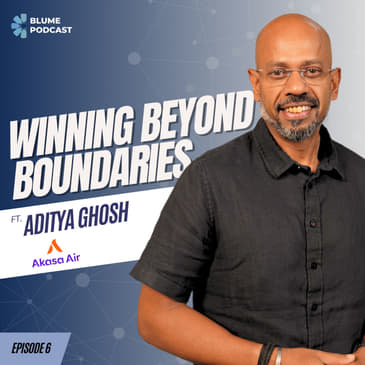

Join us for an insightful conversation with Aditya Ghosh, one of India's most dynamic business leaders, in the 6th episode of Blume Podcast S3, Winning Beyond Boundaries.
From leading IndiGo Airlines' meteoric rise to becoming India's largest airline, to now steering Akasa Air's ambitious journey, Aditya shares invaluable insights into building successful businesses in India.
In this candid discussion with Karthik Reddy, Aditya reveals:• His journey from a young lawyer at JSA to becoming IndiGo's CEO• The unique partnership between Rahul Bhatia and Rakesh Gangwal that created IndiGo• Critical business strategies that helped IndiGo maintain profitability in a challenging industry• How structural advantages built on Day 1 shaped IndiGo's success• The importance of empathy and people management in building great organizations• His current role in shaping Akasa Air's future• Insights into India's aviation market potential and growth opportunities
Aditya also shares personal stories about his upbringing in a government colony, his early career decisions, and the values that have shaped his leadership style. His perspective on India's consumption story and the opportunities it presents for entrepreneurs makes this episode a must-watch for business leaders and aspiring entrepreneurs alike.
Key Timestamps:[02:36] - Episode Introduction
[04:01] - Views on Entrepreneurship
[06:47] - Growing Up Years
[13:20] - Path to Law
[17:18] - First Job Experience
[19:26] - The InterGlobe Connection
[21:43] - Birth of IndiGo
[24:27] - Seizing Opportunities
[30:14] - Leadership Philosophy
[34:08] - Building Culture
[42:03] - IndiGo's Success Formula
[44:54] - Cost Management
[46:40] - Strategic Advantages
[50:56] - The Akasa Journey
[53:46] - Future of Aviation
[57:39] - The Founding Partnership
[01:02:10] - Rapid Fire Round
[01:09:42] - Closing Thoughts
Special thanks to our Season Partner IDFC First Bank for supporting this series.
#BusinessLeadership #IndianAviation #Entrepreneurship #StartupIndia #BusinessPodcast #IndiGo #AkasaAir #Leadership #Aviation #IndianBusiness
[00:00:00] Today you call it your self-doubt and things like that, imposter syndrome. So I was beginning to question myself that, you know, am I good really? Or am I good because I started off as a little kid in K&S and JSA, the partners like me and therefore I'm going. So I wanted to kind of test myself. I possibly could not work in another law firm because I mean, I was just too fiercely loyal to JSA. And I thought, okay, let me go and, you know, kind of work at a as an in-house firm.
[00:00:30] I went, long story short, I went and interviewed at GE. Came back from the interview, Rahul asked me, where were you? I said, you know, don't tell Jyoti. I was interviewing for a job. He said, really? You're leaving? I don't know. Like, I don't know you're looking for a job. I said, no, this is the thing. I just want to test myself out. So he said, okay, then come and join us. I said, I didn't know you were looking for someone. He said, what is it to look? And typical Rahul Bhatia side, he takes out a post-it, hands it over to me with a pen.
[00:01:00] And says, put down, you know, whatever you want, whatever, like, you know, compensation of them. So that's how I came in. And the first assignment that was given to me by that time, of course, this whole airline idea was like being thought about more deeply was to apply for the license and at least put together the application for the license and so on and so forth.
[00:01:34] Welcome to another episode of Winning Beyond Boundaries, the podcast where we dive deep into the minds of trailblazers who push past conventional limits to create lasting impact.
[00:01:43] Today, we're thrilled to be joined by Aditya Ghosh, an aviation industry visionary who's left an indelible mark on aviation and business at large.
[00:01:50] From leading Indigo's meteoric rise to becoming India's largest airline to now steering the ambitious journey of Akasa Air, Aditya has consistently broken boundaries, embracing challenges in both domestic and international markets.
[00:02:03] Beyond the boardroom is pragmatic leadership style, which balances operational excellence with a relentless focus on customer needs, has redefined what it means to scale businesses in highly competitive industries like airlines.
[00:02:15] In this episode, we'll explore Aditya's journey from his early days as a lawyer to becoming one of India's most dynamic business leaders.
[00:02:23] We'll dive into the lessons he's learned about international expansion, building sustainable businesses and what it truly takes to lead with consistency in an unpredictable world.
[00:02:33] Once again, welcome to the podcast.
[00:02:35] So welcome to the podcast, Aditya.
[00:02:36] Thank you.
[00:02:37] Lovely to have you.
[00:02:38] Season three, Winning Beyond Boundaries.
[00:02:40] And we thought, what better story to tell than the journey of how Indigo was born.
[00:02:47] Now, every time, by the way, there was the last flight I took before this recording.
[00:02:51] And now you're starting Akasa also.
[00:02:53] And the previous flight was Akasa.
[00:02:55] Awesome.
[00:02:56] Love it.
[00:02:56] So I've tried both your, you know, your brain children or your babies over the last week.
[00:03:02] And it's a remarkable story.
[00:03:04] I keep telling people that if Indigo could be built in India, you can pretty much build anything in India.
[00:03:09] And I would love to use today's, you know, episode with you to sort of double click on why I believe that.
[00:03:16] And who better to give those answers than Aditya Ghosh.
[00:03:20] So thanks again for being here today.
[00:03:22] My pleasure.
[00:03:23] Usually, of course, people know you, but like we talk to our podcast talks to entrepreneurs, you know, everyone from college kids to, you know, people in the entrepreneurial ecosystem, the startup world.
[00:03:35] So not everyone might know who you are.
[00:03:38] So I'd always love the audience to understand what shaped Anaditya Ghosh in his early years.
[00:03:43] So we know you're a Delhi boy all through.
[00:03:47] What were those early years like?
[00:03:49] What led you to the choices that you made?
[00:03:53] Initially leading you to becoming a lawyer.
[00:03:56] And then we'll touch upon how that became Indigo Man.
[00:04:00] You know, before I answer that question, I'll start off with something which happened this morning.
[00:04:06] Literally this morning.
[00:04:07] And as I was taking the flight from Delhi, early morning flight.
[00:04:11] So I posted a photograph of mine in a dhoti in the last week, you know, we had Durga Pooja.
[00:04:20] So I posted.
[00:04:21] Or there were very, very complimentary comments more about the outfit than about me.
[00:04:26] But there was one comment, right?
[00:04:31] By some handle, which has 10 posts, 10 followers.
[00:04:35] So I don't know whether it is a fake handle or whatever it is.
[00:04:38] The handle basically said, the comment was something like that, you know, I've heard you speak in various places.
[00:04:47] But, and I'm quoting, you give a manager vibe.
[00:04:51] You're not really an entrepreneur.
[00:04:52] And you're basically piggybacking on Mr. Dube in Akasa and Mr. Chatterjee in Chaurangi.
[00:05:01] And so you should not pretend to be an entrepreneur.
[00:05:06] You're not.
[00:05:07] And I actually normally ignore.
[00:05:10] But I wrote a reasonably long reply.
[00:05:13] And I mean it genuinely.
[00:05:14] And I said that you're absolutely right, you know.
[00:05:20] Actually, I don't know whether I'm an entrepreneur or not.
[00:05:23] And because I always think, have I started something completely by myself?
[00:05:30] And I don't think I have.
[00:05:33] The closest is, yes, Chaurangi with Anjan.
[00:05:36] Where both of us are kind of almost equal owners.
[00:05:40] But even there, I ride on his coattail because, you know, Anjan is such a, you know, founded speciality restaurants, listed company, known restaurants forever.
[00:05:50] But what I also mean by that is that that's where the deep admiration for entrepreneurs comes.
[00:05:57] You know, I was saying this to you in the morning.
[00:06:00] You know, we were having breakfast.
[00:06:01] And just at the end of it, I said, you know, Karthik, I have just this great admiration.
[00:06:06] I'm in awe of great entrepreneurs.
[00:06:07] The fortunate thing is I've had the good fortune, luck, whatever you call it, of observing, you know, entrepreneurs from close, working with some of them, working alongside with some of them, whether it is Vinay or Anjan or anybody else.
[00:06:28] And so, you know, with that caveat, my early days, my father was a government servant.
[00:06:39] So we grew up in a government, you know, colony in Delhi.
[00:06:47] Familiar with them.
[00:06:48] Yeah.
[00:06:48] And went to the same school from all the way from when I was five years old to when I passed out of high school.
[00:06:55] But, you know, when I think back, there are three or four things that always come back to me.
[00:07:03] And I think in some ways they have shaped me later.
[00:07:08] Firstly, when you're staying in a government colony, everybody wears the same kind of clothes.
[00:07:15] Everybody goes to the same kind of schools.
[00:07:19] There are no foreign trips where your dad comes back with some, like when your mom comes back with some fancy bag or a pencil box.
[00:07:27] I think both of us are about the same age.
[00:07:30] And so we remember, you know, those magnetic pencil boxes with a little, you know, you click one and this eraser comes out.
[00:07:36] That was the high point.
[00:07:37] That was the high point.
[00:07:38] That was the high point.
[00:07:39] Of childhood.
[00:07:41] So that was a great leveler.
[00:07:44] Parents, when they would meet and, you know, we all stayed close to each other, nobody would talk about how much money they made.
[00:07:52] Nobody would really talk about, you know, what was the next, you know, big thing that they achieved at work.
[00:07:59] All of them were doing important jobs in some ways building India.
[00:08:02] That's right.
[00:08:03] You know.
[00:08:03] And especially in the 80s and 90s, you know, as India was going through the transition.
[00:08:09] All of these people could have taken some part of the credit and some part of the credit was due to them.
[00:08:14] But they didn't talk about that.
[00:08:18] I did not for a long time know whose dad had what designation, whose mom had what designation.
[00:08:26] I did not quite understand.
[00:08:28] I certainly had very little concept of which caste somebody was from or for that matter, which region, you know.
[00:08:36] I mean, as Bengalis, I always say there are four kind of people in the world.
[00:08:42] There is Bengalis, there is non-Bengalis, there is South Indians and Punjabis.
[00:08:48] So, kind of divided into those four.
[00:08:54] We all went down to play with the same kind of shoes and stuff like that.
[00:08:59] Getting a tennis racket was like a once in a few years event.
[00:09:04] Getting new clothes was a once in a year event sort of a thing.
[00:09:10] And not because people couldn't afford it.
[00:09:12] Most of the time people couldn't afford it.
[00:09:14] But even otherwise, even people who could afford it, it was just a way of doing things.
[00:09:20] Yeah.
[00:09:20] You know, so I think that kind of shapes me, shaped me kind of always even today,
[00:09:29] being able to understand what I think makes most of us tick.
[00:09:33] What is important in life, you know.
[00:09:36] And that's why I get very cheesed off or shy of, you know,
[00:09:41] when people suddenly start talking about how much money they raised and how much money they made
[00:09:45] and all of that kind of stuff.
[00:09:46] I find it a little bit, you know.
[00:09:49] I think the value systems of even folks who were arguably the most privileged 1% 30 years ago,
[00:09:56] very different from that same 1% today.
[00:09:59] Correct.
[00:09:59] Yeah.
[00:09:59] I think priorities have shifted.
[00:10:01] That's right.
[00:10:01] The narrative has shifted.
[00:10:03] Social media doesn't help.
[00:10:04] It was not a world of outsourcing.
[00:10:06] You had to do everything yourself, you know.
[00:10:09] The second thing was that, you know, there were lots of friends.
[00:10:14] Because both my younger brother and I, we were late children.
[00:10:16] So the children of our neighbors, our other uncle and aunties, neighborhood uncle and aunties,
[00:10:23] were at least 5-6 years older.
[00:10:25] And they were all like, you know, I didn't realize at that time, everybody was going to IIT Delhi,
[00:10:31] everybody was going to some medical college.
[00:10:34] At the same time, you know, Kartik, all these, these bhaiyas and didis and dadas,
[00:10:42] all of them were good at playing cricket and used to play football and used to go to IIT.
[00:10:48] And somebody was a musician, somebody was a bodybuilder or somebody was used to play the tabla.
[00:10:53] So this, I grew up in an environment where I was surrounded by these, you know, role models.
[00:10:59] And role models.
[00:11:00] Who were multidimensional personalities.
[00:11:04] This was the pre-quota kind of date.
[00:11:07] That's correct.
[00:11:08] There was no quota back.
[00:11:08] That's right.
[00:11:09] So you went to school, you studied hard, but you were also expected to do other things.
[00:11:15] You know, it was not like you shut out the rest of the world.
[00:11:17] You were expected to read fiction and you were expected to watch good films
[00:11:22] and be able to have a conversation and be polite and all of that kind of stuff.
[00:11:27] Right.
[00:11:27] Your badge of honor was not your mark sheet.
[00:11:29] So today also, I kind of, you know, have great admiration for,
[00:11:37] I like people who are multidimensional personalities.
[00:11:40] And for the longest time, for I think 20, 30 years, people were like,
[00:11:43] no, you have to stay focused and all of that.
[00:11:46] Today, suddenly, leaders are expected to know art and be able to go to a, you know,
[00:11:53] you know, art fair and read, you know, books and, you know,
[00:11:57] be it school to play music and stuff like that.
[00:12:01] I'm going to be meeting Prateek Agarwal of Sterlite day after.
[00:12:06] He's also a DJ.
[00:12:07] You know, so that's the second thing.
[00:12:11] But the third most, I think, important lesson influence was my parents.
[00:12:22] My father did his master's in economics, but had a deep interest in history and English.
[00:12:29] My mother grew up in Delhi.
[00:12:31] She, because my grandfather was also a government servant, but she had that multiple interests.
[00:12:39] And while they kept telling us, you have no inheritance other than your education and you have to study hard.
[00:12:47] But my parents kept telling my brother and I, you have to be a good human being.
[00:12:52] You have to be a good human being.
[00:12:53] You have to be a good human being.
[00:12:55] I think, you know, those influences like remain with me even today.
[00:13:00] So when I'm disappointed with myself, it's when I feel I'm not being a good human being.
[00:13:05] When I'm disappointed with myself, I feel like I'm being arrogant.
[00:13:07] When I'm disappointed with myself, I feel like, you know, I'm not reading enough.
[00:13:13] Or I'm not understanding enough, you know, of something which is outside my area of work.
[00:13:20] Fascinating.
[00:13:21] No, it's wonderful to always hear these backstories on what shapes great leaders.
[00:13:26] So, and I'd love for all of this to weave into how your career then moved and progressed.
[00:13:31] How do I become a lawyer?
[00:13:32] Yeah, why choose, you know, becoming a lawyer?
[00:13:35] So I grew, I read a Reader's Digest article when I was in class eight,
[00:13:41] which was about this team of doctors who operated on Ronald Reagan when there was an assassination attempt at him.
[00:13:50] Okay.
[00:13:50] This group of neurosurgeons and who were able to take the bullet out and save him and all of that.
[00:13:55] So as a 13 year old, I was so, you know, impressed and influenced by it that I wanted to become a doctor.
[00:14:05] My grandfather was a doctor.
[00:14:07] My uncles were doctors.
[00:14:09] I liked biology.
[00:14:11] So it kind of was natural, but I really wanted to be a neurosurgeon.
[00:14:16] And funnily enough, my, the husband of my history teacher was also a neurosurgeon.
[00:14:23] So now came class 11 and 12.
[00:14:25] And unlike, you know, people like you, I was so, I was pretty disillusioned with science in class 11 and 12.
[00:14:35] Like CBSE was just like cramming things down and I was just not good at that.
[00:14:42] And there was no liberal arts education in those days.
[00:14:45] So after doing high school science and math and everything, and kind of sitting for medical entrance exams,
[00:14:53] I decided that I want to study something that I like studying, which was very unusual in those days.
[00:15:02] So I started studying history.
[00:15:04] That was my undergrad degree.
[00:15:06] And while at college studying history, I got lucky.
[00:15:11] I was in Delhi University.
[00:15:13] So I had all the time in the world to do debates, theater, like, you know, music festivals and this and that.
[00:15:20] And I, and, and so I was the president of the debating society and all of that kind of stuff.
[00:15:27] Passed out of college.
[00:15:29] My father had retired.
[00:15:30] My younger brother was still in school.
[00:15:33] So obviously there was this pressure of now you have to do something to get a job.
[00:15:39] And the MBA was the sure shot route to getting a job.
[00:15:43] I gave the entrance exams, got through a few business schools, but I kind of the penny dropped in thinking that, look, while I'm interested in business,
[00:15:54] this is the mid nineties.
[00:15:56] India has just opening up and all of that.
[00:16:00] In fact, 1996.
[00:16:03] In fact, 1996.
[00:16:04] In fact, 1996.
[00:16:28] I didn't top IIT.
[00:16:29] I'm not, I'm not, you know, therefore, you know, I didn't top IIT.
[00:16:35] I didn't go to, if I don't go to IIM Ahmedabad and top out of there, I'm not getting a job at, in those days, Booz Allen or BCG or McKinsey or Bain or any one of these places.
[00:16:49] And corporate law had just started being discussed in those days.
[00:16:54] You know, you find it in the business today type of magazines.
[00:16:58] So I felt that that could be one route to get closer to companies, but taking an easy route, which is basically law.
[00:17:10] Laws are, in those days, a very easy course to get into.
[00:17:13] Like anybody could get into law.
[00:17:16] And so, so, right.
[00:17:18] But when you landed, I mean, maybe J. Sagar was a little bit of a startup themselves, but.
[00:17:23] Absolutely.
[00:17:23] Was that your first job?
[00:17:24] That was my first job.
[00:17:26] It was, I was an intern.
[00:17:28] I actually started off in the IP firm of, sister firm of JSA called KNS Partners.
[00:17:35] There were three lawyers and Jyoti, Mr. Sagar and one intern.
[00:17:40] Which is you.
[00:17:41] That is me.
[00:17:42] But learning from the best.
[00:17:44] And even the next year, when I moved to Jyoti, right, I started off as his executive assistant.
[00:17:49] There were only 15 lawyers in JSA in those days.
[00:17:52] But like you said, it was a watershed event for me.
[00:17:56] Plain lucky that I got to work right next to Jyoti as his executive assistant at the age of 21, 22.
[00:18:04] Right.
[00:18:04] So when, so like, I can't even like, you know, can't wait and gold the incredible, like, you know, ringside view that I got.
[00:18:17] All the way from Bharti Singtel to like, you know, electricity privatization to power sector to geographical indication in IP to foreign direct investments.
[00:18:34] I mean, it was amazing.
[00:18:36] It was insane.
[00:18:37] It was absolutely insane.
[00:18:38] The best sort of on-site MBAs that you can get.
[00:18:41] Absolutely.
[00:18:41] Yeah.
[00:18:42] Absolutely.
[00:18:42] Those two years, first as an intern and as an executive assistant, kind of was amazing.
[00:18:50] And the first year, first two months I earned 900 rupees a month.
[00:18:56] The next 11 months I earned 1600 rupees a month.
[00:18:59] The next 12 months I earned 4,600 rupees a month.
[00:19:03] But imagine Karthik.
[00:19:05] I mean.
[00:19:06] Yeah.
[00:19:07] I mean, there is no.
[00:19:08] You're getting paid to learn.
[00:19:09] Exactly.
[00:19:10] I was, it was invaluable what I learned.
[00:19:12] And that's why Mr. Sagar remains just such an incredible influence in my life.
[00:19:18] And so he, he put you onto Indigo or was that, what, how did Indigo happen?
[00:19:23] Much later I'm guessing, but still.
[00:19:25] So, Interglobe was a client of JSA.
[00:19:28] Okay.
[00:19:30] So I would see.
[00:19:31] And a lot of people don't know that Interglobe was a thriving business before Indigo.
[00:19:35] Absolutely.
[00:19:35] So maybe you can weave that into the story.
[00:19:37] Interglobe was a very large travel services business.
[00:19:42] People mistakenly call it a travel agent.
[00:19:44] They were not a travel agent at all.
[00:19:46] They used to represent over a dozen international airlines in India.
[00:19:51] They used to run a technology distribution business in India focused on the travel trade.
[00:19:56] They had just set up Tech Development Center in 1998, 99, which was my first exposure to Interglobe.
[00:20:04] So a bunch of different things.
[00:20:07] And they're very successful businesses.
[00:20:09] So I would see Rahul and his white kurta pajama come to meet Jyoti every once in a while.
[00:20:14] And gradually I would start attending the meetings because I was Jyoti's assistant and so on and so forth.
[00:20:19] That's how I first got to know him.
[00:20:22] And very soon, in a year's time, thanks to Ashok Fenn, who was the CEO of Interglobe at that time,
[00:20:29] Rahul was very early on in bringing in professionals.
[00:20:34] So thanks to Ashok, I started doing a lot of the Interglobe legal work.
[00:20:43] So over four years, five years, we got to know each other really well.
[00:20:50] And since there was no in-house legal department in Interglobe, all of the work was being done.
[00:20:58] And again, credit to them, credit to Rahul, that I was deeply involved in many of the business discussions.
[00:21:06] Yeah, good counselor.
[00:21:07] Good counselor eventually becomes that.
[00:21:09] Somebody to bounce off.
[00:21:11] And I need to remind people that I was 24.
[00:21:13] Amazing.
[00:21:14] Right?
[00:21:14] I was 24.
[00:21:15] Yeah.
[00:21:17] So I'll come to something else in just a bit.
[00:21:20] So therefore, you know, in 2002 December, Rahul and Rakesh met in Bombay.
[00:21:28] Of course, they were friends.
[00:21:29] Rahul and Rakesh met in Bombay at the Belvedere in the Orboros at Nairman Point.
[00:21:34] And talking about this idea of an airline.
[00:21:38] And I was there.
[00:21:39] So this is the cocktail napkin stage.
[00:21:42] Yeah.
[00:21:42] Right.
[00:21:43] Literally.
[00:21:43] And at the first date.
[00:21:44] Yeah, at the first date.
[00:21:45] Yeah.
[00:21:46] So that then, and then in the meantime, the hotels business has started where Rahul's involved me a lot in.
[00:21:54] Seven years into JSA and this whole law firm thing, I was very blessed.
[00:22:01] But you know, Karthik, I had this, I wonder if today you call it this, you know, sort of,
[00:22:10] you know, your self-doubt and things like that.
[00:22:14] Imposter syndrome.
[00:22:16] So I was beginning to question myself that, you know, am I good really?
[00:22:22] Or am I good because I started off as a little kid in KNS and JSA, the partners like me and therefore I'm going.
[00:22:31] So I wanted to kind of test myself.
[00:22:33] Yeah.
[00:22:34] I possibly could not work in another law firm because, I mean, I was just too fiercely loyal to JSA.
[00:22:43] And I thought, okay, let me go and, you know, kind of work as an in-house counsel.
[00:22:51] I went, long story short, I went and interviewed at GE.
[00:22:56] Came back from the interview, Rahul asked me, where were you?
[00:23:00] I said, you know, don't tell Jyoti.
[00:23:02] I was interviewing for a job.
[00:23:04] He said, really?
[00:23:05] You're leaving?
[00:23:05] I didn't know.
[00:23:06] Like, I don't know you're looking for a job.
[00:23:08] I said, no, this is the thing.
[00:23:10] I just want to test myself out.
[00:23:11] So he said, okay, then come and join us.
[00:23:13] I said, I didn't know you were looking for someone.
[00:23:16] He said, what is it to look?
[00:23:17] You know, and typical Rahul Bhatia style, he takes out a post-it, hands it over to me with a pen and says, put down, you know, whatever you want.
[00:23:26] Whatever, like, you know, compensation of them.
[00:23:30] So that's how I came in and the first assignment that was given to me, by that time, of course, this whole airline idea was like being thought about more deeply, was to apply for the license and at least put together the application for the license and so on and so forth.
[00:23:46] You know, serendipity.
[00:23:49] I always think, I always say that opportunity knocks several times at everybody's door.
[00:23:58] And I'm not saying it has to be out of greed or ambition, but just out of honesty or purpose.
[00:24:04] I think, you know, one needs to actually try to take each one of those opportunities, you know.
[00:24:09] I mean, you know, I'm sure, Karthik, you've seen this hundreds of times with your portfolio companies.
[00:24:18] I always say, it's not like you have any idea that what I'm doing today will lead me to something somewhere.
[00:24:26] Yeah, it's never certain.
[00:24:28] It's never certain.
[00:24:29] There is never a plan.
[00:24:30] Yeah.
[00:24:30] Somebody, you know, you're photocopying papers, somebody notices you and gives you a bigger responsibility.
[00:24:36] So many times I go to these nice restaurants.
[00:24:39] I mean, in these in hill stations in India, it happens a lot.
[00:24:42] You'll find a restaurant which is like making some unique pizza or some German bakery or something.
[00:24:48] And there's always this story.
[00:24:49] Yeah.
[00:24:50] There was this person who was working there.
[00:24:52] The British owner was leaving, you know, and gave it over.
[00:24:57] Or this, you know, kind of origins of Obroy hotels.
[00:25:01] Yeah.
[00:25:02] So the lesson is that if somebody gives you a job of photocopying papers, do it with such diligence.
[00:25:09] Because someone somewhere may notice you, no guarantees.
[00:25:13] Yeah.
[00:25:13] And, you know, something better will happen, which will be far above and beyond your wildest expectation.
[00:25:18] No, beyond photocopying papers, I know you're doing a lot more.
[00:25:22] Yeah.
[00:25:22] But I'd also realize even from the early days, I remember in a conversation we had during COVID, you mentioned you were very involved.
[00:25:32] You almost became like the chief people officer alongside being counsel.
[00:25:36] And I know there was a path, but very quickly, what led to you becoming CEO?
[00:25:41] So how did that trajectory move?
[00:25:42] You know, there is at least one journalist.
[00:25:50] When I left Indigo, there was something which was basically like Aditya Ghosh was not really a CEO.
[00:26:01] And, you know, it was all Rahul Bhatia and Rakesh Ganwal.
[00:26:06] And, you know, other very capable leaders.
[00:26:09] And he was at best an HR manager or a, you know, chief HR officer.
[00:26:16] For the first 30 seconds, I felt bad.
[00:26:19] Yeah.
[00:26:21] And then I realized, then I was like, that's true.
[00:26:24] Because none of us can claim ownership, unique or ownership or sole ownership about everything, anything.
[00:26:32] That's true.
[00:26:33] That's one.
[00:26:33] So I'm deeply grateful for all the people, you know, that I got to work with.
[00:26:37] But the other one is I actually, I take a great, I mean, for me, if it's a badge of honor to feel that, you know, I am the chief people officer.
[00:26:46] At Indigo, you know, I used to say this and I say this even at Akasa today.
[00:26:50] At Indigo, I used to say this.
[00:26:51] I am your biggest union leader.
[00:26:53] I used to say this to all my pilots, all my pilots.
[00:26:55] I am your biggest union leader.
[00:26:58] You come and tell me.
[00:27:00] Let us, you share whatever.
[00:27:03] I didn't have, I was supposed to get two bottles of water in the hotel room.
[00:27:06] I only got one.
[00:27:07] My cab reported late.
[00:27:09] My uniform is the same.
[00:27:10] The wheels of my bag are coming off.
[00:27:12] Right?
[00:27:13] Chief grievance office.
[00:27:14] Chief grievance office.
[00:27:15] It's like when we go to a dentist, when we go to a doctor and we are waiting outside.
[00:27:22] And suppose I have cut my hand with a piece of glass.
[00:27:29] I'm bleeding and I've got a handkerchief around myself and I'm holding my hand like this.
[00:27:36] For me, like I'm in great pain.
[00:27:39] And if the doctor makes me wait, right?
[00:27:41] Or ignores me, I will be like screaming.
[00:27:47] But the doctor might be treating somebody who's just had a heart attack and has been rushed in.
[00:27:55] But as the person with a cut hand, I'm expecting the same amount of attention from the doctor.
[00:28:03] As a CEO, as a leader, your colleagues are expecting the same.
[00:28:10] For that person, that cab reporting late, because of which he could not make it to his flight on time,
[00:28:17] Oz was rushed and was tense and arrived on his flight like all flustered and hassled, sweating and this, that and the other,
[00:28:26] is an equally large problem as somebody coming in saying, I have an aircraft on the ground because the engine is showing a malfunction.
[00:28:35] Now you as a leader, as a doctor, will have to prioritize and understand where I have to put betadine and where I have to put a, like a, you know,
[00:28:45] where I have to revive somebody's heart.
[00:28:47] Put a stent in.
[00:28:47] But you can't say, you bleed for eight hours because I'm doing.
[00:28:53] A great leadership lesson.
[00:28:54] Yeah.
[00:28:55] It shows how much you evolved as a leader and playing those various roles.
[00:28:59] Because, because you see, like empathy is the, you know, I mean, if there was, if you're forced to define leadership in one word, that is empathy.
[00:29:10] And I've been saying this for well before it became fashionable to say in COVID.
[00:29:14] Yeah.
[00:29:17] You know, Karthik, if you think of teachers, uncle, aunt, elder, brother, sister, parent, who you remember fondly, it may not be the subject where you scored the highest.
[00:29:33] It could be a football teacher.
[00:29:35] It could be an English teacher.
[00:29:37] It could be a coach or whatever it is.
[00:29:38] It was somebody who did not give up on you.
[00:29:43] That's the leader that you keep going back to.
[00:29:45] When you think about school and college and the first teacher that comes to your mind, maybe a drama teacher.
[00:29:50] Yeah.
[00:29:51] It was just somebody who understood you, who did not give up on you, who made you realize your potential.
[00:29:58] Our job as a leader is exactly the same.
[00:30:03] So where somebody thought they were criticizing me in saying, he's the chief HR officer.
[00:30:09] I actually think.
[00:30:10] That's the most.
[00:30:10] Yeah.
[00:30:11] That's the most profound, you know, compliment I would have got.
[00:30:14] And you also, you also, I use your example when I'm talking to other young leaders.
[00:30:19] I picked it up from you.
[00:30:21] And to Naveen Tiwari's credit, I first heard it from him as well.
[00:30:25] In Mobi.
[00:30:26] Yes.
[00:30:27] Yes.
[00:30:27] Very similar outlook that almost the first five, six hundred people were in the firms of personally sort of interviewed by you or a senior leader.
[00:30:38] Yeah.
[00:30:38] In my case, the first nine years.
[00:30:41] First nine years.
[00:30:42] Everybody went through.
[00:30:43] Every human being.
[00:30:44] Amazing.
[00:30:46] Amazing.
[00:30:46] So I would.
[00:30:47] And that's only, and we only count the number of people who got hired.
[00:30:49] So that must have been three times that volume.
[00:30:52] So I made a rough math.
[00:30:54] Yeah.
[00:30:55] Not accurate, but a rough math.
[00:30:57] I have done 140,000 interviews in my life.
[00:31:00] Oh my God.
[00:31:02] Sounds scary even as you say it.
[00:31:04] So if you go to terminal one at Mumbai airport, you know, the ticket counter.
[00:31:10] Yeah.
[00:31:11] So I would sit behind the ticket counter.
[00:31:15] Like, so the window would face the thing.
[00:31:17] And there's a little, little, small little thing where, you know, there's a few printers kept and all that.
[00:31:24] I would sit there and interview people.
[00:31:27] There was only place for two people to sit.
[00:31:30] But, you know, Karthik, of course, you know, somebody may criticize that.
[00:31:36] What are you doing?
[00:31:37] But it's people.
[00:31:38] It's all people.
[00:31:39] Yeah.
[00:31:40] And that's why the connect.
[00:31:42] Today, I was on the Vistara flight coming into this.
[00:31:46] I'm taking the Akasa flight back.
[00:31:49] It's timings.
[00:31:50] I'm also forced to take all three.
[00:31:52] All this timing.
[00:31:53] I was taking the Vistara flight in.
[00:31:55] The co-pilot came out saying he had, he was ex-Indigo.
[00:32:01] One of the co-passengers said, you know, I left Indigo nine and a half years back.
[00:32:05] I was in finance team in revenue accounting.
[00:32:10] You interviewed me.
[00:32:13] I came out.
[00:32:15] I was walking out of the aircraft.
[00:32:17] This guy, very well built and all of that with a little baby in his arm said, Aditya, sir.
[00:32:24] I said, yeah.
[00:32:25] He says, I'm a captain on a Falcon.
[00:32:28] But my wife was an Indigo.
[00:32:29] And then she came across.
[00:32:32] And another guy, I remember you, et cetera, et cetera.
[00:32:35] So I think as a leader, forget about the employees.
[00:32:41] As a leader, typically I've seen, you cannot disrespect somebody who you know.
[00:32:50] If you know somebody well, it is a little bit more difficult to disrespect that person.
[00:32:56] So respect, which is the first pillar on which organization cultures should get built.
[00:33:04] If I know you, if I've hired you.
[00:33:07] Yeah.
[00:33:07] If I've had a conversation.
[00:33:09] The bar is already elevated.
[00:33:09] Yeah, the bar is already higher, right?
[00:33:11] Yeah, it's elevated.
[00:33:11] Now, even if I have to scold you, I'll scold you like a parent.
[00:33:15] I won't scold you like as if you're some role number, you know, 1378, you know, on a list of 20,000 people.
[00:33:22] I sense everything you've said that in a small firm, we have the luxury of being far more proximate.
[00:33:30] But I think I've always amazed by Indigo again.
[00:33:34] And amongst the many attributes that I think Indigo showed the way in India,
[00:33:39] one of them is this ability for every person at every touch point that the customer sees in the brand.
[00:33:48] Almost, I joke about it, almost to a point that it can look robotic.
[00:33:52] It's very, very deeply ingrained culturally.
[00:33:55] Yeah.
[00:33:55] That couldn't have happened without like a people strain in the firm being so strong.
[00:34:02] And you talked about one hack of interviewing, but the more I would love for my founders.
[00:34:08] What you said, that it cannot happen by accident.
[00:34:13] Yeah, that's true.
[00:34:14] It has to happen by design.
[00:34:15] So the other day, not other day, a few months back, for the first time,
[00:34:19] I met one of the two co-founders of this, you know, this pet store called Heads Up for Trees.
[00:34:26] I met him for the first time.
[00:34:29] And Rohit Bansal of Titan.
[00:34:32] Yeah.
[00:34:33] Rohit introduced me.
[00:34:34] And I said, you know, I've never met you before.
[00:34:37] But I've got to say, there must be something you're doing here.
[00:34:39] Yeah.
[00:34:40] How is it possible?
[00:34:41] Any store I go to, any employee of yours I talk to, right?
[00:34:47] They're all polite.
[00:34:48] They're all helpful.
[00:34:50] Yeah.
[00:34:51] There is this, and I don't know how well they're doing, what is their financials, etc.
[00:34:56] But that's a great litmus test that if on the front line when no one is watching,
[00:35:02] are you being able to deliver that?
[00:35:04] There is a small coffee outlet called Cafe Espresso in Delhi's Terminal 2, where Akasa takes off from.
[00:35:13] So I go there in the morning, I pick up coffee from there and go to the flight.
[00:35:19] I don't know who owns them.
[00:35:21] But I'll tell you, there is something.
[00:35:24] That guy who gives coffee, and there are obviously, you know, various people on the role, on the roster.
[00:35:32] Yeah, because they keep rotating, I'm sure.
[00:35:34] They're all polite.
[00:35:35] They're all helpful.
[00:35:37] Right?
[00:35:37] So they must be doing something right.
[00:35:40] Right?
[00:35:41] Absolutely.
[00:35:42] And I think, so one is interviewing, but I think, I've thought about this a lot to try to distill, like, you know, what really works.
[00:35:53] I think there are three pillars to it, you know.
[00:35:57] One is, like I was saying, a deep sense of respect.
[00:36:03] That all of us are equals here.
[00:36:05] We just have different roles to play.
[00:36:09] Especially in operational heavy, execution heavy businesses.
[00:36:15] No one human being, no CEO can say, okay, I'm firing everybody.
[00:36:20] I'm jumping in and I'm doing this myself.
[00:36:22] Yeah.
[00:36:23] Because you can't be a pilot.
[00:36:25] You cannot be a flight attendant.
[00:36:26] You cannot be an engineer.
[00:36:28] You cannot be, you know, a security professional and so on and so forth.
[00:36:33] Yeah.
[00:36:34] The second is instant recognition.
[00:36:40] Instant gratification by recognizing people who are doing the right thing.
[00:36:43] I'm a big fan of positive reassurance.
[00:36:47] Look, Karthik, so many times, 99.9% of the times, companies, leaders, when something goes wrong, absolutely will jump on the phone, call up that person, scream at that person, call the manager.
[00:37:04] What is going on?
[00:37:05] We need a review of this and this and that.
[00:37:08] But when there are 10, 15, 20, 100 things that are happening well in the company.
[00:37:15] Somebody has stepped above and beyond.
[00:37:19] Somebody has displayed a value that you hold dear, even in the kind of, you know, in the face of hardship.
[00:37:29] We don't pick up the phone with the same amount of urgency.
[00:37:33] I don't understand that.
[00:37:36] I don't know what prevents us from doing it.
[00:37:39] What did you come up with some sort of systems or mechanisms to actually put this into action?
[00:37:44] Yes.
[00:37:44] So there are, you have to set up all kinds of processes to capture, et cetera.
[00:37:49] But I'd say the top layer that works is if you do this a few times and people understand this is the way to do it.
[00:38:01] You know, human beings, we come from monkeys.
[00:38:03] So we ape well.
[00:38:05] Yes.
[00:38:06] So if somebody does it and then somebody else does it and then somebody else does it and somebody else does it,
[00:38:11] then everyone will start automatically.
[00:38:14] That's the power of culture.
[00:38:16] You know, it's a set of acceptable behaviors.
[00:38:18] That's right.
[00:38:18] So you begin to do the same thing over and over again.
[00:38:24] Right.
[00:38:24] For example, you know, I've been in so many customer-facing businesses.
[00:38:31] When there's a fog or a diversion or there's a delayed flight, people are, customers are screaming.
[00:38:40] And, you know, my colleagues would be standing there listening patiently, whether it is reasonable, unreasonable, et cetera.
[00:38:50] And just stay calm.
[00:38:53] I mean, if we had that kind of patience, you know, just to be able to, you know, live through that hardship.
[00:39:03] I think it's amazing.
[00:39:04] Yeah.
[00:39:05] And the third pillar is rewarding people for that.
[00:39:09] For that.
[00:39:10] That kind of tenacity.
[00:39:11] But the reward, because I come from low margin businesses, does not have to be money.
[00:39:20] It can be a bigger responsibility and so on and so forth.
[00:39:23] I was sharing this example yesterday.
[00:39:25] If you think of the military, the army, for example, the military, you win something, you win a battle, you do something well, you get promoted maybe once in five years.
[00:39:37] That's right.
[00:39:38] Right.
[00:39:38] It takes 20 years to become a colonel.
[00:39:40] Yeah.
[00:39:40] Right.
[00:39:42] But every time you do something well, you're given an even more difficult operation to run.
[00:39:47] You're given an even more complex, you know, campaign to lead.
[00:39:52] But that's what fires you up.
[00:39:54] Right.
[00:39:54] Yeah.
[00:39:54] It gives you that sense of mission and you're, you know, beginning to try to go after that summit.
[00:40:00] And so I definitely want to switch gears to both Indigo and now you trying to replicate that in Arkansas.
[00:40:08] Yes.
[00:40:08] There was a new playbook Indigo built.
[00:40:11] I mean, we talked about culture, people aspects.
[00:40:13] I won't harp on that more.
[00:40:15] If I were to switch gears to the financial aspects.
[00:40:18] Yes.
[00:40:18] And go with the theme of the podcast, which is what I find unique about the Indigo story.
[00:40:26] Unfortunately, not a lot of the other legacy airlines have managed to replicate that.
[00:40:32] Is how are we winning as one of the most profitable airlines, most well run airlines in the world?
[00:40:38] Yeah.
[00:40:39] So it's not you.
[00:40:40] Of course, you're dominant in India.
[00:40:42] Everybody knows that story.
[00:40:43] Yeah.
[00:40:43] You've gone from zero to 20 to 30 to now 60% market share.
[00:40:47] Yeah.
[00:40:48] And of course, you know the tricks of the trades.
[00:40:51] You're going to win some of that back through Arkansas perhaps.
[00:40:54] But when you put that in context of the global airline industry, what people don't seem to realize is your primary costs are indexed to dollar costs.
[00:41:07] Yeah.
[00:41:08] So that's the plane itself.
[00:41:10] We don't make anything indigenously to make it cheaper.
[00:41:12] The fuel, which we import.
[00:41:14] The pilots and the hostesses may be a little cheaper here.
[00:41:17] But if it's that good, they get poached by an Emirates or a BA or an Etihad.
[00:41:24] Yeah.
[00:41:25] You're competing with all of that.
[00:41:27] You're selling.
[00:41:28] If you go above 10,000 rupees on a ticket, people are crying foul saying you make newspaper headlines in this country.
[00:41:35] That's $125 price.
[00:41:37] Which is one of the lowest in the world.
[00:41:39] Yeah.
[00:41:39] You can't fly New York, Boston at less than that.
[00:41:42] One way.
[00:41:42] Yes.
[00:41:43] Which is like a small hawk, right?
[00:41:45] So how are we able to demonstrate?
[00:41:48] And I know it has history steeped from day one.
[00:41:52] Yes.
[00:41:52] I think you've got two genius minds.
[00:41:55] Yes.
[00:41:55] You were in the room.
[00:41:56] So maybe a little bit of a ringside view on how do we get the business model so right in Indigo from day one.
[00:42:03] Yeah.
[00:42:04] You actually have told me once that the amount of paid in capital and the profitability that Indigo had in the early days was just remarkable.
[00:42:12] And then it's not a flash in the pan.
[00:42:14] And then it's not a flash in the pan.
[00:42:15] As the Indigo thing, seat reminds you every time, 18 years and how time flies.
[00:42:20] Yeah.
[00:42:20] 18 years and we're still seeing nothing stopping it.
[00:42:24] And now you're actually taking the battle to the global playground.
[00:42:28] Right?
[00:42:28] It was not just the budget halls to Doha and Abu Dhabi and Dubai and Colombo.
[00:42:33] But you're now for the first time looking at long haul as well.
[00:42:37] I know you're not a part of Indigo actively.
[00:42:39] But how did this evolution, you know, stay so consistent in an industry like the airlines?
[00:42:45] So yeah.
[00:42:46] Love to hear a little bit about it.
[00:42:48] Whichever way you want to present it.
[00:42:50] Actually, you know, the fundamentals remain the same for.
[00:42:56] I'll go through some details, but the fundamentals remain the same for any of the large successful airlines in the world.
[00:43:06] And I define success by financial success over a long period of time.
[00:43:13] Let's think about that.
[00:43:15] Right?
[00:43:16] Because you could have a sovereign airline, you know, where financials may not matter as much.
[00:43:26] Or you could have a short term sort of success where it can happen for a short period of time.
[00:43:32] So in our business, as in many others, I think the real focus comes, the real success comes from the sharpest cost structure.
[00:43:45] Right.
[00:43:46] The sharpest cost structure.
[00:43:47] Yeah.
[00:43:48] The sharpest cost structure, the lowest cost structure.
[00:43:50] The reason for that is that on the revenue side, it is commoditized.
[00:43:56] Today, if you open up an online travel portal and do a Delhi Bombay, all the airlines are, you know, like few rupees of each other.
[00:44:06] Right?
[00:44:07] That's right.
[00:44:07] So it's not like I am running a full service carrier and I'm giving you a red and a blue carpet.
[00:44:14] That's right.
[00:44:14] I'm able to charge you 600 rupees more, let alone 60% more.
[00:44:19] Yes.
[00:44:20] The religion has to be an absolutely sharp cost structure.
[00:44:26] The lowest cost structure.
[00:44:29] Right.
[00:44:33] Sharpening that cost, slicing away that cost on a continuous basis.
[00:44:40] So even in Akasa today, as we are fighting or we're going to compete with one of the world's best in our own territory.
[00:44:49] Yes.
[00:44:50] Rather than 20 years ago when you were, you know.
[00:44:53] You benchmark to a different.
[00:44:54] That's right.
[00:44:55] Benchmark to a different set of people.
[00:44:56] Yeah.
[00:44:56] We have to be constantly focused on our cost structure being near that and ultimately lower than that.
[00:45:06] Right?
[00:45:07] And like you correctly said, it gets built on day one.
[00:45:12] The foundations of, you know, that cost structure pretty much gets built on day one.
[00:45:19] If you think about the airline cost, typically 40% or so is fuel.
[00:45:27] You look at the second big block, say 20% or so is the aircraft ownership, lease rental, you know, all of that kind of stuff.
[00:45:39] Say 10 to 15% is payroll.
[00:45:45] And then you have maintenance and, you know, stuff.
[00:45:50] Typically maintenance is dollar denominated.
[00:45:53] Because the OEM is doing it for you or in some ways the inventory, the supply, all of that is coming from there.
[00:46:00] Fuel is underlying dollar denominated.
[00:46:02] Of course.
[00:46:03] Lease rentals are dollar denominated.
[00:46:07] Now having said that, let's now go through a little bit more detail.
[00:46:11] If you can find a way to use newer and newer airplanes with better and better fuel burning technology,
[00:46:22] then you're reducing your fuel burn.
[00:46:25] Interesting.
[00:46:25] It may be 1%, 2%, 3%, 5%, 10% better than your competitor.
[00:46:31] But in a business where it's a billion, $1,000,000,000 ideas, that's a significant, you know, flow into your bottom line.
[00:46:40] So surprisingly large savings for that bold bet of new planes.
[00:46:44] Correct.
[00:46:44] That's right.
[00:46:45] Second, if you are being able to bet on the opportunity of a market, in this case India,
[00:46:57] and are able to wait it out and order airplanes, when there is some kind of a deep crisis or airplanes are not selling and so on and so forth,
[00:47:12] you get that structural advantage forever.
[00:47:15] However, it's like, think about this way.
[00:47:18] If I was building a hotel, I was not building, I was managing a hotel and I could find a way to lease that property.
[00:47:26] At the best price for 10 years.
[00:47:27] At the best price for 15 years.
[00:47:29] And like when COVID was at its peak or something.
[00:47:33] Yeah.
[00:47:34] Today, somebody who's going to compete with me is paying double the rental, if not double 70, 80% higher rental.
[00:47:41] Correct.
[00:47:41] Right.
[00:47:42] Now, that cost is set in stone.
[00:47:46] You cannot change that anymore.
[00:47:48] Third is, so that has an impact on that aircraft ownership cost and the lease rentals and all of that kind of stuff.
[00:47:57] Similarly, related to that is maintenance.
[00:48:00] Right.
[00:48:01] You will notice in, whether even in ACASA, we said, we've ordered the airplanes, we've done the maintenance contract.
[00:48:09] Right.
[00:48:09] People don't focus on that second part of the, you know, sentence or the press statement.
[00:48:15] Yeah.
[00:48:15] But that's very, very, very important.
[00:48:18] Right.
[00:48:19] You've ordered the airplanes, but you haven't ordered the engines.
[00:48:21] You've ordered the engines, but you haven't, you know, done the long-term maintenance contract.
[00:48:26] You cannot create predictability of cost.
[00:48:29] So, all this was like super well thought through from day one.
[00:48:32] And like, it's no coincidence that the first hundred aircraft order of Indigo was less than four years after 9-11.
[00:48:40] And the first 76 airplane order of ACASA doubled down to 226 airplane order is soon after the pandemic.
[00:48:51] Yeah.
[00:48:51] Very similar strategies.
[00:48:53] Now, then, these are the, these are what I call structural advantages.
[00:49:00] Right.
[00:49:01] Like the rental of a building.
[00:49:03] That's right.
[00:49:04] After this is all that relentless focus on how many people per airplane, how many people per rooms in a hotel, how many people per manufacturing unit.
[00:49:17] Where can you have, you know, how many, you know, in India, because of what you said, you know, we are used, we were till lately used to these very low labor costs and stuff.
[00:49:30] But we used to throw more people at the problem.
[00:49:35] Pandemic to a great extent has shown when people really need to look and take a good hard look at their own organization, you realize how much fat you actually collected.
[00:49:48] That's good.
[00:49:48] Right.
[00:49:49] And it's all replaced.
[00:49:50] A lot of dumb stuff which can be taken out by tech.
[00:49:53] Absolutely.
[00:49:54] Right.
[00:49:54] And I think Indigo has also been a pioneer on that front.
[00:49:56] And, and I think great companies are like that.
[00:50:00] Great companies are like that.
[00:50:04] So, and, and then one more specific thing, it doesn't hold out to be true 100% of the time.
[00:50:13] But if you're, if you're running a business in India, typically in a lot of cases in many, many years, the US dollar rupee exchange rate and the fuel price have opposing trends.
[00:50:29] So, when the dollar appreciates against the rupee, usually fuel price comes down or the other way around.
[00:50:36] I'm, I'm saying it doesn't, but over a 20 year period.
[00:50:40] It has played out.
[00:50:40] It's played out.
[00:50:42] Fascinating.
[00:50:42] Any, any new tricks in Akasa and what made you at one level think about I've done all that I want to at Indigo and, and what made you also come back to that industry?
[00:50:55] So, Akasa is of course Vinay's idea.
[00:50:58] Yeah.
[00:50:58] Yeah.
[00:50:59] And Vinay thought of it in the middle of the pandemic, when we were in the middle of the lockdown and he called me the next morning.
[00:51:06] So really the credit goes to him to be that brave and courageous.
[00:51:10] Yeah.
[00:51:10] And then a few months later, Rakesh Junjanwala reached out to me.
[00:51:14] What convinced me to come back at the end of the day is exactly what was true in 2005 also.
[00:51:26] India is a very large market with very low aircraft penetration.
[00:51:32] In 2005, 2005, 2006, there was one passenger airline, passenger aircraft for every 50,000 Americans and one passenger aircraft for every 2.4 million Indians.
[00:51:48] 50,000 and 2.4 million.
[00:51:50] Today it is 50,000 and about 3 million.
[00:51:54] Well, it's gotten worse.
[00:51:56] Because we added 300 million people, right?
[00:51:58] And we only added 400 aircraft, right?
[00:52:02] So that fundamental remains the same.
[00:52:05] But Karthik, that's why I get so excited about consumer businesses in India.
[00:52:11] When I say consumer business, it doesn't have to be D2C.
[00:52:13] I understood.
[00:52:14] It could be a manufacturing business.
[00:52:15] It could be anything.
[00:52:16] It could service somebody.
[00:52:17] So it's not like even in a crowded space, what looks like a crowded space, you have that ability to create great businesses which stick to the fundamentals and do something.
[00:52:28] Uniquely, structurally different from everybody else.
[00:52:32] Otherwise, why would you start another coffee chain?
[00:52:35] And why would you start another chocolate factory?
[00:52:37] And so on and so forth.
[00:52:38] There is enough coffee and chocolates.
[00:52:40] But there is always room.
[00:52:43] And I truly believe, not to sound jingoistic, but just the math will show that if there are 180 million new Indians coming into the workforce over the next 23 years, they'll be consuming.
[00:52:57] That's right.
[00:52:58] Now, what price point they're consuming at, what they're consuming at is for an entrepreneur to be able to spot.
[00:53:03] But they will be consuming.
[00:53:04] They will be spending money.
[00:53:06] And there is enough opportunity to create businesses.
[00:53:08] And as you venture, as you see Indian airline firms venturing into other geographies, I know airlines tends to be a protectionist mindset.
[00:53:21] Yes.
[00:53:22] And it's a quid pro quo.
[00:53:25] Other countries won't give you landing rights if we don't give them landing rights.
[00:53:30] Given all of that, are we more confident that we'll win over more of the region's power?
[00:53:37] Is that a way to expand as well?
[00:53:39] Or is India large enough to just go keep winning?
[00:53:42] But Indians are traveling everywhere.
[00:53:43] So the idea is to service the Indian aspiration.
[00:53:45] A bit of both, but my personal view, India is very large, very underpenetrated.
[00:53:53] And there's a lot going on.
[00:53:56] Dare I say, not all the airlines who are flying in the sky today will be around 10 years from now.
[00:54:02] So if anything, it will need even more capacity than we have today.
[00:54:07] On the other hand, like you said, with hundreds of millions of Indians wanting to travel and tens of millions of Indians now traveling abroad,
[00:54:19] it's a great way to piggyback and to take some of these Indian products out there.
[00:54:24] Whether it is a haldiram, whether it is an airline, whether it is a hotel chain, right?
[00:54:33] With this diaspora, with this reach, I mean, in a place like London, food capital of the world,
[00:54:44] literally hundreds of thousands of restaurants.
[00:54:48] The restaurant that Anjan and I started two years back, I'd say reasonably doing well,
[00:54:55] because there was no Calcutta food, there was no Bengali food, right?
[00:55:00] So it is about looking for that opportunity.
[00:55:05] And in the case of travel, it is absolutely, I think it will apply both to airlines,
[00:55:09] but also to hotel chains and an Indian sort of food, F&B sort of.
[00:55:17] We're playing into it, we're seeing it.
[00:55:19] And as you rightly said, consumption is just erupting in different forms.
[00:55:26] That said, are you both a believer in upper-end experiences and value experiences?
[00:55:32] I tend to like affordable segment of the market more.
[00:55:37] But let me nuance it by saying definitely like things which are of a sharp cost structure.
[00:55:43] Ideal will be you have a very low cost structure and you're able to charge a premium
[00:55:47] because of the scarcity value, etc., etc.
[00:55:50] That's ideal situation, right?
[00:55:52] Increase the willingness to pay for the customer.
[00:55:56] But is there always going to be some number of people who will like the premiumization?
[00:56:02] Yes, absolutely.
[00:56:04] Now, having said that, I have to say this, you know, Gartain.
[00:56:10] 182 million Indians coming into the workforce.
[00:56:14] It's a rhetorical question to ask whether we'll be able to create enough livelihood.
[00:56:18] Yeah.
[00:56:20] And what worries me is that either we'll realize this big Indian dream
[00:56:28] or we'll have the largest, most disappointed population in the world.
[00:56:33] Yeah.
[00:56:33] It's our job to create that opportunity.
[00:56:35] And it's our job to create an opportunity.
[00:56:37] Collectively, we are sitting in a position of privilege to be able to finance them,
[00:56:40] come up with ideas, build large corporations sustainably.
[00:56:44] Correct.
[00:56:44] Right?
[00:56:44] Otherwise, the employment vanishes.
[00:56:46] Absolutely.
[00:56:46] There's no point in building a quick buck here.
[00:56:48] Something, yeah.
[00:56:49] Absolutely.
[00:56:49] To wrap up, I thought maybe you can give us a little bit of a sneak peek.
[00:56:54] I know I'm trying to be sneaky here on two very private individuals, Mr. Bhatia and Mr. Ganga.
[00:57:00] So I think, you know, for someone who's known Rakesh and Rahul as the founders of Indigo,
[00:57:06] both intensely private people, not too many people know how behind the scenes this partnership
[00:57:12] came to build one of the best airlines in the world.
[00:57:16] I'm just curious, is it something unique about what both of them brought?
[00:57:20] Because culturally, the firm got set on day one in a very peculiar way.
[00:57:24] Could any other combination have built something like an Indigo?
[00:57:28] And if it was uniquely them, what would you think are the top one or two things
[00:57:33] that made them be the, you know, the creators of this airline idea that nobody else did before?
[00:57:39] Yeah, I really do think it's a pretty unique combination.
[00:57:45] Because while both of them are very understated people, very down to earth,
[00:57:54] you know, they're not chasing private jets and sailboats and stuff like that.
[00:58:00] Both of them have tremendous, relentless, you know, pursuit of excellence.
[00:58:08] Having said that, they both come with extremely complementary skills, you know.
[00:58:15] And I think that when it works, I believe that two human beings with very, very complementary skills,
[00:58:26] but where they have a deep sense of respect for what the other person is bringing to the table,
[00:58:32] because I don't have that and I see it in someone else who does it so much better.
[00:58:40] And in the case of the airline, and dare I say that in Akasa, I can see the same shades,
[00:58:50] where as investors, they were like, you know, we're investors or whatever,
[00:58:56] and let the management team, leadership team do its thing.
[00:59:00] Rakesh's ability to really help us focus on what was key and fundamental levers to making the business successful.
[00:59:11] Rahul's ability to imagine and bet on the opportunity of India 20 years back.
[00:59:17] Yeah.
[00:59:17] 22, 24 years back, where today everybody talks about the India opportunity.
[00:59:25] The ability to pick people and back them up.
[00:59:28] You know, there's that story I repeated often, that on the eve of my taking on the operating role,
[00:59:36] I sent him an SMS saying, Rahul, I'll give it my best shot.
[00:59:40] And he immediately replied back saying, Aditya, that's all I'm looking for.
[00:59:44] Rakesh, you know, even once a year when I would meet him, we would have phone calls sometimes five times a week,
[00:59:52] sometimes once in five weeks.
[00:59:53] But we would meet once in a year at least.
[00:59:57] And it was extremely painful.
[01:00:00] Because one, he was relentless.
[01:00:04] And he would say five things at the end of those five days where I'd be like,
[01:00:09] how did I ask as a team not think of this looking into this business every day?
[01:00:18] Sometimes the distance helps.
[01:00:20] Yes, of course.
[01:00:21] And that meeting would finish.
[01:00:23] And the next thing was, okay, you know,
[01:00:25] are we going to dinner at Haldiram or like going to have an ice cream?
[01:00:29] So I think that relatability to relate, ability to relate to people,
[01:00:36] that relatability was like very, very unique.
[01:00:43] I keep saying this nowadays.
[01:00:45] I'm seeing it more and more that, you know, in venture, people tell us,
[01:00:49] or what happens is you get into this trap of trying to find patterns.
[01:00:53] And the reason I try to illustrate the uniqueness of this is,
[01:00:58] we always keep joking, every story worth writing is not that of the pattern,
[01:01:02] but the exception to it.
[01:01:04] That's correct.
[01:01:04] Absolutely.
[01:01:05] So it's not like hundreds of people didn't think they could build an airline.
[01:01:09] Yeah.
[01:01:09] And it's not like some, you know, two people said, you know,
[01:01:12] we're going to start looking for a business.
[01:01:13] Let me look for a co-founder.
[01:01:14] And I mean, you know, this.
[01:01:16] No, here, I think, as you said, they rightly, they had a right to win.
[01:01:20] That's right.
[01:01:20] I mean, someone who was doing Interglobe, which is not known to too many people,
[01:01:24] but very large profitable business before Indigo.
[01:01:27] And how eminent Rakesh was probably the highest ranking Indian in the US aviation industry.
[01:01:33] I mean, you know, if I had to pick one for each,
[01:01:38] I would say Rakesh is the smartest airline brain in the world.
[01:01:43] And I'm not exaggerating.
[01:01:45] There's so many, so many smart people around the world.
[01:01:49] On the other hand, Rahul, I mean, if Delhi, out of the hundreds of qualities that he has,
[01:01:57] but if delegation was an art form, Rahul Bhatia is a Michelangelo.
[01:02:01] Oh, really?
[01:02:02] You know, so, so, you know, I think it is truly unique.
[01:02:07] And I'm privileged to have kind of worked alongside that.
[01:02:10] No, it's been wonderful chatting, Arthia.
[01:02:13] I'm going to sort of stop with our regular thing and go to a fun sort of rapid fire section.
[01:02:20] But before that, I remember...
[01:02:21] And then I get a coffee hamper.
[01:02:25] And then, you know, I remember, I think when you took over as,
[01:02:30] I don't know, at that point, maybe your title was CEO or president or whatever.
[01:02:33] And I walked into one of my morning runs to Delhi.
[01:02:37] And there you were in a Bombay Delhi flight on the first row on the other side of the aisle.
[01:02:42] And, you know, I'm typically more shy than most people think.
[01:02:46] But I had to step up and say, you know, congratulations for building such a great airline.
[01:02:52] And I don't know if you remember that encounter,
[01:02:54] but I walked you through to the luggage counter on Terminal 1 in Delhi.
[01:02:58] So that was my first interaction.
[01:03:01] And the fascination for Indigo has gone far enough to be a dedicated part of my quarterly newsletter commentary in 2012.
[01:03:09] So I think it just came from, of course, being a frequent flyer, because that's the perils of the job.
[01:03:14] But just seeing how differently it was run was very apparent to a keen observer of the aviation industry.
[01:03:20] So once again, thanks for your service to that journey.
[01:03:23] And it's been a pleasure having you today.
[01:03:25] So some fun questions.
[01:03:27] I know, by the way, before it's not on my list, but the impromptu one is some books have started coming out on the Indigo story.
[01:03:33] Any that you've read and you recommend?
[01:03:35] I've not read.
[01:03:38] I've browsed through one or two of them.
[01:03:41] I wouldn't recommend it.
[01:03:43] Okay, that's fine.
[01:03:43] We'll hope that people get as much as they can from this podcast.
[01:03:47] Then one book that has shaped your leadership style otherwise though.
[01:03:51] Actually, you know, it's not one book, but I feel that I've learned a lot from fiction.
[01:03:57] Is it?
[01:03:58] But I've learned a lot from just observing and listening to people, you know.
[01:04:04] But now since you said fiction, you have to pick a book.
[01:04:06] I'm a big fan of Amitav Ghosh.
[01:04:10] Big fan of William Dalrymple, who is not fiction, but you know.
[01:04:14] History said in a fun way.
[01:04:16] Yeah.
[01:04:16] There's a podcast called The Empire.
[01:04:18] I've heard.
[01:04:19] I binged it.
[01:04:20] It's amazing.
[01:04:21] It's great storytelling.
[01:04:22] Yeah, it's amazing.
[01:04:23] 15 episodes.
[01:04:24] Anitta is as good as in.
[01:04:25] Yeah, yeah.
[01:04:26] So he's written a new book now.
[01:04:29] But I think today podcasts are a great source, you know.
[01:04:33] All of us don't have enough time to read.
[01:04:35] Yeah, we can keep listening.
[01:04:36] Yeah, that's what I did with Empire.
[01:04:38] I haven't read Dalrymple, but I actually heard all 15 episodes of the Indian piece at least.
[01:04:43] Go to travel destinations for a quick recharge.
[01:04:46] India abroad.
[01:04:46] Bishikesh.
[01:04:47] And overseas?
[01:04:48] I think London.
[01:04:50] That's a nice.
[01:04:51] I know it's very boring, but I just find it very comfortable.
[01:04:54] I know this is a tough question given how many great folks you've worked with and seen from the outside.
[01:04:58] But a business leader that you admire the most?
[01:05:01] Quite a few.
[01:05:03] Rajiv Bajaj comes to mind straight away.
[01:05:07] And of course, Rahul Rakesh and Jyoti, of course, because I've worked with them.
[01:05:12] But I think Rajiv Bajaj, Ashish Dhawan, Pramat Sanha.
[01:05:18] I mean, these are people I feel like, how can one human being do so many things in one lifetime?
[01:05:24] That's a great way of putting it.
[01:05:25] And your own leadership style?
[01:05:27] I know you said Rahul is the king of Delhi.
[01:05:30] I think empathy.
[01:05:30] Empathy.
[01:05:30] I hope that's what people would say.
[01:05:33] Best advice you've received?
[01:05:34] You know, funnily enough, it was not advice, but it was almost like a stamp of approval.
[01:05:41] Dr. Ram Chara, the famous management guru.
[01:05:46] Ram somehow has always been very fond of me.
[01:05:49] And a couple of years back, having dinner, he said to me, by the way, Ram never smiles.
[01:05:55] I've never seen him smile.
[01:05:57] And he's not very...
[01:05:59] Very professorial.
[01:06:00] Yeah, he's very professorial.
[01:06:01] Glasses down.
[01:06:02] And he said to me, Aditya, in life, do what you love and excel.
[01:06:10] And that was a great stamp of approval because, you know, the stories that I was saying, I'm interested in so many different things.
[01:06:17] And doing history was something I loved.
[01:06:20] Studying law was something I liked.
[01:06:22] You know, running an airline was a great opportunity.
[01:06:27] And that pursuit of excellence is, I think, very key.
[01:06:31] And similarly, what advice to a great startup entrepreneur?
[01:06:35] Would it be the same?
[01:06:36] I'd say be young and enthusiastic.
[01:06:38] Don't be young and impatient.
[01:06:41] If Indigo hadn't happened, what do you think the path would have been for you?
[01:06:46] Would you have been a lawyer?
[01:06:47] Yeah, I would have been a lawyer.
[01:06:50] Would have loved to be a teacher.
[01:06:52] But probably been a lawyer.
[01:06:54] I really did enjoy being a lawyer.
[01:06:56] Any one thing in your current life that people don't know much about?
[01:06:59] What are you secretly doing other than being in the restaurant business and the aviation business?
[01:07:04] Actually, I am really relentlessly pursuing now 10 or 15 different things.
[01:07:12] Whether it is supporting a foundation.
[01:07:16] Whether it is, you know, spending time with my children.
[01:07:20] Whether it is, you know, building out and working with the companies that I, you know, either invest in, etc.
[01:07:26] I am, you know, I'd say touch wood, Karthik.
[01:07:31] I am super busy.
[01:07:33] But there isn't anything that I can think of saying, I'd rather not do that.
[01:07:37] Yes.
[01:07:38] Lovely place to be.
[01:07:39] Yeah.
[01:07:39] And I do not know whether that will lead to financial success or not.
[01:07:43] It's even better.
[01:07:44] Yeah.
[01:07:45] It is a good place to be.
[01:07:46] And in the midst of all that, anything, a hobby or something which you thought you should put more time into, but you never got time to do?
[01:07:53] Two things that come to my mind straight away.
[01:07:56] I wish I was spending more time reading.
[01:07:59] And I wish I was spending more time horse riding.
[01:08:02] You know, those are...
[01:08:03] Oh, you've learned it before.
[01:08:04] Yeah.
[01:08:04] Yeah.
[01:08:05] Yeah.
[01:08:05] So, for the last year or so, I've just hardly, I've had no time to do horse riding.
[01:08:11] Wonderful.
[01:08:12] No, it's always been a pleasure to talk.
[01:08:15] I know we haven't had the chance to engage until a few years ago.
[01:08:19] Yes.
[01:08:19] I'm grateful for that first opportunity.
[01:08:21] That's right.
[01:08:21] Thank you.
[01:08:22] You've been always very kind.
[01:08:23] This ability to have these conversations.
[01:08:25] And I wanted the world to hear your version of how Indigo came about.
[01:08:30] Thank you.
[01:08:31] And how hopefully Akasa becomes an equally compelling story.
[01:08:35] Early start, good foundation, but we've got a long journey ahead.
[01:08:39] No, but yes, as you said, the market's growing like crazy.
[01:08:42] Yes.
[01:08:42] And there can't be one Indigo with 60% market share forever.
[01:08:46] Yeah.
[01:08:46] There's room for a lot of folks.
[01:08:47] We have to keep our head down and execute.
[01:08:48] Absolutely.
[01:08:49] Thanks again.
[01:08:50] Thank you so much.
[01:08:51] Thanks.
[01:08:51] Thank you very much.
[01:08:52] Arthia, so as you know, Alphaheer is one of ours.
[01:08:55] They've kindly agreed to give all our guests and get married to you by getting married.
[01:09:00] That's right.
[01:09:01] So this is a sizing kit.
[01:09:03] It's not the ring.
[01:09:04] So you have to give us your sizes and we'll send you.
[01:09:06] Oh, thank you very much.
[01:09:07] So you and, you know, it could be a child, but you know, I think one of the best products,
[01:09:14] I'm very proud of them for becoming a global product, competing against the best.
[01:09:18] And we think it'll make us proud.
[01:09:20] That's amazing.
[01:09:21] And it sits in our team this year.
[01:09:22] Yeah.
[01:09:23] You know, winning beyond boundaries and can we actually go and build a world-class product
[01:09:27] out of India.
[01:09:27] That's amazing.
[01:09:28] So looking forward to seeing that happen.
[01:09:30] Thank you.
[01:09:30] But in the meantime, you'll hopefully be a proud owner of one.
[01:09:33] Thank you.
[01:09:34] Thank you very much.
[01:09:35] And a small gift from us.
[01:09:36] Oh, that's great.
[01:09:37] Thank you so much.
[01:09:38] Thanks.
[01:09:39] Thank you.
[01:09:40] Thank you.
[01:09:40] Thank you.
[01:09:41] Thank you.
[01:09:41] Thank you.
[01:09:42] Thank you.
[01:09:42] Thank you.
[01:09:42] Thank you.
[01:09:43] Thank you.
[01:09:43] We thank IDFC First Bank for being our annual partner.
[01:09:46] IDFC First Bank is deeply engaged with the startup community in India.
[01:09:49] The commitment to fostering innovation and supporting entrepreneurship has made them a valuable partner
[01:09:54] in the growth journey of numerous startups, including many, many Bloom portfolio companies.
[01:09:59] This partnership helps us in a mission to back the next generation of revolutionary founders
[01:10:03] in India.