
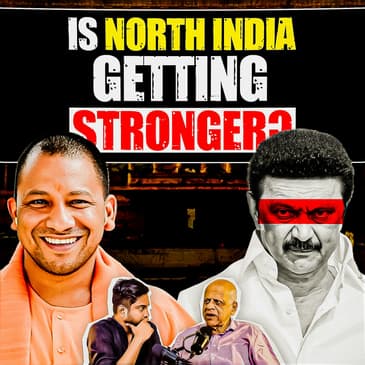
In this episode of Bharatvaarta, host Sharan engages in a deep and insightful conversation with Professor Goutham Desiraju from the Indian Institute of Science. The discussion revolves around Professor Desiraju's follow-up book on the delimitation of states in India, a pressing and contentious topic in contemporary Indian politics. The conversation addresses the need for equal value of votes across different constituencies, the historical and political context of the delimitation freeze, and the implications of reconfiguring state boundaries. Professor Desiraju provides a comprehensive analysis of how delimitation, if done scientifically and fairly, can help India become a more balanced and prosperous democracy. The episode also touches on the broader themes of governance, the effects of linguistic states, and the importance of electoral reforms in achieving a true global leadership status for Bharat by 2047.
Topics:
00:00 Introduction
01:37 Discussion on Delimitation
06:57 Historical Context and Current Issues
11:19 Challenges and Future Prospects
18:35 Demographic Concerns and Solutions
38:58 Linguistic Politics and British Influence
43:05 The British Strategy Against Orissa
43:48 Linguistic States and Social Silence
44:37 British Influence on Local Languages
46:35 Historical Repetition and Linguistic Demands
47:26 Gandhi and Linguistic States
50:17 The Role of Language in Identity
51:25 Jesuit Influence in Tamil Nadu
54:48 The Evolution of Language and Identity
01:06:19 Small States and Governance
01:13:09 Concluding Thoughts on Delimitation
Buy the book
Amazon: https://amzn.in/d/aetUjcS
[00:00:00] Delimitation, if it is going to make any sense, has to be population based. So when the constituencies are delimited on a population basis, we will have more Lok Sabha seats in the urban areas, without a doubt. There is no direct solution to this problem today that the southern states are over represented in the present Lok Sabha.
[00:00:20] So actually Mr. Stalin should press for an intra-Tamilnadu delimitation, so that where the people are really living they should have, the number of seats in Chennai should be reduced. Put your own house in order before you start howling about North India. When we made the plan for 75 small states of roughly 2 crore population each, four states ended up with a Muslim Mujabic. The first is Kashmir. The second is Hastinapur, which is the region just outside Delhi with Meret.
[00:00:49] The third is what we call Kamtaapur, which is in the chicken's neck area, Kuchbihar, Malda, Murshidabad, that part, bordering Bangladesh. And the fourth of course is Malabar. This constitution cannot go on and on with amendments. We need a complete reworking of the constitution more in line with a Dharmic constitution with a Hindu Rashtra.
[00:01:18] Namaste, welcome back to Bharatvaarta. My name is Sharon and I am your host for this program. Last year, we did a very interesting conversation with Professor Gautam Desiraju of the Indian Institute of Science. He had come out with his book Bharat 2.0.
[00:01:34] It introduced a lot of bold new ideas that our civilization requires going forward in the future. He has written a follow-up book, a slightly different one if I may, focusing particularly on the delimitation of states in India. What ideas, what regions can be introduced, why it's actually very beneficial for us, how we need to be more outward looking rather than inward looking and focus on internal divisions.
[00:02:04] What bold new ideas, what bold new ideas Bharat requires to become a true global leader by 2047. And it's been endorsed by the who's who of academia, journalism and the intelligence here in India and across the world. Professor Desiraju, thank you so much for giving us your time, sir. Welcome to Bharatvaarta.
[00:02:28] Thank you, Sharon. I am happy that we are talking together again. And thanks to Bharatvaarta for organizing this conversation about delimitation, which has become a hot topic, if I may say so, in the last couple of weeks or so.
[00:02:54] Yes. Let me begin with the current political context. Chief Minister Stalin in Tamil Nadu and followed by Chief Minister Sidramaya in Karnataka have criticized the center's attempts to even think about the idea of delimitation. Now, that's one part of politics which is quite obvious.
[00:03:20] But why is delimitation so urgent, so necessary and so important? Well, India is a democracy. And in any democracy, there is something called an election. And in something called an election, there are voters who go out there to the polling stations and cast their votes.
[00:03:48] It is an almost instinctive idea that in any democracy, and there are, I think, 50 or 60 functioning democracies in the world. Basically, they have free and fair elections. And when the people go to the polling booth and cast their votes, the implied idea is that the value of your vote for any individual should be the same all across the country.
[00:04:15] Let's take a practical example with reference to India itself. We have the Lok Sabha, which at the present time has 543 elected members. These are the MPs. Now, the idea should be that each of these MPs is elected by the same number of people in their constituencies. So, 543 MPs means 543 constituencies.
[00:04:44] And today we are physically located in a constituency called Bangalore North. So, there are so many voters here. They go and vote. Now, the idea should be that in any constituency in the country, roughly the same number of voters exist. In this way, each member of parliament, each one of those 543 members,
[00:05:12] has roughly been elected by the same number of people. which means, in turn, that the value of the vote all across the country will be roughly the same. And this will then satisfy an essential requirement of our constitution, namely Article 14, which says that the state shall treat all its citizens equally. So, my rights and privileges,
[00:05:41] and dare I say duties as a voter, would be the same whether I live in Bangalore North, or whether I live in Ladakh, or whether I live in Chennai Central. It should not matter. And this is the essence of what I may say, is what delimitation is all about. Delimitation fixes the sizes of these constituencies.
[00:06:07] So that the number of eligible voters in each Lok Sabha constituency is roughly the same. It cannot be exactly the same, but roughly the same. And when we started off our exercise in 1950, each constituency of the Lok Sabha, I think it was about 450 seats in those days, each constituency had something like 3.5 lakh voters. And they were all reasonably equally distributed in those days. What has happened today is,
[00:06:36] and we will come to this, is that the number of voters in our constituencies has now become grossly unequal. That's the beginning of the problem. Because of creation of more urban centers, a lot of internal migration happening, we see that cities like Bengaluru, for instance, just has about 3 or 4 Lok Sabha constituencies for that matter. Mumbai has a slightly higher number.
[00:07:06] But we do see that, you know, for most of the year, a person comes to a city like Bangalore or Mumbai, stays there, lives there, works there, eats there, sleeps there. And finally, when it comes to voting, he goes back to his hometown and votes. And that's unfair for both, where he's coming from and where he's living, because that sort of creates that disparity. It's a peculiarly acute problem in Bengaluru and Mumbai,
[00:07:34] where the number of migrant workers is very large. But look, delimitation in itself is good. It is something that needs to be done in any democracy. And all electoral democracies in the world are liberal democracies. There is a subtle difference between what the West calls a liberal democracy and what they call as, they call as an electoral democracy. But, and that difference is outlined in chapter 1 of our book. But,
[00:08:04] that aside, any kind of a place where there is free voting, as is true in India, delimitation is required. All the other major democracies, France, Germany, UK, New Zealand, Australia, USA, the delimitation is almost automatic. And it occurs, let us say, every 6 years, every 8 years, every 10 years. And it was happening in India, automatically,
[00:08:33] from 1950 to 1976. And, at that point in time, and that is where the problem began, which is what the book is all about, Indira Gandhi, who was the then Prime Minister of the country, put what was called a delimitation freeze. In other words, she said, that the sizes of the Lok Sabha constituencies,
[00:09:02] as they existed, in 1976, and that is based on the 1971 census. Because viewers of the program will appreciate, that, for any delimitation, you need a recent census. Because unless you know, how many people live in, what part of the country, you will not know, how to delimit the constituencies. Correct? So, you need a census. So, usually what was happening is, the census of India was held in,
[00:09:32] 1951, 1961, 1971, and so on. So, on the basis of the 1971 census, the constituencies were delimited. So, what Mrs. Gandhi said is, those constituencies, that existed in 1976, and let's not also forget, as an aside, that she passed this delimitation freeze, during the height of the emergency. So, where there was no proper discussion, even in parliament at that stage.
[00:10:02] So, she said, that, the constituencies, as they existed in 1976, will remain frozen, for a period of 25 years. So, you add 25 to 1976, you will get 2001. So, the freeze got over in 2001. At that point in time, we recollect,
[00:10:29] that the government in power in Delhi, was the Vajpayee, NDA government. And, that government, had a choice, whether to, remove the freeze, or what else to do. Now, it turns out, we all know this, that the NDA government of Vajpayee, was, particularly dependent, on the support, of the allied parties.
[00:10:59] And, some of these allied parties, were not in, favor, of removing the freeze. Because, don't forget, 25 years is a long time. And, all the parties, had gotten used to, these constituencies, being the way they were. And, they probably adjusted, their small things, to make the electability, of their candidates, better, in this. I mean, they forgot the basic idea, of delimitation. The fact that, the vote should have equal value. They worried more,
[00:11:29] about their individual parties, advantages and disadvantages. So, they had adjusted, their political realities, to suit the constituencies, of the day. So, the alliance partners, were not, apparently, very keen about it. And, as a result, and rather, regrettably, if I may say so, the Vajpayee government, decided to continue, the delimitation freeze, for another 25 years. So, add another 25, to 2,000, than 1,
[00:11:58] you get, 2026, which is next year. So, the, second freeze, 25 plus 25, 50 years, we have had a, delimitation freeze. That's going to get, over next year. So, that's why, the million dollar question, which is why, the Tamil Nadu, chief minister, and Mr. Siddharamaya, they are all, saying something. And, which is why, the home minister, felt obliged, to say something, in parliament, because everybody knows,
[00:12:28] that 2026, is not so far off. So, the million dollar question is, what will the present, BJP government do? Hmm. Thank you for setting the context. Do you think, this also partly, one is that, it's a, it's an exercise, that, has been scheduled, over time. But, secondly, there seems to be, a sense of urgency, because, they've seen that, several reforms, have actually failed.
[00:12:59] And, the young India, is growing desperate, because they want, they have tasted, reforms, and they want more reforms, they're desperate to grow, in their 30s, and their 20s. And, they want to actually see, an India, completely developed, by the end of their lifetime. And, the current political class, perhaps, and this is my opinion, somewhere also realizes, that, they've not been able, to live up to the expectations, of the young people. Which is why, you see,
[00:13:28] many more people, you see brain drain, continuously, you're seeing people, crossing over borders, jumping over fences. It's an unfortunate sight, but it is what it is. So, the delimitation, exercise in that sense, is long overdue, yes. But, is it also, an attempt to introduce, urban polity, more strongly, and move away from, say the, agricultural politics, of the past,
[00:13:58] well, delimitation, if it is going to make, any sense, has to be, population based. The migration of people, from villages, to the cities, is a reality today. So, when the constituencies, are delimited, on a population basis, we will have more, loksaba seeds, in the urban areas, without a doubt. government. And yes, although it is not,
[00:14:28] directly intended, I think it will achieve, what, the present BJP governments, wants to achieve, and that is to, bring in more, voting power, where the population centers exist. Finally, remember, one of the things, we say in the book, at the, back cover of the book, we say that, each vote, same value. So, each vote, must have the same value.
[00:14:56] I will give a small example, since I have mentioned, Bangalore North, and Chennai Central. Bangalore North, today, has about, 31 lakh voters. Chennai Central, which is also, another big, urban agglomeration, has got, 14 lakh voters. So, in other words, the value of a vote, in Chennai Central, is double the value, of the vote, in Bangalore North. So, this must go. You know, you and I both, I think,
[00:15:26] are registered voters, in Bangalore North. Our vote is not worth much, compared to the fact, suppose both of us, were living in Chennai Central. Our vote would be worth, double what it is worth, here today. So, in other words, I can ask, is the state not penalizing me, for living in Bangalore North? In a way, it is. And, so, if the, delimitation is done properly, if it is done fairly, It should be three constituencies, in Bangalore North, instead of one. It can be three,
[00:15:56] it can be seven, but, it has to be equal, in population size, to any constituency, anywhere in this country. Whether it is, Hoshyarpur, or whether it is, Buldana, or whether it is, you know, Mirzapur. I don't care, where the constituency is. Each Lok Sabha constituency, must have the same number of voters. Otherwise, otherwise, delimitation doesn't make sense. I think, the real fear that I have, is that, this government, because of,
[00:16:27] so many compulsions, or their, inherent tendencies, will try to go for, very small, microscopic, delimitation changes. You know, of the sorts they did in JNK. Moving a few things, districts here and there, drawing a few lines, redrawing something. And so, these become like, so micro changes. At the level of the individual constituency, this delimitation exercise, should not be,
[00:16:56] constituency dependent. It should be of an, all India nature. A solution, see this, there is no, direct solution, to this problem today, that the southern states, are over represented, in the present Lok Sabha. There is no, getting away from that fact. The south is, over represented today. Over represented or under represented? Over represented today. Because in comparison, to the population, this is what happened,
[00:17:25] because of Mrs. Gandhi. Because the population, of the southern states, has not grown, the way in which, the population of the northern states, has grown since 1976. So as a result, the constituencies, are still the same, but the number of people, is less, no, compared to, the number of people, per constituency, in Tamil Nadu, and Bihar, are in the ratio, of 175 to 261. Which roughly means, that the,
[00:17:54] vote in Bihar, is only worth, half the vote in Tamil Nadu. So yes, the south is definitely, over represented today. And the north, may well ask, what sin have we committed? Simply because, our population is large. And then the argument, of the south saying, but we are richer, and we didn't, we followed family planning. That, doesn't hold water. Because, delimitation and elections, have nothing to do, with all these things. It has only to do, with how many people, are living there. We are all citizens of India,
[00:18:24] you know. We are all citizens of India. So it should not, that, then it should not matter. And then you cannot say that, because we are rich, you give us more votes. That becomes very arbitrary. So on the one hand, the southern states, saying one thing, and the northern states saying, you know, we, Mr. Amit Shah said that, the Tamil Nadu, is not going to lose any, seats. That again,
[00:18:54] he is misspeaking. Because, it cannot be otherwise. What he is, what, the BJP is dreaming today, is impossible. How can they do delimitation, and properly, and Tamil Nadu, not lose seats. It will lose seats. So they have to, I mean, this is a basic, arithmetic problem. And, which has now become, a political problem. And remember that, we have been, we have been a republic, for 75 years.
[00:19:23] Out of the 75 years, 50 years, we have had this delimitation freeze. If by some, mischance, the government becomes, so feeble, that they, continue the delimitation freeze, for another 25 years, then I think, we may even stop, calling ourselves a democracy. Because then, the value of the vote, in these oversized, urban constituencies, will be so small, that it practically, won't be worth anything.
[00:19:53] So, one strong argument, that the southern states, are doing, is that, we have effectively, controlled our population. So in that sense, why should we be, penalized for it? At the same time, it's a practical reality, that the northern states, for whatever failures, or for whatever shortcomings, have exceeded, populations, that we, couldn't possibly imagine, 30, 40 years ago, that it would grow, to this extent. And it's an administrative, necessity, to have more legislators, to have more members, of parliament,
[00:20:23] being represented, from, say, Uttar Pradesh, or Bihar. Because you can't, possibly administer, a state, that has 22, crore people, with just 80 people, in the Lok Sabha. And it's a reality. So how do we, arrive at a consensus? See, you have mentioned, I think, two or three separate points here. Firstly, let me make myself, very clear. There is no question, of rewarding anybody, for following family planning. And it is also, a fallacy,
[00:20:53] which has been spread, in this country, that, because, the South, followed family planning, which it did, it became rich. Think of what I am saying. This is a fallacy. It's the opposite way. It is the opposite way. Exactly. Because it became rich, it followed family planning. Correct. So there is no question, of, rewarding somebody, and saying that,
[00:21:23] we will give you more seats, because you followed family planning. You followed family planning, because you followed family planning. With the same logic, the North East is also going to ask for a lot more. The North East is going to ask, and let me say about North India. Compared to the South, there is distinct, demographic differences, Hindus and Muslims, in the North, especially in UP, which is the problem state. Yeah. And here, the rates of population growth, are quite different.
[00:21:53] Okay. It is true that the, rate of population growth, among Muslims is falling. I think, it used to be 3.6, and now it has come down to, little above 2. 2.2 or something like that. It has fallen. But it is still higher than the Hindu, rate of population. So, the increase in, population in Uttar Pradesh, can also be, attributed to the 20% Muslims, who are there. It is undeniable. So,
[00:22:22] in that case, are you going to penalize everybody, because one group is, reproducing faster than the other? Also, they have a right to reproduce. I mean, this is, again, you cannot tell somebody, please don't reproduce. This is what China tried to do. And we see where that, let the economic, misfortune, that befell that country, because they, implemented this, one child policy. Even those things, are all unwise. You know, various countries,
[00:22:51] have tried various things. We should never feel in India, that, oh, our problems are unique, and we are very special. And so, these things are very special. Tamil Nadu is very special. Uttar Pradesh is even more special. No. These are all common problems, faced by democracies. But, historically also, these planes have had, those characteristics, right? Because, there would be fertile lands, and you know, Definitely, more people will go, where it is more fertile. Same case with eastern China as well. Correct. So, in other words,
[00:23:21] all this is only coming back to the main thing, that something called delimitation, should be automatic, and, should be going on, independent, of who is in power in Delhi, I say. It should not depend on the personality, of the prime minister, the present prime minister, the present home minister, his likes, his dislikes, should not come into delimitation. Delimitation is a very formal thing. Scientific exercise. Scientific exercise. It has got to do with elections. And elections, people have had elections,
[00:23:50] ever since the first democracy started in Greece and ancient India. Election is nothing new for the human race. A group of people get together, and in the page one of the book we have written, Decide your leader. You decide a leader, because all the people can't go and, although democracy means rule of the people, in physical form, 1.4 billion people can't go and rule the 1.4 billion. We select some people, and we tell them, right, right boss,
[00:24:20] we are electing you, you go and sit in the Lok Sabha, and represent us properly. If you, if we don't like what you are doing, we will remove you after five years. It is plain and simple. So, we do elect people, and that should be completely neutral. I repeat again, my real fear is, that, the delimitation exercise, if and when it happens, should not depend too much, on the personalities of the present Prime Minister,
[00:24:50] and the present Home Minister. If that happens, then that will not be so good. I will make myself very clear on this. Fair enough. But when this exercise is carried out, there is always, a sense of concern, with respect to demographics. Now, in the map that you have proposed, and the map can be put up, there are say 50 or 75 states, for whatever practical reasons. The number exact doesn't matter. Sure.
[00:25:19] You talk to anybody from Uttar Pradesh, for instance, the idea that, UP should be divided into four states, has been endorsed, has been there for a long time. But the excuse that I often hear, is that, say, especially Western UP, there is a demographic disadvantage. You don't want another Kashmir, being born out of there. How do we address, these issues at a, micro, say, individual constituency level, and also keeping the larger linguistic politics,
[00:25:48] and the baggage of it, in our minds, how do we make sure that the people realize that, you need to put sentiment aside, you need to bring science, into the whole exercise, into the whole exercise, and be practical about what necessities we have as a nation today. Okay. This is, a question that I have been asked very often. And it is a natural concern,
[00:26:16] of a country that was, split by partition, where the, majority of the Muslim community, decided to stay back in India. This is the other, strange fact about partition. That although the Muslims, wanted a separate country for themselves, and voted overwhelmingly, for that separate country, in 1946, the majority stayed back. And this is a,
[00:26:46] separate point, which needs to be looked into. It doesn't, come directly into delimitation. Now, when we made the plan for, 75 small states, of roughly 2 crore population each, based on geographical, cultural, linguistic, historic, administrative reasons, four states, ended up with, a Muslim majority. And I will enumerate them. Okay. The first is Kashmir.
[00:27:16] The second is, what we call Hastinapur, which is the region, just outside Delhi, with Meret, the so called Western UP. The third is, what we call, Kamtapur, which is in the chicken's neck area, Kuchbihar, Malda, Murshidabad, that part, bordering Bangladesh. And the fourth, of course, is Malabar, which is in the northern part of Kerala. So, here we have four states, which will have a distinctly, Muslim majority.
[00:27:46] So, the question that is asked is, will these become four Pakistans, in the future? I am speaking bluntly and frankly, because, the time has come, Sharon, in India, where, common people, ordinary people, who are educated, must start speaking honestly. There is nothing wrong, in using the word Muslim. This is, will be four Muslim majority states. What will they do? Now, my answer to this question, is firstly, each of these states, is only two crore in population.
[00:28:14] What can a two crore state do, in a country of about 150 crores? It cannot do much. The second thing, which we have also asked for, in the last chapter of the book, is delimitation, and in general, any kind of reworking, of the constitution itself, which is something, that was illustrated, more vividly, in my first book, which is about, the constitution itself, and not about just, one aspect of it, which is delimitation,
[00:28:44] which came in the second book. So, when we talk about, reworking of the constitution, which is a must again, this constitution, cannot go on and on, with amendments. We need a complete reworking, of the constitution, more in line with, a dharmic constitution, with a Hindu rashtra. So, we do need that. But, when we, put such a constitution, in place, it must come, these small states, of two crores, firstly, they can't do too much.
[00:29:14] They, two crore place, cannot suddenly say, I'll declare myself, as Pakistan. The second thing is, it must come, with adequate, powers, to the central government. Right. So that, when there is the slightest, sign of trouble, in any of these four states, equal to centre. It must be, with a draconian, counter reaction, where, excuse me, the supreme court, has nothing to say, about this. This is very important,
[00:29:43] because one of the things, we have asked for, in a new constitution, is the present, system of the supreme court, and the courts, is shabby, and it is a disgrace. It is an insult, to all of us. The fact that, a bunch of, unelected fellows, can finally, you know, have the last word. As it is said, the supreme court, is not, the last word, because it is correct.
[00:30:13] It is correct, because it is the last word. Nobody has any word, after the supreme court. So therefore, they automatically, become correct, about everything. This state of affairs, cannot continue. The collegium system, also must go. Because anything, that we have recommended, in delimitation, or constitution, and all that, can be, made into a joke, with just one midnight hearing, by one prominent, supreme court lawyer, who knows one judge,
[00:30:42] very well. The system is too vulnerable, at the supreme court level. So as far as, these four states, only are concerned, center must be armed, with draconian powers. As we cannot, afford to have, the supreme court, coming into the, event of these four states. So one must be, very clear about this. Today, President Trump, in America, when he is talking, to the state of the union message, he is a blunt man, who is doing,
[00:31:12] what he was elected to do. And today, the people of India, have elected, this BJP government, to do all these things. They have not elected them, to just you know, go and open ribbons, and cut ribbons, and do all these things. And just to say, we are Vishwa Guru, we have not elected them, for this purpose. We have elected them, so that India, becomes a prosperous country, economically. I want to see this country, becoming 10 trillion, by 2030. Is this government, in a position to do that?
[00:31:42] If we go on saying, that we will do this, we will do that. And actually, not do something. Then people will, simply vote them out, in 2029. They will say, Chalo, enough. We have given you, 15 years chance, what have you done? I think, being a political party, which is very savvy, and very clever, they are aware of this. It is not, I am not telling them, anything new. But let me put it this way, delimitation, a proper delimitation, with small states, could be something, which generally, people in India,
[00:32:12] approve of. Because nobody, Sharon, will feel, discriminated against. The chief minister, of Tamil Nadu, will never feel, that Tamil Nadu, is being discriminated, against, and cut up, into four states. If he is told, that Karnataka, is going to be cut up, into seven states, and Andhra Pradesh, or original, will be cut up, into three states, Talangana, Raya La Sema, and Coastal Andhra, Sema Andhra. So, nobody will feel, discriminated against. Similarly, the present Maharashtra, is,
[00:32:41] will go into, five or six states, by our plan. So, nobody will feel that, because then we will, actually, it will bring us all together. Because, we will feel, this is something, for the good, of this nation. Nobody is taking it, out on us. You know? And I think, today, the present problem, with some of the opposition states, they are not, they are not bad places. It is just that, for various emotional reasons, they feel left out. Yeah. This is very real, we have to acknowledge that. And,
[00:33:12] they feel left out. And if you feel left out, you don't make him, feel included, by just saying, no, no, we like you, we like you. He is not going to, be convinced by that. He has got to show in actions. What, according to you, are the challenges, right now? The first challenge is that, the present, ruling party, and, the majority, it enjoys in parliament, will just make some small, higgledy-piggledy changes, in this delimitation.
[00:33:42] Firstly, I am, hope that the census, is completed properly. Because census, is a prerequisite, for the delimitation. But, we are also free to use, the 2011 census, as a worst case scenario. It is a worst case scenario, but it is such an unsatisfactory scenario. Because, a lot of migration has happened, in 10 years. it has happened, the urban migration problem, has only occurred, after 2011. Correct. So, I think, in that respect, it is, and I mean, after waiting 50 years,
[00:34:12] you want to go to, some second hand, 15 year old census. You know? And, because then, people argue that, the 2011 census, as you have just said, is not very accurate. Bangalore constituencies, and, okay, another thing, let me tell you. The reverse problem, has occurred in Tamil Nadu. And this is something, that Mr. Stalin, should be told about. Tamil Nadu, has got,
[00:34:41] 39 Lok Sabha, constituencies. Yeah. I think, five of them, are in the, Chennai, metropolitan, area. So, Chennai, metropolitan area, has only got, three and a half percent, of the population, of Tamil Nadu. But it has, thirteen and a half percent, of the seats. Whereas, there are districts, like Ramanathapuram, Tirunalveli, Virudhunagar, which are very heavily populated, which just have, one and two,
[00:35:11] Lok Sabha seats. So, actually, Mr. Stalin, should press, for an, intra-Tamil Nadu, delimitation. So that, where the people, are really living, they should have, the number of seats, in Chennai, should be reduced. Put your own house, in order, before you start, howling about, North India. This is something, see, once you start, doing it scientifically, Sharon, lots of inconvenient, things will come out. And as we have said, we have said in the book,
[00:35:41] that this delimitation freeze, it has affected, all the parties. It has affected, the Congress, it has affected, the BJP, and it has affected it, both for the good, and for the bad. So, I think, it is, such a shabby idea, to start with, that, to come out of this, mess, is going to take, some very, clear thinking, objective thinking, should be put in. And that is why,
[00:36:10] Professor Joshi, when he writes, I think, the very first, sentence, in his forward, he says, in their latest book, Delimitation, and States Reorganization, the authors, Gautam R. Desiraju, and Dikit Bhattacharya, taking a clue, from science, taking a clue, from science, of all things,
[00:36:40] and realizing, that Bharat, is a civilizational state, and is a complex system, aware and argue, that electoral delimitation, and states reorganization, must be held, simultaneously, so that, each vote, same value, and each state, same heft, can be achieved, without, continuous, political, interference, he has given, a summary of the whole book, in just one sentence, scientific, taking a clue,
[00:37:10] from science, it is a complex system, complex system, is a word, which is peculiarly used, in the scientific literature, because complex system, is differentiated, from a simple system, so Bharat, is an ultimate example, of a complex system, so he has realized, and, which is what he has written, so nicely in the forward, that this must be taken, not, from the view, of the electoral advantage, of the BJP, in 2029, let me be very clear, about this,
[00:37:40] if this delimitation, is done, taking into account, only the electoral advantage, of BJP, in 2029, believe me, it will be a failure, and, the solution, we have proposed, equal states, is something, that has been spoken about, long long ago, it was spoken by, Professor Deendayal Upadhyay, in the days before he, there was even a Janasang, even from the 1940s, he was talking about this, the fact that,
[00:38:09] actually the Constituent Assembly, lost a brilliant opportunity, they should have reconfigured, the states right then and there, they stuck on to the, British division of the states, I say, whatever the British, had put for their, economic interest, and those princely states, and all that were cobbled together, let's take our own state, for instance, we had a beautiful state, in the Mysore kingdom, the original nine districts, of old Mysore state,
[00:38:38] that was a beautiful, homogeneous, well governed, well administrative, multi religious unit, there was nothing wrong, with that old Mysore state, then suddenly, in the name of linguistic states, and by the way, the book is a, strong critique, of the linguistic state idea, and we stand on the shoulders, of Dr. B.R. Ambedkar, because in 1955, itself, he has written a, beautiful little pamphlet, on linguistic states, where he said that, this whole idea, of linguistic states,
[00:39:07] is some aberration, that was given to us, by the British, it has nothing to do, with our indigenous thing, and he says, this linguistic state, is something that is, in the bane of this country, so when you, come back to this, in the name of linguistic state, Sharon, the present state, of Karnataka, was configured, then you brought in, what they call, Hyderabad, Karnataka, Bombay, Karnataka, so many things, those seeded districts, Bellari, why should Bellari, come to Karnataka,
[00:39:37] it should have stayed, in Andhra only, but then they, took Bidar, but they took, Usmanabad, from the Nisam's dominion, and put it in Maharashtra, so they did, lot of crazy things, in the name of language, and so today, even if you go, there is, you know, a consistent demand, in northern Karnataka, that it should be, a separate state, Belgium and Bangalore, are very far away, from each other, Gulbarga and Bangalore, what is the commonality, between these two places, can I ask, today we have leaders,
[00:40:06] who are from that part, ruling Bangalore, although they have, zero contributions, made to the city, so finally, the politician, is not even representing, the people, among whom he is living, Prof, I want you to explain, the, you gave the context, of Dr. Babasab, Ambedkar, and how, linguistic politics, was, a strategic, tool, of the British Empire, to make Indians, fight among each other, yes, you have, very, very, lucidly,
[00:40:36] explained this, using the, Odisha and the Bengal, example, it was the first example, page number 42, 43, so let's begin, from there, let's begin, and by the way, like all the sources, are available in public, Prof, Desiraj, has one of the highest, H index, he's, the greatest authority, who could possibly, write a book, on this subject, so any of the historical, sources that we cite, that we discuss, are from peer reviewed, journals, books, articles, and what you may, so,
[00:41:07] how did the British, take advantage, of the language, this came at a time, when there was a sense, of unification, around 1857, and years prior to that, people were starting, to get tired of colonialism, and continuous invasions, they said, we will put all our differences aside, we will come together, and that is when the British, came up with certain ideas, you know, Britain, is called, perfidious albion,
[00:41:38] if you, know the expression, perfidious, it is a word, in the English language, which suggests, certain sinister character, a certain criminal character, and a certain level of, crookedness, albion of course, is the old name, for England, so perfidious albion, is what they are called, right, and I believe,
[00:42:07] in my opinion, they are one of the most, cunning races, to have ever inhabited, planet earth, so, you must look at the situation, in 1858, when the, administration, of what was called, British India, was taken over, by the crown, from the East India Company, the country was, by that time, already, bled white, by the East India Company, and, the people,
[00:42:36] were desperately poor, famines, were rampant, throughout the place, so, the British come, and they have to have, an administration, administration, and, the administration, needs lower level, human beings, to run the daily show, whether as, chaprasis, or clerks, or, let us say, lower level people, to, do the daily work,
[00:43:07] the traditional systems, knowledge systems, of India, had already been choked off, by the Macaulay, memorandum, of 1835, so, the teaching, in Indian languages, was then, removed, the British, only funded education, in the English language, and, only to the extent, of training people, who could take up, clerical positions, that's all, then, when they did all this, they had to give, these people, small jobs,
[00:43:37] but, in a very poor country, if you obtain, small amounts of money, with security, and consistency, and that's the only money, that anybody can earn, everybody, would only flock, behind these government jobs, and this is the origin, of what we call, this, Sarkari, Naukari syndrome, today, that only a government job, is given, that kind of status, because it provides, the only thing,
[00:44:07] which is important, in a poor country, and that is, financial security, you can be paid, very little, but if you know, that salary, is not going to stop, that is enough, in India, okay, Sarkari, Naukari, what did the British, then do? They had a concerted plan, against Odisha, because Odisha, had a continuous, history,
[00:44:37] of very warlike kings, who used to fight, everybody, who came in their way, even the Mughals, for the long time, the Mughals, the British, everybody, they used to fight them, and, they were very warlike people, a very ancient race, one must not, think about, Odisha, as a, new place, very old place, which is why,
[00:45:07] when I saw that incident, when that innocent man, who had put up, both Kannada and Odia board, he was targeted, by some goon, and we are absolutely silent, as a society, look, I have spoken up, where I felt insulted, about my language, I say that, nobody, anywhere, anywhere in India, should insult, matrabhasha, matrabhumi, no, they cannot, so anybody, abuses my language, my people, I will speak up, yes, but at the same time, it is, absolutely shameful,
[00:45:36] of you to keep quiet, when somebody is being attacked, in such way, when he is following the rules, when he is speaking, the local language, and you are absolutely quiet, why, because it is a convenient, distraction for you, have we descended, ourselves into, demons, that is what has happened, because of linguistic states, let me go back, to what the British did, these government jobs, the work in the government offices, was done,
[00:46:06] in a particular language, a local language, and the British decided, what the local language, was going to be, and therefore, in those days, Orissa was part of a huge, province called, the Bengal presidency, which included, today's West Bengal, today's Bangladesh, all of Assam, all of Bihar, large parts of Jharkhand, and, all of, most of, today's Orissa, that was the old, Bengal presidency, and,
[00:46:35] throughout this vast, territory, the working language, the official language, was Bengali, the British decided that, so, once you do that, knowledge of Bengali, becomes, almost compulsory, to get a Sarkari, Naukri, am I not right? Correct. And, this is where, the Odiyas, started feeling, dispossessed in their own place, a proud, warlike race, and, we have quoted, actually somebody,
[00:47:04] they talk about, the terrible Bengali, administrators, who would come to Odisha, and, basically, you cannot speak Bengali, and, then you are, you don't seem to be in control, of your own, ecosystem, or your own, local area. Interesting that, you should say this, even in recent history, you mentioned the, 1928, Motilal Nehru report. Correct. After that, whole, possibility, of a linguistic, redivision of states, was imagined,
[00:47:33] I think it was, Jayachama Rajendra Wadayar, who goes across, Nizam Karnas, Mataka, and he says, if we ever, were to involve, these parts of, other presidencies, we are doomed. I know this, I know this one, this reference. And the same, this happened what, in the 17th century? Yes. So, 300 years later, the same pattern, repeats itself. So then you see, then, the Odiyas, then started demanding,
[00:48:03] that Odiyya, be declared a, official language, for the, now, Tharkari Naokri. Then, Kherson, why I call them, Perfidious Albion? They first, divide Bengal, in 1905. And then there was a, public outcry. And then they, rejoined Bengal, after that. But, when they rejoined, they immediately, split off, Odisha, Bihar, and Assam. So, they finally,
[00:48:33] made Odisha, the first, most people think, linguistic state, they associate, Tamil Nadu, and South Indian. It all began in Odisha. And then finally, they got an, above all, this is again, sort of, has to be remembered. Even Gandhi came and said, I support an Odisha state, Odisha language state. Interesting. He said, we have mentioned that in the book. And again, it was only Ambedkar, who had the courage to say, that these linguistic states, will be the death of the country. And,
[00:49:03] he also says very correctly, and I think it's been, we have pointed it out, that, one state, one language is correct. That means, in each of our 75 states, small states. Have one language. You have the language, which is the local language, that would be like. The opposite is not correct. One language, one state. That means, all these people, who speak Kannada, must belong to one Karnataka. You are going against, what Jai Chandra Javadir said. So because, if you see, At the same time,
[00:49:33] the Kodavas will say, we need our language. The Tulavas will say, we need our language. See, how many, see, the thing is, it is better, to establish, these micro diversities. Absolutely. And, for me, actually, the key to the Bharat book, if I may say so. Because, I allude to some of these ideas, in Bharat also. Don't forget, that, Andhra was the first linguistic state. In a post-independent. In a post-independent era, in a non-Hindi speaking area. Sure.
[00:50:03] Andhra was the first of these states, that decided to split. Correct. So, you then had, two Telugu speaking states. Correct. In 2014. So, that tells you, the hollowness of this linguistic state idea. Right. And then, this whole business, and then you see, the earlier things you have said. Politicians only fan the flames. So, these Kannada warriors and all. Kannada deli matad beko. Leave Bangalore. Go away. See,
[00:50:31] this is all jingoism. Of a kind, once again, that the center should, also step in. There was a point when, people were being disrespected, and people said, ee tara madhbaradu. Namma nela, namma bahashe, namma jana, yestu mukhyano, bere ur kuda aste mukhyya. Correct. At the end of the day, speaking for one language, doesn't mean that you, call for secessionist statements.
[00:51:00] You are still a part of this country, and that is where people draw the line. We, you can, you are very free to speak for your language, for your people, for everything. No, Rapa, nam Bangalore nela dhi vi. You go to Jainagar, they will speak Kannada. There's hundreds of languages. You go to Indira Nagar, Tamil is widely understood. You go to Sadashivnagar, Telugu is practically lingua franca wa vera. And we have managed very well. We have all managed very well. Yeen problem, there is no problem here. English ala ipat varaita i da elle. Jivagli. So,
[00:51:29] the thing is that, finally, language is only a means of communication, it's a means of convenience. And by the way, the book, I hope, shows very clearly that language was, is, was not, is not, and will never be a basis of identity in this country. Never was. You go to Hampi, you will see inscriptions in Telugu and Kannada written together. Tomorrow, they will go and destroy Hampi because of that. They will say that. Kannada delhi matadbeko.
[00:52:00] Kick Telugu's out. Krishna dev raya gothir lala bagai lal bagai lal bagai kalita God alone knows. You know, burning rubber tires near city station. You know, this kind of thing. I think this is all flames which are fanned by the politicians. If I may... Linguistic states, let's be frank, this era is over. Correct. We don't have to worry too much about it 10 years from. Yeah, Prince Lisev, we had 543 of them and we bloody managed it very well
[00:52:29] even before we were independent. It's another story. We'll have another podcast on. How the 543 fell into Sardar's lap so easily. There's a story behind that. But that will be telling too much today. You page number 56 you explain how the Jesuits bring in this whole de-Sanskritization attempt in Tamil Nadu
[00:52:58] and we see that. We see the effects of it even today. Please explain to our audience as to why this otherization is happening today and that we feel that we are a different race, we are a different people, we are a different culture altogether. Although we are equally proud of the diversities that we hold within this landmass. See, this is an old story.
[00:53:29] There was this guy called De Nobili, this Italian chap who came to Madurai in 1606 and his mission of course was evangelism. He had to convert people to Christianity. So what he did was, which they are still doing in Tamil Nadu and Andhra, appropriate local Sanatini traditions and symbology and thereafter deceive Sanatanis into including Jesus in their pantheon.
[00:53:59] So they sort of, he tried to Christianize Sanatana. He called himself a teacher of wisdom, dressed as an ascetic, wore white dhoti and wooden sandals, carried danda and commandalo. He shaved his head and kept a shikha. He wore a three-stringed thread, appearing identical to Yajnopavita across his chest, claiming it to be, this is the funny part, a representation of the Holy Trinity, Father, Son and Holy Ghost.
[00:54:30] Claiming noble parentage, he approached high caste people as an equal. He also wrote a book called Krista Purana, like Brahmanda Purana, like that, Krista Purana, which used the style of the Sanatani Puranas to retell Jesus' life. Then, this is where Dravidianism began. He told the Tamil people that they are different and in fact, even till today,
[00:55:01] the Dravidian people, they don't say they are better or they are worse, they say we are different. And then it peculiarly concentrated down into the language. language. And they say that we are different because of our language. But these insecurities never existed earlier. Well, they were, the flames were fuelled since 1606. It has been building up. Let me say it is not something that
[00:55:31] just started with Periyar. Although Periyar brought it into a very, I should call him E.V. Ramaswamy. Why should I call him Periyar? I will not call him Periyar. So I will call him E.V. Ramaswamy, who was not even a Tamalian. He was a Telugu speaking fellow. He fanned the flames even more. What they actually did was, this whole false Aryan migration theory, all these things were brought in as part of the derivative movement to show that they are different.
[00:56:01] And that is why they obsess about their language being old. And this is something, Sharon, I have never understood. A language doesn't become great because it is old. I do believe frankly, I am speaking now very objectively. The greatest language I think in the world today is the English language because it is very new. It constantly changes itself. It is the language that has changed most often
[00:56:30] in history. It is the language with the largest number of nouns. It is the one which is capable of expressing the most subtle differences in meaning. And it constantly throws out old words, takes new words. You know, so a language, actually I would say that a language that is old probably has remained socially stagnant because language is only a consequence of social changes.
[00:57:00] A rapid, socially advancing, socially progressing country will also change its language. Like today if some person in India tries to affect some fake British accent like one of our prominent congress politicians. It looks, it sounds odd today. He may not be able to help himself. Careful, anytime anybody can switch over. So let's not. He may not be able to, you know, but it sounds funny because it is simply
[00:57:29] because nobody in England speaks like that today. The point I am wishing to make is that the language, spoken language goes on evolving. Correct. And it is based on the social realities of the time. I stay, it is only a means of communication. It is not some sacred holy thing that I have to preserve or something and then, you know. Hebrew died. Hebrew was brought back to life by the Israelis when they had their own country. It was a matter of convenience
[00:57:58] because here they had people from all over the world coming to Israel. They need a common language to speak. which again brings us to the idea of linked languages which is also another issue but again not directly connected with delimitation because the linguistic states issue is directly connected to that. So let's stick to the delimitation point. Okay. Yeah, because again if we get into that we will have to discuss the three language policy. Three language policy,
[00:58:28] the role of Sanskrit because that is also a very very important point because anytime you want to strive for a dharmic constitution and a civilizational state, such an idea without the Sanskrit language is a non-starter. So basically at some level of expertise all school children must be taught this language and must also be emphasized very very very clearly that the Sanskrit language is only a language it has got nothing to do with Sanatana Dharma.
[00:58:58] the language that is also used it is called Dev Basha but that doesn't make it an exclusive religious language. Correct. Because there is so much such good usage of Sanskrit. Secular Sanskrit. Sanskrit in Kannada I was able to easily pick up on Hindi and different other languages. Where is the religion in Kalidasa's poetry? Correct. Dr. Murali Manohar Joshi has written the foreword and it's quite a rarity
[00:59:27] that he does so. Tell me what perspectives did he offer you? You have had conversations with him. We were deeply honoured. We were deeply honoured when he agreed to write the foreword. Knowing also his advanced age, I hesitated before I approached him. And I found him to be most forthcoming, a person with a keen sense of humour.
[00:59:59] And he first asked me to, if I may spend a few minutes, to send him some of the articles I have written in general on this or any other topic. So I think he wanted to know a little bit about what I wrote. Then he told me that I know you have written this Bharat book. And unlike many of the people who
[01:00:29] have asked me to send them the book and all that, he has gone and purchased the book. And he has read the whole book first. book. And then, and only then he asked me for the PDF of this book. And this was around August or September last year. And over the course of three months or so, I had almost half a dozen to ten long telephone conversations with
[01:00:59] him on the topic of the book. He took it very seriously. And he was the one who told me about Professor Deendayal Upadhyaya's original ideas on small states. And he said this is something that even predates the jansan. So he said this is a very, very old idea. And in fact, he gave me to understand. He said that something that was there right from the beginning, you have put it in a practical
[01:01:27] form which now becomes implementable by the political parties. He says, now we know, we knew that he was saying something like this but now you have told us how this can be done. And in fact, I think some of the people who have written the blurb, I think let me quote here, I think two of them actually mention the same point. This is what Abhijit Chavda says.
[01:01:57] They offer a road map for transforming Bharat's political landscape. The book is essential reading for anyone interested in Bharat's democratic future and the evolution of governance in civilizational states. Civilizational states have to be governed in different ways from nation states. The mode of governance of a civilizational state has to be different. Now, this is I think a
[01:02:26] very, very important idea that this book is about governance and Bebonus says that it's a blueprint for constitutional renewal. If I may, we'll come to that. I have three quick questions for you, which I'm hoping to get your perspective on. With other multilingual experiments, quoting Yugoslavakia and Yugoslavia as
[01:02:56] an example, which have failed, how can India's state boundaries be reorganized without exacerbating regional identity politics and linguistic chauvinism? Quick answer, because we are in the same civilization. So, once the overall canopy and umbrella is the same, it will actually be welcoming of more languages. So, it has to be done on a population basis and not on a linguistic basis. Out of curiosity, what was Gandhi's views on linguistic?
[01:03:26] It was mixed. Okay. The fact that he supported Orissa as early as 1916 showed that he probably had thought about this idea. Being the practical man that he was. Or maybe he was just playing to the gallery? I don't think so. I think being, see, they were all practical people. In fact, I too hold the view that linguistic states was a necessary intermediate step between between the very old
[01:03:56] pre-British agglomeration of principalities and kingdoms and all and a modern Hindu Rashtra. The problem was communal. So, in order to escape the communal fires, you had to find a middle school. So, I think, even Andhra, I will say, the same thing happened in Madras presidency, Saran. The Telugu's were excluded from the jobs. And only Tamil speaking people could get those jobs. In fact,
[01:04:26] that was so bad that even the people in Mysore kingdom felt that the Tamil administrators were coming and dominating. That is why they put in these reservations in Karnataka in 1920. So, when they said that Kannada speaking people will get preference and so on. So, usually the causes of these political problems is always economic. And I think linguistic states was required in the beginning. But we should have been little smart in getting rid of them as soon as we no longer needed it. People like
[01:04:56] Rajaji tried to sustain it for a while but he couldn't. Rajaji Chawali. This was very common. The trains coming from Andhra, they would scribble with Chakra, Rajaji Chawali. So, the thing again is why do people get inflamed about language? Let's think about it a little bit more. The moment you start saying that only if you know a certain language you will get a job, then
[01:05:26] people who don't know that language start feeling angry. Why is there resentment? For example, people say that unless you have some knowledge of English, you cannot go into the higher echelons of the government or company, corporate world and all. That feeling is there and it should not be there. Somebody should be able to have a perfectly sophisticated corporate conversation in Hindi or Telugu or Marathi in a nice
[01:05:56] air-conditioned office somewhere in a big urban area. It's not necessary that I mean we have spoken today this interview could equally have been held in Kannada. We would have been able to do it. So it should not be that English for example is something that is a barrier, is an obstacle, is a hindrance to somebody coming up. Which is what Mr. Stalin is arguing. He says he fears that
[01:06:25] Hindi will be made into a barrier like this which will prevent the millions from entering some higher echelons of something, whatever. So there is an imagined or real feeling of grievance here. The feeling is imagined because if somebody wants a job especially in a tier one city, you know that the reality is that you need English for it and the state governments have also been pushing for it. Yes you do and no you don't. See what to do? India is a country in
[01:06:55] transition. So if these things that we are talking about will not be issues 15 years from now where people will be very comfortable with lots of languages and language will just be something that you know you pick up and go along and who knows I mean Take pride in learning as many languages as you can. That's what I tell people. Because I mean I can speak half a dozen languages I am able to speak to some extent. I mean I am not
[01:07:25] fluent except in English and my mother tongue. But I can communicate. The best example of a leader is P.V. Narsimha Oh my God. He was an expert in 1811. He was an expert. How does historical economic neglect influence demands for new states and can reorganization address these disparities? Take the example of Raelseema that has faced significant economic challenges compared to coastal Landra? Would a new state
[01:07:54] help or worsen governance? Firstly there is a dictum. The smaller state always helps. For example the people have more contact with their elected representatives. Administration becomes easier. The place is geographically smaller. More people know more people. Everybody feels part of the thing. But we discussed this the last time when we were doing a podcast for Baruch 2.0 that yes in principle we need smaller states
[01:08:24] for easier administration but it is no guaranteed success because if a Chhattisgarh can do well a Jarkhand may not. Well I have been travelled often to Uttarakhand and I have discussed this question often with locals there. And the consensus seems to be that it is not the small state that is bad but they said that we were unlucky that we had a series of extremely either incompetent or corrupt chief ministers. They said that it is
[01:08:53] more that was the problem. They said it was not the they all agree that Uttarakhand needed to be separated and this also reminds me you talked about Professor Joshi. He confessed because I asked him about why Rajpahi government had extended the freeze and because he was part of the senior member of that ministry which put the 2001 You told me that the numbers were a problem or that the allies may get upset but he also
[01:09:23] added convinced that it had to be delayed. He added that we knew that this is a good idea. He said the very small limited thing we could do was to make Uttarakhand, Chattisgad and Jarkhand. He said these three we were able to manage because I think because of the smallness of the thing and so he said this shows that we were basically for the idea. So there was no
[01:09:53] popular demand for these states to be created but people were happy when it happened. Jarkhand, you know when it started? 1916. No, in that sense you can argue for anything. people have been asking. People have been asking for small states. I would be very happy if my home is declared a new state. I mean, come on, not to trivialize any of these minds. We are already a state in our own mind but no, on a serious So
[01:10:23] practically we could do it with these three. He said and he said this shows that we are all basically for this idea which was I think an important admission coming from him. Because I did ask him directly. As I said we had many conversations and they were all free and frank. So I told him why did you, you know, why was the freeze done? He said politically it was not very easy, not possible.
[01:10:53] Almost as if to hint that Athelji might have removed the freeze if he had a chance. I think the political capital was just not there. Of course, that was the first time they even tasted power. final question before we sign off. Even the US and the UK have struggled with fair redistricting or gerrymandering. how can we avoid the same pitfalls in India
[01:11:23] whereas electoral constituencies or the boundaries are not manipulated so as to favour one party or one class? Well, gerrymandering is of US origin peculiarly and it was a big problem there. I think I have already at a certain point alluded to the fact that delimitation will fail if it is done only to suit the
[01:11:53] interests of the BJP in 2029 and basically this is gerrymandering. So, I will say it again that as long as the BJP doesn't try to do the delimitation only looking at its chances in 2029 it will probably work nicely and for this it has to be all India, it has to be uniform, it has to be something based on a scientific principle. And you know we are extraordinarily lucky and I
[01:12:22] think we are going to say this in couple of articles we write that for geographical, historical, cultural reasons. Somehow or the other we ended up with 75 states. This was a natural division which we didn't think it up because either you look at mythology, you look at Mahabharata, you look at modern commercial activities, you look at history, you look at the Muslim invasions, you look at anything. These 75 automatically
[01:12:52] fall into place. There is nothing artificial about these states. It is very very organic. And I do believe that this is almost a core of Bharat. And this was always meant to be like this. And if you try to move into something which is organic and natural, I think it will happen in a very spontaneous and easy way. I don't think excessive pushing will need to be done to convince anybody or anyone that you
[01:13:22] need this state or you don't need that state. These are all natural things. And I have, after the Bharat book, I have talked with so many common citizens all over the country. And almost all of them say, hey, we understood because we come from that particular region. Somebody from Kosal, he said, no, you have correctly caught that we are very different from the Odiyas. So he says, how did you get that? Yesterday, the other day, somebody from Karavali, I think, somebody from Mangalur,
[01:13:52] he said, he said, sir, how did you know this? Only we thought, only Mangalur people know about this word, Karavali. So I said, it's there in our daily usage. It's there in the daily usage, exactly. Why was a movie like Kantara so popular? So these are natural concepts. Why was the movie Pushpa 2 so popular? Because he uses Raelseema Telugu. The first time a major Telugu movie is not in that nice Vijayawada Telugu, you know.
[01:14:22] Godavari Telugu. More Vijayawada than Godavari. Any concluding thoughts? Concluding thought is, I urge the political leaders in whose hands ultimately the whole delimitation exercise will die, is that there is no alternative to doing delimitation using any basis other than population.
[01:14:52] Because only then you can achieve each vote same value. Second, equally important, is that the states must have equal importance. And the only way of doing that is to make each state of the same population. That way even the council of states, the rajasava problem will be solved. It will be solved. In fact, we will be in the very pleasant situation where we can go like the US Senate and say that each
[01:15:22] of these 75 states has two elected senators. senators. So, once you have two elected senators, happy, and finally we will get a man from Assam being represented from Assam and not Manmohan Singh. I will name names. I am not scared to name names because this is a fact. Of course, it is a convenient system. fact. So, Jai Shankar is representing Gujarat. Finance minister is from Karnataka. So,
[01:15:53] the anachronism of the Rajasabha will also end and Rajasabha will then be able to exercise what it was originally supposed to do. Like in the US, it is a bicameral system where both the houses have elected. See, the problem with Rajasabha today is that it is a kind of double election. Your vote is being used two times. First to elect the Lokasabha member, the assembly member, and then who will then elect the Rajasabha member. So, each vote is being used twice which is again a distortion.
[01:16:23] I mean, if you think about it. I think politicians must sit down and look at this analytically and not just worry about how to win the next election. So, you propose a direct election to Rajasabha also? Why not? Why ever not? In fact, that is what has been recommended here that you need and also it has to go over to the executive system. But those are all things for another day because the first past the post also has run its course. Correct.
[01:16:53] And most of our electoral distortions today are because of first past the post. Thank you so much Professor Desiraju. You've explored ideas that we've already had in the past and sometimes we don't need new ideas. We need to revisit what we already had, pick the best for what we need for the future and that's the way forward. These two books are a compulsory read for anybody who wants to understand how India or Bharat that is,
[01:17:23] is going to reform itself. So it's my personal recommendation and I don't do these sort of endorsements very often but these two books have to be a compulsory reading for any youngster to understand how serious of a problem India faces today and the possible solutions for it. Please do let us know your thoughts about whatever we spoke in the comment section below and subscribe to Bharat Varta. Thank you for your continued support. Do tune in next time.