
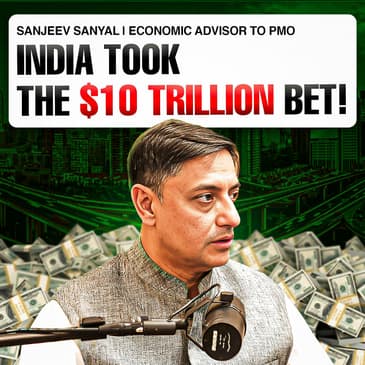
Join us for a compelling discussion with Sanjeev Sanyal, a distinguished
Member of Prime Minister Narendra Modi's Economic Advisory Council. We
delve deep into the intricacies of India's current economic policies and
its ambitious growth aspirations. Explore the strategic initiatives
driving India's development, the challenges and opportunities that lie
ahead, and the anticipated growth trajectory in the global context.
While the primary focus is on the Indian economic narrative, he also
offers his expert analysis on the broader global economic environment,
including the ripple effects of Trump's tariffs and the prevailing
uncertainty in the global stock markets. This episode provides a nuanced
understanding of India's economic future from a leading voice at the
heart of the nation's economic policymaking.
00:00 - India’s Growth, Restraint & the Free Trade Dream
01:00 - How India Plans to Navigate Global Trade Uncertainty
05:07 - Minimum Government vs Maximum Governance: India’s Gradual Approach
07:54 - Reform Pushbacks & Lessons from the Farm Laws
10:20 - Why Controlled Growth is Better Than Maximalist Growth
12:30 - Creative Destruction & Why Planning the Future Rarely Works
16:01 - India Doesn’t Need Uniform Thinking—It Needs Flexibility
18:04 - Meeting Historical Icons Who Shaped Turning Points
20:17 - Envisioning Bharat @2047: A Civilizational Comeback
23:57 - India’s Lost Maritime Legacy & Why It Matters Today
27:12 - The Population Debate: Fertility, Fairness & Federalism
30:30 - What India Must Prioritize to Reach the Next Growth Orbit
36:18 - Why Indian Industry Needs More Risk & Less Inheritance
37:20 - Adapt to Chaos: India’s Real Superpower
[00:00:00] Our ambition is to actually have a free trade agreement with the US, which is zero tariffs on both sides. And I think that would be good for both economies. I still believe the farm laws were generally speaking good for the farming sector. But obviously we had to backtrack because there were some losers and they were very vocal. My point that I have made is that to remain restrained at some point at this juncture is a good thing. This doesn't mean that we are not growing. We are still growing at 6.5% plus. We are a civilizational nation and the Republic of India is its modern manifestation.
[00:00:28] Southern India, I would argue, large parts of India should simply remove population control. Because otherwise we will, with a little bit of a lag, end up with the Chinese or Japanese problems. If you were to meet a historical personality or maybe one or two or three, how many of us? The people I would like to meet are those people who were there at certain turning points in history. How would you envision Bharat in 2047? I'll tell you what I hope it will be.
[00:01:00] Hello everyone, welcome back to Bharatvaarta. My name is Sharant. And today we are joined by a very special guest all the way in Delhi. He is a member of the Economic Advisory Council to the Prime Minister. He is a true polymath in a sense that he holds an expertise over several subjects. That's economics, geography, history, politics and several other subjects. He is an author of different books. And today he's joined us after several requests and taking some time out of his busy schedule.
[00:01:29] Thank you, Sanjeev. Sanjeev, thank you so much for giving us your time. Pleasure to be here. Let me dive right in. Now, Trump has announced tariffs and a lot of young people are also concerned about how global uncertainties are going to be, how they can navigate themselves through this. A lot of people are dependent on the stock market for their investments, for example. So, you know, how do you see this situation and what would your advice to young people be, say, sort of to navigate through all of this?
[00:02:00] So, first of all, the Trump tariffs are now just a few hours ago. So, you know, as a country, we will need to study this and see how we respond. But right off the bat, let me say that two thirds of India's exports are services, even of the ones that are, you know, the goods exports on which we have tariffs. Significant bits like, for example, the pharmaceuticals have been left out.
[00:02:28] So, while there will be, of course, an impact on India, I would say the impact is, will be limited for the time being. Now, that's the first order impact. The second order impact, of course, the turbulence it causes globally will, of course, have important second order impact. Longer term, however, our ambition is to actually have a free trade agreement with the U.S., which is zero tariffs on both sides.
[00:02:56] And I think that would be good for both economies. So, actually, that is what we would be working towards rather than try to wriggle room within this environment which has just emerged. I would argue that, you know, ideally, we would like to move into that free trade agreement. Now, longer term, the world will probably divide into two major supply chains. One will be a China-oriented one and there will be one which is a U.S.-oriented one.
[00:03:25] Of course, they'll trade with each other as well. And the likelihood if we do end up with a free trade agreement with, say, the U.S., maybe the U.K., the possibility of one with the European Union further down as well.
[00:03:40] The point to the matter is we would aim for being part of at least one of these supply chains, likely the U.S.-oriented one, and take advantage of that situation and build ourselves out into that supply chain. And, obviously, that will require a fair amount of flexibility and thinking on our feet by our policymakers, which we are prepared to do.
[00:04:07] It will also require Indian industry to really step up, take advantage of the opportunities it will create because we will have this huge big market. But it also means that there will be competition from foreign companies internally, which may not be there today. But then, at some point, Indian industry will have to adjust to all of these situations. Trying to protect our current status quo may not be an option at all.
[00:04:35] And I think our best interests lie in being as adjustable and flexible as we can be. Right. When we look at, say, the U.S. and the Doge reforms and the pushback against bureaucracy that's happening, it inspires several classes in India to sort of aspire for such a situation where there is actually minimum government and maximum governance, so to speak. But what are the challenges that are somewhat different in India in your experience? Because you've been holding this position for a while now.
[00:05:04] Now you know the intricacies within the government. So we have been trying to do many government efficiency efforts here in India for some years now. Our way in which we have gone about it, our approach has been somewhat different. So if you look at the U.S., the Doge effort by Elon Musk has been basically blitzkrieg. Go and do a whole bunch of things, suddenly shock and awe and do it. And maybe it works in their system.
[00:05:30] I personally think that some of it will be genuinely good for the U.S. in the long term in terms of getting rid of government wastages, etc., and so on. However, that approach also has its downside, which is that very often you may throw the baby out with the bathwater because you're doing too much too soon. And it's not possible under those circumstances to go each line item and optimize.
[00:05:57] You may end up with a lot of legal cases being dropped on Doge and so on and so forth. Eventually, you know, the unintended consequences plus legal cases, etc., there will be eventually a problem of sustaining this for too long. So as an initial shock and awe, get a lot of things done quickly. Maybe it's a good idea, but I think sustaining it is quite difficult. We in India have gone for what I think is a more slower approach.
[00:06:26] So we will be maybe told, accused of being gradualist. But we have gone about this one process at a time, one institution at a time. Now, it takes a long time doing this. I will admit and I'm sure that, you know, there is a case to be made for speeding this up now that we've gained some experience. But the way we have done it is much more careful. So we have indeed shut down several outdated institutions in the government.
[00:06:54] We have eased up lots of processes in the system. And of course, when you're doing it slowly, it means that while you're doing it somewhere else in the system, something else has become less efficient as well. So the net gain in the system is not always that large. You can argue if you're this slow. But we have, on the other hand, avoided having large number of cases. I mean, I've done many, many process reforms.
[00:07:22] So far, at least I don't have, you know, huge amount of litigation. Is it about taking everyone along? Because it's partly about taking people along, partly also about having, you know, crossed the T's and dotted the I's. Also thought through the unintended consequences. So supposing there's something where there is an institution or process, 80% of it is bad, 20% of it is decent. Now, in order to throw the 100% out, you will mean that you sacrifice 20%.
[00:07:50] It is possible when you do it slowly to take that 20% out and account for it in some fashion. Yeah. It is not possible in the Doge Blitzkrieg approach. So ours is attrition warfare. Okay. So attrition warfare does mean that you keep at it over time. And of course, as I said, you keep getting used to being slow. What's the cost of putting you on a spot? Like, let me ask you this.
[00:08:12] Do you think that, you know, that acceptability of reforms that we look at in India, for instance, we are trying too hard to convince people that this is... Sometimes that is true. For example, with the farm laws. Yeah. I still believe the farm laws were generally speaking good for the farming sector. Yeah. But obviously, we had to backtrack because there were some losers and they were very vocal. And the vast majority of the winners did not... So quiet.
[00:08:41] They remained quiet. So, yes, sometimes you have to backtrack as a result of this. But on the other hand, that is one case where you can see what happens when, you know, you try to do something somewhat more drastic. Yeah. And you will end up with a huge amount of opposition to it. And it will rerail the thing. So, it's not that this government doesn't do drastic reforms when necessary. So we have done a lot of structural reforms.
[00:09:10] I mean, whether it's the introduction of GST or, you know, the cleaning up of the banks and so on. So, fairly radical things have been done by this government. But the general momentum is carried down by these smaller process reforms which don't come into the front page. And most of these are efficiency gain things which Doge is trying to do. Doge is basically a government efficiency effort. So, we do government efficiency efforts all the time. Right.
[00:09:39] And I have extensively given talks about this as well. But do you think it came late for the US? Especially because, you know, I mean, people in the field of geopolitics argue that, you know, the empire is on the decline. No, you can't. You see, history is not some linear thing with nice curves. There's no doubt that President Trump is disrupting the existing system. If the existing system had perpetuated itself, there's no doubt that the US was in clear decline.
[00:10:07] And there is no doubt that something had to be done about it. Yeah. Now, whether this particular set of things that they have done will lead to good outcomes, one can debate that. And that you'll only know over time. Don't you think in the Indian context, at least we've perhaps we could have taken better use of many opportunities, especially in a post pandemic situation, say, when the global economy was recovering. You saw that many Southeast Asian countries sort of recovered very quickly.
[00:10:37] And so did we. As it happens to be, our growth accelerated as well very dramatically. In fact, we grew much faster than then. It's because in one of your interviews, you stated that it's not often a very bad move for us to sort of hold back, sit down and wait for the right opportunity to come down. No, no, no. You have misunderstood my point. My point is, you obviously have to recover fast, which we did. We recovered far faster than the Southeast Asian economies as it happens to be. Our growth was much higher. Right.
[00:11:05] But that does not mean you have to go for the maximalist growth of the fastest possible growth rate, because if you are growing fast, it also means the imports are growing fast. Right. By definition. Right. Right. Your energy needs go up. Now, in an uncertain environment, your ability to export at the same rate is the global situation. Like, look, what is happening now. Yeah. The global situation is uncertain.
[00:11:32] If you press the accelerator on a bumpy road, you will get thrown around and maybe your car will crash. That is the situation we are in. And that is the point we have made throughout. That, look, we are now growing it. We grew for a little while over 7%. Now we are growing at 6.5% to 7%. Right. Can we grow a little bit faster? I would argue, yes, we can definitely grow much faster. In fact, grow about 8% or so. At some point, we need to grow at those kind of 8%, 9% growth rates.
[00:12:00] But this is not the time to attempt it because, as I said, the external environment is too uncertain to be able to export at the same rate as we would import. So my point that I have made is that to remain restrained in some point at this juncture is a good thing. This doesn't mean that we are not growing. We are still growing at 6.5% plus growth rate, which is a pretty decent growth rate. But I am against this idea of trying to have a maximalist growth rate. In fact, as I said, even with this, we are growing faster than those Southeast Asian countries.
[00:12:30] We live in an era where, you know, NCR is expanding. Mumbai has now two different cities in its neighborhood. Bengaluru is expanding. Channa is catching up. But at the same time, you see many paradoxes in India, right? Especially when it comes to economics and even politics to a certain degree. You've been very passionate because you come from West Bengal. And we know that Calcutta was at the center of economic growth even during the empire.
[00:12:55] And it's very unfortunate that such a big potential economic center has not been tapped into. So how do you sort of pull together other states and territories that are left behind? So one important thing here, and there are several dimensions to that question. So one is the creative destruction and evolution issue. One is the geographical disparity issue. They're connected and I'll fill. First important thing is, look, when growth happens, you will get urbanization.
[00:13:23] You will get creative destruction of various kinds that will happen. Because the act of growth is driven by economies of agglomeration. So cities will grow. It is difficult to kind of plan this thing because exactly how this will evolve is impossible to tell. Okay. I mean, there is no way I could sit in 1990 and have planned how Gurgaon was going to evolve. Right.
[00:13:49] If I had attempted to heavily plan it, I would have ended up with something like Chandigarh, which doesn't have that kind of growth momentum. So chaotic as Gurgaon is, it generates that growth momentum. Organized as Chandigarh is, it doesn't. Right. So you have to be very, very careful that this is not about the ability to predict what is going to happen into the future. But creating the circumstances where uncertain things allow for creative destruction,
[00:14:19] which goes back to your very first question about what young people can do. And I'm trying to tell people the most important thing in young people is to remain flexible. Yeah. Be willing to work hard and take their risks. Okay. If your purpose in life is to have this grand plan about how these things are going to evolve, let me tell you, you're going to fail. The future cannot be planned. Nobody on the planet knows how it will evolve. The point is, the matter is to take some calculated guesses.
[00:14:45] Because some of it and sometimes all of it will go wrong. The great jobs of 15 years from now are unknown. Okay. Artificial intelligence will destroy a lot of jobs. It will also create a lot of jobs. I have no idea what those future jobs are. Okay. So therefore, the people who take advantage of those future jobs are people who are basically adaptable.
[00:15:11] After all, who knew that social media sort of influencer was going to be a job provider? Or doing this kind of podcast was actually going to be an activity that would be done by many people and they would be so popular and so on. In fact, there are now people who do podcasts who have followerships bigger than major TV channels. They're making a lot of money. Yeah.
[00:15:41] Raking in a lot of money. But nobody would have thought that that was going to be a career. Right. So the reason I'm telling you this is that similarly, AI will destroy some jobs. It will create new jobs. So the idea is to be able to respond to these opportunities at the come and not attempt to have some grand plan through some great wisdom and some projection, Excel sheet projection of past trends. You would never be able to guess all of this.
[00:16:10] Tell me, I'm always, you know, I wonder how difficult it must be for somebody like you. Because when you sit in Delhi, when you're thinking about how you can pull the country together, there are different mindsets involved. Like when we speak about young people, somebody from Bengaluru has a very different mindset. When I came to Delhi for the first time, it was a cultural shock for me, you know, looking at the bureaucracy, the way politics functions here. Because we are not exposed to that sort of an environment.
[00:16:37] Somebody from Bihar may be aspirational towards bureaucracy a lot more. So how do you sort of get that synchronized mindset at a national level? I don't want to synchronize it. That is the point I'm making. I want this creative destruction. Different people in different places who want to do different things. My objection is to this herd thing. Mentality. Yeah, just because my objection to everybody and their friend and cousin writing the UPSC exam
[00:17:07] is that mindlessly people are doing this and wasting large parts of their life. Now, there may be people who really want to be a civil servant. That's fine. I have no problem with that. That person should do it. But mindlessly people who have no other plan in life except to do this. That is what I'm objecting to. By the same token, I object to people having the same mindless sort of pursuit in other areas too.
[00:17:36] Right. That doesn't mean I want everybody to be a professor. I don't want everybody to be a cricket star. It's not possible. Correct. Right. So what I'm trying to say is that the world will evolve. You'll have to be flexible in it. And there are many ways to succeed. There is no one template. So the avenues are going to keep changing. And so that goes again back to your first question. What about people who are investing in market? Well, you know, if you cannot take risks, don't invest in markets. Fantastic.
[00:18:07] Say on a lighter note, say if you were to meet a historical personality or maybe one or two or three, how many of them? What do you think would be that conversation? What would that conversation be about? And how do you think they would envision India's future? So I think the people I would like to meet are those people who were there at certain turning points in history. Because we are at a turning point in history. So it would be very nice to hear how they thought about certain things, particularly ones that were successful.
[00:18:37] So for example, I would love to meet Chanakya. I mean, he was there at a turning point in history. A major character in that turning point. I mean, who caused that turning point by virtue of being one of the co-founders of our first great empire, the Mauryan Empire. So I would love to meet Chanakya. I would love to meet somebody like founders of the Vijayanagara Empire, Hukka and Bakka, the brothers. I would like to meet Shivaji. Again, another turning point in history. And again, a participant in that.
[00:19:07] What was he thinking? Why did he? I mean, enormous risks. Remember, these people are taking enormous risks when they are doing whatever they are doing. So these are the kinds of Samudra Gupta. You know, his father sets up a small kingdom, but he is there at a time where India is under tremendous pressure from these foreign invaders who have taken over, you know, northwestern India.
[00:19:36] And he then kind of sets up an empire to kind of take on this threat and so on. So at various points in time, turning point, they have been had very interesting characters who have come. So this I talked about political characters. Similarly, there are cultural characters who have been at turning points in history, say Swami Vivekanand and so on. So, you know, there are many in other fields also there will be.
[00:20:03] So the people I like meeting are the people who participated or maybe even triggered turning points, major turning points, whether it is political, civilizational, economic turning points. How would you envision Bharat in 2047? Well, I'll tell you what I hope it will be. As I said, I believe in uncertainty. So it's not a prediction. It's what I would like it to be.
[00:20:30] I would certainly want that Bharat is able to reclaim its rightful place in the world. We will at that time still be the world's largest population. And I think we should have a rightful place of whatever our share of population is. We should have that share of the world GDP. That should be our share in terms of our weight in global affairs. So we should at least punch at our own weight. Right. And that is what I hope will be.
[00:20:58] So it will hopefully be a reasonably developed country as an economy. It will, you know, have not just economic but cultural, social regeneration will have happened. And in some ways, you know, the 800 years of decline that we have had in our place in the world. It's not a straight line, but if you allow for a few bumps, by and large,
[00:21:23] till the 1990-hour share of the world economy kept declining with some ups and downs. But by and large, it was a pretty straight line down. And I would say that that has now in the last few decades, it has gone up. But it's just bouncing off the bottom. So, you know, we need to go to a level where we have our real position in the world. Right. And the concept of boundaries, right, when we think about India's history,
[00:21:52] like perhaps this is one moment in the last 2000 years history that where India is actually, you know, sort of reviving its glory, its heritage, its economy is becoming stronger. Not in 2000 years. I would say in the last 800 odd years. Yes. No, but at the grand scale. In the grand scale as well. I think the first millennia of the era, we were doing quite well.
[00:22:19] We had some great empires like the Guptas, the Cholas and others. Yeah. No, it was a general observation. My question was that when you look at the developments in the neighborhood and generally that, do you feel that we are slowly somewhat, somehow departing from a Westphalian system where say boundaries and borders? No. So this thing is always, see the Westphalian system and it's in its pure form
[00:22:45] existed for a relatively short period and there were many exceptions and exemptions to it. So this, the Westphalian nation state itself in the form that, you know, that, you know, you haven't, the textbooks may not have actually existed for long periods of time. But what we are is not a Westphalian type of state. We are a civilizational nation. Right. And the Republic of India is its modern manifestation. Right.
[00:23:15] This does not mean that other, there are no other countries in the world which don't have a civilizational nation idea. I mean, the Chinese have a civilizational state concept. The Japanese have it. The Iranians have it and so on and so forth. So there are other countries which also have this idea. The European Union is an attempt to weld together a civilizational state of a sort past the Westphalian state by combining together Westphalian states.
[00:23:44] So, you know, so there are many such experiments in the world. You know, Israel is an idea of a civilizational nation that has been recreated. Is this one of the reasons why you say that like in geopolitics, we are always continentalists in nature, right? Because we are talking about Vande Bharats and having a lot of airports, civil aviation. But this continental view has nothing to do with our nation state view because our civilizations
[00:24:12] are civilizational nationhood has historically not been land-based. If anything, we were always a very highly maritime-oriented civilization. I was curious to know about your experiments and why you believe that, you know, India has yet to explore that sector a lot more. Well, there may be many reasons for this, but if we take a proper history tour of our country, we will see that, you know, some of our most important moments in history are entirely maritime.
[00:24:40] I mean, if you look along our coast alone, you will see whether it's Konaruk or Somnath or Mahavalipuram, all of these are ports of importance. And then we've always had ports. Our civilization has spread at long distances, mostly through the maritime route, whether to Southeast Asia or as far as Korea and China and Japan and so on. It's always by the sea.
[00:25:05] And even westward, there's enormous evidence of Indian influence during the Roman period in the Persian Gulf and so on. So we have always had a maritime, outward maritime orientation. And so, you know, depending on which point in history you're dealing with, you will have a different view of what our civilization footprint is. So, for example, if you take ancient texts, it's quite interesting. Who is called a militia?
[00:25:35] Militia is the Indian word for barbarian, i.e. those who are outside of our civilization. Of course, sometimes they used to use it against each other as well as an insult. But I'm not getting into that. But it's quite clear that the people of Southeast Asia were not called militias. They're inside the civilizational boundary. They're the Naga people. The bird Naga or the snake people or the serpent people is the Indian term for people of Southeast Asia.
[00:26:05] And by the way, that term also is used by the people in that region as well. So if you look at Cambodia, you know, what is their national symbol? It's a seven-headed cobra. So, similarly, Nagapatnam, the port of the Nagas, right? Because Nagapatnam was trading at Southeast Asia. So it is quite clear that the Nagas are never called militias. The Yavanas are militias. The Greeks are militias. The Parasas are militias.
[00:26:35] The Bhalikas can be militias. Even the Tibetans who are at the edges of our, I think, Kiratas. They sometimes call militias, sometimes considered within our civilizational boundary. Interesting. But the Nagas are always within civilizational boundary, suggesting that from a very early period, they were considered part of the civilization. So this footprint has gone, you know, the footprint of our civilization has waxed and waned.
[00:27:03] Today, it is by and large in India and maybe a little bit like Nepal and so on. But basically, our civilization footprint is now the Republic of India. There's also a lot of comments going on, especially because, say, there's a slightly political question. You may choose to ignore it. Saying that, you know, like, especially with the whole North-South divide going on and we have internal issues where it concerns with identity.
[00:27:30] And that's really unfortunate because as a nation, we should be comfortable with who we are individually, wherever we are, regardless of it. But do you think that the state reorganization, perhaps, or the delimitation exercise that perhaps may happen at some point in the future can be inspired from, say, how states were originally back in ancient India? We have to be very careful about this because at different points in time, different states look different.
[00:27:59] So which point do you do a cutoff? Why is that cutoff better than doing a cutoff 1971 population distribution or 2026 population distribution? So anything that you do will be abitual. Right. So the question is, what is a practical solution as things stand today? And, you know, the rules when the constitution was set up, that would be based on population distribution and periodically this would be done.
[00:28:28] But let me point out that, you know, even in southern India, if you did it by pure population, you would not get the sort of distribution of parliamentary seats you get today. Correct. Karnataka, for example, would have a lot more. Yeah. Tamil Nadu should have a lot less. Yes. So, you know, there would be many, many such redistributions that would happen. Secondly, if we should freeze it at a certain date, is it not unfair to those states that have seen population growth?
[00:28:57] And incidentally, we now live in a time where our population is stabilized and they even begin to decline. So, in fact, those parts of the country that continue to have high fertility rates, in fact, are doing a favor to the country by keeping fertility rates higher. In fact, southern India, I would argue, should and large parts of India should simply remove population control departments and methods because otherwise we will, with a little bit of a lag, end up with the Chinese or Japanese problem. Yeah.
[00:29:25] So, I think already in urban India, our fertility rates are worryingly low. Yeah. And historically, I mean, civilization has always flourished along these rivers, whether it's the Ganges or Mekong and even in China. Yes. So, the point I'm making, quite apart from that, rivers and all that may not be the right way to think about modern civilizational clusters. But the point is that, you know, we now need to shift away from this idea that population growth
[00:29:55] is bad. India's population growth has basically stabilized. Our population growth now is purely because we are living longer, which is a good reason to have population growth. And it's very low. Meanwhile, our birth rates are too low. So, in fact, the fact that certain parts of the country are now well below 2.1, which is the replacement rate, is really an argument for those parts of the country to do something
[00:30:24] about increasing their fertility rates rather than criticize those parts of the country that have managed to maintain them. Last couple of questions before we wind up. In the short term, what do you think India's priorities must be, especially in terms of reforms? Say, there is a hope that somehow we'll be able to reach the 10 trillion mark by 2030. But regardless of the numbers, what do you think India must prioritize at this point? So, we are already a 4 trillion economy.
[00:30:51] And now, this is about the same size as Japan's economy. It is about 4.3 trillion dollars, where we are also about 4.3. In about 18 months or so, we will go past Germany, which is at 4.6. So, to become the world's third largest economy. From there, we have a long way to go because the US and China are, you know, level bigger than us.
[00:31:19] But still, I think it's reasonable to expect that we will be growing faster than them. So, we will be doing very well in terms of growth. But can we do better? Absolutely. And in fact, after this current period of trade turbulence is over, hopefully we'll get a clear patch where we can grow much, much faster. There has to be some point in our history we are going at 8-9%. We can't wait till that turns up and then we have to create the conditions for it. And that requires many key ingredients.
[00:31:48] So, we need, for example, a private sector, for example, that is willing to go out and take risks. Unfortunately, India's private sector is mostly comfortable to live behind protected tariff walls. They do neither invest in large-scale upgradation of capacity or in R&D. Many of them are quite reluctant to go out there and capture international markets, unlike
[00:32:15] what Chinese or at their height the Japanese used to do. So, I think we need to see some more fire in the bellies of Indian industry in terms of… So, how do you think we can increase that risk? So, one of them things is to increase the creative destruction internally. I think we need a new crop of investors, entrepreneurs, etc. That's why it's right in the beginning I said that, you know, that the important thing here
[00:32:43] is for having much higher risk appetite in the Indian economy. We simply do not have the kind of churn you would have for a cutting-edge economy. We need to be encouraged, some companies every year to go bankrupt. Just like we have new startups coming up. We need to continuously refresh our business elite. We can't have, you know, the same guys who were there 40 years ago are still turning up in all the meetings. A few can, but a large part of them should churn over. We need to get completely new talent in.
[00:33:13] So, all of that churning needs to happen all the time. And that requires that we as a society are comfortable with that churning. So, that is one big thing that we need. And I've talked about this creative destruction needs to be taken much, much more seriously by policymakers and by general society at large. And that means that we need to encourage much more risk-taking by young startups, for example. And, you know, till very recently we had… The system was biased against this.
[00:33:42] We actually had something called angel tax, which was biased against startups. So, we need to create systems. So, that requires smoothening of regulations, allowing much more new entry. Even when we create, you know, national funds for science, technology, startups, etc., you must be much more willing to give it to completely new people with completely new ideas.
[00:34:08] Today, we will ask, oh, what is your, you know, track record? In a new technology, what track record? It is a new technology. You know, so we have to find ways of financing them, allowing them space to… And a lot of those people to fail. Yeah. Because that is through which we will get that… We actually treat our entrepreneurs really horribly. Really shabbily. Yeah.
[00:34:32] And to the extent we pay attention and sort of give them space, it is always somebody who is established. Yeah. But we actually should have the opposite view. When we hear the stories of founders and of successful startups, maybe not commercially, committing suicide, it's absolutely hard. So, we need to have that. That class is the class that we need to encourage. We need people with completely crazy ideas to be allowed to do those crazy ideas. That is how progress happens. Now, by its very nature, some of it will fail.
[00:35:02] Right? That's why they're crazy. Right. Unfortunately, our society, we see these kind of risk-taking and failure as some sort of a moral failure. But in fact, what we should see is that this is one pathway. Somebody tried it out and it didn't work out. Yeah. He's done a favor to everybody else. Try another one out. This takes me back to that. There's a joke going on the internet that, you know, Bangalore startups are more focused on ideas, innovation. But they never make money.
[00:35:28] But the ones in Gurgaon may have the normal dhando idea. But they make a lot of money. No, that's fine. Both of them are important. I want people to make money. Yeah. I want some of those guys in Bangalore to make money. I have no problem. I want more creativity. But, you know, there are large Indian companies which should be doing large amount of research development and so on and creating new products which don't.
[00:35:51] We have, you know, restrict themselves to remaining service providers to some existing technology which will take you part of the way but will not take you. We have generics companies, for example, in India. In pharmaceuticals. They're no longer small companies. They're large companies. But how many molecules have they invented? We have large software companies. How many products do you use on a daily basis? Have they invented? This requires a different level of risk taking which is not coming through.
[00:36:19] So, this is one big area that I am interested. Unfortunately, what happens is that once industrial group or entrepreneur or whatever has created some size, there is a strong preference in India to then provide a moat to this and regulate it for it to allow it to consolidate itself. Now, that leads to laziness in a sense.
[00:36:45] Within a generation and certainly by the third generation, you then create inheritors who are not risk takers. Instead, they're more interested in going to Dubai and setting up a family office and living an easy life and not being on the shop floor. So, you need to be able to create more spaces for new entrepreneurs. New entrepreneurs. Otherwise, you see the entrepreneurial class will be mostly fighting their cousins about their art collections.
[00:37:13] Or lecturing other people on some CSR project or something. Not actually doing the hard risk taking on the ground. Any concluding thoughts? Yes, I mean, I think the thing that I tried to, the point I tried to make through the course of this thing was we need to be comfortable with a churning, uncertain world.
[00:37:39] This is particularly uncertain time, but let's say that periodically there will be uncertain times. Today, this is uncertain time. A few years ago, there was COVID. When I was in college, there was Soviet Union collapsed. And India itself had a 1991 moment, both a crisis and then an opening up. So, at every point in time, periodically you will go through this. This is the nature of life. And sometimes it will be a technological shock.
[00:38:08] Sometimes it will be a pandemic. Sometimes it will be technology. Sometimes it will be a war. World is always will be going through this. And you will also get periods of stability, except you can't predict when there will be. The game is to be flexible, to be prepared when those brief periods of stability come and you can take full advantage of it. But that requires that you are continuously investing yourself as a person, into the country, as a country. So, at a national level, we need to keep building our infrastructure.
[00:38:37] We need to create a cultural risk taking. We need to really clean up our legal system so that enforcement of contracts and those kinds of things can be spread out. So, we need to keep investing in the system. And so, if you have invested in a good car and learning how to drive, at some point you will get a good flat patch where you can accelerate. But you can't turn up at that flat patch and then try to buy a car and learn how to drive. Yeah, right. Thank you so much for this wonderful conversation, Sanjuta. Thank you. Thank you so much. Okay.
[00:39:07] Do let us know what you thought about this conversation and please do subscribe to Bharatwarta. This is your host, Sharant, signing off. Until the next one.