
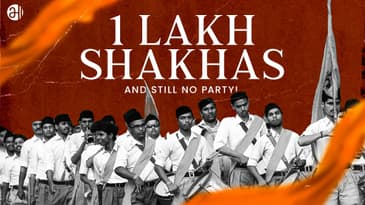

The RSS does not contest elections. So where does its influence over Indian politics and society actually come from? In this focused Bharatvaarta conversation, Roshan Cariappa speaks with Sachin Nandha about the organisation, ideology and structure of the Rashtriya Swayamsevak Sangh (RSS) - and its relationship with the BJP, Narendra Modi and the larger Sangh Parivar. What makes the RSS so influential despite not being a political party? Why does the organisation place such importance on the shakha? Is the BJP an instrument of the RSS, or does it operate independently? And how should we understand the relationship between the RSS, the BJP and the Indian state? Sachin Nandha offers a different framework for looking at these questions - from the distinction between the Rashtra and the Rajya to the way the RSS's influence extends beyond electoral politics. ⏱️ TIMESTAMPS (00:00) – How Does the RSS Have So Much Power? (03:36) – What Is the RSS Really Designed to Do? (06:00) – Why the RSS Starts and Ends With the Shakha (10:00) – Rashtra vs Rajya: What Is the RSS Really Trying to Change? (13:00) – Why the RSS Doesn't Actually Care About the BJP (15:00) – Can the Rashtra Discipline the Rajya? (18:00) – How Does the RSS Influence the BJP? (20:00) – Is the BJP Really Independent of the RSS? (21:00) – The RSS as the BJP's “Great Grandmother” (22:00) – What Is the Relationship Between Modi and the RSS? (24:00) – Who Has More Power: RSS or BJP? (26:00) – Is the RSS–BJP Conflict Real or a “Circus Act”? 🎙️ About Sachin Nandha Sachin Nandha is the author of Hedgewar: A Definitive Biography, a biography of K.B. Hedgewar, founder of the Rashtriya Swayamsevak Sangh (RSS). He is also associated with the International Centre for Sustainability and writes and speaks extensively on the RSS, civilisational movements, social capital and power structures. His book and public work focus heavily on understanding the origins and evolution of the RSS and its place in modern India. 🔗 Connect with Sachin Nandha: Instagram — @thesachinnandha X — @sachinnandha LinkedIn — Sachin Nandha Website — sachinnandha.com 📚 His book Hedgewar: A Definitive Biography: https://www.amazon.in/Hedgewar-Founder-Rashtriya-Swayamsevak-Sangh/dp/0143467662 (The book was published in 2025 and examines the life and ideas of K.B. Hedgewar and the origins of the RSS.) The complete episode - https://youtu.be/IaSo8UQ-buw ABOUT BHARATVAARTA Bharatvaarta is a platform for long-form conversations on India's politics, policy, economy and culture — the arguments that shape the country, heard in full and without the shouting. Join this channel to get access to perks: https://www.youtube.com/channel/UCfBfBd-1kvCOPxVll8tBJ9Q/join
Learn more about your ad choices. Visit megaphone.fm/adchoices
[00:00:00] Despite not directly contesting elections, how does the RSS have that amount of influence and power on India's politics and society? I think the RSS is the most powerful social movement in this country. By far. And I don't think... No, because the BJP is just an instrument to capture the Rajya.
[00:00:27] But the strength of any society is in the Rashtra, is in the people. And the thing that it does care about is the Shaka. The RSS starts and ends with the Shaka. Bodhi is deified. He may love it, he may not love it, I don't know. But he's deified. Is that deification accurate? I don't think so. I think a lot of this is a circus act.
[00:01:02] Hey Sachin, welcome to the Bharatvaarta Podcast. Thank you so much for making the time. It's a real pleasure to be here. Good to be in Bengaluru. Yeah, welcome. So there's a lot that I want to unpack with you on the RSS, its impact on India, India society, politics and so on. But perhaps I'll open with what is the quintessential question, which is that despite not directly contesting elections,
[00:01:27] how does the RSS have that amount of influence and power on India's politics and society? I think that's a good question. And I think, let me just start off by saying, I think the RSS is the most powerful social movement in this country, by far.
[00:01:49] And I don't think anybody, whether you are Indian or non-Indian, who wants to engage with India in any meaningful sense, can really understand modern India without understanding or grappling with the RSS. I just think the RSS is so dispersed, so diffused, it's interwoven itself into the tapestry of Indian life,
[00:02:14] right the way through from tribal villages, through to swanky bars in Bangalore or Mumbai. They are everywhere. And so, you're absolutely right. I mean, the RSS is, you know, it is quintessentially modern India and it is continuing in a significant way to shape the social fabric of India. Right. So, what is the RSS? Is it an ideology? Is it a movement?
[00:02:42] Is it an organization or perhaps, I mean, a mix of all of these? Let me just backtrack to Hedgawar, the founder of the RSS. His intention from day dot was that the RSS is not meant to be an organization in the traditional sense of an organization, right? Where you have systems, structures, hierarchies, right? The only organization you will see in the RSS is the shakha, that individual unit, right?
[00:03:11] Where men and boys and girls and women in the women's side get together every day or every week, you know, etc. That's an organization, that little unit. But each unit is autonomous. Each unit is an organization of its own. And they respond to their own local circumstances, their own local needs, etc. So, that's the organization. But the shakha is not the RSS.
[00:03:39] And no one shakha is the RSS. The RSS is then that diffused movement. I want to talk about the design of the organization itself, right? Because, you know, one would have thought that Hedgibar would have perhaps started a non-profit, right? If he didn't want to contest elections and so on. Or if he did want political power, he would have done the straightforward thing of like, you know, making a political party. He would have taken over the Hindu Mahasabha, by the way. The Hindu Mahasabha.
[00:04:06] The RSS could have easily taken over the Hindu Mahasabha, you know, like this, right? But they didn't. So, there's some other agenda going on. Yeah. So, why? I mean, how was this conceptualized, you know? I mean, and here perhaps, I mean, you could talk about the circumstances leading to the formation of the RSS itself. We will talk about Hedgibar G's life and influences maybe like later on in the podcast. But what led to the organization that we see today?
[00:04:33] Well, firstly, as I mentioned earlier, the first element is that him being a medical doctor and him being involved in the kind of freedom struggle from day dot, really. He saw the ailment of Indian society. So, how do you solve that problem? So, that was number one. It was a solution to a specific problem, right, of this mindset of rootedness, Deshpakti, which I would translate as social capital, right, in the Robert Putnam sense. So, that's that.
[00:05:00] But the other thing is, remember the Hedgibarian mind and the modern RSS today as well, it may not like to admit it. It may not like to admit it. But I can tell you now that just as Hedgibar and the Hedgibarian mind is syncretic, the RSS is deeply syncretic.
[00:05:19] What I mean by that is that the Hedgibarian mind, firstly, let me start there, is deeply appreciative and deeply learned about the world. It is not some parochial Indian movement bouncing around in an Indian echo chamber, right, trying to solve Indian problems. The Hedgibarian mind is international, it's globalist, right?
[00:05:47] He is reading Voltaire, he is reading Nietzsche, he is reading Mazzini, he is reading Marx, right? He's absorbed these values as much as he's memorized Dasbhod, Manobhod, Life of Shivaji, right? So, he is a syncretic mind in the truest sense. It's through that syncretic-ness that he realizes and discovers the problem of India, the Indians and what's wrong with them.
[00:06:12] Then he discovers through contemplation, through dialogue, through trial and error, through experimentation, somewhat of a solution, right? The RSS started out not as a blueprint. It started out as an experiment, right? My advice to all, you know, sort of, who am I to give advice? But my contention would be that the RSS is best served if it remains a social experiment and not some movement or some organization.
[00:06:42] And Hedgibarian was very clear that it must be a social experiment and it must be run in that spirit. So, it runs in that ebbing and flowing way, right? As a social experiment should. So, the RSS comes about in sort of this syncretic way in terms of a specific problem. It is globalist in mind. It is inspired by both Western and Indian philosophy.
[00:07:12] It's tried to take the best from everywhere, right? Which is the right thing to do, which is dharma. Dharma is universal. So, if that's the case, then dharma is everywhere, right?
[00:07:23] So, even today, I do not know of any organization in the world, never mind India, that spends its money, and it's got limited money, money and resource and time and energy on bringing together the international pagan communities.
[00:07:45] So, whether you're the Native American Indians, whether you're the Incas, the remnants of the Incas, or you're some pagans in Europe, or whether you're the Maoris in New Zealand, it's the RSS that connects with all these people and brings them together. And for what purpose? They don't have Rashtrabhav. They're not interested in a Rashtra of India. But there, that's about dharma. That's about identifying the best ideas from all the ancient traditions. What can we learn? What can we share?
[00:08:15] And I've been to these conferences. It's quite fascinating. I mean, some of it's very hippie and esoteric, but some of it's incredibly practical and pragmatic. And again, only the RSS is thinking like this. So, there is something about this, and it's rooted in the Hedgawarian mind, that we have to be open to the world. We have to be open to global ideas. And we have to be humble enough to absorb the best ideas and let go of ideas that no longer work.
[00:08:42] Now, whether the RSS still does that or not, that's not for me to say. I don't know. But this is certainly the Hedgawarian mind and the legacy of the RSS, kind of, I would say, the most senior pracharaks of the order, you know, have kept that true, I think. Right. Let me ask a more direct question. What is the RSS's relationship to the Jansung, formerly Jansung and now the BJP, right?
[00:09:10] I mean, you can't account for that level of political success to individual enterprise, right? I mean, you can't say that, you know, these folks were Swaim Sevaks within the Shakas, but they went off outside of it and formed this gigantic political party, the largest in the world today, and have won, you know, successive elections after that. So you can't quite attribute it to that, right? Yes and no, I would argue. I think it's a good question. I think it's a fair question.
[00:09:37] Look, let's be clear about how it started. Okay. Hedgawar was not interested in the Rajya. He knew by the 1920s after World War I that the British were on their way out. It was a matter of if and not, you know, it was a matter of when, not if, right? So if the British were on their way out and it was only a matter of when,
[00:10:09] then what kind of India would we inherit, right? And who would inherit that Rajya, right? The British never owned the Rashtra. The British controlled the Rajya, right? And they exploited the Rashtra through the Rajya. We should never forget that, right? So the Rajya is the state, by the way, the state. So the British came, they captured the state, and they exploited the Rashtra. Now the British were on their way out. So there's going to be a vacuum in the Rajya.
[00:10:39] Okay. And the Rashtra is broken. The Rashtra is fragmented. So Hedgawar is not interested in the Rajya because he doesn't think that's the solution. He thinks that's the red herring. He literally thinks that's the red herring. And by the way, he comes to that realization through trial and error, right? He spent most of his time in the Congress. He spent most of his time as a political nationalist. But a lot of them did. A lot of them did, right? All of them did. But he's the one that recognized, and that's what makes him unique, by the way.
[00:11:07] He's the one that recognizes that by controlling the Rajya, you cannot create the Rashtra. Why? Because the Rajya is inherently, and I want to use this word very consciously, the Rajya, as the British left it, is inherently monstrous. It's exploitative. It is not a benevolent movement. It's not a benevolent organization. So it's like absolute power corrupts absolute power. Yes. And it's designed to corrupt. It's designed to exploit.
[00:11:36] It's designed to extract wealth. The British built the Indian state with the specific objective, which is how do we maximize shareholder value? They exploited the Indian Rashtra, a fragmented Indian Rashtra, right? That would happen way before the British got there. So you can't blame the British for that, right? The British just took advantage of it, right? But they essentially created a system, a sophisticated bureaucracy,
[00:12:06] which is what the state is, right? That includes the military. That includes the bureaucracy. That includes the judiciary, right? And everything in between. An efficient bureaucracy to extract wealth and take it back to England. Now the British were going to go. So whoever takes over this mechanism called the state, the Rajya, is running a machine that is designed to exploit. It's not designed to serve. It's not designed to enhance.
[00:12:37] So now what are you going to do? So the head give out was really clear. You know that. Head give out to my mind is really clear that India is going to be in a mess. It's going to have to go through a long painful journey of renewal. But where will that renewal come from? The Rajya, which is monstrous in a systemic sense. No, it's going to come from the Rashtra. The people, the bottom up. The people have to be empowered, strengthened, unified.
[00:13:08] Social capital has to be rebuilt. When that happens to a sufficient degree, the Rashtra will discipline the Rajya. Until then, the Rajya will exploit the Rashtra. For its own ends. Right? Now, at some point, a tipping point has occurred, hasn't it? The Rashtra has got stronger and stronger and stronger. And that Rashtra has produced people in the Congress. That Rashtra has produced people in the BJP
[00:13:37] or the Jansang or whatever you want to call it. That Rashtra has produced people in the Communist parties. Right? That Rashtra has gone everywhere, isn't it? Right. Right? So we mustn't forget that. Right? RSS Swayam Sevaks have a part parcel of the political life of India. You should not think in this myopic sense that the RSS only supplies the BJP or Jansang. That is naive at best and ignorant at worst. I mean, really. The RSS does... Let me be clear.
[00:14:06] As far as I can see, if this was the Hedgawarian mind in operation, if, then it does not care about the BJP. Really? No. No. Because the BJP is just an instrument to capture the Rajya. But the strength of any society is in the Rashtra. It's in the people. And the thing that it does care about is the Shaka. The RSS starts and ends with the Shaka.
[00:14:36] The fact that the secondary effect of the Shaka is the Rashtra, and therefore the tertiary effect of the Rashtra is the BJP. The BJP will come and go. If anything, head Gewarian would have said, hey, let's create 10 more BJPs. Why should there only be one BJP? Create 10 more BJPs that all argue with each other to control the Rashtra so we can get the best ideas. So we can get the best mantan.
[00:15:05] So do you think that, you know, there could be an unease right now considering the consolidation of power within the BJP? Yes. 100%. And why not? Right? The Rashtra is there to discipline the Rajya. The Rashtra is not there to serve the Rajya. The Rajya should be there to serve the Rashtra. Right? So if the Rajya steps out of line in sync with the Rashtra, then the Rashtra should have the capacity and the energy and the strength to discipline that Rajya. Right.
[00:15:34] Now my contention is, it's only a contention, I can be wrong, that the Rajya, because of the British, has always been overwhelming, overpowering, and the Rashtra has been fragmented and weak and exploitative. Over the last 100 years, thanks to the Hedgawarian experiment, largely, as well as other things, I think India's hit the inflection point where now the Rashtra is becoming strong enough
[00:16:02] to start disciplining the Rajya. And the Rajya doesn't like it. Right? It's not used to being disciplined. It's not used to being held to account. Right? Now it's being held to account somewhat. Don't get me wrong. It's nowhere near perfect. It's nowhere near where the Hedgawarian mind would have liked it. But I think it's hit an inflection point. So this tension between the government, which is BJP, the Rajya, which is the bureaucracy, the military, the judiciary,
[00:16:31] all these babus and co. And the Rashtra, which is you and I, where you and I belong, where the common Muslim belongs, where the common Christian belongs, where the common, you know, caste-based Dalit or Brahmin belongs. We all belong to the Rashtra. We are now in a position where we are beginning to feel confident capable, strong enough to discipline whoever the Rajya is. Right? So India is going through an incredibly formative change. That formative change is what the RSS is about.
[00:17:00] So I think there must be, there should be some tension between these things. I'd be surprised if there wasn't. Yeah. One thing, I think especially over the last 10 or 12 years, is the Odin window has like completely shifted. Right? In terms of just, you know, the kind of things that are front and center in politics, in mainstream discussion and so on and so forth. How does the RSS actually influence policy? You know,
[00:17:30] because I remember, you know, perhaps during Vajpayee's time, Vajpayee's time and so on, right? I mean, there would be all sorts of rumor mills saying that, you know, the RSS wants person X or person Y to occupy a position of power or some ministry and so on. I wonder if they have that kind of influence at this point of time, but they do tend to have influence on some level of policy, let's say. Right? There's no doubt about it, right?
[00:18:01] I think Mohan Bhagwat in several of his speeches and some of his Q&As that he's recently done, I've been watching them listening intently, he's, as much as said it, right? That, look, this is a Padivaric organization, right? A collection of organizations and by that, what he meant was, as how I interpreted it, was that essentially, look, Swaim Sevaks who are part parcel of the Shaka, which is the RSS, have left the Shaka, they're out of the Shaka since the RSS, right?
[00:18:30] And they have so unseen a need, they've tried to fill that need, so they've created a political organization. In this scenario, the BJP. And the BJP was designed to capture the state through electoral means. That's what democracy is. Right. Okay. So now, one Swaim Sevaks, two Swaim Sevaks, a hundred Swaim Sevaks, a thousand Swaim Sevaks, have become part parcel of the BJP. Right. So these Swaim Sevaks,
[00:19:00] remember, have a psychological mooring, a psychological rootedness to the land, thanks to the Shaka that they attended, that they were influenced by. Right. So, in that psychological sense, the RSS has a influence on these Swaim Sevaks. Now, to that end, yes. But note what I'm saying, very subtly.
[00:19:31] As far as I can see, and I can't see any evidence contrary to what I'm about to say, the BJP is totally independent operationally, policy-wise, in every shape and form to the RSS. Right. Like, there is no direct connection in any shape or form between the two. What you have is the indirect connection of these Swaim Sevaks who are part-parsel of the RSS, who are now trying to solve a political problem,
[00:20:00] hence BJP, who have that rootedness, who draw inspiration from the RSS, right, and the RSS Pachadaks. And therefore, you can say, ah, look, the RSS has influence on the BJP. Let's be careful about that. The RSS has influence on the people who want to be influenced by it. But it's not directly causal in the sense that, it's not a cause and effect. We often hear in the media, right, that the RSS was not happy with something that the BJP did
[00:20:30] and they didn't send their Swaim Sevaks for all of the organizational stuff and the electioneering and, you know, ergo, the BJP lost in a particular election and so on. Roshan, you are a man who's built many businesses, right? You run your P&L as you have to run your P&L. To run your business. If your great-grandmother, who happened to be alive, one day found out that for your staff, you did a team-building
[00:20:59] session in Jamaica and you flew them all out and she went, ooh, I don't think that's a good idea. How much do you take that into consideration? You might because you think there's a lot of wisdom in my great-grandmother or you might not because you know how to run your P&L. Right. But you're still respectful, you're still courteous, but you agree to disagree. So RSS is the great-grandmother? Yes. RSS is the great-grandmother with a lot of depth and a lot of wisdom. There's a lot and it's thinking 100 years, 200 years. Your babu
[00:21:29] or your politician or your BJP cadre, he's thinking five years, he's thinking three years, he's thinking six weeks. Yeah. Right? So there's naturally going to be tension because they're thinking in different time frames. Right? Now that's not to say they're against each other. Your grandmother's not going to be against your business, right? No, not quite. And she may not understand the depths of your business, the granularity of your P&L, but she broadly gets you. Yeah. She wants the best for me. She wants the best for you. Right? So one has to understand this framing
[00:21:59] and this is what's going on. That's interesting. That's what's going on. So if there is unease between the RSS and BJP, I suppose that's perhaps, let's say, 10 times magnified when it comes to the RSS and Prime Minister Modi. Right? Correct. I would say, you know, because here's a man who has clearly grown up, you know... Who's a Pracharak. Who's a Pracharak. Part of the order. Right? Part of the order, so to speak. Right?
[00:22:25] And has become a legend, a hero by himself. Right? So much so that he might even outshine the organization itself, which is tantamount to sacrilege in some sense. Right? So what do you think is the relationship between Prime Minister Modi and the RSS at this point? I don't know. But since we're having a loose, open conversation, which might be interesting to your viewers, we can conjecture. Hazard a guess. Yeah, let's hazard a guess.
[00:22:55] Let's look into our crystal ball. Let's figure that out. Look, principally from the Hedgivarian perspective, right? Would Mohan Bhagwat lose considerable sleep if Narendra Modi stopped talking to him? I don't think so. I think Mohan Bhagwat would just kind of go, oh well, he doesn't want to talk to me. That's okay. Let's crack on. Because remember, Mohan Bhagwat's mind starts and stops with his shakhas and that engine of renewal,
[00:23:25] right? Engine of social capital. Right? It's called the Rashtriya Swamsevak Sangh, not the Rajya Swamsevak Sangh. I want us to be clear about that. So I would have liked to have thought that Mohan Bhagwat and his sort of core inner group of Pracharaks, the order, as it were, and there's three and a half thousand of them. Would they lose sleep much? Some might, some might not. I don't think Mohan Bhagwat would lose much sleep if Narendra Modi suddenly stopped talking to him. Right? Fine. They'd carry on. Wouldn't Narendra Modi get very upset
[00:23:55] and be nervous if Mohan Bhagwat kind of stopped talking to him? Oh yes. I think he'd get very nervous. Why? Because the Rashtra has reached a tipping point where the Rashtra has the ability to organize itself autonomously and discipline any Rajya, any government in electoral voting but also in other things. So
[00:24:25] there is a power imbalance and one mustn't forget that. Right? It used to be that the Rajya is king and everybody bows down to the king. Right? The Nehruvian story was that. The Indira Gandhi story was that as far as I can see. Right? But now I'm not sure if that's the story. We Indians love to project a hero, don't they? Indians love to create kings and heroes that are grander than reality. They love that. That's just the way Indian mind is.
[00:24:54] It's always been like that. Indian mind is the first to worship and deify anyone. So Modi is deified. He's deified. He's a deified and he may love it, he may not love it, I don't know. But he's deified. Is that deification accurate? I don't think so. Is you know, is there a power imbalance between the Sangha Padivad and the BJP and Narendra Modi at his helm? Yes. The Sangha Padivad is far more influential,
[00:25:24] far more organized, far more stronger than the BJP. The BJP happen to control the powers of the state at the moment. Even that is not so you know, strong. So you know, it's there. But like I say, Mohan Bhagwat and the RSS will be considering and the Tathre Hasbale as well will be considering the Rashtra. Right? They are equally thinking about that tribal village in Arunachal Pradesh as much as they're
[00:25:54] thinking about what's happening in the Lechun's area of Delhi. Right? So where's the BJP? To what degree are they even worried about what's happening in the tribal villages of Manipur or something? Well, you can see for yourself. So that's my point. My point, we've got to get some perspective on these things. So when, you know, Mohan Bhagwatji speaks about something in the organizer or at one of his public functions and so on and it's, you know, called
[00:26:24] a sort of like veiled commentary of sorts. Right? And it's considered quote unquote disciplining the BJP or something. Do you attribute some sort of strategic intent to it or do you think that this just happens and the media and the establishment sort of makes it out to be something of that sort? I think it's both, isn't it? I think that both things are going on. I think there's no doubt about it. You know, the the song will have its mechanisms
[00:26:54] of communication. But I think the media and I think popular narratives like to project all these things and they kind of again, deify it. They kind of make it more significant than it is. It makes them look important. It makes the media houses look important as if they're doing something really important. You know, it kind of self aggrandizes everybody so everybody wins in this story. The truth, I suspect, is that if Mohan Bhagavad wanted to communicate to Narendra Modi, they would pick up the phone and they would talk. Why? Because they have that rootedness,
[00:27:23] that psychological desh pav, desh pakti, right? That they are both of the same cloth, right? Psychologically. So actually, I think you and I would never find out what conversations they're really having, frankly. I think a lot of this is a circus act. There may be some sprinkling of truth in it. Yeah, fantastic. On that note, let's bring an end to this conversation. I have plenty more questions, but it's, you know, it's been a long day for you and
[00:27:52] we'll leave you to it. Thank you so much for being on Bharat. No, it's been my pleasure. fascinating conversation and I sure am looking forward to reading this book, Hedgawarian by Sachin Nanda. Do go and get it. Yeah, give a copy to your friends even, right? So I'm really looking forward to this. Thank you so much for having me. I've really enjoyed it. Thank you so much for writing the book and thank you for being on Bharatvaarta. Thank you.