
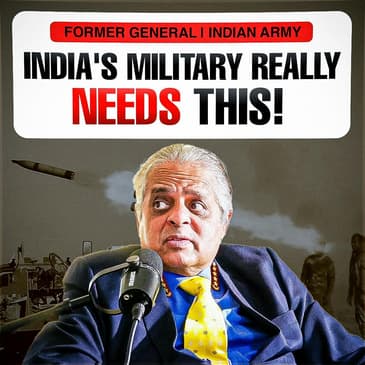

In this episode of Bharatvaarta, host Kamal Madishetty dives into the evolving landscape of security and military strategy with distinguished veteran Lt. General Raj Shukla. With over four decades of service experience, General Shukla discusses the profound changes in the nature of warfare, the importance of technology and adaptability in modern combat, and the strategic priorities for India amidst complex global geopolitics. The conversation covers a range of topics including cyber warfare, space, hybrid warfare, the military-industrial complex, and the significant role of innovation in defense. General Shukla also emphasizes the critical need for robust national security measures, strategic deterrence, and the importance of integrating civilian and military efforts through a comprehensive national security outlook. This insightful episode provides a deep understanding of the challenges and future directions for India's defense and strategic landscape.
Topics:
00:00 Sneak peak
01:21 Introduction
02:43 Discussion on Military Modernization
05:20 Impact of Drones and Technology in Warfare
07:56 Geopolitical Realities and National Security
10:45 Limiting China's Rise
17:34 Non-Traditional Security Threats
23:02 Tech innovation and military
29:56 Welfare of Veterans and Resource Allocation
38:47 Integration and Reforms in the Military
47:21 Strategic Deterrence and Military Assets
50:11 Beyond the Border: Expanding Deterrence
54:06 Space and Cyber Warfare Priorities
56:07 The Deep and Sophisticated China Challenge
57:47 China's Military and Economic Strategies
01:04:59 The Importance of Fail-Proof Deterrence
01:11:10 The CREEC Axis: A Grim Challenge
01:22:38 Strengthening National Security
[00:00:00] We are seeing the most fundamental, profound changes in the character of war in recorded history.
[00:00:08] It's a shame. Ukraine, Afghanistan, Taiwan, maybe.
[00:00:14] So it is about being smart everywhere. Just spending money will get you nowhere.
[00:00:20] Geopolitics is extremely brutal with those that are disrespectful to national security.
[00:00:26] It spares nobody, not even the mighty United States of America.
[00:00:31] The nations become great once in centuries.
[00:00:35] I mean, there have been many pretenders. Japan in the recent past, they haven't attained greatness.
[00:00:39] So while we are there, it will be such a tragedy that having come so close, we don't quite get there.
[00:00:48] Bangalore must become the Silicon Valley to the Indian military. Without tech innovation, militaries will not survive.
[00:00:58] Namaste and welcome to Bharat Varta. I am Kamal Madi Shetty, your host for today.
[00:01:04] Today, we are looking at the rapidly shifting security and military landscape across the world
[00:01:09] and particularly in India in an age of rapidly accelerating technological advancements.
[00:01:15] And we are moving towards a complex, multi-dimensional battlefield where cyber security, hybrid warfare,
[00:01:22] space and many other domains are making their presence felt.
[00:01:27] And to discuss many of these and many more pressing issues, we are honored to be joined by Lieutenant General Raj Shuklaji,
[00:01:34] who is a distinguished veteran and a thought leader in India's defense establishment.
[00:01:38] With over four decades of service experience, General Shukla has been an advocate, a strong advocate for military modernization and many other important issues concerning national security.
[00:01:49] His insights, I believe, are particularly valuable as India shapes its strategic priorities in the increasingly complex world that we live in today.
[00:01:59] General Shukla, thank you so much for joining us and welcome to Bharat Varta.
[00:02:04] Thank you, Kamal. Great to meet you and good to be on your show, Bharat Varta.
[00:02:11] And may it grow and prosper. My good wishes to you and it's wonderful being on your show.
[00:02:17] Thank you so much, sir. And really, really appreciate your time for us.
[00:02:22] So, if I can dive into some of the questions we have for you, sir.
[00:02:25] You know, you have extensively talked about the importance of adaptability in modern warfare.
[00:02:32] Could you tell us and share some thoughts on how you see technology in particular changing the battlefield?
[00:02:38] And what are the skills that young officers and the armed forces need to prioritize and up their game, so to say?
[00:02:46] Yeah. So, you know, I've been, my advocacy has been regarding change. Somehow it has got, you know, narrowly focused on technology. I'm not saying it's just technology.
[00:02:59] So, let me give you some examples in terms of two issues. One is the changing character of war. It is change.
[00:03:08] I'm quoting to you General Mark Milley, the recently retired chairman of the Joint Chiefs of Staff of the USA.
[00:03:16] He says, we are seeing the most fundamental, profound changes in the character of war in recorded history.
[00:03:26] So, it's about change. And of course, that change is about geopolitics. It's about technology. It's about tactics. It's about operations and a whole lot of stuff.
[00:03:35] So, a good example is see Ukraine. You see three eras of war playing out in simultaneity.
[00:03:44] So, you have the trench warfare of World War I. You have squadron company fights. You have men dying. You have blood and gore.
[00:03:52] You have, you know, the last hundred yards of attack. Russians losing, I'm told last month they lost 46,000 soldiers.
[00:04:04] Meat grinders. You are putting men through meat grinders. That era hasn't gone.
[00:04:09] Yeah. You also seeing Cold War era legacy platforms play their part. So, you have aircraft, you have ships, you have javelins, you have tanks, you have artillery.
[00:04:23] Nothing has gone out of the battlefield. But what is happening is that you have now bleeding edge technologies who are taking both these instruments to a new high.
[00:04:33] So, it's not technology alone. In fact, Russia is winning because it is winning the manpower battle.
[00:04:42] The Ukrainians are running out of men. Their army is aging. And the Russians are now 10 lakh strong.
[00:04:48] So, we must not draw superficial conclusions. It is everything. But look at technologies.
[00:04:58] Have we reached the drone moment in warfare? The drones are penetrating trenches.
[00:05:03] They are penetrating tanks. And they are being used as strategic air power to hit targets 1,800 kilometers away.
[00:05:13] I mean, the Houthis are hitting Tel Aviv with drones. The Houthis are hitting USS Abraham Lincoln with drones.
[00:05:23] So, this is it. And look at what… Let's take drones in Ukraine. Strategic air power. What has it done?
[00:05:31] It has degraded Ukraine's power generating capacity by 50%. It has degenerated its heating capacity by 80%.
[00:05:42] Winter is coming. How does a nation survive?
[00:05:46] Look what drones have done. Ukraine with crude drones. It doesn't have a navy of any kind.
[00:05:53] Crude drones and star links by Elon Musk targeted the iconic Black Sea fleet and pushed it out of Sevastopol.
[00:06:02] So, national security is becoming complex, sophisticated. Ukraine is a war of talents.
[00:06:09] Mediocrity will not survive.
[00:06:12] Elon Musk, Alex Karp, entrepreneurship. So, what does Alex Karp do? CEO of Palantir.
[00:06:21] He… The war breaks out, I think, in February 2022 or January 2022.
[00:06:27] One, he senses a business opportunity.
[00:06:30] And he tries to meet Zelensky.
[00:06:34] So, Zelensky, he can't get through to him. So, he drives or walks across Poland.
[00:06:40] Meet Zelensky and tells him that, Mr. President, just give me your data.
[00:06:46] And I will give you AI-powered, data analytics-free.
[00:06:51] And he has used that.
[00:06:53] If the Ukrainians are still in the game, it is because of this kind of innovation,
[00:06:57] which is affecting fire, it is affecting maneuver, it is affecting logistics.
[00:07:03] So, it's a whole comprehensive change.
[00:07:05] What does he get in return?
[00:07:06] He takes that data, he combatizes it, and he makes a business case out of it
[00:07:16] to sell stuff in Gaza, to sell stuff in Lebanon.
[00:07:21] So, look at that.
[00:07:22] So, I mean, it is complex.
[00:07:25] So, I am making this case about the changing character of war
[00:07:28] and the dramatic changes in the national security landscape, tapestry.
[00:07:33] So, look at it.
[00:07:34] Russia, $2 trillion economy.
[00:07:37] USA and the West, $40 trillion.
[00:07:41] Who is winning the war?
[00:07:42] Russia.
[00:07:43] $2 trillion.
[00:07:45] America is a $950 billion military.
[00:07:51] It has failed its seventh audit.
[00:07:54] It's an apparel of failing deterrence.
[00:07:56] Sharam ati hai.
[00:07:58] Ukraine me harai, Afghanistan me harai, shayi Taiwan me harai.
[00:08:02] So, it is about being smart everywhere.
[00:08:04] Just spending money will get you nowhere.
[00:08:07] So, you have to grasp the change.
[00:08:09] Look at bureaucracy.
[00:08:12] Elon Musk says,
[00:08:13] It is easier to launch a rocket into space than to get a permit to launch a rocket.
[00:08:22] Now, should we shed these bureaucracies?
[00:08:25] These are lessons for national security.
[00:08:28] The amount of money on the table of Elon Musk was lesser than what was on the table of NASA.
[00:08:35] Who produced Star Links?
[00:08:37] Elon Musk and not NASA.
[00:08:39] Who is the partner of US Space Com today?
[00:08:44] It is Elon Musk.
[00:08:46] Not NASA, not Boeing, not Lockheed.
[00:08:50] So, it is national security is becoming, as I said, complex, sophisticated, agile, entrepreneurial.
[00:08:57] The best man will win.
[00:08:59] Who has got a contract with US Space Com is an Indian startup.
[00:09:04] Third, iTech Bharat Semi.
[00:09:06] When the Prime Minister went to Delaware, they signed a deal recently.
[00:09:10] So, an Indian startup gets a contract with Space Com.
[00:09:15] That is the way the world is moving.
[00:09:17] So, if this is the kind of change that we see around us,
[00:09:23] should India not brace up to these challenges?
[00:09:25] That's my argument.
[00:09:27] And should we not shape up to these new realities?
[00:09:31] So, my principal advocacy is, you know, of change.
[00:09:36] If I may make one more point from the geopolitical standpoint.
[00:09:40] So, look at India today.
[00:09:42] It's the fifth largest economy.
[00:09:44] Maybe the third largest soon.
[00:09:46] Many people say we are the third most powerful country.
[00:09:51] In the next two decades, the fate of Amrit Kal will be decided
[00:09:58] on the manner in which our statecraft plays this game
[00:10:02] between a declining hegemon USA, a rising challenger China,
[00:10:07] and this aspiring Vishwabandhu called India.
[00:10:11] We have a great moment, a lot of promise opportunity,
[00:10:14] but all is not one.
[00:10:16] So, you know, there are so many things.
[00:10:19] Can USA and India get together to complicate China's rise?
[00:10:23] There are very smart ways to do that.
[00:10:26] We are here for the ideas conclave in the morning.
[00:10:29] I think the chairman of the Indo-US Business Council was making a point.
[00:10:32] Trump wants to decouple.
[00:10:37] You know, American military industrial complex
[00:10:42] in the intermediate range of group,
[00:10:44] a group of goods and services,
[00:10:48] there are 10,000 Chinese companies.
[00:10:50] How do you decouple?
[00:10:52] Out of these 10,000, why are 100 not Indian companies?
[00:10:56] You would complicate China's rise.
[00:10:59] You know, so there are a whole lot of military industrial complex.
[00:11:03] Let me make this point.
[00:11:06] Geopolitics is extremely brutal with those that are disrespectful to national security.
[00:11:12] It spares nobody, not even the mighty United States of America.
[00:11:18] So, five months back, you would recall,
[00:11:21] a town in Ukraine was surrendered, Adhvika.
[00:11:24] I am now quoting to you the CIA Director William Burns.
[00:11:33] Burns says that,
[00:11:36] Before we took that decision to surrender,
[00:11:38] we carried out an operational audit of two infantry brigades.
[00:11:42] One had 15 artillery rounds.
[00:11:44] The other had 42 mortar rounds.
[00:11:46] And when he spoke to Lloyd Austin,
[00:11:49] he said, we can do nothing before the end of 2025.
[00:11:52] This is mighty United States of America.
[00:11:56] Because you have been negligent of national security.
[00:11:59] My argument is,
[00:12:00] the change now,
[00:12:02] come 27, 28,
[00:12:04] if push comes to shove with China,
[00:12:07] we don't have that Adhvika moment.
[00:12:09] But you have to do that now.
[00:12:11] So, these are extremely complex changes in,
[00:12:14] you know, national security,
[00:12:16] character of war.
[00:12:17] So, that has been my argument.
[00:12:19] And we really have to step up our game in speed and scale.
[00:12:24] Because China is not tucked away in Latin America.
[00:12:28] Yeah.
[00:12:29] Absolutely.
[00:12:30] China is the neighbor right next to you.
[00:12:32] Yeah.
[00:12:32] And you have to acknowledge that it has been smart.
[00:12:35] Yeah.
[00:12:35] They say China's military modernization has been the most massive in history.
[00:12:43] Yeah.
[00:12:43] So, two challenges.
[00:12:45] Yeah.
[00:12:46] Character of war,
[00:12:47] pretty significant.
[00:12:48] China.
[00:12:49] Yeah.
[00:12:50] The power differential with China
[00:12:52] translates into 400 billion dollars every year.
[00:12:56] So, you have to think,
[00:12:57] either you smarten up your spending,
[00:12:59] or you spend more.
[00:13:02] Because there are limits to valor.
[00:13:04] So, I am saying that we have a great opportunity in terms of Vishwabandhu,
[00:13:12] in terms of Vikasit Bharat,
[00:13:14] Amrit Kaal.
[00:13:15] But it is not going to be a joyride.
[00:13:17] Yeah.
[00:13:18] So, we have to really,
[00:13:20] and for all the reasons that I have told you,
[00:13:23] what we did in the past will not do.
[00:13:25] You have to innovate.
[00:13:26] You have to disrupt the past.
[00:13:28] Right.
[00:13:28] If we have to play this game.
[00:13:31] And that must start now.
[00:13:32] Because anything that you do in national security,
[00:13:34] takes 10 to 20 years to happen.
[00:13:37] So, the time is now.
[00:13:39] So, that has been my real case.
[00:13:41] Right.
[00:13:42] And not merely technology.
[00:13:43] Absolutely.
[00:13:44] Technology is, of course, important.
[00:13:46] But everything else.
[00:13:49] So, it is putting your statecraft together.
[00:13:51] And you know, I keep quoting this,
[00:13:53] time without number.
[00:13:55] Look at clarity of two points.
[00:13:58] Let me make right at the beginning.
[00:13:59] Chanakya.
[00:14:01] He says,
[00:14:02] Agar shasht ko bhulogai,
[00:14:04] to apni sanskriti ko doge.
[00:14:06] If you are disrespectful to your cultural texts,
[00:14:10] hand-me-down wisdoms,
[00:14:11] you will lose culture.
[00:14:13] Par agar shastra ka tiag karoge,
[00:14:15] to rashtra hi khodoge.
[00:14:17] And he doesn't mean shastra in a narrow sense.
[00:14:19] He is saying,
[00:14:20] if you don't get your instrument of force
[00:14:23] sensibly into your national security calculus,
[00:14:27] you will lose.
[00:14:28] So, you know,
[00:14:29] all kinds of arguments basically point towards
[00:14:32] getting smart about your national security,
[00:14:35] getting clairvoyant about your national security,
[00:14:37] thinking long term.
[00:14:39] So national security is not for the mediocre.
[00:14:42] National security demands the best brains,
[00:14:46] thinking,
[00:14:47] action,
[00:14:48] everything.
[00:14:49] And that is why it is such a complex challenge.
[00:14:51] Also,
[00:14:52] the last point,
[00:14:53] if I may,
[00:14:53] nations become great
[00:14:55] once in centuries.
[00:14:57] I mean,
[00:14:58] there have been many pretenders.
[00:14:59] Japan in the recent past,
[00:15:00] they haven't retained greatness.
[00:15:02] So while we are there,
[00:15:06] it will be such a tragedy
[00:15:07] that having come so close,
[00:15:10] we don't quite get there.
[00:15:12] So that is the real point I wish to make.
[00:15:16] Amidst all this euphoria,
[00:15:18] I mean,
[00:15:19] euphoria is good,
[00:15:20] optimism is good,
[00:15:21] but we must have a sense of reality,
[00:15:27] be vigilant and cautious to the challenges to brand India.
[00:15:31] Absolutely.
[00:15:32] Absolutely, sir.
[00:15:33] Very,
[00:15:33] very fascinating insights there.
[00:15:35] I think you made many points,
[00:15:37] but I think the point about there being no room for mediocrity or complacency as well,
[00:15:45] when it comes to India's rise and particularly in the strategic space,
[00:15:49] in the national security space,
[00:15:50] I think is something that really is sort of urgent in terms of India's priorities.
[00:15:57] You know the great Sam Manikshaw,
[00:15:59] I think when we were passing out of IME,
[00:16:03] he came and addressed us and he said,
[00:16:05] you know,
[00:16:05] in war,
[00:16:06] there are no runners up.
[00:16:08] Right.
[00:16:08] You either come first.
[00:16:10] And I think he said it in Hindi or something,
[00:16:13] he said,
[00:16:13] if you lose,
[00:16:14] don't come home.
[00:16:16] Oh,
[00:16:16] Gharwali meaning,
[00:16:17] she won't recognize you.
[00:16:19] So he was trying to say that in war,
[00:16:20] you have to win.
[00:16:21] Patton said that you don't win wars by dying for your country.
[00:16:26] You win them by making,
[00:16:27] and he used some profinity,
[00:16:29] so I won't repeat it.
[00:16:30] The other son of a gun,
[00:16:32] die for his country.
[00:16:33] Wars are about winning.
[00:16:35] National security is about winning.
[00:16:37] You can't lose.
[00:16:38] And that is why you just have to get it right.
[00:16:41] Yeah,
[00:16:41] absolutely,
[00:16:42] sir.
[00:16:42] And I think the point about,
[00:16:44] you know,
[00:16:44] putting your best brains to national security,
[00:16:47] and then again,
[00:16:49] recognizing the challenges that you laid out for us so elaborately,
[00:16:52] I think is so important because I think like you rightly said,
[00:16:56] it's beyond technology.
[00:16:57] The way we started,
[00:16:58] it's a far bigger sort of canvas that we are looking at in terms of the changing nature of war
[00:17:03] and coupled with the changing strategic environment itself,
[00:17:07] which is,
[00:17:08] I think something that I would like to come to at a later stage,
[00:17:11] particularly on China.
[00:17:12] But I wanted to specifically ask you about what some of the most significant or the pressing challenges are
[00:17:20] when it comes to non-conventional or non-traditional security threats.
[00:17:24] Like what would those threats be for India in particular?
[00:17:28] And what would be the best way to address those?
[00:17:31] So,
[00:17:32] you know,
[00:17:32] while the academia keeps making this point,
[00:17:35] I haven't understood what are non-traditional threats,
[00:17:38] but let me try.
[00:17:40] I think I know what you're saying.
[00:17:43] I would like to put it this way that threats are evolving,
[00:17:46] they are mutating,
[00:17:47] and they are undergoing a great metamorphosis.
[00:17:51] They are also converging rapidly.
[00:17:54] You look at the pandemic.
[00:17:56] It started out as a health crisis.
[00:18:00] Then supply chains.
[00:18:02] Then brutal geopolitics.
[00:18:05] What happened in the South China Sea?
[00:18:07] What happened in Galwan?
[00:18:09] So,
[00:18:09] when you are down,
[00:18:11] nobody will spare you.
[00:18:14] And ultimately,
[00:18:15] it became what?
[00:18:17] People said,
[00:18:18] you want a base?
[00:18:19] Or you want vaccines?
[00:18:21] Give us a military base.
[00:18:23] I think it was US and Argentina.
[00:18:25] So,
[00:18:25] this is a brutal world.
[00:18:27] Please understand that.
[00:18:28] Especially when it comes.
[00:18:30] So,
[00:18:31] they are,
[00:18:32] it began as a health crisis.
[00:18:33] It ended up as a crisis along your borders.
[00:18:36] threats are converging.
[00:18:38] So,
[00:18:38] They are fusing.
[00:18:39] Each dimension in the national security space in terms of competition is being weaponized.
[00:18:48] So,
[00:18:49] somebody said,
[00:18:50] I think we heard of this,
[00:18:53] Vasudev Kutambakam.
[00:18:55] I hope I pronounce it right.
[00:18:56] Vasudev Kutambakam.
[00:18:58] Vasudev Kutambakam.
[00:18:59] It's a lovely idea.
[00:19:00] Yeah.
[00:19:01] One earth,
[00:19:01] one family,
[00:19:02] one futures.
[00:19:02] But we must also be cognizant of what Swami Vivekananda said.
[00:19:06] He said,
[00:19:07] the world is but a gymnasium where nations come to make themselves strong.
[00:19:11] How wise.
[00:19:12] He said,
[00:19:13] be cautious.
[00:19:15] So,
[00:19:15] don't get carried away.
[00:19:16] We talk about soft power.
[00:19:19] Soft and hard power should come together.
[00:19:22] Soft and hard power.
[00:19:23] So,
[00:19:24] national security is a fused endeavor.
[00:19:27] And therefore,
[00:19:28] now we have to reimagine our national security in terms of what you are saying.
[00:19:32] And I think that's what you were saying.
[00:19:33] It is no longer just land,
[00:19:35] air and see the traditional domains.
[00:19:38] Look at,
[00:19:38] let's take cyber.
[00:19:40] Yeah.
[00:19:40] We'll go to each of these.
[00:19:41] Yeah.
[00:19:42] So,
[00:19:42] 2017,
[00:19:44] there is a cyber exploit,
[00:19:46] WannaCry,
[00:19:47] which hits the,
[00:19:48] which hits London and its national health system.
[00:19:51] And there is,
[00:19:53] you know,
[00:19:54] Harakari.
[00:19:55] The system is upset.
[00:19:57] What was it?
[00:19:58] It was a cyber weapon designed by the American people.
[00:20:02] American NSA
[00:20:03] to be used against adversaries.
[00:20:05] It was a leak and it was hit there.
[00:20:07] Which means what?
[00:20:09] America has got cyber weapons,
[00:20:11] which will paralyze cities,
[00:20:13] which will be used in terms,
[00:20:16] in times of war.
[00:20:18] So,
[00:20:18] cyber warfare is here.
[00:20:19] It's not about passwords and hygiene.
[00:20:21] You'll have Delhi being paralyzed,
[00:20:24] or Bombay being paralyzed.
[00:20:25] You know these attacks which keep taking place,
[00:20:27] aims and all?
[00:20:27] What are they?
[00:20:29] They are reconnaissance attacks
[00:20:31] to see what your weaknesses are.
[00:20:34] Now,
[00:20:35] next time,
[00:20:36] say along a crisis with the borders,
[00:20:38] you hit,
[00:20:40] say,
[00:20:40] our power grid in Bombay.
[00:20:41] And now pop the question
[00:20:43] that you want to continue the standoff here.
[00:20:46] No,
[00:20:46] I'm not saying it will happen.
[00:20:48] So,
[00:20:49] this is how,
[00:20:50] while we may call them non-traditional,
[00:20:52] I mean,
[00:20:53] the USA says that a cyber pearl harbor,
[00:20:56] if it happens,
[00:20:57] we will respond with nuclear weapons.
[00:21:00] It means a massive cyber attack.
[00:21:03] And now,
[00:21:04] you have AI-enabled cyber exploits.
[00:21:07] WannaCry was stopped by patches.
[00:21:10] AI-enabled cyber exploits
[00:21:12] are designed to overwhelm patches.
[00:21:14] You will not be able to stop them.
[00:21:18] Now,
[00:21:18] just because it has not happened,
[00:21:21] we think nothing will happen.
[00:21:24] So,
[00:21:25] the
[00:21:27] 2016 US elections,
[00:21:29] the boss of the US Cyber Command
[00:21:31] read off the,
[00:21:33] hack,
[00:21:33] you know,
[00:21:34] into the,
[00:21:35] I think it was the Democratic Convention
[00:21:37] from the newspapers.
[00:21:38] Because he was not in the system.
[00:21:40] His mandate was not to do it.
[00:21:42] 2020,
[00:21:44] he protected it.
[00:21:44] 2024,
[00:21:45] he protected it.
[00:21:47] So,
[00:21:48] it is going to,
[00:21:50] it is,
[00:21:50] it is hitting the heart of your democracy.
[00:21:52] Your electoral,
[00:21:55] this thing.
[00:21:57] World War II
[00:21:58] was one on the back of steel and aluminum.
[00:22:00] What if I tell you,
[00:22:02] Cold War I
[00:22:03] was shaped by proficiency in chips?
[00:22:06] Cold War I,
[00:22:07] of course,
[00:22:07] had an economic angle
[00:22:08] which is over emphasized.
[00:22:10] But there was this other angle
[00:22:11] where Andrew Marshall says,
[00:22:14] Cold War I
[00:22:14] became a contest for accuracies.
[00:22:18] And accuracies in missile systems,
[00:22:20] weapon systems from chips,
[00:22:21] the Soviet realized
[00:22:23] that the American weapons
[00:22:24] were so accurate
[00:22:25] that they will not be able
[00:22:27] to win in the exchange.
[00:22:29] So chips.
[00:22:30] Why did this happen?
[00:22:31] We are in Bangalore.
[00:22:33] Because the American military
[00:22:36] had a lovely relationship
[00:22:37] with Silicon Valley.
[00:22:39] Bangalore must become
[00:22:41] the Silicon Valley
[00:22:41] to the Indian military.
[00:22:43] Without tech innovation,
[00:22:45] militaries will not survive.
[00:22:46] So in that sense,
[00:22:47] they are getting very complicated.
[00:22:49] Cold War II
[00:22:50] is going to be one
[00:22:51] on the back of ships.
[00:22:52] What's happening in Ukraine?
[00:22:53] Right.
[00:22:54] Russia was out of the fight
[00:22:55] till it got ships from China.
[00:22:58] Right.
[00:22:58] From drones to hypersonics.
[00:23:01] Amrit Kaal will be shaped by ships.
[00:23:04] No longer just steel and aluminum.
[00:23:06] Yes.
[00:23:06] Also steel and aluminum.
[00:23:08] Today somebody was making a point
[00:23:09] in the morning.
[00:23:10] Military Industrial Complex.
[00:23:12] Right.
[00:23:12] 2014,
[00:23:14] China's military industrial
[00:23:16] manufacturing capacity,
[00:23:18] civil, not military.
[00:23:20] Manufacturing capacities,
[00:23:22] civil value added
[00:23:23] were half of that of USA.
[00:23:27] 2022,
[00:23:28] they become twice that of USA.
[00:23:32] But now a bigger wow.
[00:23:34] Because of that,
[00:23:36] China's military industrial complex
[00:23:38] on American admission
[00:23:39] is five to six times
[00:23:41] more powerful
[00:23:42] than that of USA.
[00:23:43] Complex,
[00:23:44] sophisticated.
[00:23:45] Manufacturing capacities,
[00:23:47] non-traditional,
[00:23:49] traditional,
[00:23:49] everything is fusing.
[00:23:50] Without a basic
[00:23:52] industrial capacity,
[00:23:54] you can't have a military
[00:23:55] industrial complex.
[00:23:57] TikTok.
[00:23:58] TikTok.
[00:23:59] TikTok is the
[00:24:00] algorithmic manipulation
[00:24:01] of Western audiences
[00:24:04] to advance China's
[00:24:06] influence and agenda.
[00:24:07] It has skillfully been done
[00:24:09] in the social media system
[00:24:10] through ambiguous ownership,
[00:24:13] this and that.
[00:24:15] So,
[00:24:15] it has been woven smartly,
[00:24:19] as I said,
[00:24:19] into the social media system.
[00:24:22] So,
[00:24:23] we were having this conversation
[00:24:24] offline.
[00:24:25] I am no scholar,
[00:24:27] but in a hand-me-down
[00:24:28] manner,
[00:24:29] I heard it from somewhere,
[00:24:31] but it really stuck
[00:24:31] in my mind.
[00:24:33] What is statecraft about?
[00:24:35] Unfortunately,
[00:24:36] post-47,
[00:24:37] we grew into these silos.
[00:24:38] Civil,
[00:24:39] military,
[00:24:40] private sector,
[00:24:41] government,
[00:24:42] academy,
[00:24:43] DRDO,
[00:24:44] all of them.
[00:24:47] Actually,
[00:24:47] it should be,
[00:24:49] once again,
[00:24:50] the Chinese did,
[00:24:50] military-civil fusion.
[00:24:52] The Americans
[00:24:53] are following it.
[00:24:54] They call it
[00:24:54] civil-military fusion.
[00:24:55] But what did
[00:24:56] our text tell us?
[00:24:57] They said,
[00:24:58] Saraswati,
[00:24:59] Lakshmi,
[00:25:00] or Durga,
[00:25:01] Ka Mishran.
[00:25:02] Look how smart.
[00:25:03] So,
[00:25:03] invest in your
[00:25:05] universities.
[00:25:06] Have top-class
[00:25:08] universities like
[00:25:08] Nalanda.
[00:25:09] They will produce
[00:25:11] cutting-edge talent,
[00:25:13] technologies,
[00:25:14] use that
[00:25:15] to create wealth,
[00:25:17] and multiple
[00:25:18] equations must change.
[00:25:19] I think today,
[00:25:20] Shamika was making
[00:25:21] this point,
[00:25:21] that we must
[00:25:23] respect private sector,
[00:25:24] respect wealth creation.
[00:25:25] Lakshmi,
[00:25:27] pehle toh Saraswati,
[00:25:30] phir Lakshmi ka adar,
[00:25:32] aur is Lakshmi seh,
[00:25:33] continuously nurse
[00:25:34] your instruments
[00:25:35] of power.
[00:25:36] 1962,
[00:25:38] our GDP was
[00:25:39] almost that of China.
[00:25:40] Upper capita GDP
[00:25:41] was higher that of China.
[00:25:43] We chose to neglect
[00:25:45] our national security.
[00:25:46] Dekho kya asaraat hui.
[00:25:49] So,
[00:25:49] non-traditional,
[00:25:50] traditional,
[00:25:51] everything is fusing
[00:25:52] in this manner.
[00:25:54] So,
[00:25:55] we should do
[00:25:55] away with all that.
[00:25:57] It is civil,
[00:25:57] military fusion,
[00:25:58] talent from anywhere,
[00:26:00] talent of any kind.
[00:26:02] Our national security
[00:26:03] system needs
[00:26:04] Elon Musk's.
[00:26:05] It needs Alex
[00:26:06] Karp's.
[00:26:08] It needs
[00:26:09] the best brains.
[00:26:11] It needs
[00:26:13] less of bureaucracy.
[00:26:14] Just as they have
[00:26:15] done away with
[00:26:16] their Washington swamp,
[00:26:17] or not done away,
[00:26:18] they are planning to do away,
[00:26:19] let's see how they succeed.
[00:26:20] We must minimize
[00:26:21] our own bureaucracies.
[00:26:23] So,
[00:26:23] all kinds of challenges.
[00:26:25] Yuval Narahari
[00:26:26] in this book
[00:26:27] of his own AI nexus,
[00:26:30] you know,
[00:26:30] says all information
[00:26:31] systems have
[00:26:33] two pillars.
[00:26:35] One is
[00:26:36] the myth maker,
[00:26:38] the storyteller,
[00:26:39] the one who creates
[00:26:40] the mythology.
[00:26:42] That's also an art.
[00:26:45] And the other
[00:26:46] is the bureaucracy
[00:26:47] which does it.
[00:26:49] So,
[00:26:51] and he says,
[00:26:52] you know,
[00:26:52] a man who knows facts
[00:26:54] will always be
[00:26:54] subservient to the man
[00:26:56] who can spin stories.
[00:26:57] So,
[00:26:58] the smartest
[00:26:59] nuclear scientist
[00:27:01] will report
[00:27:01] to an Ayotala.
[00:27:03] The brightest
[00:27:04] general will report
[00:27:05] to a president
[00:27:06] or a prime minister.
[00:27:07] So,
[00:27:07] just knowing facts
[00:27:08] is not enough.
[00:27:08] The storytelling
[00:27:09] is important.
[00:27:11] Now,
[00:27:11] that storytelling
[00:27:12] piece
[00:27:13] is going to get
[00:27:15] taken over
[00:27:15] by AI.
[00:27:17] How are we
[00:27:18] preparing for AI?
[00:27:20] And that other
[00:27:21] piece of bureaucracy,
[00:27:22] I think Walter Meade
[00:27:23] also made this point
[00:27:24] last night.
[00:27:25] Your bureaucracy
[00:27:26] which was human
[00:27:27] is now getting
[00:27:28] taken over
[00:27:29] by algorithms.
[00:27:30] And there is a live,
[00:27:32] I think it is
[00:27:32] Google Brains,
[00:27:34] they did a
[00:27:36] an interplay
[00:27:37] between three computers
[00:27:38] A, B and C.
[00:27:40] So,
[00:27:40] A and B are
[00:27:42] asked to create
[00:27:43] codes.
[00:27:44] C is asked
[00:27:45] to bust them.
[00:27:46] So,
[00:27:47] in the initial
[00:27:47] 15,000 exchanges,
[00:27:49] C keeps winning.
[00:27:50] It busts those
[00:27:52] codes.
[00:27:52] But when these
[00:27:53] computers get
[00:27:54] begin talking
[00:27:55] to each other,
[00:27:56] computer bureaucracies
[00:27:57] and there is no
[00:27:58] human intervention,
[00:27:59] A and B
[00:28:00] come to a point
[00:28:00] after 15,000
[00:28:02] exchanges,
[00:28:03] they create a
[00:28:04] code which is
[00:28:04] non-bustable.
[00:28:06] So,
[00:28:07] digital bureaucracies
[00:28:08] or digital platforms
[00:28:09] are acquiring
[00:28:10] a bureaucracy
[00:28:11] of their own.
[00:28:12] They are spinning
[00:28:13] out of human
[00:28:13] control.
[00:28:15] So,
[00:28:15] these are,
[00:28:16] I mean,
[00:28:16] you have to,
[00:28:17] there is enough
[00:28:17] that's happening
[00:28:18] in Ukraine
[00:28:19] and there is
[00:28:20] this whole future.
[00:28:23] The countries
[00:28:23] which master
[00:28:24] the present
[00:28:25] and also can
[00:28:27] somehow,
[00:28:28] you know,
[00:28:29] grasp the future
[00:28:30] are the ones
[00:28:30] who are going
[00:28:31] to win.
[00:28:31] And now,
[00:28:32] we are not
[00:28:33] 75,
[00:28:34] you know,
[00:28:35] three decades
[00:28:35] back when I
[00:28:37] was growing up,
[00:28:38] there was a
[00:28:38] piece in a
[00:28:39] media,
[00:28:40] the wallflower
[00:28:41] and the dance
[00:28:42] of the dinosaurs.
[00:28:43] So,
[00:28:44] that article
[00:28:45] likened India
[00:28:45] to a wallflower
[00:28:46] whom the two
[00:28:47] powerful dinosaurs,
[00:28:49] USSR and USA
[00:28:50] would not even
[00:28:50] ask for a dance.
[00:28:52] Today,
[00:28:52] we are the
[00:28:53] geopolitical toast.
[00:28:54] But now that
[00:28:54] we are number
[00:28:55] three,
[00:28:56] we have to start
[00:28:57] playing all these
[00:28:58] games in
[00:28:58] simultaneity.
[00:28:59] The challenges
[00:29:00] are growing.
[00:29:01] So,
[00:29:01] in that sense,
[00:29:02] you know,
[00:29:03] traditional,
[00:29:03] non-traditional.
[00:29:05] Indeed,
[00:29:05] indeed,
[00:29:06] indeed,
[00:29:06] indeed, sir.
[00:29:06] I think
[00:29:07] very,
[00:29:08] very important
[00:29:09] point there
[00:29:09] that you
[00:29:11] can't think
[00:29:11] of this
[00:29:12] in silos.
[00:29:13] There is no
[00:29:13] point thinking
[00:29:14] of this in
[00:29:14] silos and
[00:29:15] one certain
[00:29:16] kinds of
[00:29:17] threats are
[00:29:17] not going to
[00:29:18] wait for the
[00:29:18] other threats
[00:29:19] to play out
[00:29:19] and there is
[00:29:21] a continuum,
[00:29:21] it's a spectrum,
[00:29:22] it's a continuum
[00:29:23] where everything
[00:29:24] and multiple
[00:29:25] things can hit
[00:29:26] you at once,
[00:29:27] one after the
[00:29:30] detour here
[00:29:31] and talk about
[00:29:32] something slightly
[00:29:33] related but
[00:29:34] different as well
[00:29:35] which is that
[00:29:36] to make all
[00:29:37] these changes
[00:29:38] in our systems,
[00:29:39] we also need
[00:29:40] resources and
[00:29:41] sometimes when we
[00:29:41] talk about
[00:29:42] resources,
[00:29:43] you know,
[00:29:43] there are many
[00:29:43] other priorities
[00:29:44] in the defense
[00:29:45] establishment that
[00:29:46] we, you know,
[00:29:47] have to address
[00:29:48] and you have
[00:29:49] spoken about
[00:29:49] the need for
[00:29:50] and the importance
[00:29:52] of welfare of
[00:29:53] veterans and
[00:29:54] there are a
[00:29:54] whole bunch
[00:29:55] of issues
[00:29:55] associated with
[00:29:56] that which
[00:29:57] sometimes come
[00:29:58] into the debates
[00:29:59] about resources
[00:30:00] on whether
[00:30:00] how, you
[00:30:01] know,
[00:30:01] defense,
[00:30:02] military should
[00:30:02] allocate their
[00:30:03] resources,
[00:30:03] etc.
[00:30:05] So, you
[00:30:06] know,
[00:30:06] what would
[00:30:07] those challenges
[00:30:08] be?
[00:30:08] I mean,
[00:30:08] what are the
[00:30:09] priorities,
[00:30:10] what are the
[00:30:10] challenges when
[00:30:11] it comes to
[00:30:11] veterans welfare
[00:30:12] that, you
[00:30:13] know,
[00:30:13] need attention
[00:30:14] as we go
[00:30:15] forward?
[00:30:17] So, you
[00:30:17] know,
[00:30:18] the armed
[00:30:18] forces are a
[00:30:19] family of
[00:30:20] the serving
[00:30:21] soldiers who
[00:30:22] will one day
[00:30:22] retire.
[00:30:23] So, since
[00:30:24] everybody retires,
[00:30:26] the armed
[00:30:26] forces,
[00:30:27] the makeup
[00:30:28] of the armed
[00:30:29] forces is
[00:30:29] serving and
[00:30:30] they retire.
[00:30:31] Look at the
[00:30:32] strengths of
[00:30:32] the regimental
[00:30:33] system.
[00:30:34] I mean,
[00:30:34] once you are
[00:30:34] commissioned into
[00:30:35] a regiment,
[00:30:36] you are virtually
[00:30:37] taken care of
[00:30:38] for your life
[00:30:39] and not taken
[00:30:40] care in that
[00:30:41] welfare sense.
[00:30:41] I have a
[00:30:42] problem with
[00:30:42] that welfare
[00:30:43] sense.
[00:30:44] But taken
[00:30:44] care of in
[00:30:45] so many other
[00:30:46] ways.
[00:30:47] Say an
[00:30:47] officer or a
[00:30:49] jawan, he,
[00:30:51] you know,
[00:30:53] makes the
[00:30:54] ultimate supreme
[00:30:55] sacrifice.
[00:30:55] there are
[00:30:56] traditions to
[00:30:57] care of the
[00:30:58] family right
[00:30:59] up till the
[00:31:00] wedding of
[00:31:01] the daughter,
[00:31:01] so on and
[00:31:02] so forth.
[00:31:03] So, these
[00:31:04] are what
[00:31:04] basically good
[00:31:06] Indian values.
[00:31:07] In that
[00:31:08] sense, it is
[00:31:09] one whole.
[00:31:10] It's not a
[00:31:10] trade union.
[00:31:11] Yeah,
[00:31:11] absolutely.
[00:31:12] It is a big,
[00:31:13] and why?
[00:31:13] Because I think
[00:31:14] it's the only
[00:31:15] profession in the
[00:31:16] world where you
[00:31:17] give your life
[00:31:18] on word.
[00:31:19] So, if I
[00:31:20] and you were
[00:31:20] in the army
[00:31:21] and I was
[00:31:21] your senior
[00:31:22] and you were
[00:31:22] part of a
[00:31:23] patrol, I
[00:31:24] would tell you
[00:31:24] to come.
[00:31:25] You wouldn't
[00:31:25] question it.
[00:31:25] I would say
[00:31:26] six-wheel move.
[00:31:27] At 630, you
[00:31:28] may get shot.
[00:31:30] You don't ask
[00:31:31] for a rule
[00:31:33] or a written
[00:31:33] order.
[00:31:35] That sense.
[00:31:36] So, what we
[00:31:38] must understand
[00:31:38] is that the
[00:31:39] armed forces
[00:31:39] embody talent,
[00:31:41] commitment,
[00:31:42] diligence,
[00:31:43] discipline,
[00:31:44] values,
[00:31:45] trust.
[00:31:46] In that
[00:31:47] sense,
[00:31:48] we,
[00:31:49] not only
[00:31:50] we,
[00:31:50] the government
[00:31:51] is honour
[00:31:51] bound to
[00:31:52] take care
[00:31:52] of its
[00:31:52] veterans.
[00:31:53] And it
[00:31:54] does,
[00:31:54] and not so
[00:31:55] much the
[00:31:55] officers,
[00:31:56] especially the
[00:31:58] jawans,
[00:31:59] the soldiers,
[00:31:59] because they
[00:32:00] also retire
[00:32:01] early.
[00:32:01] You make
[00:32:02] them retire
[00:32:02] early so that
[00:32:03] the army is
[00:32:04] young.
[00:32:05] So,
[00:32:06] people say
[00:32:07] the armed
[00:32:07] forces are
[00:32:08] not a job,
[00:32:09] they are not
[00:32:09] a profession,
[00:32:10] they are a
[00:32:11] calling.
[00:32:12] Calling in
[00:32:13] that sense.
[00:32:14] I mean,
[00:32:14] see,
[00:32:15] I've spent
[00:32:15] 40 years
[00:32:16] and somebody
[00:32:17] says,
[00:32:17] it still
[00:32:18] irritates me
[00:32:19] because I
[00:32:20] have not
[00:32:20] been brought
[00:32:21] up on that.
[00:32:22] You always
[00:32:23] kept your
[00:32:24] word.
[00:32:25] In that
[00:32:26] sense,
[00:32:26] you know,
[00:32:27] so I'm
[00:32:27] not an
[00:32:28] advocate of
[00:32:28] welfare.
[00:32:29] I am
[00:32:30] saying we
[00:32:30] must take
[00:32:31] care.
[00:32:31] Now,
[00:32:31] how do
[00:32:32] you take
[00:32:32] care?
[00:32:33] So,
[00:32:33] the OROC was
[00:32:34] a very good
[00:32:36] signal that the
[00:32:36] government gave
[00:32:37] where it said,
[00:32:38] listen,
[00:32:38] we will equalize
[00:32:39] pensions because
[00:32:39] we care for
[00:32:40] you.
[00:32:42] Let me
[00:32:42] also say
[00:32:43] that the
[00:32:43] armed forces
[00:32:44] are very
[00:32:44] talented.
[00:32:46] You,
[00:32:47] welfare is
[00:32:47] not the
[00:32:48] issue.
[00:32:48] You just
[00:32:48] give them
[00:32:49] equal
[00:32:49] opportunities.
[00:32:50] Now,
[00:32:50] I'll tell you
[00:32:51] how this
[00:32:52] whole thing
[00:32:52] was twisted
[00:32:52] in the
[00:32:53] past.
[00:32:53] I think
[00:32:54] in the
[00:32:54] third or
[00:32:54] fourth pay
[00:32:55] commission,
[00:32:56] an infantry
[00:32:57] soldier was
[00:32:59] equated with
[00:33:00] an unskilled
[00:33:01] laborer.
[00:33:02] Now,
[00:33:03] you know,
[00:33:03] I respect
[00:33:04] the unskilled
[00:33:04] laborer,
[00:33:05] but the
[00:33:06] infantry
[00:33:06] soldier,
[00:33:07] unskilled,
[00:33:08] you try
[00:33:10] operating at
[00:33:11] that post at
[00:33:11] 16,000 feet,
[00:33:13] you have a
[00:33:13] different set
[00:33:14] of skills.
[00:33:15] Combat
[00:33:16] skills,
[00:33:16] marksmanship,
[00:33:17] tradecraft,
[00:33:18] weapon handling,
[00:33:19] you can't
[00:33:20] say he's
[00:33:20] unskilled.
[00:33:21] Now,
[00:33:22] this worthy
[00:33:23] kind of
[00:33:24] insensitivities
[00:33:24] which need
[00:33:25] to be removed.
[00:33:26] You give
[00:33:27] them equal
[00:33:27] opportunities,
[00:33:28] they will
[00:33:28] find their
[00:33:29] way.
[00:33:29] And they
[00:33:30] are doing
[00:33:30] it.
[00:33:31] So many
[00:33:32] officers who
[00:33:32] have left,
[00:33:33] some of
[00:33:34] them very
[00:33:34] bright ones,
[00:33:35] have made
[00:33:37] their names
[00:33:37] everywhere.
[00:33:38] In academia,
[00:33:40] in this
[00:33:40] IAS,
[00:33:41] I think
[00:33:42] Mr.
[00:33:42] N.
[00:33:42] Bora,
[00:33:43] the defense
[00:33:43] secretary,
[00:33:44] had a brief
[00:33:44] time in
[00:33:45] the army.
[00:33:46] Shekhar
[00:33:46] Dutt,
[00:33:47] who became
[00:33:48] the defense
[00:33:48] secretary,
[00:33:49] was in
[00:33:49] the artillery.
[00:33:50] So,
[00:33:51] they are
[00:33:51] talented.
[00:33:51] We don't
[00:33:52] need welfare.
[00:33:53] Just give
[00:33:54] us equal
[00:33:55] opportunities.
[00:33:56] And,
[00:33:56] you know,
[00:33:57] in the
[00:33:57] corporate world,
[00:33:58] look at
[00:33:58] startups,
[00:33:59] Samir
[00:33:59] Joshi here,
[00:34:01] I think,
[00:34:02] which,
[00:34:04] some new
[00:34:05] space.
[00:34:06] I mean,
[00:34:07] he's a
[00:34:08] leader in
[00:34:08] drones.
[00:34:09] Today,
[00:34:10] what must
[00:34:11] be,
[00:34:11] I don't
[00:34:11] know,
[00:34:11] 400-500
[00:34:12] crore company.
[00:34:13] Look at
[00:34:14] what you see
[00:34:15] second generation
[00:34:15] army officers,
[00:34:16] or children,
[00:34:17] those of what
[00:34:17] you call
[00:34:18] cantonment
[00:34:18] brats.
[00:34:19] The
[00:34:20] who's who
[00:34:20] in India
[00:34:21] and abroad,
[00:34:22] they are
[00:34:23] cantonment
[00:34:24] brats.
[00:34:24] From
[00:34:25] Banga to
[00:34:26] I don't
[00:34:26] know who,
[00:34:26] you rattle
[00:34:26] off names,
[00:34:27] Arunabh,
[00:34:27] Goswami.
[00:34:28] So,
[00:34:29] it is a
[00:34:29] culture of,
[00:34:31] I began by
[00:34:32] saying talent,
[00:34:33] commitment.
[00:34:34] So,
[00:34:35] the nation
[00:34:36] owes it
[00:34:37] to these
[00:34:38] soldiers and
[00:34:39] the veterans
[00:34:40] to just
[00:34:40] give them
[00:34:40] opportunities,
[00:34:41] the space,
[00:34:42] they will
[00:34:43] find themselves.
[00:34:44] You know,
[00:34:45] there was
[00:34:45] a JCO
[00:34:46] whom I
[00:34:46] had served
[00:34:47] with me
[00:34:48] and recently
[00:34:48] I just
[00:34:49] recommended
[00:34:50] his name
[00:34:50] to one
[00:34:51] startup
[00:34:51] who took
[00:34:52] him.
[00:34:52] And after
[00:34:53] three,
[00:34:53] four months
[00:34:54] he rang me
[00:34:55] up and
[00:34:55] said,
[00:34:55] sir,
[00:34:56] we are
[00:34:56] so grateful.
[00:34:57] This guy
[00:34:58] brings with
[00:34:58] him a set
[00:34:59] of qualities
[00:34:59] which no
[00:35:00] civilian
[00:35:00] brings.
[00:35:01] The same
[00:35:02] things I
[00:35:02] was talking
[00:35:03] of.
[00:35:07] You just
[00:35:08] respect them
[00:35:09] and
[00:35:11] that's
[00:35:11] my
[00:35:12] advocate.
[00:35:13] It's
[00:35:13] really not,
[00:35:13] we'll all
[00:35:14] find our
[00:35:14] way.
[00:35:14] And how
[00:35:15] do you
[00:35:15] do it?
[00:35:16] First
[00:35:16] question,
[00:35:17] break silos.
[00:35:18] There is
[00:35:19] no need.
[00:35:19] What is
[00:35:19] the civil
[00:35:20] military
[00:35:20] silo?
[00:35:21] And
[00:35:21] therefore,
[00:35:21] I'm an
[00:35:22] advocate of
[00:35:22] Agniveer.
[00:35:23] What happens
[00:35:24] in Israel
[00:35:25] and USA?
[00:35:26] You
[00:35:26] equalize
[00:35:26] opportunities.
[00:35:27] A guy
[00:35:28] serves in
[00:35:28] the Marines,
[00:35:29] he goes
[00:35:29] to Congress,
[00:35:30] he goes
[00:35:30] to a
[00:35:31] company.
[00:35:31] Their
[00:35:32] unit
[00:35:32] 8200,
[00:35:33] 9300
[00:35:33] Israeli
[00:35:34] exploding
[00:35:37] pages.
[00:35:38] It is
[00:35:43] put them
[00:35:44] in
[00:35:45] 8200,
[00:35:46] 9300.
[00:35:47] He has
[00:35:48] to
[00:35:48] live
[00:35:48] life
[00:35:48] time.
[00:35:49] He goes
[00:35:50] to a
[00:35:50] company.
[00:35:51] This is how
[00:35:52] talent should
[00:35:52] move.
[00:35:53] Cross
[00:35:53] pollination,
[00:35:54] may the
[00:35:54] best man.
[00:35:55] What is
[00:35:55] civil
[00:35:55] military?
[00:35:56] If I
[00:35:57] have two
[00:35:57] sons and
[00:35:59] say one
[00:35:59] goes to
[00:36:00] the IAS,
[00:36:01] very good.
[00:36:01] The one
[00:36:02] who goes
[00:36:02] to the
[00:36:02] military,
[00:36:03] shouldn't
[00:36:03] I take
[00:36:03] care of
[00:36:04] him?
[00:36:05] In
[00:36:05] fact,
[00:36:05] in a
[00:36:05] good
[00:36:05] family,
[00:36:06] I
[00:36:06] should
[00:36:06] take
[00:36:06] more
[00:36:07] care
[00:36:14] you
[00:36:14] give
[00:36:16] equal
[00:36:16] opportunities.
[00:36:17] And
[00:36:17] things like,
[00:36:19] if we
[00:36:19] understand
[00:36:20] this,
[00:36:20] the whole
[00:36:20] equation
[00:36:21] will
[00:36:21] change.
[00:36:22] Look
[00:36:22] at
[00:36:23] Trump.
[00:36:23] Trump
[00:36:24] 1.0,
[00:36:25] he
[00:36:26] employed
[00:36:26] all
[00:36:27] generals.
[00:36:29] Mattis,
[00:36:30] McMaster,
[00:36:32] John
[00:36:32] Kelly.
[00:36:34] Then
[00:36:35] he
[00:36:35] sacked
[00:36:35] all those
[00:36:36] generals
[00:36:36] and now
[00:36:37] he's
[00:36:38] got
[00:36:39] left-hand
[00:36:40] colonels,
[00:36:41] Tulsi Gabbard,
[00:36:42] Mike
[00:36:42] Walts.
[00:36:43] But
[00:36:43] generals
[00:36:44] are
[00:36:44] so
[00:36:47] USA,
[00:36:48] Israel,
[00:36:49] that is
[00:36:49] where those
[00:36:49] kind of
[00:36:50] so the
[00:36:51] argument
[00:36:51] really and
[00:36:52] the reason
[00:36:53] is what?
[00:36:55] We
[00:36:55] grew up
[00:36:56] in an
[00:36:56] environment
[00:36:56] of CMR,
[00:36:57] I don't
[00:36:57] know what
[00:36:58] the logic
[00:36:58] was,
[00:36:59] civilian
[00:36:59] control of
[00:37:00] the
[00:37:00] military.
[00:37:01] It
[00:37:01] should
[00:37:01] be
[00:37:01] civil
[00:37:01] military
[00:37:02] fusion
[00:37:03] where
[00:37:03] civil
[00:37:04] and
[00:37:04] military
[00:37:04] fuse
[00:37:05] their
[00:37:05] attributes
[00:37:06] for
[00:37:06] national
[00:37:07] security
[00:37:07] good.
[00:37:08] It
[00:37:09] is also
[00:37:09] related to
[00:37:10] another
[00:37:10] puerile
[00:37:10] debate,
[00:37:11] defense,
[00:37:12] guns
[00:37:12] versus
[00:37:12] butter.
[00:37:14] National
[00:37:14] security is
[00:37:15] a public
[00:37:15] good.
[00:37:18] There's
[00:37:19] that
[00:37:19] Ramdhari
[00:37:19] Singh
[00:37:20] Dinkar,
[00:37:21] he says,
[00:37:24] in the
[00:37:26] weapon,
[00:37:26] it is
[00:37:27] with power
[00:37:28] that the
[00:37:29] adversary
[00:37:30] shows
[00:37:30] humility
[00:37:31] or grace.
[00:37:32] Sandhi
[00:37:33] vachan
[00:37:33] sampu
[00:37:34] jusika
[00:37:34] jisme
[00:37:35] shakti
[00:37:36] vijayki.
[00:37:36] So power,
[00:37:38] economy,
[00:37:38] diplomacy,
[00:37:39] culture have
[00:37:40] all go
[00:37:41] so our
[00:37:42] debates
[00:37:42] and we
[00:37:45] must give
[00:37:46] entitlements
[00:37:47] to our
[00:37:47] veterans
[00:37:48] with grace
[00:37:48] and not
[00:37:50] these
[00:37:50] endless
[00:37:50] litigations
[00:37:51] which are
[00:37:52] on
[00:37:52] he
[00:37:52] don't
[00:37:52] give
[00:37:52] that
[00:37:53] he
[00:38:10] don't
[00:38:11] have
[00:38:11] tech
[00:38:11] era
[00:38:12] that we
[00:38:12] have been
[00:38:13] talking about.
[00:38:13] That won't
[00:38:14] happen just
[00:38:15] by people
[00:38:16] who are
[00:38:16] disconnected
[00:38:16] or outside
[00:38:17] of the
[00:38:17] system.
[00:38:18] There has
[00:38:18] to be
[00:38:18] free flow
[00:38:20] of ideas
[00:38:21] on both
[00:38:21] sides
[00:38:22] and some
[00:38:23] great examples
[00:38:24] that you've
[00:38:24] shared with
[00:38:24] us on
[00:38:25] that front.
[00:38:27] And just
[00:38:28] coming back
[00:38:29] to the
[00:38:29] military
[00:38:30] and the
[00:38:31] need for
[00:38:32] reforms in
[00:38:33] the way
[00:38:34] the military
[00:38:35] and the
[00:38:36] defense
[00:38:36] establishment
[00:38:37] operates.
[00:38:38] There's been
[00:38:39] a lot of
[00:38:39] discussion
[00:38:40] about this
[00:38:40] in India
[00:38:41] in the
[00:38:41] last few
[00:38:41] years
[00:38:42] especially
[00:38:42] I think
[00:38:43] after
[00:38:43] Galwan
[00:38:43] but even
[00:38:44] otherwise.
[00:38:45] What is
[00:38:46] your take
[00:38:46] sir on
[00:38:47] the
[00:38:47] integration
[00:38:47] of the
[00:38:48] various
[00:38:48] branches
[00:38:49] of the
[00:38:50] military
[00:38:51] theaterization
[00:38:52] as one
[00:38:52] would call
[00:38:53] it and
[00:38:54] how can
[00:38:54] this be
[00:38:55] realistically
[00:38:56] achieved
[00:38:56] so that
[00:38:57] we have
[00:38:57] better
[00:38:58] outcomes
[00:38:58] on the
[00:38:58] battlefield?
[00:39:01] So this
[00:39:01] should have
[00:39:02] happened
[00:39:03] 20 years
[00:39:04] back.
[00:39:04] We are
[00:39:04] 20 years
[00:39:05] late.
[00:39:06] You know
[00:39:07] where we
[00:39:07] are in
[00:39:07] terms of
[00:39:08] CDS?
[00:39:08] So we
[00:39:09] appointed a
[00:39:10] CDS DMA.
[00:39:10] By the way
[00:39:10] let me
[00:39:11] say
[00:39:13] over the
[00:39:14] last 10
[00:39:14] years
[00:39:16] some of
[00:39:16] the boldest
[00:39:18] and most
[00:39:19] consequential
[00:39:20] reforms have
[00:39:20] been carried
[00:39:21] out in
[00:39:21] national
[00:39:22] security.
[00:39:23] CDS DMA
[00:39:24] is a game
[00:39:24] changer.
[00:39:25] The
[00:39:26] government
[00:39:26] is saying
[00:39:27] that listen
[00:39:27] here we
[00:39:28] are empowering
[00:39:28] you.
[00:39:29] CDS a
[00:39:30] department
[00:39:30] of your
[00:39:31] own now
[00:39:32] drive change
[00:39:33] through the
[00:39:33] national security
[00:39:34] system.
[00:39:35] I began
[00:39:35] by talking
[00:39:35] of change.
[00:39:36] The
[00:39:37] prime
[00:39:37] minister I
[00:39:38] think 2014
[00:39:39] in an
[00:39:40] address to
[00:39:40] the combined
[00:39:41] commander
[00:39:41] says we
[00:39:43] have had
[00:39:43] lot of
[00:39:44] leaders who
[00:39:44] have been
[00:39:44] valorous,
[00:39:45] brave,
[00:39:46] professionally
[00:39:46] competent.
[00:39:48] We now
[00:39:48] need thought
[00:39:49] leaders who
[00:39:50] can drive
[00:39:50] change through
[00:39:51] the national
[00:39:51] security
[00:39:51] system.
[00:39:52] That is
[00:39:52] our
[00:39:53] challenge.
[00:39:53] So CDS
[00:39:55] DMA but
[00:39:55] what is
[00:39:55] it?
[00:39:56] The
[00:39:57] Americans
[00:39:57] had a
[00:39:58] permanent
[00:39:58] chairman
[00:39:59] joint
[00:39:59] chiefs
[00:40:00] of
[00:40:00] staff
[00:40:00] in
[00:40:00] 1949.
[00:40:02] Then they
[00:40:03] went through
[00:40:03] problems in
[00:40:04] Vietnam.
[00:40:05] Then the
[00:40:06] other problems
[00:40:07] Iran.
[00:40:09] There was a
[00:40:10] whole rescue
[00:40:10] mission which
[00:40:11] was a
[00:40:11] disaster.
[00:40:12] That prompted
[00:40:13] Barry Goldwater
[00:40:14] to the
[00:40:15] That led to
[00:40:16] what you saw
[00:40:17] in Gulf War
[00:40:17] network
[00:40:18] centricity.
[00:40:19] You had
[00:40:20] integration where
[00:40:21] a tank
[00:40:22] commander could
[00:40:24] call for
[00:40:25] the fire of
[00:40:26] an air
[00:40:27] crude
[00:40:27] platform.
[00:40:28] We have a
[00:40:29] long way to
[00:40:29] go.
[00:40:30] We are in
[00:40:30] 1949.
[00:40:32] So the
[00:40:32] military has
[00:40:33] to integrate
[00:40:34] and now you
[00:40:34] have new
[00:40:35] challenges.
[00:40:36] Forget structural
[00:40:37] corrections, you
[00:40:38] need digital
[00:40:38] theatres.
[00:40:40] The data of
[00:40:41] the services
[00:40:41] has to talk.
[00:40:42] So the
[00:40:43] challenges are
[00:40:44] only growing.
[00:40:45] See each
[00:40:45] reform that
[00:40:46] doesn't happen
[00:40:46] in time, it
[00:40:47] only accumulates.
[00:40:48] It doesn't
[00:40:49] vanish.
[00:40:50] And then as I
[00:40:51] said, you
[00:40:52] need now
[00:40:53] cross-pollination,
[00:40:54] you need
[00:40:54] fusion.
[00:40:55] In the
[00:40:55] MOD, you
[00:40:57] should have
[00:40:57] civilians
[00:40:58] driving AI.
[00:40:59] The guy
[00:41:00] driving AI
[00:41:01] in Pentagon is
[00:41:03] not a service
[00:41:03] officer, not a
[00:41:04] civilian.
[00:41:05] He is Craig
[00:41:06] Martel who
[00:41:06] was doing
[00:41:07] machine learning
[00:41:07] for Lyft, a
[00:41:08] cab company.
[00:41:10] There is an
[00:41:11] innovationist
[00:41:12] in CENTCOM,
[00:41:14] I think
[00:41:14] Juliana Moore
[00:41:15] is the name,
[00:41:15] who advises the
[00:41:16] CNC CENTCOM
[00:41:17] on innovation.
[00:41:20] As I said,
[00:41:21] the whole
[00:41:21] system is
[00:41:22] changing in
[00:41:23] reforms in
[00:41:23] this direction.
[00:41:25] Atma Nirbhartha
[00:41:26] and defense
[00:41:26] is remarkable.
[00:41:28] What is it
[00:41:29] saying?
[00:41:29] It is saying
[00:41:30] that the
[00:41:32] defense services
[00:41:33] will not grow
[00:41:34] unless they
[00:41:35] bring innovation,
[00:41:36] energy,
[00:41:37] enterprise of
[00:41:37] startups and
[00:41:38] private sector.
[00:41:40] So now you
[00:41:41] have a whole
[00:41:42] lot of
[00:41:42] third ITEC,
[00:41:44] what is it,
[00:41:46] Bharat
[00:41:47] Semi,
[00:41:48] New Space,
[00:41:50] Digiantra,
[00:41:51] Skyroot.
[00:41:52] They are
[00:41:53] bright startups.
[00:41:54] They need to be
[00:41:54] given orders.
[00:41:55] They will give
[00:41:55] you the
[00:41:56] technologies of
[00:41:56] the future.
[00:41:58] Those PSUs
[00:41:59] have to reform,
[00:42:00] DRDO reform.
[00:42:02] I didn't think
[00:42:03] it will happen
[00:42:04] in our time.
[00:42:04] Corporatization
[00:42:05] of OAB,
[00:42:07] new normals in
[00:42:07] strategic outlook,
[00:42:09] Kailash,
[00:42:11] Balakot.
[00:42:12] All these
[00:42:13] things.
[00:42:14] Yet,
[00:42:15] despite all
[00:42:17] this happening,
[00:42:17] those two
[00:42:18] things that I
[00:42:18] told you,
[00:42:19] enormity of
[00:42:20] the China
[00:42:20] challenge.
[00:42:21] China is
[00:42:22] acquiring military
[00:42:24] prowess at an
[00:42:25] astonishing clip.
[00:42:28] A few years
[00:42:29] back,
[00:42:30] you know,
[00:42:31] we were
[00:42:32] talking of
[00:42:34] the largest
[00:42:35] Navy USA.
[00:42:37] USA.
[00:42:37] So,
[00:42:38] 2030,
[00:42:38] it was the
[00:42:39] Navy.
[00:42:40] Now,
[00:42:40] it is the
[00:42:41] Air Force.
[00:42:41] There is
[00:42:41] talk of
[00:42:42] China becoming
[00:42:42] the largest
[00:42:43] Air Force.
[00:42:44] Their rocket
[00:42:45] force is the
[00:42:45] most formidable
[00:42:46] machine of
[00:42:47] long-range
[00:42:48] precision.
[00:42:49] The strategic
[00:42:50] support force
[00:42:51] has been
[00:42:51] raised a
[00:42:52] separate service
[00:42:53] like the
[00:42:53] Navy to
[00:42:54] drive AI.
[00:42:56] So,
[00:42:56] we have to
[00:42:57] step up our
[00:42:58] game in
[00:42:58] speed and
[00:42:59] scale.
[00:42:59] I have
[00:43:00] already spoken
[00:43:01] to you about
[00:43:01] the character
[00:43:02] of war.
[00:43:03] So,
[00:43:04] what can be
[00:43:05] done?
[00:43:05] Look at
[00:43:05] the three
[00:43:06] I's.
[00:43:06] Now,
[00:43:07] IDEX has
[00:43:07] happened,
[00:43:08] which is
[00:43:08] basically
[00:43:09] identifying
[00:43:10] talented
[00:43:11] startups in
[00:43:12] defense.
[00:43:13] ISET has
[00:43:14] been initiated,
[00:43:15] private sector
[00:43:15] startups between
[00:43:16] India and
[00:43:17] USA and
[00:43:18] IndusX to
[00:43:19] drive innovation.
[00:43:20] Can we
[00:43:21] develop the
[00:43:21] technology piece
[00:43:22] between us?
[00:43:23] Can we find a
[00:43:24] modest vivendi
[00:43:25] with Trump on
[00:43:27] tariffs and
[00:43:28] technology to
[00:43:29] complicate China's
[00:43:30] rise?
[00:43:32] So,
[00:43:32] emerging
[00:43:33] technologies.
[00:43:34] All these
[00:43:35] startups,
[00:43:36] you know,
[00:43:36] they are
[00:43:36] there.
[00:43:37] See,
[00:43:37] look what
[00:43:37] happened in
[00:43:38] Ukraine.
[00:43:39] So,
[00:43:39] there's a
[00:43:39] company called
[00:43:40] Capsula
[00:43:41] Startup.
[00:43:42] It went and
[00:43:43] asked the
[00:43:43] warfighter,
[00:43:44] what is your
[00:43:44] biggest challenge?
[00:43:46] So,
[00:43:46] he said,
[00:43:47] he doesn't
[00:43:48] see through
[00:43:49] and see
[00:43:49] the night.
[00:43:50] Such an
[00:43:51] easy challenge.
[00:43:52] In seven
[00:43:53] months,
[00:43:54] they delivered
[00:43:54] a SAR
[00:43:55] configuration,
[00:43:56] which allows
[00:43:57] them to
[00:43:57] see through
[00:43:58] clouds and
[00:43:58] at night.
[00:43:59] Seven
[00:43:59] months.
[00:44:01] Similarly,
[00:44:01] planet Earth
[00:44:02] has reduced their
[00:44:03] revisit times to
[00:44:04] 15 minutes.
[00:44:05] In our
[00:44:06] case,
[00:44:06] it is
[00:44:06] weeks.
[00:44:08] If
[00:44:09] persistent
[00:44:09] surveillance was
[00:44:10] there in
[00:44:11] adequate number,
[00:44:12] maybe Galwan
[00:44:12] would not have
[00:44:13] happened.
[00:44:13] So,
[00:44:14] these
[00:44:14] startups like
[00:44:15] 114AI,
[00:44:16] Newspace,
[00:44:17] Skyroot,
[00:44:18] they must
[00:44:18] take these
[00:44:19] technologies,
[00:44:20] convert them
[00:44:21] into combat
[00:44:21] effects and
[00:44:23] deliver them to
[00:44:23] the squadron
[00:44:24] company fight.
[00:44:25] Not seminars
[00:44:26] and laboratories
[00:44:27] and GSQR
[00:44:29] and all
[00:44:30] that, you
[00:44:31] know,
[00:44:31] that lengthy
[00:44:31] bureaucratic
[00:44:32] chain.
[00:44:33] This can
[00:44:34] happen.
[00:44:35] But these
[00:44:36] are mighty
[00:44:36] challenges.
[00:44:37] So,
[00:44:37] basically,
[00:44:38] I told you
[00:44:39] where we
[00:44:39] are in
[00:44:39] terms of
[00:44:40] integration,
[00:44:40] the long
[00:44:41] road that
[00:44:41] we have
[00:44:42] to travel,
[00:44:43] the new
[00:44:43] challenges
[00:44:44] coming up
[00:44:44] about AI,
[00:44:45] digitization
[00:44:46] and this
[00:44:47] whole technology
[00:44:48] piece.
[00:44:50] And as I
[00:44:51] told you,
[00:44:51] the Indian
[00:44:51] military needs
[00:44:52] a Silicon
[00:44:53] Valley,
[00:44:53] Bangalore,
[00:44:54] these defense
[00:44:55] corridors that
[00:44:55] are coming
[00:44:56] up.
[00:44:56] We must
[00:44:57] see less
[00:44:57] of Brahmos
[00:44:59] and Prithvi
[00:45:00] and PSUs
[00:45:01] and more
[00:45:01] of startups.
[00:45:03] Because it
[00:45:04] is these
[00:45:04] startups who
[00:45:05] will give
[00:45:05] you these
[00:45:05] technologies.
[00:45:07] You also
[00:45:07] need cultural
[00:45:09] transitions,
[00:45:09] that bureaucracy.
[00:45:10] This business
[00:45:11] of L1 is
[00:45:11] nonsense.
[00:45:12] The whole
[00:45:13] world has
[00:45:13] national security
[00:45:15] champions.
[00:45:15] So I
[00:45:16] identify a
[00:45:17] good chap,
[00:45:18] I give him
[00:45:18] firm demand
[00:45:19] signaling,
[00:45:20] firm orders.
[00:45:21] This business
[00:45:21] I tell you
[00:45:22] that come
[00:45:23] and make
[00:45:23] ammunition and
[00:45:24] I will give
[00:45:25] you orders
[00:45:26] after 10
[00:45:27] years.
[00:45:30] This GSQR.
[00:45:31] So in the
[00:45:32] long term we
[00:45:33] must see how
[00:45:33] also India
[00:45:34] will become a
[00:45:35] defense powerhouse.
[00:45:36] If out of
[00:45:37] 20 companies in
[00:45:38] the world,
[00:45:39] 7 are Chinese,
[00:45:40] why not Indian
[00:45:41] companies?
[00:45:41] So you
[00:45:42] see the
[00:45:43] challenge.
[00:45:43] So by
[00:45:44] 2047,
[00:45:45] we have to
[00:45:46] do this.
[00:45:46] It is a
[00:45:47] massive
[00:45:48] challenge.
[00:45:49] Right.
[00:45:50] Absolutely,
[00:45:51] sir.
[00:45:52] Very
[00:45:53] interesting that
[00:45:53] we are actually
[00:45:54] having this
[00:45:54] conversation in
[00:45:55] Bengaluru,
[00:45:56] the hub of
[00:45:57] startups.
[00:45:57] startups.
[00:45:58] Because I
[00:45:59] think startups
[00:46:01] and entrepreneurship
[00:46:02] tends to be
[00:46:03] that area or
[00:46:05] that part of
[00:46:06] our society
[00:46:07] which is
[00:46:07] focused on
[00:46:08] finding solutions.
[00:46:09] So because we
[00:46:10] have a lot of
[00:46:11] discussion a lot
[00:46:12] of times on
[00:46:13] the problems,
[00:46:14] but until
[00:46:14] those problems
[00:46:16] are communicated
[00:46:16] to those who
[00:46:18] obsess over
[00:46:19] finding solutions
[00:46:20] who happen to
[00:46:20] be entrepreneurs,
[00:46:21] I think that
[00:46:22] we won't really
[00:46:23] solve the
[00:46:25] most pressing
[00:46:25] challenges that
[00:46:26] like the ones
[00:46:27] you mentioned.
[00:46:28] And it is
[00:46:28] not difficult
[00:46:29] at all.
[00:46:29] I have given
[00:46:29] you the
[00:46:30] examples of
[00:46:30] Capsula,
[00:46:31] Planet Earth,
[00:46:32] our startups
[00:46:32] are as bright.
[00:46:33] So clearly
[00:46:34] there is a
[00:46:34] need for
[00:46:35] rethinking
[00:46:36] some of the
[00:46:36] ways in
[00:46:37] which we
[00:46:37] engage or
[00:46:39] rather conduct
[00:46:40] our relations
[00:46:41] between the
[00:46:42] military and
[00:46:43] outside of
[00:46:44] the military.
[00:46:44] So a lot
[00:46:45] of thinking
[00:46:45] and I think
[00:46:46] you rightly
[00:46:46] mentioned about
[00:46:47] the bureaucracy
[00:46:48] as well.
[00:46:49] So challenging
[00:46:50] some very
[00:46:52] entrenched
[00:46:53] dogmas as
[00:46:53] some have
[00:46:54] called it.
[00:46:56] You mentioned
[00:46:56] the China
[00:46:57] challenge and
[00:46:57] before I
[00:46:58] sort of ask
[00:46:58] you specifically
[00:46:59] about that,
[00:47:00] I wanted to
[00:47:00] ask you about
[00:47:02] recently you
[00:47:03] had tweeted
[00:47:03] about this,
[00:47:04] about how
[00:47:05] in order to
[00:47:06] boost our
[00:47:06] strategic
[00:47:07] deterrence,
[00:47:08] India should
[00:47:09] consider platforms
[00:47:10] like the
[00:47:11] TU-160M
[00:47:13] or equivalent.
[00:47:15] how do
[00:47:16] you sort
[00:47:16] of look
[00:47:16] at these
[00:47:17] such assets
[00:47:18] fitting into
[00:47:19] the overall
[00:47:20] military strategy
[00:47:20] and generally
[00:47:23] are there any
[00:47:23] challenges in
[00:47:24] integrating
[00:47:25] these such
[00:47:26] systems into
[00:47:27] our equipment?
[00:47:30] So see,
[00:47:32] I think we
[00:47:33] have focused
[00:47:34] for far
[00:47:35] too long
[00:47:36] on
[00:47:37] territoriality
[00:47:39] and see,
[00:47:40] I mean I
[00:47:41] am not for
[00:47:41] one moment
[00:47:42] undermining the
[00:47:42] importance of
[00:47:43] the LAC and
[00:47:44] all that.
[00:47:44] It is extremely
[00:47:45] important but
[00:47:47] as you focus
[00:47:47] on the LAC,
[00:47:49] the other
[00:47:50] challenges don't
[00:47:50] disappear,
[00:47:51] they only
[00:47:51] grow.
[00:47:53] And so here
[00:47:54] what I am
[00:47:55] proposing now
[00:47:55] that after
[00:47:57] Galwan we have
[00:47:58] carried out
[00:47:59] a considerable
[00:48:00] amount of
[00:48:02] rebalancing along
[00:48:03] the northern
[00:48:03] borders which
[00:48:04] means by and
[00:48:05] large troops
[00:48:06] numbers,
[00:48:09] you know has
[00:48:09] been enhanced
[00:48:10] greatly.
[00:48:11] We have made
[00:48:12] a lot of
[00:48:13] investments in
[00:48:13] infrastructure,
[00:48:14] we have also
[00:48:15] made a lot of
[00:48:15] investments in
[00:48:16] ISR so on
[00:48:17] and so forth.
[00:48:18] So now we
[00:48:19] need to take
[00:48:20] a call.
[00:48:20] First thing
[00:48:21] that we have
[00:48:21] to say is
[00:48:24] what will
[00:48:24] give us
[00:48:25] fail-proof
[00:48:26] deterrence?
[00:48:26] And what I
[00:48:27] mean is,
[00:48:28] see there is
[00:48:28] no point
[00:48:28] till today
[00:48:29] Cargill
[00:48:30] happened,
[00:48:31] Galwan
[00:48:31] happened and
[00:48:32] then we
[00:48:32] say intelligence
[00:48:33] failure and
[00:48:34] he was to
[00:48:35] blame and
[00:48:35] who was to
[00:48:36] blame.
[00:48:37] Why not say
[00:48:37] now?
[00:48:38] These are
[00:48:38] the troops,
[00:48:39] what are the
[00:48:40] technologies you
[00:48:41] need?
[00:48:41] So all these
[00:48:42] persistent
[00:48:43] surveillance with
[00:48:44] all these
[00:48:44] startups,
[00:48:45] give them
[00:48:46] those
[00:48:46] technologies.
[00:48:47] What is
[00:48:47] the money
[00:48:48] that you
[00:48:48] need?
[00:48:48] A little
[00:48:48] bit.
[00:48:49] And now
[00:48:50] make sure
[00:48:50] that there
[00:48:51] is no
[00:48:51] deterrence
[00:48:51] failure on
[00:48:52] the LAC
[00:48:53] because what
[00:48:53] happens is
[00:48:54] that today
[00:48:55] the broader
[00:48:56] Sino-Indian
[00:48:58] relationship
[00:48:58] is held hostage
[00:49:01] to
[00:49:01] deterrence
[00:49:02] along the
[00:49:03] LAC.
[00:49:04] When
[00:49:05] deterrence
[00:49:05] breaks down,
[00:49:06] the larger
[00:49:06] relationship
[00:49:07] gets affected.
[00:49:09] diplomacy has
[00:49:11] to bail out
[00:49:11] the military
[00:49:12] when deterrence
[00:49:13] fails.
[00:49:14] The diplomacy
[00:49:15] should ride on
[00:49:16] fail-proof
[00:49:17] deterrence.
[00:49:18] So fail-proof
[00:49:19] deterrence should
[00:49:19] not be very
[00:49:20] difficult now.
[00:49:21] Instead of
[00:49:21] that should be
[00:49:22] the endeavor.
[00:49:25] And not
[00:49:25] next time
[00:49:26] say,
[00:49:26] intelligence
[00:49:26] failure
[00:49:28] next time
[00:49:29] the question
[00:49:30] should be
[00:49:30] not China
[00:49:32] attacked us.
[00:49:33] Why did
[00:49:34] China attack?
[00:49:35] Why did
[00:49:36] your deterrence
[00:49:36] fail?
[00:49:37] He will only
[00:49:38] attack if he's
[00:49:38] encouraged.
[00:49:39] So I think
[00:49:40] that can be
[00:49:41] done
[00:49:42] in this
[00:49:43] manner.
[00:49:44] And that
[00:49:45] should now
[00:49:45] leave you
[00:49:46] free to
[00:49:47] focus on
[00:49:48] the other
[00:49:48] issues.
[00:49:49] So do
[00:49:50] we need
[00:49:50] long-range
[00:49:51] stealth?
[00:49:51] Do we
[00:49:52] need to
[00:49:52] turn to
[00:49:53] the seas?
[00:49:53] If you
[00:49:54] don't
[00:49:54] turn to
[00:49:54] the seas,
[00:49:55] those 400
[00:49:56] ships,
[00:49:57] he's building
[00:49:58] not to
[00:49:58] patrol his
[00:49:59] coastline.
[00:50:00] Maritime
[00:50:01] power will
[00:50:01] come to
[00:50:02] the IOR.
[00:50:03] When it
[00:50:03] comes now,
[00:50:04] we will
[00:50:04] say,
[00:50:04] you will
[00:50:06] be in a
[00:50:07] strategic
[00:50:07] squeeze.
[00:50:08] LAC in
[00:50:09] here.
[00:50:10] So do
[00:50:11] we have
[00:50:11] any other
[00:50:11] option?
[00:50:12] We have
[00:50:13] to start
[00:50:13] looking at
[00:50:14] other levers
[00:50:15] of deterrence
[00:50:16] beyond the
[00:50:17] border,
[00:50:18] in the
[00:50:18] strategic
[00:50:18] realm.
[00:50:20] Missiles and
[00:50:21] drones are
[00:50:22] flying all
[00:50:22] over the
[00:50:22] world today,
[00:50:23] at least
[00:50:23] in Europe
[00:50:24] and Asia.
[00:50:25] What is
[00:50:25] protecting us?
[00:50:26] Where is
[00:50:26] our AD
[00:50:27] topology?
[00:50:28] Do we
[00:50:29] have those
[00:50:30] sophisticated
[00:50:31] instruments of
[00:50:32] AD?
[00:50:32] THARD was
[00:50:33] moved in
[00:50:33] to protect
[00:50:34] Israel.
[00:50:35] Here you
[00:50:36] are talking
[00:50:36] of the
[00:50:36] most
[00:50:37] sophisticated
[00:50:38] rocket force,
[00:50:39] China,
[00:50:40] AI enabled.
[00:50:41] When will
[00:50:42] we start
[00:50:42] talking of
[00:50:43] these issues?
[00:50:44] They don't
[00:50:44] disappear.
[00:50:45] They don't
[00:50:47] disappear.
[00:50:48] So that
[00:50:49] is one
[00:50:49] part.
[00:50:50] And the
[00:50:50] other
[00:50:51] part is
[00:50:51] that we
[00:50:52] seriously
[00:50:52] need to
[00:50:54] look at
[00:50:55] what we
[00:50:55] need to
[00:50:56] now invest
[00:50:56] in defense.
[00:50:57] Do we
[00:50:57] need to
[00:50:58] raise our
[00:50:58] defense
[00:50:58] expenditure?
[00:51:00] Deterrence
[00:51:01] is costly
[00:51:03] but wars
[00:51:04] may be
[00:51:04] costlier.
[00:51:05] Ask the
[00:51:05] Ukrainians.
[00:51:08] China is
[00:51:09] not
[00:51:09] for
[00:51:09] war
[00:51:09] fighting
[00:51:10] but
[00:51:10] for
[00:51:10] deterrence.
[00:51:11] To me
[00:51:12] it seems
[00:51:12] it is
[00:51:13] possible.
[00:51:13] China is
[00:51:14] not an
[00:51:14] illogical
[00:51:15] player.
[00:51:16] China will
[00:51:17] only do
[00:51:17] something if
[00:51:18] it senses
[00:51:18] weakness.
[00:51:19] Whether at
[00:51:20] the tactical
[00:51:21] level or
[00:51:22] at the
[00:51:22] operational
[00:51:22] level or
[00:51:23] at the
[00:51:23] strategic.
[00:51:33] Now
[00:51:33] NICOMBAR
[00:51:34] was created
[00:51:35] to project
[00:51:35] power across
[00:51:36] Malacca.
[00:51:37] Then we
[00:51:38] started going
[00:51:39] and defending
[00:51:39] every island
[00:51:40] over there.
[00:51:41] So we
[00:51:41] have to
[00:51:42] think our
[00:51:44] strategic stride
[00:51:46] must match
[00:51:47] our,
[00:51:48] must keep
[00:51:49] pace with
[00:51:50] our economic
[00:51:51] flight.
[00:51:52] You can't
[00:51:53] be talking
[00:51:54] of IMEC
[00:51:54] and
[00:51:55] Sapsibadi
[00:51:56] economy
[00:51:57] and strategically
[00:51:58] think small.
[00:51:59] They have
[00:51:59] to grow
[00:52:00] in tandem.
[00:52:00] If they
[00:52:01] don't,
[00:52:02] you will
[00:52:02] fall on
[00:52:03] your face.
[00:52:03] So I
[00:52:04] am not
[00:52:04] saying
[00:52:05] that we
[00:52:05] buy T
[00:52:06] to you
[00:52:07] 160s
[00:52:08] tomorrow.
[00:52:09] I am
[00:52:09] saying,
[00:52:09] people say
[00:52:10] it is
[00:52:11] too early.
[00:52:12] You start
[00:52:12] thinking
[00:52:13] today it
[00:52:13] will take
[00:52:13] 15 years
[00:52:14] for these
[00:52:14] systems to
[00:52:15] come.
[00:52:16] So India
[00:52:17] has to
[00:52:17] think,
[00:52:18] we call
[00:52:18] multi-alignment,
[00:52:19] why not
[00:52:20] multi-dimensionally
[00:52:21] national security?
[00:52:22] Why do
[00:52:23] we get so
[00:52:24] coy in
[00:52:24] national security?
[00:52:25] So it
[00:52:26] is these
[00:52:27] and ultimately
[00:52:28] what is
[00:52:28] deterrence?
[00:52:29] The
[00:52:29] American
[00:52:29] Chinese
[00:52:30] must know
[00:52:30] that we
[00:52:31] have potent
[00:52:32] missile systems
[00:52:33] looking at
[00:52:34] Beijing,
[00:52:34] at the
[00:52:35] prosperous
[00:52:35] East
[00:52:35] Coast.
[00:52:36] Will they
[00:52:36] be used?
[00:52:37] Certainly
[00:52:37] not.
[00:52:38] You don't
[00:52:38] use them,
[00:52:39] we won't
[00:52:39] use them.
[00:52:39] We are
[00:52:40] not an
[00:52:40] irresponsible
[00:52:40] power.
[00:52:41] I am
[00:52:42] not making
[00:52:42] a case
[00:52:43] for a
[00:52:44] military
[00:52:44] that
[00:52:44] jackboots
[00:52:45] around the
[00:52:45] world.
[00:52:46] I am
[00:52:46] making a
[00:52:47] case for
[00:52:47] a calibrated
[00:52:48] technologically
[00:52:49] enabled
[00:52:50] military
[00:52:50] which can
[00:52:51] intervene
[00:52:52] on political
[00:52:53] direction
[00:52:55] when your
[00:52:56] national interests
[00:52:56] are threatened.
[00:52:58] That is
[00:52:59] wisdom and
[00:52:59] not
[00:53:00] escalation.
[00:53:01] That is
[00:53:02] the case
[00:53:02] that I
[00:53:03] sometimes
[00:53:04] make for
[00:53:05] upgrading the
[00:53:06] levers of
[00:53:07] our strategic
[00:53:07] deterrence.
[00:53:08] Very
[00:53:09] interesting,
[00:53:09] sir,
[00:53:09] because I
[00:53:10] think like
[00:53:10] you mentioned
[00:53:10] also with a
[00:53:11] power like
[00:53:12] China,
[00:53:12] it only makes
[00:53:13] sense to
[00:53:13] have strong
[00:53:14] deterrence,
[00:53:14] which is a
[00:53:15] power which
[00:53:16] understands the
[00:53:17] vocabulary and
[00:53:18] the grammar
[00:53:19] of power
[00:53:21] capabilities.
[00:53:22] So,
[00:53:23] would you
[00:53:24] also look
[00:53:25] at a
[00:53:26] role for
[00:53:27] cyber
[00:53:27] capabilities,
[00:53:28] for space
[00:53:29] capabilities,
[00:53:31] maybe a
[00:53:32] little bit of
[00:53:32] psychological
[00:53:33] warfare and
[00:53:33] many other
[00:53:34] such domains.
[00:53:36] If we
[00:53:37] imagine and
[00:53:38] if you look
[00:53:38] at deterrence
[00:53:39] in an
[00:53:40] expanded sense,
[00:53:41] is there
[00:53:42] role for
[00:53:42] some of
[00:53:43] these
[00:53:43] capabilities
[00:53:43] as well?
[00:53:44] Obviously,
[00:53:45] I have
[00:53:46] been arguing
[00:53:47] that in
[00:53:48] the so-called
[00:53:50] theater
[00:53:50] command
[00:53:51] restructuring
[00:53:51] which has
[00:53:52] happened,
[00:53:52] the first
[00:53:53] priority should
[00:53:54] be space
[00:53:54] and cyber.
[00:53:56] Space has
[00:53:57] become a
[00:53:57] domain of
[00:53:58] warfighting.
[00:53:59] It is no
[00:54:00] longer a
[00:54:00] domain.
[00:54:01] So,
[00:54:01] we actually
[00:54:02] need a
[00:54:02] strategic forces
[00:54:03] command or
[00:54:04] a strategic
[00:54:04] command which
[00:54:05] looks at
[00:54:06] space,
[00:54:07] cyber,
[00:54:07] AI.
[00:54:08] AI is
[00:54:08] here.
[00:54:09] It's not
[00:54:09] 10 years
[00:54:11] down the
[00:54:11] line.
[00:54:12] AI is
[00:54:13] shrinking
[00:54:13] decision-making
[00:54:14] cycles,
[00:54:15] the OODA
[00:54:15] loop in
[00:54:16] Ukraine.
[00:54:17] Target
[00:54:18] engagement
[00:54:18] cycles are
[00:54:19] shrinking.
[00:54:19] I am a
[00:54:20] gun and
[00:54:20] artillery
[00:54:20] officer.
[00:54:22] We,
[00:54:23] the artillery
[00:54:23] used to
[00:54:24] complete
[00:54:24] shoots in
[00:54:25] 35 to
[00:54:25] 40 minutes.
[00:54:27] With AI
[00:54:27] now,
[00:54:28] those shoots
[00:54:28] are being
[00:54:29] completed in
[00:54:29] 5 minutes.
[00:54:32] So,
[00:54:32] you need
[00:54:33] somebody to
[00:54:33] leverage these
[00:54:34] what are
[00:54:34] called emerging
[00:54:35] domains.
[00:54:36] So,
[00:54:36] space and
[00:54:37] cyber should
[00:54:38] be our
[00:54:38] foremost
[00:54:38] priority.
[00:54:39] Even
[00:54:40] before that,
[00:54:40] you know,
[00:54:40] we have an
[00:54:41] army training
[00:54:41] command which
[00:54:43] looks at
[00:54:43] training,
[00:54:44] doctrines,
[00:54:45] futures.
[00:54:46] I am saying
[00:54:47] this is the
[00:54:47] first command
[00:54:48] which should
[00:54:48] get joint.
[00:54:49] Unless you
[00:54:50] think joint,
[00:54:51] how will you
[00:54:51] act joint?
[00:54:52] So,
[00:54:53] I totally
[00:54:54] agree with you.
[00:54:55] Space and
[00:54:55] cyber are
[00:54:56] not some
[00:54:57] airy-fairy
[00:54:57] things now.
[00:54:58] They are
[00:54:59] affecting the
[00:55:00] squadron
[00:55:00] company fight.
[00:55:01] I gave you
[00:55:02] the example
[00:55:03] of cyber.
[00:55:04] Look at
[00:55:04] if China
[00:55:05] is so
[00:55:06] cyber
[00:55:06] connected,
[00:55:07] it should
[00:55:08] be vulnerable.
[00:55:09] What is
[00:55:10] cyber?
[00:55:12] The West
[00:55:13] brought
[00:55:13] HIMAR
[00:55:14] missiles and
[00:55:15] Javelin
[00:55:15] missiles,
[00:55:15] precision
[00:55:16] systems,
[00:55:17] which were
[00:55:17] creating
[00:55:18] havoc.
[00:55:19] Then,
[00:55:20] the Russians
[00:55:21] discovered
[00:55:21] how they
[00:55:22] can be
[00:55:23] cyber
[00:55:23] disenabled,
[00:55:24] which is
[00:55:24] basically
[00:55:25] satellite
[00:55:26] signals
[00:55:26] were jammed.
[00:55:27] From
[00:55:28] becoming
[00:55:28] precision
[00:55:29] systems,
[00:55:29] they have
[00:55:29] become
[00:55:31] embarrassingly
[00:55:31] inaccurate.
[00:55:32] Cyber.
[00:55:33] So,
[00:55:34] look how
[00:55:34] the game
[00:55:35] is shifting.
[00:55:36] It is
[00:55:36] not that
[00:55:37] you will
[00:55:37] create
[00:55:37] cyber
[00:55:37] command
[00:55:38] in 2030
[00:55:39] and its
[00:55:39] capacities
[00:55:40] to be
[00:55:41] on the
[00:55:41] ball.
[00:55:42] So,
[00:55:42] this should
[00:55:43] be our
[00:55:43] foremost
[00:55:43] priority
[00:55:44] in my
[00:55:45] view.
[00:55:46] I want
[00:55:47] to go
[00:55:47] back to
[00:55:48] the China
[00:55:48] point,
[00:55:49] sir,
[00:55:50] because
[00:55:50] you mentioned
[00:55:51] about the
[00:55:52] need for
[00:55:52] looking at
[00:55:54] challenges
[00:55:55] beyond the
[00:55:56] territorial
[00:55:57] defense,
[00:55:58] which is
[00:55:58] extremely
[00:55:59] important,
[00:55:59] but the
[00:56:00] challenges
[00:56:00] are not
[00:56:00] limited to
[00:56:01] that.
[00:56:01] So,
[00:56:02] in that
[00:56:02] sense,
[00:56:02] how do
[00:56:03] you look
[00:56:03] at the
[00:56:03] China
[00:56:03] challenge
[00:56:04] in terms
[00:56:05] of the
[00:56:06] sophistication
[00:56:06] of the
[00:56:07] challenge
[00:56:08] itself?
[00:56:08] What are
[00:56:09] the other
[00:56:09] areas that
[00:56:11] threaten
[00:56:12] India and
[00:56:13] how would
[00:56:14] you think
[00:56:15] we should
[00:56:15] be preparing
[00:56:16] for that?
[00:56:16] The Chinese
[00:56:17] military
[00:56:17] challenge is
[00:56:18] very much
[00:56:18] like their
[00:56:19] economic
[00:56:19] challenge.
[00:56:21] I am
[00:56:21] told in
[00:56:22] 1990,
[00:56:22] The Economist,
[00:56:26] in one of
[00:56:27] its editions
[00:56:29] was headlined
[00:56:30] the coming
[00:56:31] collapse of
[00:56:31] China,
[00:56:32] 1990.
[00:56:34] What was
[00:56:34] China's
[00:56:35] economy?
[00:56:35] I am
[00:56:35] told 350
[00:56:36] billion dollars.
[00:56:38] This year,
[00:56:40] The Economist
[00:56:40] has again
[00:56:41] come out
[00:56:41] with an
[00:56:43] issue which
[00:56:44] is headlined
[00:56:45] the end
[00:56:47] of the
[00:56:47] China growth
[00:56:48] story.
[00:56:49] What is
[00:56:49] China's
[00:56:49] economy?
[00:56:51] 18
[00:56:51] trillion
[00:56:52] dollars.
[00:56:53] So in
[00:56:53] the time
[00:56:54] the industry
[00:56:55] has spent
[00:56:55] in predicting
[00:56:56] China's
[00:56:57] fall,
[00:56:58] its economy
[00:56:59] has grown
[00:56:59] 50 times,
[00:57:00] 5-0.
[00:57:01] So it
[00:57:02] is still
[00:57:03] in trouble.
[00:57:04] I hope
[00:57:05] it fails,
[00:57:05] but it
[00:57:06] doesn't.
[00:57:07] So the
[00:57:09] Chinese economy,
[00:57:10] you know,
[00:57:10] somebody said
[00:57:10] it's the
[00:57:11] bubble that
[00:57:11] never pops.
[00:57:12] And there's
[00:57:13] a book by
[00:57:13] this name,
[00:57:14] Oliver,
[00:57:15] somebody.
[00:57:16] Now when
[00:57:16] you look at
[00:57:17] the military,
[00:57:18] you know,
[00:57:19] some of
[00:57:19] the things
[00:57:20] are so
[00:57:20] mind-boggling
[00:57:21] that people
[00:57:22] say it's
[00:57:23] not possible
[00:57:23] and then
[00:57:24] it will
[00:57:24] happen.
[00:57:26] So that
[00:57:27] is why
[00:57:27] it is
[00:57:27] very deep,
[00:57:29] sophisticated.
[00:57:30] See,
[00:57:31] what do
[00:57:31] the Americans
[00:57:31] and all
[00:57:32] do?
[00:57:32] They write
[00:57:33] strategies.
[00:57:33] AI strategy,
[00:57:35] defense strategy,
[00:57:36] poor follow-up.
[00:57:37] The Chinese
[00:57:38] don't write
[00:57:38] any strategy.
[00:57:39] Their
[00:57:39] strategies are
[00:57:40] to deceive.
[00:57:42] They say
[00:57:42] that to
[00:57:44] cross the
[00:57:45] oceans,
[00:57:45] deceive the
[00:57:46] heavens.
[00:57:46] it's in
[00:57:47] their
[00:57:48] statecraft.
[00:57:48] But they
[00:57:49] have a
[00:57:49] hundred-year
[00:57:50] marathon,
[00:57:51] which is
[00:57:51] instilled into
[00:57:52] the blood
[00:57:53] of every
[00:57:53] bureaucrat,
[00:57:54] every soldier,
[00:57:55] every
[00:57:55] Politburo
[00:57:56] member in
[00:57:57] think tanks
[00:57:58] like
[00:57:58] Singhua
[00:57:59] and the
[00:57:59] CCP.
[00:58:00] They
[00:58:01] are told
[00:58:01] that
[00:58:02] they were
[00:58:04] told
[00:58:05] hundred
[00:58:05] years
[00:58:05] back.
[00:58:06] Have
[00:58:07] they
[00:58:07] begun
[00:58:07] to do
[00:58:07] that
[00:58:08] now?
[00:58:09] That
[00:58:09] is
[00:58:09] why I
[00:58:10] say
[00:58:10] the
[00:58:10] Chinese
[00:58:10] challenge
[00:58:11] is
[00:58:11] deep,
[00:58:12] sophisticated.
[00:58:13] It
[00:58:13] is not
[00:58:14] that
[00:58:14] the
[00:58:15] government
[00:58:15] is
[00:58:16] done.
[00:58:17] We
[00:58:18] did a
[00:58:18] few
[00:58:18] things
[00:58:19] here.
[00:58:19] No,
[00:58:19] it's
[00:58:20] not
[00:58:20] going
[00:58:20] away.
[00:58:22] So let
[00:58:23] me give
[00:58:23] you just
[00:58:23] two more
[00:58:23] examples.
[00:58:25] See how
[00:58:25] they work
[00:58:25] at it.
[00:58:26] 1950,
[00:58:27] Mao is
[00:58:28] waiting with
[00:58:29] his troops
[00:58:30] to cross
[00:58:31] the Taiwan
[00:58:31] state.
[00:58:33] It was a
[00:58:33] done thing.
[00:58:34] What is
[00:58:34] Taiwan?
[00:58:35] The US
[00:58:36] 7th
[00:58:37] fleet intervenes.
[00:58:38] Mao has
[00:58:39] to go
[00:58:39] back.
[00:58:41] 1958,
[00:58:42] I'm
[00:58:42] told it's
[00:58:43] repeated.
[00:58:44] This
[00:58:44] time the
[00:58:44] Americans
[00:58:45] threatened
[00:58:45] nuclear
[00:58:46] war.
[00:58:47] China
[00:58:47] retreats.
[00:58:49] Before
[00:58:49] that in
[00:58:50] the
[00:58:50] 1940s,
[00:58:51] 49,
[00:58:52] Mao writes
[00:58:52] to
[00:58:52] Washington
[00:58:53] and says
[00:58:53] whether
[00:58:54] it is
[00:58:54] deception
[00:58:55] or the
[00:58:55] truth,
[00:58:56] we are
[00:58:56] like you,
[00:58:57] we are
[00:58:57] poor now,
[00:58:58] we need
[00:58:58] your money,
[00:58:59] your
[00:58:59] technology,
[00:59:00] give it
[00:59:00] to us,
[00:59:00] we will
[00:59:01] become
[00:59:01] like you,
[00:59:02] the CCP
[00:59:03] will
[00:59:03] democratize.
[00:59:04] He was
[00:59:05] pleading.
[00:59:06] Americans
[00:59:07] didn't
[00:59:07] listen.
[00:59:09] And
[00:59:10] then,
[00:59:11] they make
[00:59:12] up their
[00:59:12] mind,
[00:59:13] all right,
[00:59:14] A2
[00:59:14] AD.
[00:59:16] We
[00:59:16] will
[00:59:16] develop
[00:59:17] such an
[00:59:17] instrument
[00:59:18] of long
[00:59:19] range
[00:59:19] precision
[00:59:19] that
[00:59:20] they
[00:59:20] will
[00:59:21] not
[00:59:22] in
[00:59:22] the
[00:59:22] first
[00:59:23] island
[00:59:23] chain.
[00:59:23] When
[00:59:24] they
[00:59:24] are
[00:59:24] building
[00:59:25] it,
[00:59:25] we have
[00:59:25] everybody
[00:59:26] writing
[00:59:26] how the
[00:59:27] Chinese
[00:59:27] can't
[00:59:27] do
[00:59:27] it,
[00:59:28] these
[00:59:28] missiles
[00:59:28] have
[00:59:28] never
[00:59:29] been
[00:59:29] built,
[00:59:29] they
[00:59:29] will
[00:59:29] miss
[00:59:30] ships,
[00:59:31] fancy
[00:59:32] trajectories,
[00:59:33] equations,
[00:59:33] how they
[00:59:34] will
[00:59:34] miss.
[00:59:35] Now
[00:59:35] the
[00:59:35] Americans,
[00:59:36] the
[00:59:37] CNC
[00:59:37] PACOM,
[00:59:38] IPACOM
[00:59:38] says,
[00:59:39] what will
[00:59:40] you do
[00:59:40] in a
[00:59:40] Taiwan
[00:59:40] crisis?
[00:59:41] Hellscape.
[00:59:42] What is
[00:59:42] that?
[00:59:43] Autonomous
[00:59:43] systems,
[00:59:44] no
[00:59:44] aircraft
[00:59:45] carriers.
[00:59:46] They
[00:59:47] don't have
[00:59:47] the guts
[00:59:48] to send
[00:59:48] aircraft.
[00:59:49] The
[00:59:49] point I'm
[00:59:50] making,
[00:59:50] look how
[00:59:51] they,
[00:59:51] there is
[00:59:52] a
[00:59:53] geopolitical
[00:59:54] humiliation,
[00:59:55] they look
[00:59:56] at the
[00:59:56] military
[00:59:57] need,
[00:59:58] convert it
[00:59:59] and now
[00:59:59] look at
[01:00:00] the
[01:00:00] geopolitical
[01:00:00] outcome.
[01:00:01] The
[01:00:01] geopolitical
[01:00:02] outcome
[01:00:02] is that
[01:00:04] American
[01:00:04] power cannot
[01:00:05] project into
[01:00:06] the first
[01:00:06] island chain.
[01:00:09] What message
[01:00:10] does it send
[01:00:10] to allies?
[01:00:11] What are
[01:00:12] the consequences
[01:00:13] on the
[01:00:14] alliance
[01:00:14] structure?
[01:00:15] So it
[01:00:16] is in
[01:00:16] this sense
[01:00:17] that the
[01:00:17] Chinese
[01:00:17] thing is
[01:00:18] so,
[01:00:20] you know,
[01:00:20] we need
[01:00:20] to be
[01:00:21] respectful
[01:00:21] of it.
[01:00:22] It can
[01:00:22] still be
[01:00:23] social media
[01:00:23] fluff,
[01:00:24] I hope
[01:00:24] it is.
[01:00:25] It can
[01:00:26] still be
[01:00:26] exaggeration,
[01:00:27] but with
[01:00:28] all these
[01:00:28] things it
[01:00:29] doesn't
[01:00:29] seem to
[01:00:29] be.
[01:00:30] I'll
[01:00:30] give an
[01:00:30] example of
[01:00:30] the military
[01:00:31] civil
[01:00:31] fusion.
[01:00:32] I'm told
[01:00:33] that Politburo
[01:00:34] every 10
[01:00:35] years picks
[01:00:35] on a
[01:00:36] technology.
[01:00:37] So 10
[01:00:38] years back
[01:00:38] they chose
[01:00:42] batteries.
[01:00:43] Now can
[01:00:43] you think in
[01:00:44] India if the
[01:00:44] Prime Minister
[01:00:44] says batteries
[01:00:48] they design
[01:00:51] a whole ecosystem
[01:00:53] of courses in
[01:00:54] their universities
[01:00:55] based on
[01:00:55] batteries.
[01:00:56] They have
[01:00:57] graduates,
[01:00:58] post-graduates,
[01:01:00] PhDs in
[01:01:01] batteries.
[01:01:02] They create a
[01:01:03] university in
[01:01:04] central Chaiwan
[01:01:05] which looks
[01:01:05] at batteries.
[01:01:07] That
[01:01:08] university is
[01:01:09] linked with
[01:01:09] the PLA
[01:01:10] Academy of
[01:01:10] National
[01:01:14] Security or
[01:01:15] are you
[01:01:15] surprised
[01:01:16] that the
[01:01:16] BYD is
[01:01:17] pushing
[01:01:17] Volkswagen
[01:01:18] out of
[01:01:19] the German
[01:01:19] car market
[01:01:20] and that
[01:01:21] Tesla is
[01:01:22] being challenged
[01:01:23] and those
[01:01:24] batteries also
[01:01:24] go into
[01:01:25] submarines.
[01:01:26] Those
[01:01:26] batteries go
[01:01:27] into AD
[01:01:28] systems.
[01:01:28] In our
[01:01:29] case if you
[01:01:30] see Indian
[01:01:31] AD systems
[01:01:31] we have
[01:01:32] one gun
[01:01:33] and five
[01:01:34] vehicles
[01:01:34] trailing.
[01:01:35] They are all
[01:01:35] power sources
[01:01:36] because we
[01:01:36] have not been
[01:01:37] able to
[01:01:37] miniaturize
[01:01:38] batteries.
[01:01:38] So look at
[01:01:39] batteries.
[01:01:40] Now this
[01:01:41] is what
[01:01:42] makes the
[01:01:43] Chinese case
[01:01:43] mind-boggling.
[01:01:45] And so I
[01:01:45] am saying
[01:01:46] they have
[01:01:47] used defense
[01:01:48] to pump
[01:01:49] prime their
[01:01:49] economy.
[01:01:50] What is
[01:01:50] our argument
[01:01:50] is defense.
[01:01:54] Look at
[01:01:54] AI.
[01:01:55] They are
[01:01:55] so
[01:01:56] clairvoyant.
[01:01:56] They have
[01:01:57] recently come
[01:01:58] out with a
[01:01:58] strategy in
[01:01:59] AI which
[01:02:00] says civil
[01:02:02] space we
[01:02:03] will have
[01:02:04] overweening
[01:02:04] controls.
[01:02:05] Maybe
[01:02:06] because of
[01:02:06] surveillance.
[01:02:07] But strategic
[01:02:08] military space
[01:02:09] freewheeling
[01:02:10] because of
[01:02:10] national security
[01:02:11] interest.
[01:02:12] In our
[01:02:12] case what is
[01:02:13] more likely
[01:02:13] to happen?
[01:02:14] The opposite.
[01:02:16] This is
[01:02:17] what we have
[01:02:17] to be careful
[01:02:18] of a very
[01:02:19] different beast.
[01:02:21] It's not
[01:02:21] the usual
[01:02:22] challenge.
[01:02:23] So let me
[01:02:24] end by saying
[01:02:24] that China
[01:02:25] is five feet
[01:02:26] tall.
[01:02:28] Biologically.
[01:02:29] By what it
[01:02:30] does it
[01:02:30] becomes eight
[01:02:31] feet tall.
[01:02:31] By what we
[01:02:32] don't do we
[01:02:33] make it 12
[01:02:34] feet tall.
[01:02:35] Yeah.
[01:02:35] Very very
[01:02:36] true.
[01:02:36] So China
[01:02:37] is five
[01:02:38] feet tall.
[01:02:39] If we do
[01:02:40] all that we
[01:02:40] are supposed
[01:02:40] to do he
[01:02:41] will be six
[01:02:41] feet tall.
[01:02:42] He won't
[01:02:43] mess with
[01:02:43] us.
[01:02:44] It also
[01:02:44] seems to
[01:02:45] be you
[01:02:45] see look
[01:02:45] at their
[01:02:46] brutal
[01:02:46] geopolitics.
[01:02:47] They say
[01:02:48] one tiger
[01:02:49] on a
[01:02:49] hill.
[01:02:50] In the
[01:02:50] recent
[01:02:53] meeting at
[01:02:54] I think
[01:02:54] where was
[01:02:55] it?
[01:02:56] Wuhan?
[01:02:57] No.
[01:02:58] The recent
[01:02:59] meeting.
[01:03:00] Kazan.
[01:03:00] Kazan.
[01:03:00] Kazan.
[01:03:01] If you
[01:03:01] see the
[01:03:02] readout
[01:03:03] the diplomatic
[01:03:04] readout
[01:03:05] the Chinese
[01:03:06] talk of a
[01:03:07] multipolar world
[01:03:08] and keep
[01:03:08] quiet on
[01:03:09] Asia.
[01:03:09] We talk
[01:03:10] of multipolar
[01:03:11] world what
[01:03:12] are they
[01:03:12] telling you
[01:03:12] one tiger
[01:03:13] on a hill.
[01:03:14] That's
[01:03:15] their metaphor.
[01:03:16] India and
[01:03:18] China are
[01:03:19] number one
[01:03:21] and number
[01:03:21] three economies.
[01:03:22] For the
[01:03:23] first time in
[01:03:24] history growing
[01:03:25] in close
[01:03:25] proximity.
[01:03:26] Their
[01:03:27] geostrategic
[01:03:28] trajectories are
[01:03:29] bound to
[01:03:29] clash.
[01:03:30] The only
[01:03:31] way to keep
[01:03:32] the clash
[01:03:32] peaceful is
[01:03:33] through
[01:03:33] deterrence.
[01:03:34] I am
[01:03:35] making the
[01:03:36] case for
[01:03:36] deterrence.
[01:03:36] It's not
[01:03:37] very expensive.
[01:03:38] It is
[01:03:39] better to
[01:03:39] spend now
[01:03:40] in
[01:03:40] deterrence
[01:03:41] than to
[01:03:42] spend on
[01:03:42] war fighting
[01:03:43] later.
[01:03:43] So that
[01:03:45] is I
[01:03:46] think my
[01:03:47] understanding
[01:03:48] of China
[01:03:49] and a
[01:03:50] commonsensical
[01:03:50] view of
[01:03:52] looking at
[01:03:52] China.
[01:03:53] Indeed sir
[01:03:54] and I
[01:03:54] think that's
[01:03:54] also the
[01:03:55] surest and
[01:03:56] safest way to
[01:03:57] safeguard our
[01:03:58] economic story
[01:03:59] as well because
[01:03:59] you don't want
[01:04:00] to run into
[01:04:02] conflicts and
[01:04:02] deterrence is
[01:04:03] that surest way
[01:04:04] to avoid
[01:04:05] that.
[01:04:06] So it
[01:04:07] sort of
[01:04:07] meets many
[01:04:08] objectives
[01:04:09] beyond
[01:04:11] warfare.
[01:04:12] So
[01:04:13] I wanted
[01:04:14] to again
[01:04:15] just go
[01:04:15] back to
[01:04:16] India a
[01:04:17] little bit
[01:04:17] and what
[01:04:18] would be
[01:04:19] those threats
[01:04:20] that India
[01:04:20] should prepare
[01:04:21] for especially
[01:04:22] if we have
[01:04:23] to adapt
[01:04:24] our military
[01:04:24] to encompass
[01:04:26] both kinetic
[01:04:27] and non-kinetic
[01:04:27] warfare elements
[01:04:30] in the
[01:04:31] times to come.
[01:04:32] So I think
[01:04:33] I have given
[01:04:33] you a sense
[01:04:34] of all that
[01:04:34] needs to be
[01:04:35] done so
[01:04:35] just let me
[01:04:36] now repeat
[01:04:36] some of
[01:04:36] them.
[01:04:37] My
[01:04:38] immediate
[01:04:38] priority I
[01:04:39] think is
[01:04:39] what I
[01:04:40] say fail
[01:04:40] proof
[01:04:41] deterrence
[01:04:41] along the
[01:04:41] areas.
[01:04:42] It won't
[01:04:42] be very
[01:04:42] costly.
[01:04:43] You have
[01:04:44] troops give
[01:04:45] them these
[01:04:46] technologies which
[01:04:47] these startups
[01:04:47] can give you
[01:04:48] quickly.
[01:04:49] Seven, eight,
[01:04:50] nine, one
[01:04:51] month.
[01:04:51] What are
[01:04:51] those technologies?
[01:04:52] Beef up your
[01:04:53] postures and
[01:04:55] I can assure
[01:04:56] you the
[01:04:57] Chinese will
[01:04:57] not mess if
[01:04:58] they see
[01:04:58] strength.
[01:04:58] just that
[01:05:00] having got
[01:05:01] this fail
[01:05:01] proof
[01:05:01] deterrence
[01:05:02] for the
[01:05:03] other stuff
[01:05:04] either step
[01:05:05] up your
[01:05:05] defense
[01:05:05] expenditure
[01:05:08] or make
[01:05:09] sure that
[01:05:10] you don't
[01:05:10] get into a
[01:05:11] full-fledged
[01:05:11] fight.
[01:05:12] There are
[01:05:12] ways of
[01:05:12] doing it.
[01:05:13] But I
[01:05:14] am saying
[01:05:15] that a
[01:05:15] full-fledged
[01:05:16] fight with
[01:05:17] China when
[01:05:18] you are
[01:05:18] spending
[01:05:18] 1.98%
[01:05:20] of your
[01:05:21] GDP on
[01:05:21] defense is
[01:05:22] a fool's
[01:05:23] errand.
[01:05:23] Don't do
[01:05:24] that.
[01:05:25] So maybe
[01:05:27] fail proof
[01:05:28] deterrence
[01:05:28] along the
[01:05:29] LAC.
[01:05:30] Take time
[01:05:31] to build
[01:05:31] your
[01:05:31] capacities
[01:05:32] but we'll
[01:05:33] build them
[01:05:33] vigorously.
[01:05:34] If China
[01:05:35] seeks you
[01:05:35] working on
[01:05:36] those capacities
[01:05:37] it will not
[01:05:37] mess with
[01:05:38] you.
[01:05:39] It messes
[01:05:40] with us
[01:05:40] when we
[01:05:40] don't do
[01:05:41] things.
[01:05:43] You see
[01:05:43] Nathula,
[01:05:45] you see
[01:05:45] Sumandhu
[01:05:45] Rongchu,
[01:05:46] whenever
[01:05:46] we've acted
[01:05:47] strong
[01:05:47] he's backed
[01:05:48] off.
[01:05:49] Even
[01:05:49] Galwan,
[01:05:50] Kailash and
[01:05:50] all that.
[01:05:52] It is that
[01:05:52] 5, 8,
[01:05:53] 12 feet.
[01:05:54] Indeed,
[01:05:55] sir.
[01:05:56] Look at
[01:05:57] this AD
[01:05:57] topology.
[01:05:59] Drone
[01:05:59] missile
[01:06:00] force.
[01:06:01] We have
[01:06:02] to move
[01:06:02] away from
[01:06:03] the LAC.
[01:06:03] We are
[01:06:03] far too
[01:06:04] LAC
[01:06:04] obsessed.
[01:06:05] You see
[01:06:06] every
[01:06:06] analyst in
[01:06:07] Delhi also
[01:06:08] is a
[01:06:08] master of
[01:06:09] finger 8,
[01:06:09] finger 5.
[01:06:11] These larger
[01:06:12] issues,
[01:06:13] that 400
[01:06:14] billion dollar
[01:06:16] power
[01:06:17] differential
[01:06:17] in defense
[01:06:18] will manifest
[01:06:19] if we
[01:06:20] don't do
[01:06:20] anything.
[01:06:20] Is it
[01:06:20] not common
[01:06:21] sense?
[01:06:22] So either
[01:06:22] you do it
[01:06:23] that Russian
[01:06:23] way,
[01:06:24] 2 trillion
[01:06:24] dollar,
[01:06:25] 40 trillion
[01:06:25] dollar,
[01:06:26] smart ways.
[01:06:26] There are
[01:06:26] a lot of
[01:06:26] things.
[01:06:27] Civil,
[01:06:27] military fusion,
[01:06:28] technology,
[01:06:29] startups,
[01:06:30] cultural
[01:06:31] enablement.
[01:06:33] But if
[01:06:33] you don't do
[01:06:34] anything or
[01:06:35] you don't do
[01:06:35] anything,
[01:06:36] then you
[01:06:36] have a
[01:06:37] need to
[01:06:42] have a
[01:07:06] interesting
[01:07:06] And that is a larger long term point of view, but even tactically it also looks at opportunities,
[01:07:13] windows of opportunities to push the envelope.
[01:07:17] But we've had an agreement in Kazan and we don't know what dynamics led to that.
[01:07:25] But do you think we should be preparing for something?
[01:07:29] Because the US again is distracted, it's involved in Europe, it is involved in West
[01:07:35] Asia, but of course that might change soon with the Trump administration coming in.
[01:07:40] So in a scenario like this, how would you predict Chinese behaviour?
[01:07:46] The most, the very difficult sort of thing to do.
[01:07:51] Would it take some windows of opportunities and if it does, would India be probably a theatre
[01:07:57] that it would like to focus on or would it like to avoid?
[01:08:00] How should we be thinking about this?
[01:08:03] So we have a choice.
[01:08:04] Either we look at Chinese capacity or we speculate on its intent.
[01:08:10] I would rather look at Chinese capacity and work on the capacity.
[01:08:18] Speculation on intent can be done in idea, conclave and other places, but the soldier must look at capacity.
[01:08:27] That is what is going to hit him.
[01:08:30] And the second reason why you must look at capacity is that capacities take decades to generate.
[01:08:36] Intentions change overnight.
[01:08:40] So firstly, let me say this, that the deal is very welcome.
[01:08:44] I mean, our diplomacy has done a great job.
[01:08:46] Yeah.
[01:08:47] Yeah.
[01:08:47] It's a lot of hard work.
[01:08:48] Yeah.
[01:08:51] But the deal has also been extracted.
[01:08:54] These last three to four years.
[01:08:55] Yeah.
[01:08:55] What has happened along the LAC, a lot of strengthening of tropes, reserves, rebalancing, infra, technology.
[01:09:04] He has got the message.
[01:09:05] Yeah.
[01:09:05] The deal has been extracted.
[01:09:07] Extracted.
[01:09:07] Yeah.
[01:09:08] The deal having been done.
[01:09:10] Yeah.
[01:09:11] Would it be wise to lower your guard or to step up your game?
[01:09:14] Yeah.
[01:09:14] Step up the game.
[01:09:16] Yeah.
[01:09:16] And create fail-proof debtors.
[01:09:19] You know, Mark Milley, when Ukraine happened, he was being, I think, at one of those armed forces congressional hearings.
[01:09:29] Yeah.
[01:09:30] He was giving reasons why Putin did this and Putin did that.
[01:09:33] Right.
[01:09:34] And one congressman tells him, General, don't tell me what Putin did.
[01:09:37] Tell me why did your deterrence fail?
[01:09:39] Right.
[01:09:40] He will do something that he has to do.
[01:09:41] He will do something.
[01:09:42] He will do something.
[01:09:43] Why are we not strong enough now?
[01:09:45] Are we not strong enough now?
[01:09:47] So I'm, you know, an advocate to create fail-proof deterrence there.
[01:09:51] Let the broader relationship grow.
[01:09:53] Don't make it hostage to that.
[01:09:55] Yeah.
[01:09:56] Yeah.
[01:09:56] Yeah.
[01:09:56] Broader relationship, you see supply chain issues.
[01:09:59] Right.
[01:09:59] You see, you know, our own business gets affected.
[01:10:02] Yeah.
[01:10:02] The economy doesn't grow.
[01:10:04] Right.
[01:10:04] So deterrence is very important.
[01:10:06] Right.
[01:10:06] George Shultz, and it also increases leverage.
[01:10:09] I think this famous American diplomat, George Shultz, he said that negotiations are but a euphemism
[01:10:17] for capitulation unless the shadow of power is cast across the bargaining table.
[01:10:23] Right.
[01:10:24] So the military must increase its power to enhance diplomatic leverage.
[01:10:29] Yeah.
[01:10:30] Exactly.
[01:10:30] So force and diplomacy are two sides of the foreign policy coin.
[01:10:34] Yeah.
[01:10:34] They must complement each other.
[01:10:36] So I think that would be the smarter way to look at the challenge going forward from the
[01:10:44] thaw along the LAC.
[01:10:45] Right.
[01:10:46] Right.
[01:10:47] Right.
[01:10:47] Right.
[01:10:48] And I want to go back to some of the international security environment that I touched upon in
[01:10:54] the last question.
[01:10:54] And because you have talked about the CRIC axis, China, Russia, Iran, and North Korea.
[01:11:00] How coherent and how cohesive is this grouping?
[01:11:05] And because again, there is a lot of change that is happening.
[01:11:09] There is a Trump presidency that is coming in.
[01:11:11] So would this, is this an axis that India should be worried about?
[01:11:16] Or how does, how do you see it impacting on having an impact on India if there is any impact
[01:11:22] that you expect at all?
[01:11:24] So before that, you know, the last question, one point I just wanted to make.
[01:11:29] Yeah.
[01:11:30] India is enjoying a peace dividend.
[01:11:33] Right.
[01:11:33] We should be grateful while missiles, Europe is at war.
[01:11:36] Yeah.
[01:11:36] Europe is thought which will never go to war.
[01:11:39] Europe is at war.
[01:11:40] Yeah.
[01:11:40] Look at what's happening in West Asia, Gaza, Lebanon.
[01:11:44] Yeah.
[01:11:44] We should smartly use this peace dividend to enhance our deterrence so that come 2028,
[01:11:50] we are not embarrassed by the Advika moment.
[01:11:53] Right.
[01:11:53] That would be the smart thing to do.
[01:11:55] Yeah.
[01:11:55] I say we may be in a pre-war era.
[01:11:58] Right.
[01:11:58] You know, at one time, Bill Clinton said it's the economy stupid.
[01:12:02] Right.
[01:12:02] I think it's national security stupid.
[01:12:04] Right.
[01:12:05] Geopolitics is swiveling towards national security.
[01:12:07] Right.
[01:12:07] Yeah.
[01:12:08] That seems to be the reality.
[01:12:09] Right.
[01:12:10] Right.
[01:12:10] So we must acknowledge it.
[01:12:12] Right.
[01:12:12] And as I said, if you don't acknowledge it, geopolitics is extremely brutal.
[01:12:16] Right.
[01:12:17] It's unforgiving.
[01:12:17] It spares not even the national...
[01:12:19] Right.
[01:12:20] Now coming to these questions.
[01:12:21] Henry Kissinger told his colleagues that in your statecraft, never let Russia and China come together.
[01:12:32] That was the whole basis of his visit to China.
[01:12:36] China and all.
[01:12:36] And what have his successors done?
[01:12:38] Yeah.
[01:12:38] They have not only let them come together, they are in a warm embrace.
[01:12:42] Yeah.
[01:12:44] When Putin and Xi signed this treaty, friendship without limits.
[01:12:48] Right.
[01:12:49] What does it mean?
[01:12:50] Right.
[01:12:51] Or the one they do with Pakistan, what is that?
[01:12:53] Higher.
[01:12:54] Higher mountains, deeper than the sea.
[01:12:55] So they don't write Article 5, Article 6, Article 8.
[01:12:58] Right.
[01:12:59] They will tell us this.
[01:13:00] That's what happened.
[01:13:02] So Anthony Blinken said that, you know, China will do everything.
[01:13:07] It will not give any military assistance.
[01:13:10] Right.
[01:13:10] What happened?
[01:13:12] China has given them ships, CNC equipment, jamming equipment.
[01:13:17] The resurgence of the Russian military complex would not have happened without China.
[01:13:23] So this is our strategic innocence, West Cup.
[01:13:26] He said it.
[01:13:27] They are not like you, Baba.
[01:13:28] Deception is in their statecraft.
[01:13:30] He said friendship without limits.
[01:13:31] I keep wondering what does that mean?
[01:13:33] It means everything.
[01:13:34] It means everything.
[01:13:35] Okay.
[01:13:35] Then we said,
[01:13:36] No, this is not happening.
[01:13:37] 10,000 North Korean troops in Kursk.
[01:13:40] Yeah.
[01:13:40] When the world was short of artillery ammunition,
[01:13:43] when Putin's artillery had been destroyed by HIMAR,
[01:13:47] who came to his rescue?
[01:13:49] North Korea.
[01:13:50] North Korea.
[01:13:50] What is Russia doing in ingratitude?
[01:13:54] Missile technology, space technology.
[01:13:56] Yeah.
[01:13:57] What is it going to do?
[01:13:59] North Korean nuclear missiles will now target the American hotland.
[01:14:03] Right.
[01:14:03] How the deterrence equations change?
[01:14:05] Yeah.
[01:14:05] What are they doing in the Korean peninsula to South Korea?
[01:14:08] Right.
[01:14:09] Fascinating.
[01:14:12] Iranians,
[01:14:13] are they going to do in Ukraine?
[01:14:14] What are they going to do to Iran?
[01:14:17] Right.
[01:14:18] They,
[01:14:18] Thaigu spent two weeks in Tehran to smarten up their AD system.
[01:14:24] Right.
[01:14:25] Iran.
[01:14:25] Why?
[01:14:26] Iran, a country under sanctions, supplied them with Shahzad drones.
[01:14:31] Right.
[01:14:31] Three thousand drones at one time, they set up a factory in Tatarstan.
[01:14:35] Right.
[01:14:35] Three hundred drones per month.
[01:14:37] Right.
[01:14:38] Right.
[01:14:39] Right.
[01:14:39] So China ho gaya, Russia ho gaya, Iran ho gaya, North Korea ho gaya, Krik ho gaya.
[01:14:45] Right.
[01:14:45] Now you keep speculating ho gaya. I am to seeing the evidence.
[01:14:48] Right.
[01:14:49] Right.
[01:14:49] Interesting.
[01:14:49] Drones, ammunition, troops, ships, CNC equipment, jamming equipment.
[01:14:56] Right.
[01:14:56] Now we are going to do it.
[01:14:58] Friendship without limits.
[01:14:59] Right.
[01:15:00] And what is it doing on a more serious note?
[01:15:02] Right.
[01:15:02] It is fragmenting American military power.
[01:15:04] Yeah.
[01:15:05] What was the basis of American power?
[01:15:07] The ability of its military to roam the globe.
[01:15:10] Yeah.
[01:15:10] What have you done?
[01:15:12] Yeah.
[01:15:12] You have created checkmates in each theatre.
[01:15:14] Right.
[01:15:16] Russia, Iran, North Korea and China.
[01:15:20] Right.
[01:15:20] And now the even more dangerous piece,
[01:15:22] which is nuclear North Korea, you are giving missile shantah to target the American heartland.
[01:15:28] Right.
[01:15:30] Yeah.
[01:15:30] Yeah.
[01:15:31] So the Europeans have fired these long range weapons.
[01:15:34] What is Putin saying?
[01:15:35] All right.
[01:15:36] Now I will give nuclear assistance to Iran.
[01:15:39] Yeah.
[01:15:39] Yeah.
[01:15:40] To North Korea.
[01:15:41] Yeah.
[01:15:41] My advice, my allies will take care of you.
[01:15:43] Yeah.
[01:15:45] Yeah.
[01:15:45] Yeah.
[01:15:45] Look at in terms of Kissingerian advice.
[01:15:48] Look in in terms of common sense statecraft.
[01:15:51] Yeah.
[01:15:52] Is it not a challenge?
[01:15:53] It is a grim challenge.
[01:15:55] What American statecraft today is faced with this Hobson's choice.
[01:16:01] Do you fight in three theatres or do you focus on winning in one?
[01:16:05] Which one?
[01:16:07] How do you pull out of Ukraine if you have to get to Taiwan?
[01:16:09] Yeah.
[01:16:10] So look at the whole complications.
[01:16:12] So I am saying and the other bit, you know, it may not happen immediately, but they are making moves of de-dollarization.
[01:16:19] I know it's a very far dream, but they are saying, all right, we are civilizational countries.
[01:16:27] Every time we disagree, sanctions, you push us out of the system, we will create an alternate system.
[01:16:33] It may not happen.
[01:16:36] BRICS is becoming an alternate to Western dominated institutions.
[01:16:43] Look at how they are working things out in the global south.
[01:16:47] See how they play the long game.
[01:16:51] Putin asked one of his ideologues, Wang Yumin, to do a study of Western democracies and the reasons for the collapse of Soviet Union.
[01:17:00] So one of the points in the collapse was how America contained the Soviet Union on its periphery.
[01:17:07] Eastern Europe, Japan, South Korea.
[01:17:12] Now what do they do?
[01:17:14] ASEAN.
[01:17:15] ASEAN is set up as a pro-Western grouping.
[01:17:19] When ASEAN is set up, USSR condemns it, China condemns it.
[01:17:23] But then China senses the opportunity.
[01:17:27] ASEAN asks for a free trade agreement with USA.
[01:17:30] Europe, they decline.
[01:17:33] So what does China do?
[01:17:36] It signs a free trade agreement with ASEAN.
[01:17:46] In 2000, the Chinese trade with ASEAN is $45 billion.
[01:17:54] Today it is $975 billion.
[01:17:59] American trade grows from $135 to $450 billion.
[01:18:05] $975, $450 billion.
[01:18:07] When ASEAN is asked to make a geostrategic choice, will it think twice?
[01:18:14] Because of the trade relationship.
[01:18:16] The largest relationship in trade is not America or European Union.
[01:18:20] It is China, ASEAN.
[01:18:22] So these games are being played in multi-dimensional, forward-looking ways.
[01:18:29] This is where India needs to wake up.
[01:18:31] All things are going to be played.
[01:18:33] Trade, diplomacy.
[01:18:35] So, you know, if I return to my initial proposition,
[01:18:38] it is not narrowly about defense, not narrowly about military,
[01:18:42] but comprehensively about national security.
[01:18:45] And the Krik is a good example.
[01:18:47] To me, it does seem to be an alliance or you call it whatever.
[01:18:51] Something is there which is very disturbing.
[01:18:55] But the evidence is there for all of us to see.
[01:18:59] Yeah.
[01:18:59] Do you expect that under the Trump administration,
[01:19:02] there will be some kind of a prioritization or attempts to probably break the Krik access in any sense?
[01:19:13] You see, Trump, you know, Trump may, speculating, may turn out wiser than what people think he is.
[01:19:22] One is he is unpredictable, but he is not foolish.
[01:19:26] Even in Trump 1.0, he did not do any really foolish things.
[01:19:31] In fact, the economy did pretty well under him.
[01:19:35] So what?
[01:19:36] And the things, some of the things that he is seeing are right.
[01:19:38] When he says, tells NATO to spend above 2%, it is common sense here.
[01:19:43] I don't understand why the richest cohort in the world cannot spend on its defense.
[01:19:47] I am the richest or USA should spend on me.
[01:19:52] So he is saying freeloaders get out.
[01:19:53] And by the way, you know, people in his administration, they have made some good points.
[01:19:56] Elbridge Colby says that we had enough of these pathetic dependencies, freeloaders in the alliance structure.
[01:20:07] We value autonomous partners like India.
[01:20:12] India stands a good chance because we are telling them, why?
[01:20:15] We don't want your blood.
[01:20:17] We don't want your treasure.
[01:20:18] We'll take care of the Chinese on our own.
[01:20:21] All we want from you is technology.
[01:20:23] And can we reach a modest vivendi on tariffs and technology?
[01:20:27] I think we can.
[01:20:30] So I am not a fan of Trump, but I am optimistic because he is transactional and he is commonsensical.
[01:20:40] He may be better than the Washington swamp because he is so commonsensical.
[01:20:46] And he will do what is right.
[01:20:50] And the broad winds are in any case in favor of strengthening Indo-US relationship.
[01:20:57] And see, he is not doing us a favor.
[01:21:00] Today we are the geopolitical toast to the world.
[01:21:02] For all reasons.
[01:21:03] Look at DPI.
[01:21:05] Look at our markets.
[01:21:07] You know, we just have to correct our ecosystem.
[01:21:09] Kishore Mehbubani says, if the Indian ecosystem allows the average Indian to operate at even 25% of the productivity of his Indian counterpart in USA,
[01:21:22] our economy will be $25 trillion.
[01:21:26] So if our ecosystem is set right, Trump is really not the issue.
[01:21:30] If we can set our own ecosystem right, and of course the relationship should help us.
[01:21:35] But we must not forget the value of the Russians.
[01:21:38] They have been traditionally very good to us.
[01:21:41] All our strategic capacities.
[01:21:43] I don't think I quite agree with the foreign minister when he says that the Russians have never acted against our self-interest.
[01:21:50] So the Russian relationship is great.
[01:21:53] But so can the American relationship be fascinating.
[01:21:57] But the Russian relationship is equally valuable.
[01:22:01] And today India has the heft to carry both.
[01:22:04] We are no longer a wallflower.
[01:22:06] We can dance with both the dinosaurs.
[01:22:09] Whoever asks us.
[01:22:11] Indeed, indeed, sir.
[01:22:13] You know, before I close the conversation, sir, I want to go back to where we started.
[01:22:17] Which is the need to never ignore national security.
[01:22:22] Be it in our conversations on economic growth or innovation or anything for that matter.
[01:22:28] Keep that in mind because, you know, this is what the national security is what sort of enables all of the other things.
[01:22:35] So in that context, I wanted to ask you, what would your sort of message be for people watching this in terms of how we as an economy, as a growing economy, as a rising power, manage defense spending, the focus and the allocation of resources for the purposes of defense and national security.
[01:22:56] Alongside many other, you know, imperatives that our political economy, you know, pushes us to do.
[01:23:03] Because at least when we talk of it in a political sense, in a political economy sense, sometimes some of the very obvious decisions are also not happening.
[01:23:13] Right.
[01:23:13] Like they had held up for years because of, you know, systemic issues, issues of our political economy.
[01:23:19] So as people, you know, watching this who want to advocate for, you know, stronger national security, what should be those focus areas for us?
[01:23:29] And what would be the rationale, you know, on which we can build on in order to have adequate focus, adequate spending on defense and national security?
[01:23:41] You know, I sometimes wonder, these false dichotomies that we have drawn between guns and butter, economy and national security, what is their source?
[01:23:52] Because I have quoted to you Chanakya.
[01:23:55] I have quoted to you a street poet called Ramdhari Singh Dinkar and many other people.
[01:24:05] So who has ever said that don't take care of your national security?
[01:24:08] And where does this wisdom come from?
[01:24:09] I want to know that don't spend on your national security.
[01:24:12] Where does this wisdom come from?
[01:24:14] I haven't found.
[01:24:15] You look at America, one of the, you know, top strategic advisors was Andrew Marshall.
[01:24:22] He was an economist.
[01:24:24] An economist with an interest in statecraft.
[01:24:27] He was the guy who said the Cold War has become a contest between accuracies.
[01:24:32] Who was the guy who predicted China's rise and said it will not be peaceful?
[01:24:36] People are revered economists.
[01:24:41] They should make a case for more defense spending.
[01:24:44] Do they not want to secure the economy?
[01:24:47] When a general makes a case, you know, it can be misunderstood for militarization or whatever.
[01:24:53] So I am saying you please make the case.
[01:24:55] You should make the case.
[01:24:57] When we do this economic survey before the budget, we do a massive survey of the economy.
[01:25:01] We take into account all social, political and other factors.
[01:25:05] It's not equal.
[01:25:05] Just why not national security?
[01:25:08] The assumption that geopolitics is constant is false.
[01:25:12] And that within geopolitics, much of the swivel is moving towards national security is obvious.
[01:25:20] So if you see this, the obviousness of what is happening, you yourself should spend.
[01:25:26] And you are spending on deterrence so that in the long term you do not spend on national security.
[01:25:33] So that should be the commonsensical argument and it should come from civilians.
[01:25:38] It should come from economists and not generals like me.
[01:25:41] Because when I make the argument, you will make militarize and this.
[01:25:45] So I am saying you please make the argument.
[01:25:48] Do you not want to secure this 10, 12 trillion dollar economy?
[01:25:57] For every thousand rupees that you earn, you spend 75 on an insurance policy.
[01:26:05] This is common sense.
[01:26:07] Our grandmothers have told us that.
[01:26:10] So I really don't know where this comes from.
[01:26:13] And these are absolute false debates.
[01:26:15] Let me make some more points.
[01:26:18] Percentage of expenditure has varied.
[01:26:20] World War II, America spent 50% of its GDP on defense.
[01:26:25] Cold War 6%.
[01:26:27] Reagan years 9%.
[01:26:29] Today, Germany has hiked its defense expenditure.
[01:26:32] Japan has hiked it.
[01:26:33] Everybody is seeing the geopolitical straws in the wind.
[01:26:37] It is common sense.
[01:26:39] And wisdom is what?
[01:26:41] When you have a peace dividend,
[01:26:42] now increase.
[01:26:45] If you are pushed, so that you are not pushed into conflict.
[01:26:49] So this is fortifying the economy, securing Amrit Kaal.
[01:26:53] So I could not make a more passionate case,
[01:26:56] though I am pretty sure I will still not be heard.
[01:26:58] I certainly hope and I do believe you will be, sir.
[01:27:02] Because I think, like you said,
[01:27:03] focusing and strengthening national security is common sense.
[01:27:07] There is no other way to put it.
[01:27:09] And national security doesn't mean military alone.
[01:27:10] Yes, exactly.
[01:27:11] It is defense, diplomacy, economy, supply chains.
[01:27:15] See, today a chip from sand to finished product,
[01:27:19] I am told, passes through 70 countries the process.
[01:27:22] But the chip goes into your refrigerator.
[01:27:25] It also goes into your drones.
[01:27:26] It also grows into your hypersonics.
[01:27:28] So everything is at the cusp of civil-military fusion.
[01:27:32] It is calling for an integrated view of national security.
[01:27:36] I think the conversation should be like it was today and going forward,
[01:27:41] about how we can best integrate different areas.
[01:27:45] Do defense startups create jobs?
[01:27:47] Absolutely.
[01:27:48] Do they add to the economy of Bangalore and the Indian GDP?
[01:27:54] So whether it is defense or it is making milk,
[01:27:58] it is of economic value.
[01:28:00] So I really don't understand how does it become guns versus butter.
[01:28:04] Yes, absolutely.
[01:28:06] I think that's a brilliant case that you've made.
[01:28:09] So I don't think it leaves any room for doubt.
[01:28:12] And because like you very articulately mentioned that,
[01:28:17] you know, the impact on the economy of innovation
[01:28:21] that come out of, you know, this churning that happens is tremendous.
[01:28:25] And that is, if you're really talking about India being that kind of a power,
[01:28:29] it is through this that, you know, something,
[01:28:32] the vision like that can be achieved.
[01:28:34] The innovations don't happen in vacuum.
[01:28:37] They happen when there is an urgent need
[01:28:39] and there is a larger picture under which they operate and have.
[01:28:43] I think that's the, and you've given us enough information
[01:28:46] and insight into various aspects of warfare, of national security,
[01:28:51] the changing nature of warfare,
[01:28:53] the larger geopolitical environment in which we operate,
[01:28:55] in the systemic changes that are required inside the country.
[01:29:00] So it's been a very, very enriching conversation, General Shukra.
[01:29:03] And thank you so much for, on behalf of our audience at Bharat Varta
[01:29:08] for giving us, you know, so many insights and your time, of course.
[01:29:13] Thank you so much, sir.
[01:29:14] All the best to you and all the best to Bharat Varta.
[01:29:16] May you all grow and prosper in a secure India.
[01:29:19] Thank you so much, sir.
[01:29:21] And that's it for this podcast.
[01:29:23] Thank you.