
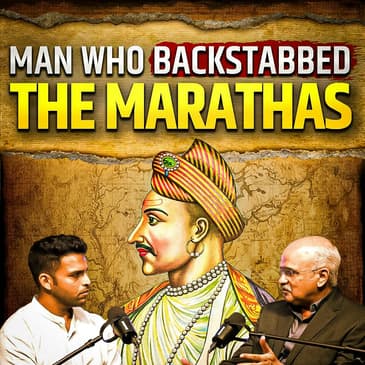
In this episode of the Bharatvaarta podcast, we explore the rich tapestry of Maratha history with Dr. Uday S Kulkarni, a naval surgeon turned historian, discussing his latest book, 'Raghoba, The Assassination of Narayana Rao Peshwa.' The conversation reveals the challenges and triumphs of historical research, including accessing archives and overcoming biases. Dr. Uday S Kulkarni sheds light on significant events during the Maratha Empire, such as the Battle of Panipat and the first Anglo-Maratha War, while addressing topics like discrimination under Mughal rule and the strategic evolution of Maratha artillery. With reflections on unity, leadership, and cultural renaissance, this episode presents a comprehensive narrative on the impact and legacy of the Maratha Empire.
Buy the book: https://amzn.in/d/adSFe16
Topics:
00:00 Sneak peak
02:08 Introduction
04:04 Dr. Uday's Journey from Medicine to History
06:55 Importance of Maratha History
11:00 Process of writing history
16:40 Being an outsider to writing history
21:53 History and Politics
24:24 Cultural Renaissance During the Maratha Period
27:56 Unknown facets of Chhatrapati Shivaji Maharaj
30:04 Temple Restoration Efforts
31:30 Decline of the Maratha Empire
33:18 Shivaji Maharaj's Tactics and Nationalism
34:31 Significance of Narayanrao Peshwa’s Assassination
35:37 Battle of Panipat and Its Aftermath
39:34 Raghunath Rao's Ambitions and Conflicts
44:52 Role of Anandibai and the Ghardis
50:16 Consequences and Decline of the Maratha Empire
54:25 Reflections on Indian History and Unity
57:39 Future of Historical Narratives
01:00:48 Dr. Kulkarni’s Upcoming Work and Conclusion
[00:00:00] History is essentially a story and narrative history is the bedrock on which all these other histories are actually erected. They stand on this bedrock. There was a huge national surplus. We were probably having 20-25% of the world's GDP at that time in India.
[00:00:16] So he says that the Mughals preferred a garden to a canal at that time and they preferred a tomb to a well. So the great national surplus was not put to any great economic use and therefore the lot of the common people did not improve because of that entire surplus which was generated. It was used for these kind of ostentatious expenditure.
[00:00:36] But they didn't give anything to the people. They were taken from the income of the people and used for a very selfish purpose at that time.
[00:00:43] The indigenous people, you may call them Hindus, you may call them Jaiids, you may call them… they were always second class citizens. If you don't pay taxes in Aurangzeb and Akbar's time, you could…
[00:00:53] Wives and children could be sold as slaves. There are mentions about such kind of things. That is what led to the Great Bengal Famine of 1770 and so many people died. And the company was only interested in extorting money and sending it back to England.
[00:01:08] They were happening because they did not identify with the people that these people are my people. And when Chhatrabhadi Shivaji formed his kingdom, he considered them my people.
[00:01:19] So he writes in his letters, he tells them that the Mughal menaces come to your area, so stay safe. As I said, the rot always sets in within before it becomes obvious outside.
[00:01:29] So the people of the time should have recognized what is happening. And there were people who saw it, but they didn't have the power to stop it, what was happening.
[00:01:39] So eventually it's not for anybody of us to kind of criticize anybody, because they were living in the present, like people today are living in the present.
[00:01:47] Any personalities you find in the political scene today, they are fighting… they are not thinking of what people think of them 200 years later. They are fighting for the here and now.
[00:01:55] So, not for us to pass judgment on them. We just read about it and if possible try to draw lessons from them. That's about it.
[00:02:07] In 1771, the ruler of the Maratha Empire, Madhav Rao Peshwa passes away. And in 1773, Narayan Rao Peshwa, his then very young son, who has just ascended to the throne, is murdered by his uncle Raghunath Rao or Raghoba.
[00:02:26] What is the significance of this event in Maratha history? And who are the prominent characters that were involved in these events?
[00:02:35] All of this and more in this fantastic book called Raghoba, The Assassination of Narayan Rao Peshwa.
[00:02:43] The author is Dr. Uday Kulkarni, who you have perhaps heard multiple times on the podcast. He is a naval surgeon turned historian and he's written a fascinating account of those incidents.
[00:02:57] In this very engaging discussion, we discuss various facets of the assassination and what followed as a consequence.
[00:03:04] So, stay tuned.
[00:03:07] Hello, sir. Welcome to Bharat Varta again. Thank you so much for making the time.
[00:03:11] Thanks a lot. Wonderful to have a face-to-face conversation this time.
[00:03:15] Yeah, always better. And you know, you are no stranger to Bharat Varta. You have been appearing on the podcast for almost three, four years now.
[00:03:23] Of course, we are missing our resident history buff and expert Amit Paranjpe.
[00:03:28] But hopefully this will be a different type of conversation. I am really looking forward to discussing, you know, a lot of elements of your book.
[00:03:37] Okay.
[00:03:38] One thing that really intrigued me, I mean, before we get into the book and you know, specifics of your writing is that, you know, you started to be a surgeon, you joined the defense forces.
[00:03:48] Again, you started to be a journalist and were, you know, writing articles and so on and so forth. And then 2009, you published your book.
[00:03:56] 11, maybe you published your book. And since then, you've written eight books, right?
[00:04:02] I think most of us would probably take two or three lives to, you know, have one of these. But how do you do it?
[00:04:10] Basically, the question that you're asking me that from medicine, how did we come to history? It should be reversed.
[00:04:15] Okay.
[00:04:16] How did we come to medicine from history? Because when I was in school, I wrote two books on history.
[00:04:21] Oh!
[00:04:22] I was in a boarding school and without anybody's prompting, I took a school notebook and wrote two books on history.
[00:04:28] One of which I still have, the ninth standard one I still have. So that was originally something which came from within.
[00:04:34] And of course, then you want to get into medical college, you want to do your post-graduation.
[00:04:38] That follows and then, you know, suddenly before you know it, 30-35 years have passed before you really have time to come back to what you were originally interested in.
[00:04:49] So then that happened around 2009, 2010. Actually, 2008 onwards, I began collecting documents which are not available easily from various libraries,
[00:05:01] photos scanning them and storing them on my hard disk. Because without this material, you really can't write a non-fiction account of anything.
[00:05:08] And when I was reading these books, I had to find a lot of slant in the way a particular facet is presented.
[00:05:15] The second thing I found that 18th century, the way it is represented in various books or talks or people, it's a skewed kind of a thing.
[00:05:24] And the reason I found for that was that the people who are writing in English, whether it was the British or it was other authors who write in English about Indian history,
[00:05:34] they have never read the documents of the time because they are all in Marathi.
[00:05:38] And they are in Marathi and last published maybe a hundred years ago.
[00:05:42] And they have not been translated into English.
[00:05:44] So unless you are a collaborator who can read them for you or translate them for you, like Sarkar to a certain extent,
[00:05:51] to a certain extent, depended on Sardesai to get him some of the Marathi documents, translate them for him.
[00:05:57] But nowadays what is happening is people are sitting in one place, accessing what they can,
[00:06:04] whether it is English, French translations, Portuguese translations and coming out of the book.
[00:06:08] Most of these people, whether Persian, Rajasthani, all these documents would usually present only one aspect of the Marathi history.
[00:06:16] But unless you read the Marathi letters, the original contemporary letters of the time,
[00:06:21] you really don't know what was the motivation behind what they did and what was actually going on behind the scenes.
[00:06:27] So those documents I got together in my first three years, so I had the material ready with me when I started writing.
[00:06:36] And because of this feeling that everything is skewed, everything is biased, Delhi-centric history is being presented.
[00:06:42] And while 18th century history is not that the Mughal Empire got over and the British started their rule from Placid,
[00:06:49] it never works out that way. It is looking at, it is by hindsight that you say that.
[00:06:53] And in the process of missing out an entire century and a half, when the Marathas were actually starting their empire and ending it till 1880.
[00:07:01] So 1774, Chaturabhadi Shivaji was coronated as the King. But his work started 20 years before that.
[00:07:08] And so that is the period from where this whole enterprise begins.
[00:07:11] And even during his own lifetime till 1780, you find he has reached the Kaveli in the south.
[00:07:19] And he has reached almost Nasik and those areas in the north.
[00:07:23] Khandesh he has reached.
[00:07:24] Kokan entire he has captured from Goa upwards.
[00:07:27] So this part is always missed out.
[00:07:30] And in the 18th century, this was taken a step forward when they crossed the Narmada,
[00:07:35] India went all the way to Delhi, captured Delhi several times, changed Mughal emperors.
[00:07:41] When the Mughal emperor became so weak that he asked them for help, they became his protectors by a treaty
[00:07:47] in exchange for which he gave them certain provinces, certain amount of money.
[00:07:52] And that is how they came to defend the Mughal emperor, the capital Delhi and India's frontiers
[00:07:59] when they fought with Ahmed Shah Abdali at Panipat.
[00:08:02] So this understanding of what were the Marathas up to has been kind of lost.
[00:08:07] And we are still just focusing on what they did in Bengal, which was a very small chapter of their entire history.
[00:08:14] And that was done in different circumstances.
[00:08:17] I have described what happened in Bengal over five chapters in my book on Nana Sai Peshwa.
[00:08:21] So this was a feeling I had. So that kind of was a motivation to write the first book.
[00:08:27] And the anniversary of Panipat, 250th anniversary was coming up.
[00:08:31] So I decided to start with that. I started the campaign of Panipat.
[00:08:35] So that was the first book. And probably I would have, I didn't know where I will write another book.
[00:08:39] I didn't know where this will get sold because it's not like a historian is writing the book.
[00:08:43] And it's just that I had a habit of looking at, as a clinician, as a doctor, looking at things in an apathetic manner.
[00:08:51] Objectively.
[00:08:51] Objectively. Clinically.
[00:08:53] You look at your patient, you don't get involved, oh, he's got cancer.
[00:08:56] You don't really get into that. So, same way I look at history with a slight, I keep my distance from the subject.
[00:09:03] And then I read it and make my own assessment of what actually happened.
[00:09:07] Of course, you cannot completely eliminate bias. That's a part of your constitution.
[00:09:11] You are brought up in a certain way that is part of your...
[00:09:15] So that you cannot get rid of entirely. But you consciously try to be objective,
[00:09:20] keep your subject at a distance and then start the process of writing.
[00:09:25] So that's what I tried to actually do. And I place my facts.
[00:09:28] I don't give long editorials, you know, on what the facts say.
[00:09:33] Like today's newspapers, you find the news getting mixed up with the editorials.
[00:09:36] So you're on the first page, you don't get news, you get editorials.
[00:09:40] So I try to avoid that. I just put the facts. And the facts speak for themselves, I always feel.
[00:09:45] Somebody might take one aspect of it and focus on that. Somebody may take the other.
[00:09:49] But that is a choice the reader has.
[00:09:51] I have just placed the facts in the way I saw them before them in my books.
[00:09:56] And the whole purpose was in the 18th century. Even today, there is a controversy about the 18th century.
[00:10:01] What does it represent? Does it represent the beginning of the British rule?
[00:10:06] Does it represent the end of the Mughals?
[00:10:08] Does it represent a period when the Marathas were supreme in this country?
[00:10:11] Because that was a phase in the 1750s.
[00:10:15] From the plains of Kumao to Kaveri. That's how they spread.
[00:10:19] And so if you ignore this, in the 18th century history economy you really cannot write unless you have studied Maratha history.
[00:10:27] And many authors are doing that without knowing anything about this empire over here which took place.
[00:10:33] So that was the kind of the motivation which led me into this whole thing.
[00:10:39] History writing is such that you can't sit at a desk and conjure up whatever happened.
[00:10:44] I mean it's not a novel or something.
[00:10:45] So you have to painstakingly go to certain places, procure artifacts, access things, so on and so forth.
[00:10:53] So it takes a lot of time and effort on your part.
[00:10:56] Could you talk about your process of writing some of these books?
[00:11:00] I mean, you know, considering that our colonial past, I mean a lot of these are in the UK right now I would assume.
[00:11:07] There are a huge lot of things lying here which are unread also.
[00:11:11] Like in Puna archives, one of the archives under the government of Maharashtra.
[00:11:14] There are nearly 3.9 crore documents which are unread.
[00:11:19] Access to these documents is difficult.
[00:11:22] The government doesn't encourage the people.
[00:11:24] Have they been digitized?
[00:11:25] No. There's no such thing going on.
[00:11:27] In fact, if you want to go and see a paper there, they will not show it to you very easily.
[00:11:31] They will not let you photograph it.
[00:11:33] They will not, if they photograph it for you, they will give it to you after 90 days, the photograph.
[00:11:38] So that's our difficulty.
[00:11:39] They'll first ask you for a certificate that you know the Modi script of Marathi.
[00:11:43] So all these difficulties are put in your way and then you have to navigate your way and finally if you are really persistent, you might get it.
[00:11:51] On the other hand, in the US where I got documents for this book on James Wales which I wrote for example, his diaries.
[00:11:59] Those diaries had not even been digitized when I inquired about them.
[00:12:02] I had seen his work, his paintings which he had done when he spent five years of his life in Western India where he died eventually.
[00:12:08] So his diaries were lying in the Yale University in the US.
[00:12:11] So when I contacted them, that was in 2013 or 14, so they said it has not been digitized as yet.
[00:12:19] But it will be digitized in about a six months time.
[00:12:21] So they digitized those four years diaries and at the end of six months when I sent them a mail, they said yeah we just finished digitization and feel like we can send them to you.
[00:12:30] And they sent a whole lot of diaries, all the pages which were digitized in high resolution, digitized to me by email and then they were all running ahead of course.
[00:12:41] So I had to first type it out in Microsoft Word, make sense of what it is,
[00:12:46] and then I just wed them to the pictures I had got and then divide them into various chapters.
[00:12:51] So that's how that book came about. It was a difficult task and probably the only time I am going to do this kind of a thing.
[00:12:56] Then there were other documents which were being looked for by historians as way back as 1926.
[00:13:02] The historians have written articles about Marathi historiography
[00:13:07] where they have said that some British officers took Marathi documents to England and we are not able to find them.
[00:13:13] So these and they say that the documents are deposited in a particular library in the UK.
[00:13:19] So and they sent letters to the libraries and the libraries did not respond.
[00:13:24] So I took that up again and I sent them emails saying that this is what the 1926 article says.
[00:13:29] So could you look it up? Now those documents had not been catalogued, Royal Asiatic Society for example.
[00:13:34] So the librarian there actually went physically box by box to look for them and nice of her to really find 200 papers of Marathi history,
[00:13:45] original letters and papers which had never been published before.
[00:13:48] Like for example there is a map of Aurangabad. Today it is called Chhattrbadi Sambhajanagar of the 18th century.
[00:13:55] With various gates, various buildings inside which are written in Modi script as well as in Persian.
[00:14:02] So that entire map are found over there. Then the entire Bakhar of Panipat which is an 80 page document
[00:14:08] which gives an eyewitness account with some subjective overlay about the actual battle of Panipat.
[00:14:13] There are various letters. In fact a cache of letters which was from Nara Faddis, very important letters,
[00:14:20] were given by his wife to the British resident who took them there and deposited them there.
[00:14:26] Charles Mallet was the resident of Puna. He took several documents.
[00:14:28] So all these things were lying over there for 200 years just waiting to be discovered.
[00:14:33] And when I went there they were very kind to give me all the scanned copies against some token payment.
[00:14:38] And that is where the Bakhar of Panipat is the outcome of that.
[00:14:43] And even now, like even in this book, I have published Bakhar of the assassination of Nara Nara Peshwa,
[00:14:49] which was again lying there, which had never been published before.
[00:14:52] So I put it here as an appendix in the original Marathi and the translation in English.
[00:14:57] It throws up some new facts which are not known so far.
[00:15:01] So such things are going on.
[00:15:03] And wherever I keep finding, I keep trying to get it.
[00:15:06] Like I found a map of Shanivarwada in the Deccan College a few months back, which I have used in the book,
[00:15:12] which was originally drawn in 1796.
[00:15:15] So that was when the Peshwa was actually in power.
[00:15:19] The British had not yet reached Puna.
[00:15:21] So those maps show the places as they were at that time.
[00:15:24] Today of course the whole thing is just foundations left.
[00:15:28] The whole superstructure has been burned down.
[00:15:29] So that helps to identify like when the Gardi soldiers entered the Shanivarwada and were chasing Nara Nara.
[00:15:36] There is one Hakikat published by the government of Maharashtra,
[00:15:39] which describes how he ran, from where he ran, how the Gardis chased him,
[00:15:44] what happened when he finally reached the place where he was killed,
[00:15:47] and what all happened later.
[00:15:49] So that Hakikat traces the entire pathway where the Peshwa was chased by these Gardis.
[00:15:55] Gardis were the armed gunners or the guards who were supposed to be there in the Marat army.
[00:16:00] So those things which are found, I could use them in this book.
[00:16:04] So the process continues I suppose.
[00:16:06] What I find is that you have a clinician's approach, you know, to looking at these things.
[00:16:12] Does it really help to have like an outsider's perspective on some of these things?
[00:16:17] Because, you know, we've had Abbas who wrote The Chessboard King.
[00:16:21] And similarly he's an architect and he went into primary sources,
[00:16:24] looking at the Babarnama and so on and so forth.
[00:16:26] Whereas, I mean if you contrast it with typical, you know, academic historians,
[00:16:31] there's a huge pressure to sort of tow a certain line and, you know, be in the good graces of the powers that be
[00:16:38] and get peer reviewed, all of those things.
[00:16:42] Considering you have no such compulsions, you are, you know, sort of a free agent.
[00:16:46] Does that kind of give you the, you know, unique advantage?
[00:16:50] Actually it's very funny that all the famous historians of India, say, Adunath Sarkar,
[00:16:55] he was a professor of English literature to start with in Patna University or Sardesai.
[00:17:01] He was not a historian, he was a BA, but he was a tutor to Sayajiroga Akward's children.
[00:17:08] And from there his interest in Maratha history began and he wrote all this massive amount of work he has done.
[00:17:14] So the earliest pioneers who gathered the Marathi documents, whether it is VK Rajwadi,
[00:17:20] whether it is K. N. Sani, whether it is Rao Badur, Parasnis, they were not historians.
[00:17:24] They had a, inborn kind of a, it was a quest for them to find these documents.
[00:17:30] They went door to door and asked people, do you have any old documents with you?
[00:17:35] Please give them to us.
[00:17:36] Otherwise today, those days what was happening is old documents are of no use.
[00:17:39] People are burning them, literally.
[00:17:41] Even today there are researchers who are finding these documents in some kind of dump houses,
[00:17:47] procuring them and reading them.
[00:17:49] So these are the people who did it now.
[00:17:52] Now, academic historians have written books but they are meant for academia.
[00:17:55] Now if you write an academic book, it is one professor talking to the other or to a student.
[00:18:00] It is not for the lay people.
[00:18:02] And the lay people don't understand that kind of theories about subaltern history, economic history of India.
[00:18:09] So these topics are for very specific niche people.
[00:18:12] I mean they are important.
[00:18:14] They are important.
[00:18:15] But your history is essentially a story.
[00:18:17] And narrative history is the bedrock on which all these other histories are actually erected.
[00:18:23] They stand on this bedrock.
[00:18:26] So unless you have the narrative history, if you don't know who was when and what he did and why he came to a particular,
[00:18:31] why he did a certain thing, talking about just the economic history or the cultural history or the social history or the administrative or the judicial systems.
[00:18:40] These things are only when you basically know the narrative history which as far as the 18th century is concerned is largely unknown or it has been largely misrepresented.
[00:18:51] So that is the reason I have focused on.
[00:18:54] I do give bits of tidbits about narrative, about economic history, about the cultural aspects that are happening there.
[00:19:00] In between the books, I put a rapporteur or I put a sutradhar or somebody who kind of interjects between the narrative and the chapter where he is talking of ancillary things that are happening at that time.
[00:19:11] But a dedicated book purely on these subjects is really not for the lay audience.
[00:19:18] So my objective is that this history must be known on an all India level.
[00:19:24] That's the reason why I write in English, though they are translated into Marathi later on,
[00:19:28] because this history has to go to not only outside Maharashtra, it has to go all over the world.
[00:19:34] And this perception of Indian history which is basically depending on those who ruled in Delhi.
[00:19:40] The Delhi Sultanate came and then the Mughals came and the magnificent monuments which are left behind.
[00:19:45] We looked at them, oh they were great.
[00:19:46] Now there is a historian called Perseval Spear. This is an aside which I will just mention some days back also.
[00:19:53] Perseval Spear was a historian who wrote a book.
[00:19:55] In 1950s he was also teaching in schools in Delhi.
[00:19:58] So he wrote the Mughals, there was a huge national surplus.
[00:20:01] We were probably having 20-25% of the world's GDP at that time in India.
[00:20:05] But what use was it put to? I would say that way.
[00:20:08] So he says that the Mughals preferred a garden to a canal at that time and they preferred a tomb to a well.
[00:20:15] So the great national surplus was not put to any great economic use and therefore the lot of the common people did not improve because of that entire surplus which was generated.
[00:20:25] It was used for these kind of ostentatious expenditure.
[00:20:28] Then the Jagirdars, when they died, their entire property was confiscated.
[00:20:32] So during their lifetime, they built these massive tombs for themselves.
[00:20:36] And I was here.
[00:20:37] So looking at the size of the tomb, you think that this guy was a great man.
[00:20:40] So you find the whole countryside is dotted with such tombs.
[00:20:43] They spent all their money.
[00:20:45] On their death it will be confiscated by the government.
[00:20:47] That was the policy of the Mughals.
[00:20:49] So this was, so as in fact Percival Spear goes one step further, when he says when the people, common people looked at these mausoleums which were built, they could not subsist on them.
[00:21:02] They could only look at them.
[00:21:04] For them it was the equivalent of Maria Antoinette's cake.
[00:21:07] So that is the very, I mean say, I would say very harsh verdict given on these monuments about which we are very proud of and we go to visit in large numbers.
[00:21:19] But they didn't give anything to the people.
[00:21:21] They were taken from the income of the people and used for a very selfish purpose at that time.
[00:21:26] No, and caused great famine, distress and so on and so forth.
[00:21:30] Often times when people such as yourself write history or even I would say others that I mentioned, you are often smeared with the epithet that you are rightist historians or so on and so forth.
[00:21:48] Like why does that happen?
[00:21:50] When someone is looking at something objectively and writing about it, why do certain people not want this to be portrayed?
[00:22:01] I would not like to be a leftist or rightist.
[00:22:03] I am a realist.
[00:22:04] What has happened I am just putting before it.
[00:22:06] I mean if the people perceive it to be rightist, so be it.
[00:22:10] Now look at the last 800 years of Indian history.
[00:22:16] 400 years we were under various sultanates in the north and the Bahamanis and so on in the south.
[00:22:22] And then we had the Timurids as Abbas likes to call it and Mughals who came for another 200 years.
[00:22:28] So this entire period, the indigenous people, you may call them Hindus, you may call them Jayids, you may call them.
[00:22:35] They were always second class citizens.
[00:22:38] I will tell you why.
[00:22:39] And we were under an alien rule because there was a foreign faith which was the state religion.
[00:22:44] There is a foreign language which is the court language which is followed in all the correspondence, Persian.
[00:22:49] There was a system of promotions which was designed in such a way that those with Turku, Persian ancestry were promoted.
[00:22:57] The highest mansabs in the period from Akbar to Aurangzeb were given to people with this ancestry.
[00:23:03] Not to Rajputs. Second priority were the people who converted, then the Rajputs and then the other people.
[00:23:10] So this was one form of discrimination. The taxation system.
[00:23:15] The taxation was skewed because the Hindus were charged higher taxes, the agricultural taxes, the Kharaj.
[00:23:21] The Kharaj was a land revenue which was 50% for Hindus and 10% for Muslims.
[00:23:25] So that is what actually led to Chhatrapati Shivaji beginning his enterprise by calling it Swarajya.
[00:23:33] Own rule. Because what they were going through at that time was a Pararajya.
[00:23:37] Now by stating these facts, very, very objective facts, if somebody labels you as left or right, I don't really concern myself with that.
[00:23:46] Because what I am saying is the honest truth.
[00:23:49] So I am not writing any revisionist history. I am putting forth facts and those facts speak for themselves.
[00:23:56] Right. You have written eight books now. What fascinates you about the entire Maratha period?
[00:24:05] You mentioned a few things, perhaps the first indigenous empire in a long time.
[00:24:12] The length and breadth of their kingdom. A few of the things they did, whether it is the navy or other things.
[00:24:21] But what is that fascination for you?
[00:24:23] Actually, one finds that there was a cultural renaissance which began with the Maratha period.
[00:24:28] That 150 to 170 years, say from 1650s to 1818 that was there.
[00:24:34] You find there is a cultural renaissance in that what was lost.
[00:24:38] Thousands of temples have been destroyed. The entire city of Varadasi, if you see today,
[00:24:43] all the buildings and the ghats which are there in existence in the 21st century were built in the 18th century.
[00:24:50] Nothing exists before that. It was all destroyed.
[00:24:54] So if you go to the Dasha Shwamedh Ghat, at the entrance to that lane,
[00:24:58] there is a placard even today saying it was built by Badaji Bajirao Peshwa or Nanasa Peshwa.
[00:25:02] There is a Shinde Ghat. There is a Bosle Ghat. There is a Raja Ghat. There is a Ganesh Ghat.
[00:25:07] All these ghats were again built by them. Ahilya Devi Holkar built the present temple of Kashi Vishwanath.
[00:25:13] Even the Kalabhirao temple which people go to, you find a plaque there even today
[00:25:19] which says that it was rebuilt in 1811 by the Chhatrapati of Satara and the last Beshwa.
[00:25:27] Their names are and it was done on behalf of them by their Sardar, Sardar Vinsurkar.
[00:25:32] So you find that plaque there. So all these buildings which were built, it was a renaissance.
[00:25:37] And that is what, to a certain extent, resurrected what was lost in the previous 4 centuries.
[00:25:44] So had this period not been there, it would have been a different kind of country
[00:25:48] and different kind of ethos which we would have seen today.
[00:25:53] And that ethos actually comes from the Maratha period.
[00:25:58] So that is, I think, would be the importance of that period.
[00:26:01] And of course, the political freedom that they achieved for other people
[00:26:04] and then which later on people took for granted.
[00:26:07] There was no longer that slavery which was that you have to do this
[00:26:10] and if you don't pay taxes in the Aurangzeb and Akbarzeb,
[00:26:13] you could have wives and children could be sold as slaves.
[00:26:17] There are mentions about such kind of things.
[00:26:20] These kind of atrocities didn't take place in the farmers.
[00:26:23] Some people didn't pay taxes.
[00:26:25] There were famines.
[00:26:25] Even the East India Company, the Bengal famine of 1770.
[00:26:30] Why did it take place?
[00:26:31] Because there was famine all over the country.
[00:26:34] The people at the Jagirdars were told that you must extort this tax from the farmers.
[00:26:40] They were starved to death but that tax has to be extorted.
[00:26:43] The East India Company, that is what led to the great Bengal famine of 1770
[00:26:48] and so many people died.
[00:26:49] And the company was only interested in extorting money and sending it back to England.
[00:26:53] So this was happening.
[00:26:55] All these things which happened at this time, whether it was the Mughal period or the English period,
[00:27:00] they were happening because they did not identify with that these people are my people.
[00:27:04] And when Chattarbadi Shivaji formed his kingdom, he considered them my people.
[00:27:10] So he writes in his letters, he tells them that the Mughal menace has come to your area.
[00:27:14] So stay safe.
[00:27:15] Go down the ghats so that he doesn't attack you.
[00:27:18] And he tells the Subedhar to whom he writes the letter also.
[00:27:20] That you also stay safe in your place.
[00:27:22] So this is a concern for the people, whether it's in the form of taxation,
[00:27:27] whether it's in the form of punishments,
[00:27:29] whether it's in the form of concessions given adverse circumstances that they had to face.
[00:27:33] So this was because there was an empathy with the people at that time,
[00:27:37] because it was their own people.
[00:27:38] That empathy was missing in the earlier days or even later in the colonial period.
[00:27:44] Right.
[00:27:46] Often times when you talk about this period,
[00:27:49] the shining star is Chattarbadi Shivaji Maharaj.
[00:27:52] And everyone knows him to be fearless and all of those things.
[00:27:56] But are there two or three facets that people don't know about him that you can bring out?
[00:28:03] Actually, his whole life is a very stirring story, which can really…
[00:28:08] Because you see, Chattarbadi Shivaji was a brave man.
[00:28:12] He had a vision for a kingdom of his own.
[00:28:17] His establishment in the Navy was a vision in itself.
[00:28:20] And he was very clear about his objectives.
[00:28:23] And it was not that he would go about achieving his objectives in a foolhardy manner.
[00:28:30] He had the diplomacy, the tact to soften his approach when the time comes.
[00:28:37] And when the situation was right, he had the good sense to capitalize on that.
[00:28:43] So it was not just a warrior.
[00:28:47] He was more than a warrior.
[00:28:48] He was a statesman, a general and eventually a king who cared for his people.
[00:28:52] So, his cultural kind of roots which came from the teachings which he had from his mother.
[00:29:02] Like his seal for example, which he made in 1646 when he was just 16 years of age.
[00:29:09] He writes a seal in Sanskrit.
[00:29:10] When his parents' seals are in Persian.
[00:29:13] So he was the first one to really identify with…
[00:29:16] He got the Rajya Vivaar Kosh written, which was a book which was written to eliminate Persian words
[00:29:26] which had crept into the court language.
[00:29:29] The eight prime ministers which he had appointed, they were originally having Persian names.
[00:29:35] He changed their names and got Sanskrit names for each of them.
[00:29:39] So, a Dabir in Sanskrit became the Sumant, a foreign minister in his nomenclature.
[00:29:45] The Peshwa again is a Persian word.
[00:29:47] It was called Pradhan Pandit, Pandit Pradhan.
[00:29:50] Pradhan is an Indian word.
[00:29:52] So this kind of thing shows that these orders were not given in a vacuum.
[00:29:56] They were given because some thought had gone into them.
[00:29:58] So that shows what he was trying to do.
[00:30:01] In Goa, there was a temple which he built, which had been destroyed first by the Mughals,
[00:30:06] then by the Christians and that temple stands today.
[00:30:09] It's called Saptakoteswar.
[00:30:11] So his temple in the south, he had come to Tiruvannamalai when he went to Kaveri,
[00:30:15] where some local people told him that two temples had been destroyed and mosques had been built in their place.
[00:30:19] He destroyed the mosques and this tradition continues like in Nasik, one of the Jyotiralingas, Trambakeshwar.
[00:30:26] It had been levelled in Aurangzeb's time and a mosque had been built in its place.
[00:30:29] In the 1750s, Nasik was captured by Nana Sahib Peshwar's men.
[00:30:34] Nana Sahib Peshwar ordered the mosque to be levelled and a temple to be built there.
[00:30:38] And that temple which you see today was built over a period of 30 years.
[00:30:42] That is the Jyotiralinga of Trambakeshwar.
[00:30:44] So this kind of system was when Mallara Holkar went to Kashi, along with Nana Sahib's expedition to Bengal.
[00:30:53] He was saying that if you want I will go to Kashi just now, destroy that Aurangzeb's mosque and rebuild the temple of Kashi Vishwanath.
[00:31:01] So people of Kashi told him that you are here today, but when you go away who will protect us?
[00:31:06] Because it was under the Nawab of Awad at that time.
[00:31:09] So that's why he held his hand and did not do it at that time.
[00:31:12] So you find this thread throughout Malata history of re-establishing the religion and the faith and the structure of the indigenous people.
[00:31:22] And at various points of time it is expressed not only by their actions, but in their letters, which you see what they have to say about certain things.
[00:31:29] So this tradition continues right up to the end of the 18th century.
[00:31:33] Now towards the end what happened is that like every empire as I say has a shelf life.
[00:31:41] And nepotism, corruption, assassinations as in this book you find that for political power, personal ambition, division of the kingdom was sought.
[00:31:50] So like Madhara Peshwa tells Raghava, whose kingdom is this?
[00:31:54] Who am I to divide it and give you half the share?
[00:31:58] It's a people's kingdom.
[00:32:00] I am just a trustee looking after it in other words.
[00:32:04] So that feeling was gradually going down and people were forming groups, fighting for their personal gain, personal ambition.
[00:32:13] The feeling of nationalism, especially after this period which I deal with in the last book Raghava,
[00:32:20] that feeling of nationalism was lost probably because they feel that they are no longer threatened by external power.
[00:32:25] So when the external threat disappears, one tends to be a little more lackadaisical about preserving your own core values.
[00:32:34] And a lot of you find even in the 21st century today, you find that in public life, whether it is the kind of corruption that you see in public life.
[00:32:45] I mean these are signs of a kingdom or an organization which is kind of on its decline.
[00:32:54] Yeah.
[00:32:55] So there's this, I was listening to another podcast and what they said was when 9-11 happened in New York, right, there were no Democrats or Republicans the day after, right?
[00:33:07] Everyone pretty much came together for a brief period of time.
[00:33:10] And I think an external aggression or some kind of a threat sort of unites people.
[00:33:15] Particularly about Shivaji Maharaj, couple of things you mentioned really caught my attention.
[00:33:21] One is the fact that he was tactical as well, right?
[00:33:24] Because he probably recognized the mistakes that we made earlier where we were being principled versus, you know, the barbarians and the invaders who had no such rules, right?
[00:33:35] And second thing is this sense of nationalism, this sense of identifying with our own people, right, beyond maybe like kingdoms and borders and so on and so forth.
[00:33:47] Truly fantastic.
[00:33:48] And of course, you know, I would recommend everyone read the Maratha Century which is your previous book which kind of gives an overview of this entire period as such.
[00:33:57] It talks about the Peshwas and so on and so forth.
[00:34:00] We'll get to this book, right?
[00:34:02] One of the things, you know, before we were recording what I mentioned was, typically if you look at succession with the Timurids or Mughals basically or anyone else, it is by assassination, right?
[00:34:15] So, I have three sons or whatever and one of the sons assassinates everyone, perhaps including the father and gains ascension to the throne.
[00:34:22] But it is such an exceptional thing in our history that such an assassination is spoken about even today, right?
[00:34:33] That such a thing happened, right?
[00:34:36] So, what is the significance of this if you could just talk about it?
[00:34:40] It was a sign that some kind of decadence had crept into the moral fiber of the ruling class, I would say.
[00:34:50] Because… and secondly, there was a collapse of a central leadership.
[00:34:55] In 1749, Chhatrapadi Shahu died.
[00:34:58] Now, Chhatrapadi Shahu, though he was not a person who led armies into battle, he was a central authority, a moral authority which kind of could bring the entire…
[00:35:09] all the component parts of the empire together.
[00:35:12] And when he died, he had no son.
[00:35:17] There was a succession struggle about who will take over and of course I have described that in one of my books.
[00:35:23] And eventually, in order to make the empire work, the administration all came to Pune and Nana Sahib became the de facto head of the Maratha Confederacy.
[00:35:33] And you find that from then on, the Battle of Panipat, these decisions which were taken to protect the Mughal Empire, to combat Abdali as the ruler of Afghanistan, going from the south.
[00:35:48] Now, the idea was to defend India's borders.
[00:35:50] He was on his fifth invasion, every time he came to Delhi, he came to Mathura, slaughtered people.
[00:35:55] So, it was to defend this, against external aggression.
[00:35:58] And had they won the Battle of Panipat, the future of Indian history would have probably been completely different.
[00:36:04] Like, there is a famous story in Marathi by noted astrophysicist, Jayad Naradikar, where he says that had Marathas won Panipat,
[00:36:12] today when you go from Pune to Bombay, there would have been a customs and a customs post when you enter Bombay,
[00:36:18] where you have to give a visa and a passport and then enter.
[00:36:21] So, he describes this as a dream of somebody who is travelling there.
[00:36:25] So, the whole picture of the future would have changed. Why go even up to Palipat?
[00:36:30] If Chhattarabhati Sambhaji had not been captured and killed the way he was, had he lived his full natural life,
[00:36:37] probably till 50 or 60 years of age, he was killed before he was completed his 30th birthday,
[00:36:43] you find the entire history could have changed because it would have been the rule of the Chhattarapati.
[00:36:48] When the Chhattarapati's rule devolved onto the Peshwa, and after this assassination, you find the Peshwa was assassinated,
[00:36:56] the uncle was a hunted man kind of, he was chased by Marathi armies.
[00:37:02] There was a vacuum at the top and the leadership of the Marathi Empire shifted from the king to the prime minister to hands of ministers and generals.
[00:37:11] So, a strong centre which is necessary for the functioning of a proper empire and administration,
[00:37:17] that was missing and there were always checks and balances between each other.
[00:37:21] That he has got the military power but I have got the administrative powers in my hand.
[00:37:26] So, that kind of struggle began.
[00:37:28] So, in face of increasingly aggressive English power after the 1770s,
[00:37:34] you find it's a surprise that we survived for another 50 years.
[00:37:39] So, as I said, the rot always sets in within before it becomes obvious outside.
[00:37:44] So, the people of the time should have recognised what is happening and the people who,
[00:37:50] there were people who saw it but they didn't have the power to stop it, what was happening.
[00:37:54] So, eventually it's not for anybody of us to kind of criticise anybody,
[00:37:58] because they were living in the present, like people today are living in the present.
[00:38:02] Any personalities you find in the political scene today, they are fighting,
[00:38:05] they are not thinking of what people think of them 200 years later.
[00:38:08] They are fighting for the here and now.
[00:38:11] So, not for us to pass judgement on them.
[00:38:14] We just read about it and if possible try to draw lessons from them.
[00:38:18] That's about it.
[00:38:19] So, this book would probably start a kind of a slow decline of the Maratha period and slow deterioration.
[00:38:28] But as you said earlier, when there is a crisis and external power kind of attacks them,
[00:38:33] they still did come together.
[00:38:35] Like when they fought the English, they came together.
[00:38:37] The first Anglo-Maratha war.
[00:38:39] When the Nizam attacked them in 1795, 130,000 men were on the field.
[00:38:45] From all the chiefs had contributed contingents for fighting with the Nizam and defeating him.
[00:38:50] And that was the last time in 1795 that the entire Maratha army came on the battlefield to fight a common adversary.
[00:38:58] But then mutual jealousies began creeping in and this kind of unity even on the battlefield did not manifest itself.
[00:39:05] And that worked for the English in the second Anglo-Maratha war.
[00:39:09] It was only the Sindhiyas who fought with the English and two years later Holkar fought with the English separately.
[00:39:16] So, this kind of thing was not… had they fought together because the Sindhiyas were defeated in five battles and they were all very close battles.
[00:39:24] But had they been supported by all the others, it could have been a different outcome.
[00:39:30] Right.
[00:39:32] I find Raghunath Rao very fascinating.
[00:39:35] You call him Ragobha here.
[00:39:38] This is a person who at the time of like this where it is set, right?
[00:39:43] I mean the assassination.
[00:39:44] By then he is already like recognized as a war hero, right?
[00:39:48] And so on.
[00:39:49] And I can quite empathize, right?
[00:39:50] The man is senior but he has passed over and he has to abdicate the throne or rather take care of his nephew,
[00:39:58] who is the new king.
[00:40:01] And you know obviously there are differences in their style and so on and so forth as one may have, right?
[00:40:08] Do you think that he was… I mean like do you see his point of view in terms of…
[00:40:14] So, there was a custom of primogeneship for eldest son takes over whether it is a king or whether it is a prime minister.
[00:40:22] In fact, when Bajirao died for example, his younger brother was still alive.
[00:40:29] But his younger brother didn't say make me the Peshwa.
[00:40:33] His 19 year old son Nana Sahib was made the Peshwa and in fact his uncle Chibaji Appa supported Nana Sahib for whatever…
[00:40:40] He also died eight months later.
[00:40:42] But he supported him for those eight months.
[00:40:44] And it was only after Nana Sahib's chosen successor, his eldest son, Vishwasara was killed in Panipat.
[00:40:52] And Sadashira Bhau, his cousin who was the Diwan, he also was killed at Panipat.
[00:40:58] And then suddenly you find that the next in line is a 16 year old boy, second son of Nana Sahib.
[00:41:02] Because Nana Sahib also died within six months of the battle.
[00:41:05] So when his second son who is 16 years old comes forth and by the custom being followed till then is appointed the Peshwa by the Chhatrapati.
[00:41:14] Actually that time Queen Tarabai was the person in charge.
[00:41:18] She was still alive in 1761.
[00:41:20] And she was the one who gave the robes of office to Madhav Rao.
[00:41:23] That was the time when Raghunath Rao first felt that I should have…
[00:41:26] I am the senior statement.
[00:41:28] Senior meaning he was that time about 27 years old.
[00:41:31] It was not that he was very old.
[00:41:33] Because he was quite…
[00:41:34] He was 11 or 12 years younger than his brother Nana Sahib.
[00:41:37] And Nana Sahib was more like a guardian to him than a brother.
[00:41:40] Because Bhaji Rao died when Raghunath Rao, Raghoba was just five or six years old.
[00:41:45] So it was Nana Sahib who supported Raghunath Rao, who sent him on expeditions to the north,
[00:41:49] who nurtured him, who catered to his various…
[00:41:53] and kind of covered up for his deficits also.
[00:41:56] Like for example the attack on…
[00:41:58] His attack on Punjab.
[00:42:01] Where Marathas went to Attok and Peshawar and all these places.
[00:42:04] When he came back from there, he came with a debt of some 80 lakh rupees.
[00:42:08] A huge sum in those days.
[00:42:09] And Nana Sahib quietly paid it off.
[00:42:11] But Sadashivara Bhao who was the Diwan,
[00:42:14] he would not accept this.
[00:42:15] I mean you go out not to lose money.
[00:42:18] You go out to earn money and come back.
[00:42:20] Or you sustain yourself from money earned from that spot where you are going to.
[00:42:24] Unfortunately the area was all ravaged by previous invasions
[00:42:27] and nobody was there to pay the taxes.
[00:42:29] So he came back with a loss.
[00:42:30] So when the Panipat expedition came,
[00:42:32] for the first time he had to present Sadashirava Bhao North.
[00:42:35] So you find that Raghunath Rao's nascent ambition emerged
[00:42:41] after this debacle and the deaths in the family in Panipat.
[00:42:45] And the first two years he was also the regent.
[00:42:47] But again there is a reaction when somebody tries to take power in his own hands.
[00:42:51] So the reaction came from Madhav Rao, his mother and other ministers who knew that
[00:42:56] Raghunath Rao will not probably make a good Peshwa administratively.
[00:43:00] He will probably not be able to control the expenses.
[00:43:05] His personal habits, his superstitions were not good for becoming a Peshwa.
[00:43:11] So they were opposed to him.
[00:43:13] And therefore eventually in a couple of years when Madhav Rao became a little more mature,
[00:43:18] he came into his own and he took over the role of the Peshwa.
[00:43:20] And then Raghunath Rao kept asking for a division of the kingdom.
[00:43:24] When that didn't work he tried to bring foreign powers to defeat the Peshwa,
[00:43:28] collaborated with the Nizam for example.
[00:43:31] He tried to himself raise an army and come back and fight his nephew.
[00:43:35] And nephew went to fight with him, captured him and brought him and put him in a prison in 1768.
[00:43:42] So this happened during Madhav Rao's time.
[00:43:44] So actually when Madhav Rao was on his deathbed, Raghunath Rao was in prison.
[00:43:49] But when Madhav Rao found that he was going to die,
[00:43:51] and his younger brother 17 year old Nara and Rau,
[00:43:54] he was going to be the next Peshwa.
[00:43:55] He felt that he must make up with his uncle, appeal to his good sense,
[00:44:00] ask him to look after the young boy and guide him.
[00:44:03] So he came and he promised that I will do that,
[00:44:06] I will accept, I will be responsible for Nara and Rau and so on.
[00:44:09] But within a few months as you find in the book, things went wrong.
[00:44:14] And that gradually, it's a stepped kind of approach to final event,
[00:44:19] which took place nine months into Nara and Rau's realm of the assassination.
[00:44:22] So the plot grew slowly.
[00:44:25] And at various stages, people who were disgruntled or offended by the new Peshwa,
[00:44:31] by the way he behaved, the way his rules that he passed and all,
[00:44:35] they gradually began getting together and a conspiracy began forming over the months that followed.
[00:44:40] And the obvious counterpoise to the Peshwa was Raghava who was in prison.
[00:44:46] So you remove them and put him in his place.
[00:44:48] Somewhere along the line, this capturing and replacing the Peshwa turned into assassination of the Peshwa.
[00:44:55] What was the role of Anandibai in this?
[00:44:58] And also, I mean, there is this common trope that actually, I mean, he was supposed to capture,
[00:45:04] but the Gardis actually end up killing Nara and Rau.
[00:45:07] There was, the original order which Ragunathra signed was probably to capture Nara and Rau.
[00:45:12] And because the Gardis asked for it.
[00:45:14] He said, we want a written document otherwise we will be held responsible for the action that we are taking.
[00:45:18] And the Gardis are, at this point, I mean, they are very diverse, right?
[00:45:21] I mean, they are not Indian local.
[00:45:23] See, the Gardis actually came into the Indian army in the 1750s.
[00:45:27] Because when Nana Saheb found, Nana Saheb Peshwa found here to face the French artillery,
[00:45:32] the French had practically taken over the Nizam.
[00:45:34] So the French General Busi was leading the French artillery and the Marathas had no answer for that.
[00:45:39] Because the guns were very powerful and in the battle they found they could not face them.
[00:45:43] So he started developing a Maratha artillery and overnight it could not be done.
[00:45:49] So he imported people.
[00:45:51] So the people who imported were students of Busi.
[00:45:54] And they were paid a salary and they were brought into the part, made a part of the Marathami.
[00:46:01] In fact, the famous example is of Abraham Khandgardi, who fought and was killed at, who died at Panipat.
[00:46:07] So when he went there, he joined the Marathas, his guns worked well.
[00:46:11] But when the battle was lost, Abdali captured him and let him die from his wounds.
[00:46:16] So they were loyal.
[00:46:18] They were not considered to be disloyal.
[00:46:21] Though periodically they were outbursts about indiscipline was there,
[00:46:27] that we are not being paid last month's salary as yet.
[00:46:29] They were very particular about being paid on time.
[00:46:31] So in a way they fit into the description of being a mercenary.
[00:46:36] They had no...
[00:46:38] The original nationalist idea of the foundation of the Maratha state was not something the Gardis would identify with.
[00:46:44] Because they were either from the north or they were Muslims.
[00:46:48] But they were brought in because there was a need for an artillery at that time.
[00:46:51] And the Maratha chiefs at that time, they were more interested in the cavalry.
[00:46:57] So you find that the Maratha cavalry right up to the early 19th century, the Maratha cavalry was something which,
[00:47:02] even in the battle of Assai, welllessly when he fights the Marathas,
[00:47:07] he is worried about the Maratha cavalry.
[00:47:09] Because that is something even the English don't have.
[00:47:11] Nobody had as good a cavalry as them.
[00:47:12] So they were always interested in being part of the cavalry.
[00:47:15] There was certain status about being in a cavalry.
[00:47:17] They were not much interested.
[00:47:18] First thing, the guns at that time were very slow loading.
[00:47:22] So if a cavalry charge comes at you, you may get one shot off.
[00:47:25] Before you load and put the second shot, the cavalry is upon the gunner.
[00:47:29] So that did not make it very attractive.
[00:47:31] As the 18th century progresses, you find rapidly reloading guns.
[00:47:35] And that is when the artillery began to take over the battlefield role from the cavalry.
[00:47:43] Okay. Interesting.
[00:47:45] Yeah. Anandi Bai is...
[00:47:47] Yeah. So Anandi Bai actually was the wife of Raghobadada.
[00:47:53] And as a wife in the 18th century and probably even today, it was her duty and her belief that she was supporting her husband.
[00:48:02] Very often she probably felt that what her husband is doing is the wrong thing.
[00:48:06] But she supported him nevertheless. In private, she may have tried to give him some advice.
[00:48:13] In public, she supported him at all times.
[00:48:15] Now this entire thing about Anandi Bai converting this order of capture into kill, there is no original document, letter where Anandi Bai is named as a conspirator.
[00:48:26] There are long lists of conspirators which have been published.
[00:48:30] 100 people, 150 people.
[00:48:31] But in none of these lists is Anandi Bai's name mentioned.
[00:48:35] Anandi Bai's name comes to us only in the bakhars, which are subjective accounts written by individuals.
[00:48:41] So you really cannot find any proof that it was Anandi Bai who converted the Dhalsama.
[00:48:45] So is she being scapegoated or...?
[00:48:47] We don't know. Because somebody has changed it. The reason for that is that the letter was seen by Ramshastri Prabhune who was the Chief Justice.
[00:48:56] And on the base of that letter, he decided that Raghobad was to be held guilty for this assassination.
[00:49:03] And it was also noted by Grand Duff who was a resident of Sathara after 1818.
[00:49:08] And he had a huge number of Marathi documents to go through.
[00:49:12] So he mentions about that letter.
[00:49:14] And Anandi Bai herself mentions about that letter much later in 1784 when she is kind of kept in a palace in Kopergao and not allowed to move out.
[00:49:27] Where she says that, she writes to Nana Furness,
[00:49:30] Why didn't you investigate who converted the letter from Dhara to Ma?
[00:49:34] Means Dharae is to catch and Marave is to kill.
[00:49:38] Who did Dhalsama? Why didn't you properly investigate it at that time?
[00:49:42] And why was I the person who was constantly blamed for it?
[00:49:46] So that's what she writes in her letter.
[00:49:47] Whether she writes it out of genuine anguish or she writes it to cover something which she might have done.
[00:49:52] It's very difficult to say today.
[00:49:54] Because every letter has got its own motivation by the writer and the person who is receiving it.
[00:49:59] You have to go back into their way they were thinking at that time.
[00:50:02] So this is still an unsolved puzzle.
[00:50:05] Who did that Dhalsama?
[00:50:07] But because of the writings in the Bakars, general impression among the population remains that it was Anandi Bai was responsible for it.
[00:50:17] You mentioned about this briefly but what happens as a consequence of this?
[00:50:22] And if you could also talk about the decline the final few years before a change.
[00:50:27] So this was in 1773 the assassination took place.
[00:50:31] And had the ministers at that time accepted it?
[00:50:35] Like Mughals accepted it.
[00:50:36] The assassination took place, another person took their place,
[00:50:38] he was accepted and the administration went on as before.
[00:50:41] But there was a certain group of ministers led by people like Nana Ferdinand,
[00:50:46] Trimba Krao Pethi who was a family member or even Sakharam Bapu who was actually pro-Raghava but he was not prepared for assassination.
[00:50:54] He was willing to go along as far as capture is concerned.
[00:50:56] So these people were shocked.
[00:50:58] I mean their sensibilities were really disturbed at that time.
[00:51:00] And they kind of felt that but they had no proof at that stage.
[00:51:04] The proof emerged later on and when Ramshastri sent his people to investigate they found the proof.
[00:51:09] So when the proof was found they decided that immediately Raghava leaves for a campaign.
[00:51:16] Because Raghava, a month and a half later he went on a campaign against Nizam
[00:51:21] and then he was going to go against a campaign against Haidar Ali
[00:51:24] because Haidar Ali was taking advantage of this lull in the Maratha camp to capture more territories.
[00:51:31] So he decided to go to, as he moved away from Puna,
[00:51:34] this group which had accompanied the army one by one on pretence of sickness or something or the other,
[00:51:39] they started leaving the army and coming back to Puna.
[00:51:41] And when they came back to Puna they all got together and they declared that Narayan Rav's wife
[00:51:47] who was pregnant at that time,
[00:51:49] we will run the administration in her name.
[00:51:52] And for her safety they took her to a mountain fort
[00:51:55] and they lodged her there under a very strong guard
[00:51:58] and they hoped that she will have a son who will be declared the next Peshwa.
[00:52:04] So that is how the, it was a coup against Raghava when he was away from Puna.
[00:52:08] So he started coming back towards Satara to take the Chhatrapati
[00:52:12] because the Chhatrapati finally appoints and removes the Peshwa from his post.
[00:52:15] So he started coming back to Satara for that purpose
[00:52:18] and the ministerial army went out to stop him from reaching Satara.
[00:52:23] And they had a battle also there which I have described in the book.
[00:52:26] And after the battle,
[00:52:27] then all Maratha armies from Puna and Satara,
[00:52:30] they started coming and converging on him.
[00:52:33] He found that he could not face them on his own
[00:52:35] and he started moving north.
[00:52:38] The idea being that he would join the,
[00:52:40] he would go to the Sindhya's and the Hulkars who had so far remained neutral.
[00:52:44] They had not kind of opined that they will be on either side.
[00:52:48] So they,
[00:52:49] and he goes there and other armies are all chasing him.
[00:52:53] And eventually you find that this becomes a opportunity for the Mumbai English people
[00:52:59] who had so far not made any gains in that territory.
[00:53:02] They just had that small island of Bombay.
[00:53:04] And Bombay at that time was restricted to the area which was south of Bandra.
[00:53:10] Bandra and the remaining suburbs of Bombay were still with the Marathas.
[00:53:14] But they wanted that island of Salsit.
[00:53:18] And when they found the Marathas are busy in their civil war,
[00:53:21] they decided to make a grab for this island.
[00:53:25] And that actually began this Anglo-Maratha confrontation.
[00:53:30] And then Anglo-Maratha confrontation eventually you find becomes,
[00:53:34] leads into an Anglo-Maratha war.
[00:53:36] So that was the first Anglo-Maratha war.
[00:53:39] And then luckily for Ganga Bhai,
[00:53:43] who was the wife of Naren Rao,
[00:53:44] she delivers a boy.
[00:53:46] And on the 40th day of his, after birth,
[00:53:49] he is appointed the Peshwa by the Chhatrapati.
[00:53:53] And his name, the administration is carried on from there onwards.
[00:54:00] So this is a fascinating story.
[00:54:03] And for sure, I mean more people should read about this.
[00:54:07] As a follow up to the last question that we were,
[00:54:10] I mean last answer that we were talking about.
[00:54:12] Often times there is this trope that, you know,
[00:54:16] we were not united against the invaders,
[00:54:18] the people who came from outside.
[00:54:20] And there were warring factions.
[00:54:22] And that has caused our downfall.
[00:54:25] And here perhaps, I mean, I am asking you to abstract a little away from,
[00:54:28] let's say the Maratha empires itself
[00:54:30] and look at Indian kings as a whole.
[00:54:33] Do you think there is some credence to that?
[00:54:35] Or do you think maybe not?
[00:54:38] Geographically, you find that we were a vast country.
[00:54:41] Communications was not sufficiently.
[00:54:43] So, unless from time to time there was a Chakravarti Raja,
[00:54:46] India, who was probably able to capture a vast portion of the country
[00:54:50] and rule over it.
[00:54:52] So when these Chakravarti Rajas were there,
[00:54:54] whether it is Harsha Vardhan or whether it is the Rashtrakutas
[00:54:56] or these kind of people,
[00:54:58] India was perceived as a very strong power.
[00:55:00] And people were not taking,
[00:55:03] they would not lightly undertake this invasion into India.
[00:55:07] But when a few probing attacks in the 10th and 11th centuries
[00:55:11] turned out to be successful,
[00:55:12] they realised that there is some perceived weakness on the borders.
[00:55:17] And it was always a very rich land.
[00:55:19] And there were always scruples about how you fight a war.
[00:55:23] So these were the two things which,
[00:55:25] so because of scruples they probably in today's parlance,
[00:55:29] they fought with their one hand tied behind their back
[00:55:31] and did not indulge in the same kind of manner of having a battle
[00:55:37] or being generous to your adversary.
[00:55:39] Those principles were still prevalent in many of these Rajas.
[00:55:43] And when the Frontier Raja was attacked,
[00:55:46] it did not necessarily follow the whole country rushed to his help.
[00:55:49] So probably it was kind of taking over one area after another.
[00:55:55] Like Sindh was lost in the 8th century.
[00:55:57] And then again for 3 centuries nothing happened.
[00:56:00] Then they started incursions into Punjab
[00:56:02] and gradually they came beyond the Indus.
[00:56:05] So these probing attacks,
[00:56:07] initially only the Frontier Rajas were really affected by that.
[00:56:11] And gradually they came up to Delhi.
[00:56:12] Even then the significance was not,
[00:56:14] I mean they were not taken seriously by people in the far south
[00:56:18] or people elsewhere.
[00:56:20] They didn't,
[00:56:20] I mean such things keep happening,
[00:56:22] people come.
[00:56:22] Nor did they recognise the character
[00:56:24] of the new invaders who had come.
[00:56:26] Because invasions coming from the North West
[00:56:28] were not new to India.
[00:56:29] Whether it was Sakas or the Kushans,
[00:56:32] they all come from the North West.
[00:56:34] But they did not create a sudden change
[00:56:37] in the social and religious milieu
[00:56:40] which was there prevailing in India.
[00:56:42] But this time there was,
[00:56:44] that change,
[00:56:45] that change would take place.
[00:56:46] And how it would affect our lives
[00:56:48] over the next 100 or 200 years
[00:56:50] when it would spread to the entire country politically
[00:56:53] was initially not understood.
[00:56:55] That's what my feeling is.
[00:56:56] We didn't understand the adversity.
[00:56:58] We didn't understand what is the significance of, say,
[00:57:00] a Kutabuddin Ayibag coming here
[00:57:01] and establishing a kingdom at Delhi.
[00:57:05] And unless you found the actions of these invaders,
[00:57:09] what they were doing,
[00:57:10] and then you found that they are going to be here for some time.
[00:57:13] It's not a question of 10 years and they go back
[00:57:15] and then the matter is over
[00:57:16] and we come back to our normal life.
[00:57:18] This kept on increasing.
[00:57:20] And that became a,
[00:57:22] it was a momentum,
[00:57:23] it had acquired a momentum of its own.
[00:57:26] Right.
[00:57:27] You know, initially when we started discussing,
[00:57:29] we spoke about a certain slant of history and so on.
[00:57:31] And thankfully, I mean,
[00:57:33] there are enough books right now
[00:57:35] that are sort of correcting a certain narrative as such.
[00:57:38] Right.
[00:57:39] So are you optimistic about that,
[00:57:41] that more people will come up and perhaps, you know,
[00:57:44] 10, 15, 20 years down the line,
[00:57:46] even what, you know,
[00:57:47] people read in schools and so on
[00:57:50] will significantly change?
[00:57:52] So as far as the future is concerned,
[00:57:54] one is that I wish the government stays out of history
[00:57:57] and history teaching
[00:57:58] because that immediately a particular,
[00:58:01] uh, government of a particular,
[00:58:03] uh, by, by my mind, mindset,
[00:58:07] starts dictating what should be taught in history.
[00:58:10] The opposite party looks at it that this is tampering with history.
[00:58:14] So I wish the government stays out of it,
[00:58:15] leaves it to people who are studying history.
[00:58:18] It becomes a matter of contention then.
[00:58:19] Should, yeah.
[00:58:19] Then it becomes a matter of contention.
[00:58:21] Even new authors who write about history,
[00:58:23] I tell them that many of them may have,
[00:58:25] uh, left liberal approach,
[00:58:28] some may have the right liberal approach.
[00:58:30] So I tell them,
[00:58:30] look at your target audience.
[00:58:31] Who's your target audience?
[00:58:33] If you want to write a completely right wing history,
[00:58:36] say, suppose there are a hundred people
[00:58:38] who are your target audience
[00:58:39] and 20% of them are say, right wing,
[00:58:42] 20% are left wing
[00:58:43] and there is a 60% in the middle.
[00:58:46] I would say that if you try to write for the right wing,
[00:58:50] the others are going to label you as biased.
[00:58:52] If you write for the left wing,
[00:58:54] the right wing is going to ignore you completely.
[00:58:56] Your job is to write for the middle 60%.
[00:58:58] Because you want to present them the right history
[00:59:00] and you want them to know the right history
[00:59:03] so that they can make up their minds of what actually happened
[00:59:05] and they can then take up this argument further
[00:59:09] when somebody says,
[00:59:10] either from the right or the left,
[00:59:12] they present a certain narrative that this is a fact.
[00:59:14] They can say, no, this is not the case.
[00:59:16] But there's no need to be worked up about it.
[00:59:19] As I said, history should be looked upon as clinically as possible.
[00:59:23] All these social media wars which are going on.
[00:59:25] So there's a long, I think one of the German historians
[00:59:30] in the very early stage had said,
[00:59:32] the first thing he said is that there is narrative history,
[00:59:35] the bedrock of all history.
[00:59:36] Then he said that without documents
[00:59:38] and authoritative contemporary sources,
[00:59:41] you can't write history.
[00:59:42] But the third thing he said was very important.
[00:59:44] He said that one should not give this cup of knowledge to write
[00:59:50] before you reach a certain age of maturity.
[00:59:53] Today's world you can say,
[00:59:54] till you are about 50 years of age.
[00:59:56] Because when you, it's like you know,
[00:59:57] when you first come across something,
[00:59:59] oh so many atrocities were done.
[01:00:01] You tend to immediately bring pen to paper and start writing.
[01:00:04] Or today you start posting on Twitter.
[01:00:07] Let the froth settle.
[01:00:10] Assimilate the entire knowledge.
[01:00:12] And then make your statements.
[01:00:14] So for that you need to be of a certain age and maturity
[01:00:18] before you really start jumping into the field
[01:00:20] and starting fighting these social media wars.
[01:00:24] So I feel that is very important.
[01:00:26] So that then we can kind of get this history,
[01:00:29] this monkey which is sitting on our necks, you know,
[01:00:31] and pushing us left and right and kind of looking at it.
[01:00:35] I mean after 75 years of independence,
[01:00:37] if we can't look at our history objectively,
[01:00:39] if we don't have the maturity to face facts,
[01:00:42] when are we going to get it?
[01:00:43] It's time we faced our facts and understood them
[01:00:46] and accepted them, all of us,
[01:00:48] and put them behind us and get on with our jobs.
[01:00:51] Yes.
[01:00:52] Truly.
[01:00:55] What do you have coming up next sir?
[01:00:57] So far actually,
[01:00:59] except for periodic books which I go out of the chronological order,
[01:01:03] I usually am going forward chronologically.
[01:01:05] So I have left this book at a stage where the sequel has to come
[01:01:09] and that will probably deal with the 1775 to 1783 period
[01:01:14] because I will probably finish Raghava's Till His Death.
[01:01:20] That will be probably the next book.
[01:01:22] But I am also thinking of coming with something which is slightly away from the chronological order,
[01:01:28] but I have not yet decided what it will be.
[01:01:31] So like my James Wales book was out of the chronology,
[01:01:34] it didn't come with that.
[01:01:35] The Maratha century we did not go chronologically.
[01:01:38] The Bakhar of Panipat,
[01:01:39] that was written immediately after Panipat.
[01:01:40] It was not a,
[01:01:41] it was a,
[01:01:42] it was a original source which I wanted to bring out.
[01:01:45] So there is,
[01:01:46] there are some thoughts of what I can present which is not in the chronological line,
[01:01:51] but I have not yet really put,
[01:01:53] because it has been a month since the release of this book,
[01:01:55] so it is still early days.
[01:01:56] No, no, I am only asking because you are very prolific, right?
[01:01:59] I mean it's your book.
[01:02:00] Yeah, I mean,
[01:02:00] see I have now done my first innings in the Indian Navy,
[01:02:04] done my second innings as a surgical specialist
[01:02:07] and as a postgraduate teacher,
[01:02:09] all that is done,
[01:02:10] done, dusted.
[01:02:11] In COVID period,
[01:02:12] they said don't come to the hospital,
[01:02:13] you guys are senior citizens,
[01:02:15] we don't want you to get infected.
[01:02:16] So that gave me more time to write.
[01:02:19] And now,
[01:02:19] this year I have kind of reduced my surgical commitments also.
[01:02:23] So there is more time to write.
[01:02:24] Amazing.
[01:02:25] So,
[01:02:26] and I do,
[01:02:26] I don't see movie serials or TV series,
[01:02:29] so I want time on my hands.
[01:02:32] So that's why it's prolific,
[01:02:34] every one and a half years,
[01:02:35] two years a book comes out.
[01:02:36] That's about it.
[01:02:36] No, fantastic.
[01:02:37] And we are fortunate that,
[01:02:39] you know, we get to read these books.
[01:02:41] Thank you again for being on Bharat Varta, sir.
[01:02:44] And wish you all the best for everything that you are coming up.
[01:02:46] Thanks a lot.
[01:02:46] Thanks a lot for having me here.
[01:02:47] And thanks a lot to all my readers.
[01:02:49] If they don't buy the books,
[01:02:50] I won't, we'll write the next one.
[01:02:52] Absolutely.
[01:02:53] Thank you.
[01:02:54] Thank you so much for tuning into the Bharat Varta podcast.
[01:02:57] Definitely check out Ragova,
[01:03:00] Dr. Uday Kulkarni's new book.
[01:03:02] We'll link to it in the description below.
[01:03:05] And yeah, we'll see you on another episode.
[01:03:09] Thank you.