
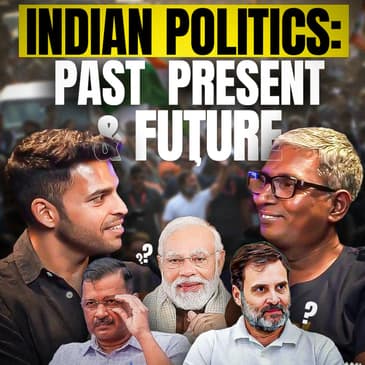
Join us on this insightful conversation as we delve into the dynamic world of Indian politics with Vijay Chada, a prominent political commentator and social media influencer. Vijay, known by his Twitter handle @centerofright, has been a keen observer of India’s political evolution over the past decade. In this episode we learn about Vijay’s journey—from his early days as a civil engineer to becoming a respected voice in political discourse. Vijay and Roshan talk about the evolution of political discourse on social media, the milestones in the past 10 years and more!
Topics:
00:00 Introduction
01:40 How PM Modi has evolved as a political force since 2012-2013
09:48 Evolution of political discourse on Social media
15:24 Milestone moments in the past 10 years
26:30 Key issues for this election
32:13 Will Ayodhya Ram Mandir have an impact on the election?
34:24 Has Modi ji become more of a statesman?
36:00 Has Modi ji's fan/voter base increased?
37:34 PM Vajpayee v/s PM Modi
42:48 The state of political opposition in India
52:15 What will a term 3 be about?
54:33 Who after PM Modi?
01:00:00 Democracy in the BJP
01:01:54 Looking ahead and Vijay's advice for youngsters
Join this channel to get access to perks:
https://www.youtube.com/channel/UCfBfBd-1kvCOPxVll8tBJ9Q/join
[00:00:00] Namaste and welcome to another episode of the Bharatvaarta Podcast. In this episode, we speak with Vijayaji who goes by the Twitter handle at Center of Right. Some of you may recognize him. He's been active on the platform for almost 10-12 years now and a very nuanced, reasonable, well-balanced person on all things politics and policy.
[00:00:23] So we had a freewheeling conversation about his engaging in the Mission 272 campaign in 2012-2013 and what has followed since. The two terms of Prime Minister Modi, some of those highlights and where we stand right now as we have elections upcoming in a couple of months or so.
[00:00:44] So this was a fascinating conversation. Parts of it I'm sure that you will find really juicy and interesting for sure. So I hope you like it. Namaste Vijayaji. Thank you so much for making time for the Bharatvaarta Podcast. You know, I've been meaning to talk to you for a while. You know, I've followed you for long and I want to say that you are one of the more reasonable voices on social media, on politics and policy and other stuff. Right. So thank you so much for making the time.
[00:01:13] Thanks, Roshan. It's a pleasure coming down here and talking to you. I've been following most of your podcasts both on Bharatvaarta and the startup operator. It's a pleasure being here. Awesome. And I should say that you have one of the cooler t-shirts I've seen in recent times. For people on audio platforms, it says Modi once more 2024. Right. Kind of sets the tone for our conversation, I would say.
[00:01:41] You know, I want to start with like a Wodin kind of a question. Right. I mean, 2012, you quit your job and, you know, you got behind mission 272. And I would say, I mean, that was an epic moment in time, I would say. Right. I mean, certainly a milestone for us. Right. It caused a change, which, you know, the impact of which we're still feeling right now. And perhaps, I mean, we'll feel for another 10, 20 years as well. Right.
[00:02:07] Can you take us back to, you know, 2012, 2013, when Prime Minister Modi was, you know, it was not such an obvious political force as it is today. Right. As he is today. And, you know, some memories from those days.
[00:02:23] Yeah. It's a very interesting point that you made. The way it has actually evolved. I should say that the roots actually go even beyond 2012. It should have been right from Vajpayji's days.
[00:02:43] Yes. So, the way this entire thing has evolved was people came together during Vajpayji's time. When he lost the first 13 days, they lost the government in 1996. That's when actually it pushed many people to come out and support.
[00:03:04] Then, in 1998, Vajpayji lost the no-confidence motion by one vote. But then again, in 1999, he came back and 2004 was the first full five-year term of the BJP and the government at that particular point of time.
[00:03:25] Everyone was expecting Vajpayji has done phenomenal job on policy side and it would have been great. It would be a cakewalk. The loss was really shocking for many supporters. I think people still have memories of it. It's a heartbreak that I don't think people have ever recovered from. So much so that, you know, even for, you know, it's hard to say it, but nothing is for granted victory even now.
[00:03:54] Everyone has that memory of that. And so, everyone is a little skeptical, you know, little fingers crossed. I mean, it's good that you have that 2004 experience at the back of the mind so that people don't get overconfident and they go out and vote. So, that's so, yeah. So, that was a shocker for many supporters and folks. And then from 2004 to 2009, that was the UPI government won.
[00:04:25] So, just before the election, 2009 Lok Sabha election, after the nuclear deal and all. So, the BJP started, not BJP started, but Friends of BJP. There was an organization called Friends of BJP where Amit Malviya, who is the current BJP ITC and many other folks came together.
[00:04:46] And as volunteers, they tried to campaign for Modi. Not Modi, BJP at that particular point of time. But the elections were lost. BJP lost the elections in 2009 too.
[00:05:00] So, once the elections were lost. So, there was brainstorming what happened. So, at that time, it was also at the same time, Twitter, now X, but at that time, Twitter, it was gradually gaining in popularity. 2008, 2008, 2008, 2008, 2010. And it was the famous Shashi Tharoor statement of cattle class. That was really the boost which, where it took off.
[00:05:29] So, people started expressing themselves on that platform. It was, people came together, they started identifying that, okay, there are some, there is a support base for BJP leaning folks. Because mainstream media at that particular point of time, did not give voice to any of these opinions. And that's where we have seen people together, coming together, countering the narratives.
[00:05:58] And the narratives were more to do with the, what you call the falsehoods that were spread, either on 2002 Gujarat riots or against Narendra Modi ji or BJP for that matter. So, that's when people on their own, they, internet was also just picking up, mobile revolution was taking off.
[00:06:24] So, it was a good junction of many things. That was a good point for many things. And so, people really took it on themselves to counter the falsehoods that were being spread. So, people formed groups like, in a sense that like-minded people, it was like people came together and then somewhere in 2012 people, they said that, okay.
[00:06:51] It's, if you want to really do and support the cause, there are many people like me who have left their jobs at that particular point of time and wanted to volunteer to make Modi ji the prime minister.
[00:07:07] Even 2012, 2013, when Modi ji was announced as PM candidate of BJP, it so happened, most of the now currently discarded mainstream media folks, they still thought the Modi phenomenon was only an online phenomenon.
[00:07:28] In a sense that, they always used to think that there was somebody who was giving money and it was being publicized that people were being made to ask to tweet on something. But they never understood that it was organic. It was an organic support base that came up at that particular point of time.
[00:07:53] And more than the social media, the support for Modi ji and BJP on the ground was overwhelming. So, that's when 2014 results came. People were really surprised how did BJP win 282 seed. But there was a lot of effort which went in by the organization, by Modi ji. The number of rallies he has done.
[00:08:23] The vision. Most importantly, the vision that he has shown to the people that things will be done. What can be done. What has not been done till now and what can be done. And the corrective steps. People bought into that vision. And they voted for it. And now we are 10 years later. We are sitting. So, to answer your question. These 10 years. So, at that point of time.
[00:08:54] Okay. Social media was ahead at that point of time. In saying that Modi ji. The support for Modi ji. But today Modi ji's support transcends barriers. There is no social media or internet or anything. It has seeped all the way to the ground level. Across the country. So, we have seen 282 seats. 303 seats. And the number of state elections that they have won. So, there is a huge difference.
[00:09:23] So, that is the growth. Hopefully. Ab ki bar char so par. We oppose that. Definitely. Yeah. Yeah. No, I think. You know. On hindsight. When you look at certain times. Right. I mean. I feel like a lot of things came together. For the phenomenon to happen. Right. I mean. Just take X as a platform itself. Twitter as a platform itself. Perhaps it was the first platform where you congregated on interests. Right. On that scale. You know.
[00:09:52] Perhaps the only platform up until then. Where you had a direct access to. You know. Celebrities. You know. People of national stature. As such. As in. You can directly tweet to them. Etc. And perhaps also the first and only platform at that time. Where things could go viral. You know. In the sense that we mean it today. Right. Outside of your network. Outside of your groups. And so on. And so forth. I think all of that sort of galvanized.
[00:10:20] All these very disparate forces. Right. I mean today. I feel like. You know. Whether you look at. Right wing as they call it. Or. You know. Modi supporters. Bakhts. Or whatever it is. Right. I mean. People kind of think of it as. Sort of a monolith. On the internet. Right. But. It's important to remember that. You know. These were. These different forces. Coming from various other places. That were galvanized together by. Social media. And you're right. I mean.
[00:10:49] I think the early use case. For social media. Was basically. Outing the truth about things. Right. I remember. Many different people. Media crooks. For what it's worth. Right. Did a fantastic job. Like. Taking these guys to the cleaners. Right. All the mainstream folks. Plenty of Twitter handles also. I mean. Who. You know. Who were always. Fact checking. Before fact checking. Became a. Thing as such. Right. But do you see that.
[00:11:19] Social media has kind of. Evolved from that time. Where. It was. Let's say. Anti establishment. To today. You know. Where we are the establishment. In some sense. How do you see. That evolution. That has happened. On the social media. Political discourse front. See. Agenda setting. In 2012. To 2014. Or even today. It is being done. By the same set of people. People who are. As passionate.
[00:11:48] In 2012. 2013. 2014. It is the same set of people. Who are doing it. And there are. Looking at some. Some folks. Who come in. Today. What is happening is. I can see. That. Most of the times. There are. New set of people. There are new set of folks. Who are coming in. Who put in.
[00:12:18] Data. To counter. Narratives. It happens. Because. Not everyone has. The same amount of time. That they had. A decade ago. Their priorities change. People move. They have to take care of. Their families. And all. But not everyone has. Full time. They can't. At that time. It was a passion. Now. There are some new set of folks. Who come into the place. But. Overall. As I said. Right. The noise. Has also increased. Both from. Opposition. And some supporters.
[00:12:48] I don't say all supporters. But some supporters. There is no. Middle ground. There is no. Debating points. Which are left anymore. So. Earlier. At least. There used to be. It. The platform. Used to be. In such a way. That people. Debate. Or. Argue. With. With. People from. Opposition. On. Issues. You mean. It is not that you are. Trying to. Convince the other person. To.
[00:13:17] Accept your viewpoint. But at least. You could. Put up your point. But now. It is more like. It's. Finally. It all boils down to. Giving. What you call. Abuses. That's. That's where it has. Reached. In some places. But. As users. We have. We should have the. Mind. To. To see. What you want to. Engage upon. Or what you don't want to. Engage upon.
[00:13:47] There are many folks. Look. Look for. New technologies. Or. People who want to discuss. About new. Manufacturing things. Or about startups. Like how. It has happened. What you do. Or. There are some. Users. Who. Speak about finance. Hands. It depends again. Up and on the user. I mean. How that person is using. The platform. You cannot blame the platform. It's. How. What you are looking. To. As an input.
[00:14:17] Or an output. On the platform. That's how it is. And. I also see. It's not only. X as a platform. Things are moving beyond. Now. Things happen on Reddit. Things happen. I mean. Small videos. It happened on Insta. Yeah. So. That sort of a thing. I mean. Now. There is a huge. WhatsApp. WhatsApp groups. Are one of the biggest. Biggest tool for.
[00:14:49] What you call. Passing on messages. And. Because. WhatsApp. Is so powerful. Because anything that you pass on. It is. If you and me are part of. The same group. There are 10 groups. So. You send me something. People in the group. They assume that. Okay. It has been vetted by. Roshan. Or. It has been vetted by me. So. There should be some. Merit into. Something that you are sending. So. That is where the conversations have gone.
[00:15:18] At that level. So. Basically. It's. It's become very micro. That's what. Yeah. It's been fascinating to. Watch how. Social media has kind of. Merged into the mainstream. You know. It. I think. You know. Back in 2009. 2010. It sort of. Existed outside of. The mainstream media. Two different worlds. All together. And then. You know. I saw a period in between. Where you know. Mainstream channels. Or whatever. Would say. Follow us on. By the way. Follow us on this. And stay connected. And so on.
[00:15:48] Today. If you look at any of these. Television debates. Etc. It's all about. You know. What's trending on Twitter. And you know. The viral video. That is being discussed. And so on. And so forth. So that's been. It's been quite a change. I should say. If you look back at. You know. The last 10 years. Right. 2014 to. You know. Now. What are some of those. Milestone. Milestone moments. For you. You know. In. In the last two terms. Right. I mean. This term continuing. Of course.
[00:16:19] What would you say. Are the three or four. Defining moments. In the last two terms. I mean. People will have different. Ideas. But. One. Being a civilian. Myself. The. The huge. Focus. On. Large scale. Infra projects. Of course. And. Executing them. World class projects. I mean. Because that's.
[00:16:48] That's my partiality. That's what I feel. I mean. Infrastructure. All. All. You can say. Metro. Trains. Electrification of railway lines. Power. Line. Vandai Bharat trains. You name them. Airports. Number of airports. That have been increased. Highways. Express. Bridges. All sorts of things. All intraworks. That have been done. Top marks. In the last ten years. The second important thing. What.
[00:17:19] Is. All the digital public goods. What we see. Of jam. Which started. Basically. The jandhan accounts. The. What you call. The. The way mobile has. Exploded in. In India. And. The digital transactions. That happen. So. That entire. The social. Benefits. The way government. Has really. Done. Where.
[00:17:49] Directly transferring the money. To the last mile. I mean. I was just. Looking at some of the stats. The. As per latest. It was like. Thirty four lakh roads of money. Has been transferred. Through direct benefit transfers. From central government. Itself. In the last ten years. Now. Normally. Earlier. It used to happen that. There used to. One. There used to be a delay. In transfer.
[00:18:19] Second. There always used to be a cut. You know. When. Finally. When a person. Actually. The eligible person. Had to go. And get some. Money. From the government. Either as a pension. Or whatever you can call. Or any of the benefits. So. The middle. People used to have. Take a cut. Even if the cut. At bare minimum. You just count that. Even if it was a ten percent. People had to take a cut. To even deliver that sort of an amount. Ten.
[00:18:48] Fifteen percent. It's roughly. Minimum five lakh crores has been saved. Going out. From the. People who used to. And this is not counting all the hassle. To actually get the money. Get the money. It's straight coming into your account. Account. As I said. Jandan account. There are around. More than 50 crore. I don't exactly remember. The number of account. But. When Jandan. Was launched. The first thing. In September 2014. Was basically.
[00:19:18] To do the. So Chhwarath and Jandan. Was I think. Perhaps the first few. Yeah. Things that. So. When it. When. The Jandan accounts were launched. There was actually. From many bankers. And including. If I am not mistaken. And. Raghuram Rajinder. Narbe governor. Said. Saying that. This is. Not. Going to work. As of today. There is around. 2 lakh crores of money.
[00:19:48] Which is there. In those accounts. The funny thing is. The reports that came out. Soon after they were launched. Saying that there is no money in it. Exactly. Right. As if people who are. Not used to banking. For. You know. All of this time. Were suddenly going to put money in it. You know. In a day's time. Or a week's time. Or even a month's time. Right. So. Yeah. Almost like saying. Why build the road at all. When you haven't traveled. Yeah. Right. Yeah. Exactly. So. Then.
[00:20:19] Out of. After these two. The other one is. GST. People. Whatever they may call. Economically. We have integrated. With. By having a common. GST rates across the country. On the same product. Of course. There are some products. Which are out of GST. Otherwise. Many of. The products. GST.
[00:20:48] The rates are the same. To bring all the states on board. And. Doing it in 2017. That was. One of the biggest. The. The. The impact of the GST. Implementing GST. Is going to be. Far reaching in India. And. That's. That's. One of the biggest. The last one. Fourth. I mean. I have a. Tie. Of course. Being. A. VJP supporter.
[00:21:17] Removal of 370. Yeah. It. Not. I will not say. Removing of 370. Nullifying the 370. Article 370. And. Basically. There is no. Special status. Abrogation. Yeah. Abrogation. And. That. And the recent. Ayurthar Ramandir. I will add. You said 4. I added the 5th one. So. These are the top 5 for me. Okay. You have taken all of the. Most significant ones. But. Yeah. I mean. I would add.
[00:21:47] Balakot to the mix. There. Right. Certainly. I feel. The significance of. Beyond what just happened. I mean. That. We were able to actually. Crossover. And. Inflict. You know. Return it to them. The way. You know. They. They. They do it. Right. I mean. I mean. And this is. I think. My own personal memory. Of just watching us. You know. Being hapless. After the 2611.
[00:22:17] Attacks. Right. And. I think it was some form of redemption. For me. I feel. Right. And it also set the tone. Saying that. Hey. You. You. You screw around with us. I mean. Obviously. We are. You know. We are not going to be gentlemanly. About it. You. You raised that one. Balakot. So. Basically. If you look at it. That way. Then. There are three. Three. Two more things. We can add. Basically. The foreign policy. Yeah. Basically. The foreign policy. And. The internal security.
[00:22:48] Huge. Huge strides. Absolutely. We have seen. Twenty. Twenty. Two. Two. Two. Two. Two. Two. Two. Two. Two. Two. The sheer number of. Terror attacks. That used to happen. The random bombs. You know. Trains and scooters. Even. The chin is from. Yeah. Of course. Yeah. The IIC. Shooting that happened. And so on. Yeah. I mean.
[00:23:16] I think that's the one thing. Perhaps. That people take for granted. Right now. Which is the whole national security stuff. Right. I mean. You know. I remember reading this book on Hindu terror. By R. V. S. Money. Right. And he notes. In a very academic way. All of the incidents that happened. And. Yeah. I mean. It was so periodic. That we had. Just like. We had lost count of. You know. How many actually happened. And. And you know. So we can perhaps count on our fingertips. How many of.
[00:23:45] Those kind of incidents have happened. You know. Over the last. Nine. Ten years. So. It's like. They say that. Right. When things are working. We don't bother. Only when. Suddenly something. Is not working. That's when we realize that. Yeah. Oh. There's something. Is not working. Now. Things are just. Going smooth. I mean. You have not. Not seen it. Right. Many people have not seen. Though. What has happened. During that period. So that. If in that.
[00:24:15] In a sense. Is. Again. A huge thing. You have asked me for. If not. I could have actually. Listened on. More. Another thing. Which. People. Don't realize. Particularly. In the second term. Is that. Two. Two and a half years. We have lost. Just due to COVID. We. Many people. Though. Would not like to. Remember. That period. For various reasons. In a sense. Some near and dear ones. People have lost. Their near and dear ones. Or people went through.
[00:24:44] Tough time. But the government. Central. And all the state government. The way. We have come together. To overcome. That particular. Period. And with. Modiji. Leading from the front. Taking. The progress. I mean. Taking. The. Citizens. Into. Confidence. Putting. The data. Out. If. I mean. Everything. Very.
[00:25:15] Transparent. At that particular. Point of time. Right from. When is the vaccine. Getting developed. When is the vaccine. Going to be. Delivered. How. We had an app. You. Booking. Your appointment. Going there. Everything. We did. Whatever. Was possible. In that particular. Point of time. To come out of it. So. Even in this. Five years. What we see. Two and a half years. The second term. Particularly. Two and a half years. Have been lost. Only managing COVID. Right. I mean. That's. The big thing.
[00:25:44] That we came out. When. Rest of the countries. Were printing. Money. And. Economically. Now. After. How they are. Going down. Compared to. What India. We did not print money. But we did. Direct. Again. We had. PM. Food drain program. That. Garib. Kalyan. Anna. Yojana. If you look at it. We are. We have continued. At that particular point. Of time. And we are still going to continue that.
[00:26:13] The government is continuing. At that scale. At that scale. Right. There are multiple things. So. These are some of the things. Which I can say. Which are politically. So. Good. Yeah. No. I think. When I look back at. COVID. Right. I mean. Perhaps. I mean. Again. You know. The memory. I mean. We tend to obviously move on. Just for self-preservation sake. But. Those two years. The amount of ambiguities. That we managed. At the scale. At which.
[00:26:43] We managed. It's just. Crazy. Crazy. Right. I mean. Two books. In particular. I mean. There's a book on COVID. By Priyam Gandhi Modi. Right. And. Ashish Chandorkar. And another person. Called Suraj. They wrote a book. On the vaccine story. Yes. Right. Those two books. Helped me sort of. Relive those. Two and a half years. Two and a half years. Right. What are the various things. That are happening. Different pressure points.
[00:27:13] And so on. And again. Very factual. Research based. Sort of. Retelling of those two years. Yeah. I think. Really. Epic. Sort of. Management. At scale. I would say. Right. Okay. When we come back to the present right now. You know. Elections. Perhaps in April. May. Right. As of today. How do you fancy. Prime Minister Modi. And. India's chances. And. What do you think. Will be the key issues. For this election.
[00:27:46] I mean. If you have seen. The last. Three months. To six months. The messaging. That is going out. Is. Modi key guarantee. In a sense. That's something. Which. Ji promises. He delivers. If. If. If anyone actually. Does. I look at. The. Manifestos. Of 2014. And 2019. Of BJP. And look at. The things. That have been.
[00:28:16] Mentioned. In the manifesto. And what they have implemented. That's what shows. That. Whatever he says. That it will happen. Is happening. So that's what. Modi key guarantee. And. And he goes. With the. Ten year. Experience. As a prime minister. Of delivering. The goods. That have been. Well. We just. Take. For instance. I'll give you. A very small example.
[00:28:47] In the last. Ten years. I think yesterday. It was. Mentioned. Seventeen lakh crore. Projects. Were. Which was stuck. For a long time. They were. Fast tracked. They were implemented. So you can see. How he has. Gone ahead. Doing it. Systematically. On each issue. One of the. The first term. Basically. The Ujwala. You know. Is it. Giving LPG. Gas cylinders. Connections.
[00:29:17] To the. BPL fam. Or you. Take. Which this has been. Continued. Even. Now. Which. For the new. People. Who are. Eligible for it. Then. You take. Aishman Bharat. Around 50 crore. Health. Insurance. For the. 5 lakh. For people. You take. The. The recent. One. That. They are doing. Which is. Basically.
[00:29:47] Jalji. One mission. Hargar. Today. In Bangalore. We are. Recently. Now. We are seeing. A problem. In water. That. For one. Two. For. There is. Water issues. Now. Imagine. In rural areas. Where. Women and kids. Used to walk. Kilometers away. To fetch. Water. For them. When you take. It is a desert. It can be. Bundal Khantan area. Or it can be. Uphills.
[00:30:17] But. You just. Think. For. Families. That. Or women. That used to do. So much of work. To just. Fetch water. When they open. The tap. Water. Going to come. In their home. In the rural areas. This is what. That entire. Jalji. One mission. And it has been. Done. At such a scale. We had a 15% coverage. Of water. Tap. Tap water. Connections. And. When it was launched. Today. We are almost like.
[00:30:47] 13 crore to 14 crore. Houses. Which are already. Households that have been. Provided with tap. Connections. And. They are on track. To finish that project. So. When. Even think about it. Right. And. When. Modiji launches. A project. Like for example. Jalji. One mission. Let us take. Example of Jalji. One mission. Or. PM. Mujula. You know. Can. Can. If somebody says. No. It has not been given. But the people who. The families.
[00:31:17] Who have got. The gas connection. Connections. Or. The families that. Got the water connection. They know. That. The water connection. Has been provided. Or. That. Garib. Kalyana. Anno. Yojana. Where. The food grains. Are being provided. Under PM. Garib. That program. Every month. So. When it is being. Delivered. Can anyone say that. No. It is not being delivered. So. That. That's what. Modi. Guarantee. Modi. That is a.
[00:31:47] It is. It is. The track record. Of. Delivering. On the promises made. Delivering. On the services. Delivering. On what. He said. That he would deliver. That's what he is going to go. With elections. That is the biggest issue. If you. If you look at it in that way. Yeah. I think 2019. When we had those landmark results. Right. I mean. A few of these. The usual suspects. On mainstream media. Attributed pretty much everything. To. You know. Nationalism.
[00:32:17] And so on. And so forth. And were. Supposedly like. Really baffled. That you know. Someone in rural. Jharkhand. Or somewhere else. Right. Uttarakhand. Or wherever. Care so much about all. All that kind of stuff. Right. But. I feel like. It was. A confluence of things again. Right. And. Yes. I mean. Pulvama. And what happened afterwards. Would have certainly played a. Maybe a. You know. Top of mind recall. In that sense. Right. To. Help. Swing the. Pendulum. And push the needle.
[00:32:46] So to speak. Right. Do you think that. Ram Mandir. At this point of time. Right. Would have that same. Impact on people. That yes. I mean. All the social welfare has happened. But. Yeah. I mean. The cherry on top is that. You know. The Pran Pratishtan has happened. And after 400 years. We have a. A temple at Ayodhya. Yeah. It will definitely play on the minds of people. Definitely. There is no doubt about it. That's what the party has stood for. Right from.
[00:33:16] Their Palamur resolution. If I am not mistaken. Right. Where they have. Made a call for building Ramjan Bhoomi. At that particular place. And. They have delivered it. Again. It is. It is. It is like BJP's guarantee. Right. Think about it. The core issues. I mean. I have been support. Supporting BJP from 1988. On the street. Campaigning for. Corporate candidate.
[00:33:46] In from 1988. When I was 15 years old. Even then. The core issues were the same. The two big issues. As removal of. I mean. 370 and Ramandar. I mean. For people like us. Yeah. It is done. Now all we need to do. Is just blindly. Whenever elections come. Just go and. Press the button. Come on. So. So. It is like that. So. Two core issues. Are done. But. It is over and above. Above that.
[00:34:15] There are many things. That he has. Right. Yeah. You think Prime Minister Modi. Himself. Has kind of changed. I mean. I. Sometimes miss. Some of that old. Election rhetoric. You know. You think he has. Kind of toned down. Himself. Has become a little more. Of a statesman. Of sorts. I don't think so. I mean. The campaign has still not started. Right. See. I mean. In one of the parliament. speeches. Modiji has given.
[00:34:46] Right. In 2014. If I am not mistaken. Was. Basically. He said that. First four years. Let us work towards. The betterment of the country. Is. When. When the laws are being discussed. Or. Any issues that needs to be brought. To the. To. To the. To the parliament. Let us discuss all those issues. Let us do politics. for the last one year. He told opposition even at that particular point of time, 2014,
[00:35:15] if people remember it. So, that's how he worked. For four years, it's completely governance-related thing. It's all governance-related thing. You see, you go back and see 2014 to 18 period or 2019 to 2023 period. You will see all are policy-related, governance-related. That is what he speaks of. Projects, Scheme, that's all voting. It's only the last,
[00:35:44] when the election campaigns happen, that is when he is always at his best. So, the campaign has still not started. So, one of the elections that he announced, I think we'll see him back at his full form. Do you think, obviously, I mean, I see that happen, but do you also notice that his base is sort of widened? I mean, like, there are newer sort of demographic and target segments that have come into... Absolutely. Absolutely. Which we have seen in Gujarat and which we are now seeing
[00:36:12] across the country. Women, women and youth are as strongest supporters. And there's the schemes that, as I said, right, Ujjvala, Jaljivan, or there are many other things in a sense that even Peeam Awasi Hojana, I mean, if it is registered in the name of women. So, again, right? And also, in the new
[00:36:41] parliament house, they had a special session to do women's reservation, right? So, that's, I mean, how he clearly sees them as part of the importance of women in public life as well as in the growth of the country. In Nari Shakti, what he clearly says, right? Yeah. Those are the sections which, and also, you can see
[00:37:10] the other backward classes, the Dalai. There's a huge, all the benefits, Labhati is that what the BJP is calling, all the beneficiaries of various schemes, they're all, it has increased. So, that's his support base now. Right? So, one perennially interesting question I always have in these discussions is a comparison of Prime Minister Modi with Prime Minister Vajpayee. Okay?
[00:37:41] Both very different in their outlook. Right? And of course, I mean, different times as well. So, it would be sort of unfair to compare their styles and, you know, their core support as well. Right? But considering that, you know, you've seen, you've been a supporter for as long, almost three decades right now. Right? How do you sort of compare and contrast Prime Minister Vajpayee with Prime Minister Modi and their styles, the kind of things that they've done, their approach and so on?
[00:38:11] Yeah. So, I mean, it's a very interesting comparison. I have seen, I mean, from far away only, both their styles of working or Vajpayee is all work that has been done at that. What policy, the policies were like
[00:38:41] world class telecom revolution that was brought in, calling party, power reforms, national, golden quarter and I because I worked on one section of the golden quarter so I know the importance of it. What, what, school, back to school programs, then one of the people don't realize now
[00:39:10] if we tell to any of the young today that we used to pay calls even to receive, we used to pay even to receive calls on mobile phone. remember that but one of the last reform here, Vajpayee has done was basically to do the calling party pays regime sort of thing, CPP regime where incoming calls became free as part of that policy reform. So, so those sort of things were at such
[00:39:40] a high level but, and he had like, Vajpayee was also was hemmed by being head of a coalition call. There were various pulls and pressures at that particular point of time but, whatever he has done, where the UPA won for the first four years have really enjoyed the reforms that it has done and Vajpayee is the last financial year or the one year before it,
[00:40:10] we hit the 8% growth rate at that particular point of time and I, of course, I forget that pension reforms that new people government employees moving to the new pension scheme which was a huge exercise. So, at that time Vajpayee's whatever reforms were like path breaking for that particular point of time. There is no doubt about it. Within the limited capacity that time, only if you
[00:40:40] look back in hindsight, it's only wisdom in hindsight, is that all the impact of all those reforms for people to feel, as I said, it came from 2004 to 2008, the highways that were constructed. The economic impact at an individual level, if you look at it, only people felt post-2001, after years long.
[00:41:11] Modiji's work, as I have said, if you have noticed, one, he has absolute majority in Lok Saban, both times, 2014 it was 282, and now 2019 it was 303 in Lok Saban. At Modiji's in these 10 years, won absolute majority, but still all the, what you call, alliance dharma he has maintained, all alliance
[00:41:41] people got, ministries and all this. The work that Modiji has done, at the policy level there was reform, whatever, opening up of FDI for, like, recent one was FDI and retail, not retail, the space, space industry, and there were various other policy level reforms at Modiji's also, and infraworks and all those things that I have listed in the, earlier,
[00:42:11] there were also something which directly benefited the common, like when we speak about Jaljeevan mission, or Vujwal Ayyajana, or Ayesh Mankat, there is something or the other, an individual has felt that the government has done, at that level, to run it, so that is the fundamental difference I see between Vajpayeej and Modiji's government.
[00:42:41] Right. So, it would be fair to say that Vajpayeej was more structural in some sense, so, I mean, the benefits were, I mean, they had a little bit of a lag, also perhaps, I mean, we didn't have this kind of digital infrastructure as we're talking about, right, whereas, you know, Prime Minister Modi's reforms have had almost an immediate impact, right, again, because of internet and digital infrastructure and so on and so forth, and of course, you know,
[00:43:11] the fundamentals that were set earlier by the previous governments, right, yeah. He's also been gifted perhaps the worst opposition, right, or, I don't know, I mean, actually, I tend to swing between opinions here, right, I mean, I sometimes feel like they are quite vicious, right, nothing is off the table in that sense, right, I mean, we've seen some pretty dangerous ideas being talked about, right, whether it's the census or whether it is, you know,
[00:43:41] Rahul Gandhi saying that, you know, we're going to see who owns how much wealth and we're going to do something about it or things to that effect, right, or being a little easy on even matters of national security, international diplomacy, etc., right, or, I mean, just being totally out of touch with whatever the common man thinks and feels today, you know, whatever their aspirations are. So, I personally, I mean, I tend to kind of swing between these two pendulums. Sometimes I
[00:44:11] think that they're particularly vicious and they're particularly dangerous and sometimes I think they don't have a damn clue, you know, what people want and so, I mean, it could actually, you know, benefit us in some way, right. So, you know, where are your thoughts in that sense? I mean, one, there is no one national level opposition candidate against Mutiji. That is point one.
[00:44:41] See, in any of the alliance, whether UPA or NDA, there was always one national party, which was there, and there was a national party was the nucleus around which either a government or the opposition came together for whatever. Today, we do not know the national party, so-called national party, which is Congress.
[00:45:10] In 2014, they got 44 seats, and in 2019, they got 51 seats. If you take away some of the things which are due to alliance, which Tamil Nadu and some sort of states where due to alliance, they got the opposition party, if you call Congress as an opposition party, they themselves are imploding
[00:45:40] state by state. So, there is no other party which is coming to, which can bring opposition people together. That is one. And the second one, as you said, they don't, so one is feeding the other. One, they are no longer in touch with what are the aspirations of the people. Absolutely, they don't have any clue. And that is the reason why that viciousness is creeping in. Some or the other, I think
[00:46:10] 2019, if I'm not mistaken, in one of the interviews, Rahul Gandhi has told, we will ensure to bring down the name of Modiji or the image of Modiji. That is what he told in interview also. So, if that is the part, and compared to what the opposition is saying, to the vision that Modiji is promising, what is he promising? There will be
[00:46:39] some tough decisions, but we have to do it because if we have to, during the Amrit Kavl of 2047, by 2047, we should be a developed nation. If he is providing a vision that this is where we want to be, and he is saying that policies that we are doing today is going to lead us there, compared to what the opposition is providing. People are smart
[00:47:08] enough today, voters are very smart, they know exactly what each leader stands for or what each party stands for, what are their policies, with the proliferation of internet and it is the same thing a person in Delhi will get and in five minutes later, in some rural area, the same video will actually go through, in whatever format, whether through WhatsApp or
[00:47:38] Insta or whichever format, but it reaches. So, he or she, they get the same information and they are very clearly, they know what is what and based on that, the decisions are made to whom to vote for or whom not to vote for. In the last ten years, if you have seen, at least in my mind, though I keep track of many things,
[00:48:06] but I don't see on one issue where they have given a constructive feedback. back. You take it on any of the good things that have been done. They have been invited to the recent one for the Ayodhya Pranapratishtha. People have, they did not attend it. They have been invited
[00:48:36] by the trust people. They did not attend it. The new parliament house inauguration, they boycotted it. And compared to go to Modiji. Just look at the Bharat Ratna awards that have been announced by the government under Modiji. In 2019, Pranamokarji got it. This time it was Advani Ji, then
[00:49:05] Karpuri Thakur Ji, Narasim Marawji, Chaudhary Children's India. I mean they were not even like BJ except Advani Ji. Most of them were like opposing parties. They recognized and they have given. The government has recognized the impact that they have had. So this is the fundamental difference. I mean one of the reasons why they are losing the battle is
[00:49:36] they are unable to provide any alternate. See, in 2014 as we have started discussing Modiji provided a vision what he wanted. Reducing corruption, being strong on internal and external security. These are the things that he has promised and he has delivered on that. Right? But they are not even offering any vision. As of today it is basically opposing for
[00:50:06] opposing sake or giving random statements. So that is why they are in the situation that they are in. It's a very unfortunate fact actually because they are still trying to play upon people's fears and insecurities whereas I think clearly the new generation at least you mentioned the youth are gaining in support to Prime Minister Modi they are a lot more hopeful and optimistic about India than their previous generations. Right?
[00:50:37] And you can't sell this story of despair to them. Right? Because they feel that this is the time for them. I mean I end up talking to a lot of entrepreneurs who are in their 20s, in their 30s and so on. They are supremely optimistic about India right? And its place in the world not just locally domestically right? You can't sell doomsday stories to these people right? I mean you have to have an alternate vision for the future which somehow I mean they don't
[00:51:07] seem to be able to conjure up. Yeah. Exactly. This is I mean that's really fundamental as I was about to say you speak to a lot of startup entrepreneurs on your podcast. I meet them quite regularly. The fire and the way that they see India
[00:51:37] 10 years down the line or 15 years down the line is completely at odds with what opposition is. There's no doubt that these people are so confident that we will win the world. With that they are getting into it. That confidence was not there when we were growing up at least. So that's fundamental difference. That confident India is what confident youth is what Modiji.
[00:52:07] That is the change that has happened. And before people say anything I mean entrepreneurship is I'm not just talking about a Bangalore phenomenon here. I'm talking about even tier 2 folks as you can see from the Shark Tank for instance the kind of people who come on the TV show. So what do you think term 3 will be about? A potential term 3 that is not
[00:52:38] presumptuous. Important decisions is what Modiji has spoken about for 2047 very clearly. There could be many things. I mean we can't second guess. I mean in the last 10 years if you have seen something is that you can't second guess what are the things that are coming up. But few things which he has already
[00:53:07] highlighted identified and so there would be a huge focus on urban housing for middle class people. Urban infrastructure will be there. And yesterday Nirmala Sita Ramajiyas mentioned that it will be land, law, entrepreneurship, innovation, artificial intelligence, this sort of thing. And there may be
[00:53:37] many more roles. We don't know exact things. We will see only once BJP releases its manifesto which they started collecting feedback yesterday. So we will see what's going to come. So once we see the manifesto we will come to know what are there in the third term.
[00:54:31] I go thought and half way through the third term Modi might step back and make way for another national leader to take his place. Any thoughts on what after Prime Minister Modi and who could potentially fill the rather large vacant position after that? No, I think it's too early to discuss that. For a few
[00:55:00] reasons, I'll just give you my reasons. I may be wrong. One, the election is they are going to go with Modi Ji's name. My view is that Modi should be there for another 10 years. I have my own reasons for various things, but I'll give you one, two reasons. When Vajpayaji became the Prime Minister in 98, I'm not saying 96 is 13 days period, from 75 till
[00:55:30] 2004, from 75 till 6 years, you can say 81. So even if you have that thumb rule, he can still continue for 8 years at bare minimum. But my reason for why he needs to various periods of chaos
[00:55:59] and turmoil. We need a steady hand. We have seen how Modiji handled the COVID during one of the toughest times across the whole world, going through chaos and turmoil. But very steadily it was handled without much of an impact to the there can be multiple shocks which we cannot
[00:56:29] foresee today. But 10 years is a period where there will be multiple such shocks. Not like COVID, but there can be wars coming or economic shocks. The country requires a stable hand at the top, governance, administration and all. So that is one thing which I see. The other one is it will approximately be the midpoint from
[00:56:58] 2022 to when that Amrutkal thing from 75 to 2047 so 10 years period would have been over from 22 to 34 if you say 10 years is exactly midpoint roughly midpoint of 12 years out of the total 25 years. So I don't know what will be the economic period of what would be the GDP at that particular point of time but we would be midway through
[00:57:28] this entire period of 25 years from 75 years of India's independence to 100 years of India's independence. So if that particular hump is crossed at 10 trillion dollars economy 10 to 15 trillion dollars of economy then we are in auto mode. So that is selfish motive I would like to see him to do 10 years more and he is quite sharp in health way. I
[00:57:58] think Tachud in that sense he shows at least no signs of slowing down physically mentally and of course if you compare him with other folks in other parts of the world less said the better about those right so I would pack that question that's why I said it's unfair to do any sort of
[00:58:28] kite flying that who will be when the time comes the party will take a decision which we are not privy to and it is way beyond our grade to even think about it but as a supporter I mean who do you see as the next rung of leadership I mean surely there I mean the party throws up quite a few and everyone if you have noticed they're bled in various state units and
[00:58:58] even at a CM level even at the central government level there are quite a few I mean we cannot I currently they would have they would normally do internally they would have identified who could be the potential but that we don't know
[00:59:27] right but are you excited by you know folks like himanta Biswas anomaly here in the south you know everyone is I mean what they have mobilizing people of governance administration that that way they are winning elections or they are increasing the vote percentage and all right so that's what yeah
[00:59:57] that's another major contrast right in the sense that democracy at least within the BJP functions phenomenally well right you get such unobvious choices you know whether it is Yogi J in UP at that point of time or whether it is himanta Biswas or whether it is Annamalai right or the three CMs in the recently concluded exactly right I mean more people
[01:00:27] Rajasthan CM and no one has expected who they are but they are all old time Karakarta who have worked for the party and party has given them the opportunity to lead the states who it's always it's very that's why party has grown along with Modiji's image the organization has also expanded to tap into the
[01:00:57] new water basis the demography that you have asked earlier so the party was earlier under Amish Haji's leadership and now under Nataji's leadership we see that how party is able to co-opt various new demographic groups coming to support the party I
[01:01:39] span of roughly 35 years it's huge yeah I mean it's certainly come a long way I should say right this has been a fascinating conversation Vijayji and you know each of the stuff that we spoke about I think I can have many more rabbit holes that we could go down but in the
[01:02:15] I am optimistic very much that India is on the right path right right in as well in the correct as in correct as well as
[01:02:44] I have absolute confidence and in the next 10 years I mean I would formally be retired age I will reach the retirement age at 60 so so I am very happy for the future very optimistic I've always been an optimistic the last 10 years really show that there's a good way ahead for the country and for the viewers definitely
[01:03:14] I would say that please spend some time if it is youngsters I would definitely ask them to participate in the political process it will not be BJP it can be any party of your choice but take an interest participate in the system either as a volunteer if you
[01:03:43] have a full time job and you want to do something I would sincerely request that they participate
[01:04:54] has been given till now. Opposing for just for the opposition's sake, somewhere we are missing, we are just crossing the line of opposing the person and opposing the country. So don't do that. That's my only suggestion to your phone. Right. Fantastic. Thank you so much again for being on the podcast. It was truly a pleasure speaking with you and hopefully we'll do a follow up soon. Sure. Thank you. Thanks. Thanks so much for joining us on this episode of
[01:05:24] Bharat Varta. If you like the content, don't forget to share, subscribe, do all of the good stuff. I'll see you soon on another episode.