
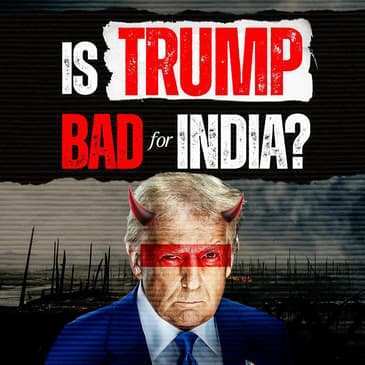
In this episode of the Bharatvaarta podcast, host Roshan Cariappa is joined by panelists Ruchir Sharma, Surya Kanegaonkar, and Anang Mittal to discuss the potential impact of the Trump presidency on India and the broader world. The conversation covers a range of topics, including the potential for creative diplomacy, the state of India's indigenous military technology programs, and the effects of U.S. foreign policy on India's strategic autonomy. The panelists also discuss how India can take advantage of this period to reform its internal policies and redefine its role as a regional hegemon. With insights into defense, economic policies, and the evolving geopolitical landscape, this episode offers a comprehensive look at what India might expect and how it can best prepare for the future.
Topics:
00:00 Sneak peak
01:21 Introduction
02:59 Trump's Policies and Global Reactions
08:15 India's Geopolitical Maneuvering
20:24 Modi's US Visit Highlights
27:40 Negotiating with Trump
37:09 Regional Powers and India's Role
45:13 Indian Talent Exodus and Innovation Challenges
01:00:29 Protectionism and Indian Industry
01:19:52 Multilateralism and Global Organizations
01:29:45 The Role of Non-State Actors in U.S. Influence
01:35:21 Opportunities for India Amid Global Shifts
01:38:30 The Need for Bureaucratic and Policy Reforms
01:41:19 Concluding Thoughts and Future Outlook
[00:00:00] He knows what he has to do now to implement his plans, because he does have a vision. The Indian society and state, still in many people's minds, is built around the idea of cohesion and harmony. Disruptive technologies are not going to be a good idea, because innovation is anti-cohesion. So let's not have the farmers leave the land and move into urban cities. Let's just keep them subsisting on things and give them freebies so they can vote for us, so we continue to stay in power.
[00:00:25] Indigenous military technology programs in India must be killed so that India is dependent on American military hardware. I think that India has a massive edge in terms of the number of people it can actually throw at a problem. India does not really have strategic autonomy, given the great power rivalry that exists between China and the US, and the China threat that there is towards India. So we have to pick a side.
[00:00:50] I don't want to see Maruti Suzuki with a 55% market share in these death traps. I would happily see Maruti Suzuki and Hiro Honda fight the dust into the grave, into the dustbin of history. No one would miss that. There are many countries who are afraid of the new America, who have something to lose. India is not one of them.
[00:01:20] Namaste and welcome to another episode of the Bharatvaarta Podcast. I am Roshan Karyapa. Today we will talk about the impact of the Trump presidency on India and the rest of the world. I am joined by Ruchir and Surya, who you have heard on multiple other Bharatvaarta podcasts earlier, talking about geopolitics, India's global standing and so on. We are also joined by Anang Mittal, who is a communications strategist based in DC.
[00:01:44] And we have three very diverse perspectives on what the Trump presidency could mean for all of us. We are speaking at a time when Prime Minister Modi has just concluded his first visit to the US under this new presidency. And we spoke about tariffs, the impact on India's economy. This whole jobs, immigration and H-1B issue that propped up about a month or month and a half back. What was that about?
[00:02:12] And in hindsight, really what is the lasting impact it will have going forward? And then some of the global geopolitical stuff, right? I mean, is multilateralism still relevant? Will there be a reshaping of the world and so on and so forth? This was a super insightful conversation. We recorded for well over two hours and yeah, I hope you like it. Hey guys, thank you so much for making the time. Welcome to the Bharatvaarta podcast.
[00:02:42] There's a lot of ground for us to cover. Perhaps I'll begin with Anang. Anang, the last 25 days have been sort of a whirlwind, right? President Trump has come to power pretty convincingly, right? And has set about changing plenty of things. The first, perhaps, thing that I want to ask you is like, do you sense a vibe shift on the ground? Hey, thanks for having me.
[00:03:08] Yeah, I think there is a marked vibe shift on the ground. I think the transfer of power was peaceful. The resistance or anger from the left this time was much, much less so. I think they pretty much took the defeat in stride in November and kind of felt that the candidate wasn't the best candidate that they had. And so everybody kind of just went back home with their tail slunk between their legs this time.
[00:03:38] Obviously, there are going to be future challenges. They're maybe hoping things will change in the midterms. But for the time being, in the first month of the Donald Trump presidency, we've essentially seen his approval ratings go up to 53% or something close to that. 55% maybe. So the nation seems to be going along with what he wants to do.
[00:03:57] I think people generally approve of the measures that he's taken, which is to cut down the federal bureaucracy, to secure the border, deport criminals who shouldn't be here, who don't have citizenship or status here. And then also, again, revive the robust foreign policy that focuses on American interests versus multilateral interest around other countries, the UN, Europe, NATO, whatever you want to call it. And J.D. Vance has just arrived at the Munich conference.
[00:04:26] He's giving a speech right now. He's just concluded his speech in which he's called for the focus of that speech is essentially that Europe is stifling free speech that, you know, so when when Europe sort of, you know, acts holier or higher than, you know, higher than thou kind of attitude, America and J.D. Vance and Trump are calling them out on it that, you know, you guys talk about democracy, but, you know, you had the undoing of the Romanian election by a court and things like that.
[00:04:55] So I think the feeling from the American side is very positive. The feeling from the Canadian side, the Mexican side or the European side is not so positive. And we just concluded the Prime Minister Modi's visit here went over swimmingly. I think people were very happy with the way it went. It wasn't anything. Nothing was signed. But certainly the, you know, a resumption of the good old feeling that was there during the first Trump administration is there.
[00:05:22] And so I think people are feeling pretty, pretty positive about this administration so far, even from the corporate giants, the big tech people, the Silicon Valley people. They have either exceeded or are quietly going along with the program. I think that was a problem in the first Trump term because there was so much chaos, not just with the transition, but with the way that he became the president in terms of getting the nomination.
[00:05:45] I think the corporate giants and the sort of the bigger money people were very confused and they bought the line that this guy was not popular in America. I think this time he has shown himself to be popular. He has shown that he the people are on his side and people do want some of these things to happen. And so if there's pain down the line in the midterms that will be reflected, then people will turn on him, obviously. But I think this really does feel like the resumption of the first term than a second term, in my opinion.
[00:06:12] He does not seem to be acting like a president who cares about his legacy. He's not rolling out some massive kind of programs or terms. It's really just, nope, we're just going right back to work with more knowledge from the four years that he was out of power than he then he didn't. So. Right. Just a quick follow up on that. Right. I mean, could you delve a little more on how Trump 2.0 is different from the first term?
[00:06:35] What we sense is, I suppose, obviously he has the experience from earlier and also he has a more established team at the helm of things. Yeah, I mean, I think this is one of the greatest comebacks as far as his return to power since Richard Nixon, probably. And probably the most I mean, even his first election was the most the biggest shock to the system since Andrew Jackson's election. So you have to go back more than 100 years to get that kind of shock in terms of, you know, who this person is, came out of the blue, became president.
[00:07:04] And so Trump 2.0, he's it's weird because he's been in he's been in the public eye since forever, but in the political eye, at least since 2017. So this really is almost a metaphysical third term because the four years during Biden, Trump actually and his people sat down with policy people.
[00:07:27] They sat down with Intel people, they sat down with everybody who was on their side, who could tell them about how the federal bureaucracy works, what they need to do for them, for the Trump 2.0 administration. But it really is almost like a third term in the sense that he knows what he has to do now to to make his implement his plans. And usually in the second term, presidents focus on legacy. So they let things go. Oh, you want money for this? Take it, whatever. Put my name on the building. Right.
[00:07:52] Like they really don't think about changing things. They really think about settling their legacy and getting, you know, people on board for a lot of things. And so that's really what this feels like, that this is a this is a guy who is now who now has the experience of two terms, not just one term. Right. So, Syria, should the rest of the world be as thrilled as the American public awarded Trump 2.0 presidency?
[00:08:15] I mean, we are seeing varying reactions. Right. I mean, Europeans, of course, are a little more guarded, perhaps less enthusiastic. Right. I mean, what do you make the mood of the world, so to speak, is? I think, first of all, thank you for having me, Roshan. It's great to be back on your podcast. Glad to have you back. The world is actually quite divided.
[00:08:42] I think there are many people, many leaders across the world who feel that their countries are going to be targeted very significantly with tariffs. They have they stand a lot to lose from from the sort of trade war that Trump will is actually engaging in at the moment.
[00:09:01] And and the countries that are in a geopolitical sweet spot, India being one of them, they have an opportunity to come out relatively less scathed. I would not say unscathed. But if we look at, for example, where India is, you know, in its trade deficit versus the US, it's about it was around 50 billion dollars.
[00:09:26] Trump's that is around 100 billion dollars now. So maybe it might have gone up. But, you know, you're looking at when China had the same GDP as India does as today. China ran a $235 deficit with the US or other surplus from their end. The US was running a $235 billion deficit.
[00:09:52] So and India intends to become a major exporter of goods and even a bigger exporter of services down the line. And and it needs foreign currency inflow to stabilize its currency. And in such an environment when you have to end up dealing with with with a country that that that kind of wants to reduce import dependency and is the biggest consumer in the world.
[00:10:21] I think that is that is actually a challenge which India has to deal with. But I think there are many like if you take Europe, for example, they are having an energy. They have an energy crisis on their hands. They have a massive problem with overregulation. They're coming out of the this this this this process of dealing with Ukraine and this conflict with Russia.
[00:10:49] And now they're under pressure from the US to increase spending on defense at a time when they're deindustrializing very rapidly, largely because of the cessation of Russian gas flows into Europe and high energy input costs and also overregulation, as I mentioned earlier.
[00:11:13] And at such a time they are having to probably spend more on on on on NATO. So I think this is going to hurt them even more. We're seeing growth flatline in Europe and at that at that in that period of time when you have tariffs on European goods, it's definitely going to be problematic. That said, Europe is probably going to look at at at playing China off the US in some ways there.
[00:11:39] They're they're they're willing to admit Chinese capital into Europe for to buy out, say, for example, Volkswagen factories in Germany. This is going to be part of their their economic play against to kind of secure some deal with with with Trump at some point, I would expect. But I don't know how far they can really go with that, given their deep dependencies on the US more broadly from a geopolitical perspective.
[00:12:08] So I would say that Europe actually is a standout loser unless they're able to to to to cut a reasonable deal, which can help them actually improve their economic competitiveness. Russia, I would say, comes out as more of a winner, potentially depending on the sort of deal that that that that that ends the Ukraine war.
[00:12:31] And amongst the East Asian countries, you would say that China last time they came out on top in this trade war. They increased their sales of their exports across the world. This time, perhaps they're more dependent on exports than they have ever been. They're going to be a market. Their consumption profile is actually changed quite rapidly because of an aging demographic going forward. Their population today, it's around median ages around thirty nine by twenty forty.
[00:13:01] It's going to be about forty forty seven. And by twenty fifty is going to be fifty seven. So it's going to age very rapidly. And even just in these four years, they're going to they're already starting to see the limits of consumption, domestic consumption and how much that can add to economic growth. So I can come to the Chinese question a bit later.
[00:13:22] But the reality is that they are extremely dependent on pushing more volume out of their country of all products, which is why we hear this story about Chinese overcapacity. And they're driving down the marginal cost of production by automating, by making their companies more competitive, but also subsidizing specific export sectors.
[00:13:43] And in this sort of environment, if they if if the U.S. has to push back with tariffs, the extent to which China actually is able to drop their cost of production will end up determining whether those goods really will continue flowing into the U.S. And my suspicion is they will continue to flow. I think it'd be very difficult for the U.S. to to to get off this the addiction to Chinese goods, because if it really depends on how far they are able to drop the price.
[00:14:11] And a lot of that is coming from technological intervention. So I think China is still up in the air at the moment when it comes to their how they're going to respond to the Trump presidency. And I would say that Japan and Korea, they they're actually struggling at the moment and they probably are going to play China of Washington, of Beijing to some extent, but probably still stay closer to the Washington. Right. So, so, so, so, so, so, so, so, so, so we're talking about the impact of the Trump presidency on the world.
[00:14:39] And, you know, we hear all these soundbites, right, that it is a threat to the rule-based world order and that it's going to sort of shake up the natural consensus that has sort of existed and the United Nations and all of those sort of supranational entities will, will become less relevant and all of that, right? How much of that should we actually take for real and how much of that is like, you know, is just exaggeration?
[00:15:08] Well, I think it's a wonderful opportunity to reset the basis of international relations that we've seen this already in the first few weeks of the Trump administration. So, your past relationship with the U.S., whether positive or negative, no longer matters. What matters is with the reset of their relations, what are you willing to do to win over the trust and support of the U.S. and vice versa?
[00:15:38] What can they do for you? This transactional, transparent form of international relations is refreshing. It's a pleasant change from the so-called rules-based order where the ones who make the rules are the ones who are allowed to break it, which have never really been defined. It's essentially a second world order that's in parallel to the established ones post-war.
[00:16:08] So, you have the U.N., you have all of its associated organizations, the WHO, ILO. Essentially, the rules-based world order, global order, says that it doesn't matter what they say. What matters is the hegemon and their allies or vassals can do what they want, like in Yugoslavia, like in Iraq, like in Libya. So, if we're moving away from that, that's positive. It's to be welcomed.
[00:16:33] And it's a wonderful opportunity to fill in any vacuums that are left by the withdrawal of the U.S. That's something that China is already ready to do as the U.S. withdraws from the World Health Organization or other U.N. agencies. And it's also something that you can see with the renegotiation with even the most close neighbors and allies of the U.S.
[00:16:59] And in the U.S., I found it incredibly amusing that when Trump threatened countries like Canada and Denmark with annexation, with tariffs, their response was not to stand up for themselves. Their response was to beg and say, oh, we've been the most loyal for you. Anything you've asked us, we've given you. Canada, you know, Trudeau's crying, oh, we spilt our blood in Iraq for you.
[00:17:27] We spilt our blood in Afghanistan for you. We sold you our cheap oil to power your economy. Who cares? You know, that was then. This is now. What are you going to do now? What are you going to do now? And this show of servility and it's the same with Denmark. Denmark, you know, is the most craven of all of the vassals in the in the EU. They're the ones most willing to go the extra mile to please Washington.
[00:17:49] For example, a few years ago when Angela Merkel was still in in charge as the chancellor of Germany, her phone was tapped and 200 of the top bureaucrats in Germany, their phones were tapped. It was done by Denmark on behalf of the NSA. And again, the Danes were like, oh, we've been your closest ally. We've done so much for you. Well, that show of weakness just invites more punishment.
[00:18:17] The most loyal servants are the ones who are beaten the most and they deserve it for their cowardice. So fantastic. And countries like like India. So this is something that Dr. Jashankar said as well. He said that there are many countries who are afraid of the new America, who have something to lose. India is not one of them because we had a bad relationship for the past four years. This is a wonderful opportunity to renegotiate our bilateral arrangements with the US.
[00:18:47] And quite frankly, put as many tariffs as you want on us as long as you stop interfering and putting a veto on our domestic politics. It's worth that much. You know, our trade with them, you know, if we have a surplus of 100 billion, cut it in half. But use the opportunity for the next four years to finally clean out the country.
[00:19:07] You have, you know, you're fighting a 2.5 front civil, 2.5 front war, including an undeclared domestic civil war, completely one sided, a low intensity one. This is your opportunity. Forget about economic relations with them, you know, and focus on developing state capacity, ending this use of violence by non-state actors.
[00:19:31] And establishing the foundations of a modern and successful country that understands its place in the world, understands its own identity and understands where it wants to be in five years and 10 years and 50 years and 100 years. It's a golden opportunity. And whatever loss we're going to take in tariffs, it costs 50 billion a year. That's worth it. It's worth 100 billion. It's worth a trillion a year. You've got to learn from other countries. You've got to learn from Sri Lanka.
[00:19:58] Who cares about economic development before you've won your civil war? Win your civil war, defeat your internal enemies, defeat your external enemies, then fatten yourself up. If you fatten your economy beforehand, like Yugoslavia did in the 70s, they became very rich in the 70s. It was all lost in the next 20 years because they didn't consolidate internally. Right. Okay. So this is like a rabbit hole that we'll definitely explore further along in the conversation for sure. Right?
[00:20:28] I mean, just a slight tangent. I mean, I just absolutely love the way Trump communicates. I mean, he's reset whatever that standard was as well. Right? I mean, he called Trudeau Governor Trudeau, I think, yesterday or something. Right? I mean, he's out there trolling the world establishment, all the leaders and the media and everything. It's a lot of fun to watch.
[00:20:50] Anang, we're talking at a time when Prime Minister Modi has visited the US and, you know, we see a lot of fantastic photo ops and like, you know, sound bites and so on and so forth. What were some of the key highlights from this trip for you? Yeah, I think the main highlight is obviously the friendship that is there. Trump values the personal touch.
[00:21:12] He values the personal relationships and I think he knows how to talk to people in other parts of the world that don't think in terms of let's get the bureaucrats in the room and let them have it out. No, they want to do the one to one kind of meeting. And so that was the biggest highlight that, you know, there really is a genuine rapport between the two leaders. Remember how the Modi and the most of the Trump, those weren't just, you know, sort of fake showy kind of things.
[00:21:40] They were really meant to show that that there was genuine and even down the line. Mike Walsh, NSA, he is part of the when he was congressman, he was part of the India caucus. Right. So that all of that sort of relationship building over the last 20 years has yielded results and it has yielded results on the Democrat side also. You know, they there's people there who are very pro India. Maybe they're more silent than usual, but they are there. So I think that was the biggest thing that this relationship really is something that is beyond partisanship or presidents.
[00:22:10] There may be bumps on the road, but that relationship will continue because the whatever you want to call it, the establishment or people in the US generally believe that India is a good partner. It's a good it's somebody that they can trust, they can do business with. That's the main part part. I think the because there wasn't anything signed, this was really just more of a reestablishment and reset of relations between the US state and the Indian state, the government. I think what some of the announcements that were made were interesting.
[00:22:40] So the reciprocal tariffs thing, I think that's again, it's it's wasn't just meant to be only targeting India. It's meant to target all countries. And I think what he's talking about in the fairness part there, I mean, I think India can actually benefit from that. So, you know, people were focusing the news organizations were focusing on things like steel tariffs still is like 2% of what India sends to the US. So, okay, fine block our steel. In fact, it may it may actually help India because India gets steel from China, South Korea, Taiwan.
[00:23:09] So maybe India raising its tariffs on that, you know, reciprocal tariff might be a good thing because that will help Indian domestic producers. Right. So you so whatever Trump's trying to do with protecting steel manufacturing in America, India can also do in in in their own country. The other part of it was the meeting with Elon Musk, because this is something that people aren't really understanding. Some people in the media were like, well, you know, Elon's very friendly with China. So Trump's going to be more friendly with China now. I don't think that's the case.
[00:23:35] I think Elon's actually on the outs with China, the Chinese electrical car companies. They are doing much better. Tesla's lost market share in China. They're still there. But Elon is looking for his next market. And I think that is going to be India. So that's the one negative that some Indian nationalists have said, hey, we don't want Tesla in our country. I understand that. But I think that is going to be the one sort of, you know, carrot and stick method there with the tariffs that that Trump wants Tesla to be sold in India.
[00:24:02] He wants Harley's to be sold in India. So some of those things are going to change, I think, with the negotiations that continue. And then on the defense front, again, nothing signed, but they keep saying they're open to selling the F-35 to India. Again, I don't know how much of carrot or stick that is because other presidents have also said that.
[00:24:20] So it's an open question because India does own Russian equipment that American observers do not want tested on the F-35 in the open or in any kind of that's why they haven't sold the F-35 to Turkey yet. So if they're not selling to Turkey, will they sell to India? That's the biggest question. That's a huge hurdle because that is the most modern aircraft that America has. And it's more modern than the F-22. So if they sell that to India, that'll be a big, big deal.
[00:24:49] But India needs them. I mean, there's I think there's a dearth of about 40 squadrons from from what I read. So India definitely needs fifth generation fighters by the end of this decade, if not earlier. So that'll be an interesting thing to see what that translates to, whether the defense will actually move in that direction. Apart from that, I mean, I think it's a it's a good thing. It's a on the H-1B again. This is some of this. I'm discounting the Indian media side of it. I'm not from India. So maybe my perspective is too chauvinistic, whatever you want to call it.
[00:25:19] I just don't think people really care about the noise that was made about the handcuffed illegal immigrants being landed through military planes in Amritsar. I think that was really domestic politics. That was Punjabi politics because they didn't want the pride of Punjab being, you know, harmed by watching these guys come down in shackles. But I don't think that that's something that either the American public or Indian public at large cares. These guys broke the law. Yes, they shouldn't be mistreated. They weren't mistreated.
[00:25:46] Somebody was saying they looked emaciated. I mean, they look like they're healthy hatha hatha guys to me. So, again, that's one thing that I saw people making a lot of hate out of. I was like, I don't think that's going to be something that that's not something that Modi would have brought up. That's not something that Trump is going to bring up. And then the other the last part is the return of Tawahur Rana, the one of the plotters or one of the terrorists involved in the Mumbai attack.
[00:26:09] So that part is a quid pro quo, in my opinion, from the Trump administration saying, look, you guys have you guys were helpful as far as the Pannu case in terms of, you know, you made some inroads on that. You've been very cooperative. This is our you know, we are returning this guy back to you because we want to keep that relationship going.
[00:26:27] We want to keep see that cooperation happen on the intel basis. We may see some more intel come out later if DNI Gabbard or some of the people in the intel industry who are now on top of that stuff decide to release that. That would be interesting as well on what was going on in Bangladesh, what was going on with some of these democracy building aid initiatives and all that.
[00:26:50] Right. So, Surya, I think the approach that a lot of us were hoping with Trump is that, you know, let's keep him focused on Canada and Mexico and Europe and all of these other, you know, countries. Right. Before he kind of turns to us and obviously negotiates like the schoolbilly who kind of owns the bat, the ball, the wickets, perhaps the land that you play in also.
[00:27:12] Right. I mean, and you know, you had to play by the rules basically. Right. But this wasn't too bad. Right. Just sound bites. I mean, casual meetings, nothing signed yet. So you think we got away with this one. I mean, and how do we how do we negotiate with Trump? Right. I mean, at this point, as you mentioned, maybe 50 billion dollars, you know, is definitely not insignificant, but not something super significant as well.
[00:27:41] Right. But if we have to buy oil, I mean, if we have to buy those jets at some point of time and so on. Right. How does that impact us economically, geopolitically? I think that we basically are looking at India buying more oil and LNG from the US. And I think that's that actually makes sense if you're having to deal with the country, which is one of the largest producers of energy.
[00:28:07] And you have a strong commercial relationship more broadly with them. And this is part of their the way that they deal with the world and they want you to buy energy. You're coming out of a period where we had this massive spike in energy prices during after the Ukraine war, actually, when it started and still continued up to a point. And then the market started pricing down a bit.
[00:28:34] And now that competitiveness that you got from buying Russian crude is is not as much, is not as significant. So if India does go and source oil from the US in larger volumes and and also gas gas demand in India, LNG demand is is supposed to set to double by 2030.
[00:28:53] As India basically lays out vast, very vast network of domestic pipelines connecting hundreds and hundreds of cities to to a grid. Now, this grid needs to get fueled by by LNG to a large extent. So I think that this relationship is this this energy relationship, I think, is is good. It doesn't actually tie India down because in there are many suppliers of LNG.
[00:29:23] There are many suppliers of oil around the world. So if depending on how the diplomatic relationship evolves over time, you can choose your supplier based on on the prevailing geopolitical conditions.
[00:29:34] When it comes to the F-35 and and the broader defense relationship, I think it's the very fact that in 2025 India may even may may consider buying Russian about buying American fifth generation fighters stands testament to the country's inability to develop its own technologies.
[00:30:00] And it's a it's very unfortunate, I would say. I'd say that that India's geopolitical maneuverability is severely limited by bureaucratic corruption, by lack of devotion of resources to to research and development.
[00:30:20] And this is ultimately giving an open field to arms exporters to dump their goods on India. The the LCA program took decades. Now, the AMCA program initially there were hopes that we would get some that the first first rollout by 2030.
[00:30:44] Now it's 2035. If we end up seeing F-35s operated by the Indian Air Force, the AMCA program program may face serious headwinds, which may further delay India's indigenization and R&D efforts.
[00:31:00] And I would like to remind the audience at this point that when we look at a the prime minister's vision of a developed India by 2047, that would essentially mean that India's per capita GDP should be between 10 to 15 thousand dollars. India would have to be a global superpower if it is to be a developed country, just in terms of absolute GDP.
[00:31:30] I mean, you would have to essentially exceed or match what China is today, if not exceed it. So under those conditions, do you I've never seen any. Any major power in the world of that that caliber not have an indigenous military.
[00:31:50] India, they probably will not even reach developed status because it does not have the geopolitical maneuverability, the economic leverage that comes with that geopolitical maneuverability, primarily because it does not have an indigenous defense system. And I think that's a full spectrum in indigenization, I think is absolutely essential for economic development.
[00:32:15] And I think this seems to be lost on sections of the Indian government. And I think that the sort of close defense partnership that we see with the United States is born out of necessity, not out of a deep sense of shared values. Yeah, just a quick follow up on that, right? I mean, while the defense acquisition council, the IDEX and so on was directionally right.
[00:32:41] I feel like and you know, all of us will kind of resonate with this, the the level of Babudam has kind of hamstrung every small step that you can make in that direction, right? I mean, you still have to fill out like piles of forms to source or, you know, procure anything at all. So, and that coupled with the fact that, you know, we have the HLs of the world and the DRDOs that haven't really caught up to the times.
[00:33:06] So I suppose it is a necessity that we cannot avoid at this point of time, sadly so. But hopefully, I mean, things will change, right? One can hope after all. So, if I can, yeah, if I can just jump in real quickly. I don't think, I'm not trying to defend the Babudam or the bureaucracy, but there's only, there's only maybe four, maybe five countries that have an indigenous jet engine program.
[00:33:33] And then a jet fighter program is really just to come make two main countries, especially when we go to 5G, and even maybe not that. So I think the problem here is that developing these technologies has actually become quite complex and quite Japan, I think spent close to 10 billion, maybe more on their own indigenous Mitsubishi, you know, five gen jet. And they finally gave up and said, all right, just give us the F-35. We'll just, you know, make our, you know, make our own style version of it and you guys can customize it for us.
[00:34:01] So I think, you know, it's one of those problems that has stymied pretty much every other country apart from the United States and maybe Russia. Yeah. And even maybe not that I don't know how good their 5G technology is or how good their stealth technology is. Yeah, that's a fair point. I would like to add a very quick point to this. I think that Japan has already been, had been a, it had gone down the route of becoming a vassal state since World War II. It had very little maneuverability anyway.
[00:34:31] And any real efforts to kind of indigenize its military on a very large scale was bound to meet some sort of resistance. In fact, there was a very interesting paper by published by, I believe it was Carnegie Endowment that they basically said that we should make military.
[00:34:54] And I think it's to this effect that we should make our military assistance to Japan conditional on them purchasing more military equipment from the United States. And this was published, I believe, to maybe a couple of years ago. And I think it shows the mindset that indigenous programs in countries should be killed. I'm being very, very clear about this.
[00:35:17] The indigenous military technology programs in India must be killed so that India is dependent on American military hardware. So that America has a veto over India's foreign policy. I think both of those are true. I'm extremely negative about the developments that are taking place because we have seen over the last 10 years an indigenous engine which was partially developed, which had reached a certain thrust, still did not get access to a flying test bed.
[00:35:45] Which it was not developed with partners potentially like Russia or France over these years. And we're sitting 10 years after this government came to power without the capabilities that I believe we should have had. We may not have actually built, say, a fifth generation fighter, but we should have been on our way to at least delivering something by 2030.
[00:36:17] But if we have not, then we are in this position that we are in. No, I think both of those are true, right? I mean, you know, we can at least start with small arms. We can start with rifles and munition and so on and so forth, which we have people producing in India as well, right? I mean, and they are lagging with contracts and so on. We still import the INSAS and a few others, right? So, yeah, I think both of those are kind of true.
[00:36:44] Ruchir, you know, one of the things that I found really interesting was, you know, the Bangladesh question, right? When it was posed to Trump, he said he will let Prime Minister Modi handle it and he has to quote hundreds of years of experience dealing with this kind of stuff, right? Now, you know, Trump is known for very transactional diplomacy, right? Tariffs, you know, and those kind of things, right?
[00:37:11] But here he did kind of allude to sort of a civilizational narrative, civilizational imperative as such. I mean, has Prime Minister Modi kind of converted him to, you know, our side, so to speak? So, I wouldn't say that President Trump has been converted to one way or another. I think he always believed in spheres of influences. He wants his country and his administration to disengage from certain regions.
[00:37:41] And essentially, in every region, there is a regional power that can be seen as the natural leader. Now, in our part of the world that is historically India, it does have the light culture, the leading, you know, culture and the strongest military power within this part of Asia.
[00:38:06] And it's also, you know, a reflection of how low priority Bangladesh is, that he has not yet been briefed about it by his State Department, by his advisors, because unlike the previous administration for whom this was, yeah, democracy on the line,
[00:38:25] and how this was such a great victory for the people, and how you had former US diplomats cheerleading all the way that, yeah, we have to bring down this dictator, we have to replace him with, you know, an enlightened Nobel Prize winner. I think all of that, the legacy around that, the baggage that comes with it, that this was very much a Biden signature project.
[00:38:55] So towards the end of his administration, you had the fall of the quite stable and relatively secular and pro-India governments in both Bangladesh and Syria. That was the final big bang of the deep state, as you call it, or let's say the neoliberal democracy promoting policymakers in Washington, D.C.
[00:39:24] So the fact that he didn't even want to speak about it, he just deferred the question. It's the question at the moment, just the press question, not the region yet, but it's nice to think that as well, towards his Indian counterpart. But it shows, yeah, it's not a priority, and hopefully they'll pull the plug on this fanatic regime that they've installed there,
[00:39:48] just like they are planning to pull the plug on a few other propped-up administrations around the world. Right. One of the things that I want to talk about, and here I think, Anand, your perspective will be especially relevant, is this whole H-1B controversy that got raked up about a month back or so, right? I mean, it all started with Sriram Krishnan being appointed to some sort of a formal position,
[00:40:17] and then there was this barrage of anti-India sort of sentiment on X. And some of that was also palpable in real life as well. I mean, just very anecdotally from, you know, just polling a few friends that I have, more than a few friends that I have in the U.S. Could you talk about that entire, you know, situation on hindsight? I mean, what really kicked that off and are there any remnants of that still?
[00:40:45] Yeah, I mean, look, there's the immigration restrictionist view inside the MAGA camp. You have people like Steve Bannon and Stephen Miller, who's in the White House at the moment. And so they are very much of the belief that not just illegal immigration, but that other forms of immigration should be curbed so that, you know, less people are coming into the country overall.
[00:41:09] Now, I don't know whether that is a wider or widely accepted view within America. It's definitely not within the Republican Party. I think most Republicans, if you talk to them, would have positive views of Indians and wouldn't think in those terms. So they're trying to I think many of these hard right nativist types are trying to change that view. I don't know how much how far that will go, because like I said, I've said it before in many other programs.
[00:41:38] You talk to a normal guy in Texas or somewhere in anywhere, anywhere in India and or in America. And most of the times they have either worked with an Indian, they know Indians or what I what I would get sometimes like, oh, yeah. You know, 10 years ago, I was in Delhi. I helped set up a fridge factory, you know, in like Noida. You know what I mean? Like the guy and you're like, this is just a normal redneck type person. And you wouldn't even think that this guy has like any knowledge of India. And he's probably spent more time in India than I have at some point, you know.
[00:42:07] So so it's one of those things where there's there's a widely accepted view and some people call it this the model minority myth, whatever you want to call it. But there is a widely accepted positive view of India. And so I think this H1B controversy was ginned up by people who are anti immigration completely to try to change some of that. So I think on the online perspective that has shifted slightly from a lot of people. But again, in a normal, you know, leave the online world behind, meet people normally. They just don't share that view.
[00:42:37] So that that's that's sort of the base sort of set a setup of it. But the larger part of it is that there, you know, you saw Elon Musk say that he will die on this hill, that, you know, H1Bs should be skilled immigration, skilled immigrants, educated people should be coming to this country. So I think that's the larger view. And he's quieted down about it now. Some people have also quieted down about it. I think Trump is also pro H1B. What he actually meant because he said, oh, H1Bs come to my golf club.
[00:43:06] What he was talking about was the guest worker program, which is H2B. But overall, I think they do want a bigger control on what you know who is coming in. What are the qualifications for people coming in? You know, how do we improve that? And that may include easing up of the green card caps and things like that in the future. I don't know if that's the official policy right now or even if they're thinking about it, but that may actually happen in the future.
[00:43:30] I think currently because we were in this weird transition period in December during Christmas where there was nothing going on and that news popped up, it opened avenues for these sort of, you know, restrictionists and to be honest, racists and quite, you know, xenophobic people to sort of open the door on hating Indians online.
[00:43:52] It's been going on for the last couple of years, I think, really for the last couple of years because, you know, Indians are now very successful as a demographic in America. So there's a lot of status envy that comes along that alongside of that. There's also, I would say, bot farms, you know, people who are legitimately, excuse me, from other countries who are online, who have big followings, who are anonymous accounts are using that. So what I've seen personally, because I used to work at YouTube.
[00:44:20] So what I've seen is people used to do travel videos about India and how cool it was. And then those same accounts, not everyone, but some key accounts I've seen, it's usually white guys have now shifted that to let's cover scams in India. Let's cover, you know, let's, you know, you wouldn't, you wouldn't go to Alabama and buy gator meat, you know, a normal tourist wouldn't go buy gator meat in Alabama in the backwater bayous. And then say, oh, this is the epitome of like American food, right?
[00:44:48] But that's essentially what they're doing when they're going to the slums and, you know, filming people who are, you know, living on like less than a dollar a day. And so I've seen that because it's, they realize you get engagement from that. You either get hate or you get love from the racists. So that's sort of the other part of it. And this is part and parcel of being a much more visible community, much more prosperous community. And I think there's a sense of paternalism that is there. And that's something that I've seen many people say.
[00:45:15] A lot of white people, you know, Europeans, not just Americans, Europeans are not used to hearing the subaltern sepoy talk back. They just are not used to that. They're used to hearing us do a good job and go home and not say anything. They're just not used to hearing us slap back in their face. Yeah. Surya, we spoke about defense and innovation and so on, right?
[00:45:38] I mean, part of the problem that we have also is that they're still not able to retain the best and the brightest here, right? And aside from a sense of patriotism, I suppose, I mean, there really isn't, you know, a viable enough option for people to stay back and do high tech research here, right? I mean, they do prefer going to the US or, you know, parts of Europe or whatever, right? I mean, how do you see that going further, right?
[00:46:04] I mean, with AI and, you know, tech pretty much becoming mainstream right now and there's a huge battle for, you know, who will own some of those more fundamental pieces of technology that will influence our life. What do we do about this whole talent gap and this war for talent?
[00:46:21] I think there are three, maybe four major drivers behind this sort of exodus that we see of Indian talent and the inability of the Indian state to be able to bring people back, encourage people to come back and also innovate what the innovation ecosystem is lacking. First, I would say that people move for better economic opportunities.
[00:46:48] They also move for better academic opportunities at first. They feel that the universities in the US in particular, more so than even Europe, offer high quality education and technology and pretty much STEM research. And it's these universities are feeders into a corporate space, which is very well supported financially.
[00:47:19] In some ways, the American technology industry benefits from the US having the world's reserve currency. By being able to print dollars, even when the country runs a massive deficit.
[00:47:37] If this currency is a reserve currency, it still is able to suck liquidity in from pretty much all parts of the world into the dollar, into American capital markets, which ends up going into big tech companies. And there's a whole, there's a trickle down of this capital, which goes into startups, which goes into the wider American economy, specifically in high-end tech.
[00:48:04] So it gives employment opportunities to young Indians who can earn multiples of what they can at home. So that is the financial angle. But I think that there are many who would choose to live in India and contribute to the Indian R&D cause if the cities they lived in were world class, if they didn't have, if they didn't have to face pollution problems.
[00:48:30] If their children could go to, could play in the park and comfortably go to school without having to deal with one hour of traffic. You could, you could talk about many lifestyle choices, which they, which individuals have to make when they, when they choose to stay back, which some of those lifestyle choices, they, they, they feel that are not necessary to make. If they, if they, if they find an alternative elsewhere in the world.
[00:49:01] There's another aspect, which is the whole lobbying aspect, which is coming from the Indian IT services companies. Which have been very much focused on labor arbitrage, lower end labor arbitrage. Slowly they're making their way up into, into slightly, slightly more competitive, more, more technologically advanced sort of areas, but nothing cutting edge.
[00:49:26] Um, so your big so-called IT companies in India are run by people who are dependent on, on, on, uh, on providing services to the Americans. And, um, this I think has resulted in a certain narrative, which has percolated through, um, we've seen it in, in many articles.
[00:49:48] We've seen it even by, from people in the Confederation of Indian Industries talking about India, not having to build its own foundational, uh, AI models that can compete with open AI and with now DeepSeq. Um, and they have even doubled down when DeepSeq came out having produced their, their, their system with clearly a fraction of the cost that, that open AI was able to, to produce theirs.
[00:50:14] Um, and, uh, they're doubling down on their, their lobbying and, and, and frankly, uh, the, the, the sort of capital required from the Indian state to go out there and invest in this is clearly not there. But what India does have, and I've repeated this many ad nauseum, in fact, on Twitter on, in, in many long form posts was that India has a very long, uh, consumption tail based on its demographics.
[00:50:42] It, it, it, it, it can grow for decades based on, on, on, on its, its foundational economic, um, uh, uh, its, its, its basis, um, uh, its factors of production. Um, but, uh, to capture this from, to incentivize people to innovate, you would need to cut taxes for companies that are reaching critical, are meeting critical indigenous innovation targets.
[00:51:11] Um, uh, like how we have a production linked incentive scheme for mass production of goods. We should be having an innovation linked incentive scheme, which unlocks capital, which unlocks, um, incentive compensation as well as, as tax cuts for companies that achieve critical indigenous technological, um, uh, standards, which are world class.
[00:51:35] So that has not been something that the government has looked into from what I can gather. Secondly, from the influence side, first were the people in the IT services space, but I'd also say the bureaucracy is playing a very negative role in this process. Over-regulation has definitely stymied innovation.
[00:52:03] And the amount of money that the Indian government is willing to put into research labs is a fraction of what it really should be having to do. So coming to the point of capital, I would say that just from just government money that can be used to incentivize and pay people world-class salaries, global standards, at global standards.
[00:52:25] I would say that if you are spending money on freebies, if you're spending money on unproductive agricultural subsidies, which have clearly not been able to lift agricultural yields or production, you're essentially spending money in areas which are not giving you the dividends that they should.
[00:52:48] High-end technology and innovation should be looked at from a monetary stability point of view as well. Because high-end technology is fundamentally, you know, it fundamentally reduces inflation. If you're able to produce something which can improve productivity and reduce costs, your competitiveness globally increases, your costs reduce, your inflation actually reduces.
[00:53:16] So we need to fundamentally rethink how the Indian state subsidizes various parts of its economy and look at R&D and innovation as part of an inflation-targeting sort of program that you have.
[00:53:34] That if you're spending initially upfront, you're cutting taxes further out on the cash flow curve with the intention of being able to reduce costs overall and interest rates overall in the long run. And when you are able to cut interest rates in the long run, you spur capital formation across the entire economy. So this is really the problem that we see.
[00:53:58] But coming back to the point specifically about people leaving, that won't stop unless the incentives are correct, unless urban spaces are created which enable people to come back and work. We take a look at what the U.S. did under the Manhattan Project. They built a city for scientists to go and work, right? India should be thinking along these lines.
[00:54:20] And I come back to the point that I made earlier, which was that India will not become a developed country unless it has its foundational technology and cutting-edge technology as its own. If you are a licensed user of fundamental models, how do you expect to engage in next-generation warfare if you have to?
[00:54:43] Your autonomous drones, your autonomous underwater vehicles, your entire electronic systems, which are going to be plugged into something which is far more advanced eventually, will end up being reliant on foreign suppliers of foundational models in some ways.
[00:55:03] Now, I'm just saying that you can look at AI user applications for consumption and for improving productivity and production of certain goods, but that's not enough. This has to be looked at as a national security issue. And the incentives need to be in place. And for that, you need to find a way to attract people back.
[00:55:25] And as I say, urbanization, good, clean urbanization is extremely important for this, as well as compensating people according to their talent. One last point on this, I would say, if you don't mind. I think that India has a massive edge in terms of the number of people it can actually throw at a problem.
[00:55:48] And the probability of success dramatically increases if you are able to test and find your best and brightest in the country and be able to deploy them in areas of research and innovation.
[00:56:02] I have recommended a much more rigorous national testing program at every level in school, combined with a sort of school which, in every district, which harnesses the best talent from that district. Top 1%, top half a percent, top 0.1%. And you can really look at some of the brightest people coming in to work potentially in this space.
[00:56:31] And you're not giving, you're not restricting their freedom to go and move out of the country. But you're telling them that we are able to identify who is the best and brightest in our land. Yeah, if I can step in there real quickly on the AI issue, it's the first principles issue. What is the purpose of the Indian state? What is the purpose of Indian society? And I think for a long time, that purpose really was to maintain social cohesion, maintain harmony, as the word is.
[00:57:00] And so if you're trying to disrupt society using technology with LLMs and AI, which will absolutely eat into Baijiu's business, will eat into the educational mafia's business, if I can use that word. It will disrupt the educational business, not just the education business, but many other businesses. And the idea that, you know, well, you know, kids have to, you know, go to school and learn and do certain things. And it's like, no, we have AI to do that. We don't need that. You know, maybe we should be teaching kids other skills.
[00:57:29] That is just not going to fly because the Indian state and the Indian culture depend. And look at the controversy with this beard and biceps guy, right? All the people, everybody around the country came around in a mob to beat up this poor guy who said some, you know, off-color jokes. And it's because the Indian society and state still in many people's minds, at least we can say the elite's minds, is built around the idea of cohesion and harmony.
[00:57:54] So if that's the case, then disruptive technologies are not going to be a good idea. And so we're kind of stuck in this weird, you know, self-isolationist period where we know things exist outside of the world, outside of our own bubble, but we don't really care about them. And they're certainly not going to disrupt us, even if they are currently happening in other countries and they're going ahead of us because innovation is anti-cohesion.
[00:58:20] So let's not have the farmers leave the land and move into urban cities so we can have prosperity. We can use that farmland for other things. We can have, you know, innovation in those areas. Let's just keep them subsisting on things and give them freebies so they can vote for us so we continue to stay in power. So that's a problem both on the left and the right in India. Okay, I'm a little more optimistic than that. I know. It was a bit of a, yeah, black-told image there.
[00:58:50] Now, so is the state going to lay out even a couple of hundred million dollars and say that, look, here's this couple of hundred million is row or, you know, IIC. Why don't you just like attract the top 200 people, Indians from across the world, pay them like three times or four times salary and get them to work on the most difficult problems? Is the state going to do that? I don't know. I'm not very sure of that, right?
[00:59:17] Are the likes of Infosys at 30 billion or Tata at like a few tens of billions more going to set aside a couple of hundred million dollars and like, you know, fund, if not work on innovation themselves, like fundamental innovation themselves? Are they going to fund startups? I don't think they're going to do that, right? Because their business model is not set up for that. Even now, I think the organization that's making the most amount of money like in actual revenue is Accenture, right?
[00:59:45] I mean, and they're doing a billion dollars a quarter in AI services revenue and these guys will follow as well. So I'm not very optimistic on those two fronts, but I have a feeling that we will have our own versions of, you know, this fundamental innovation driven by the likes of Reliance and Tata and Adani and so on. And the best that we can hope for is, you know, for the government to sort of like incentivize that with these guys, right?
[01:00:12] I mean, develop our own versions of the Chibals and the Zaybatses and so on. So I feel like we have the talent, right? And also, I mean, since we are not the pioneers in this, the cost of innovation is going to be significantly lesser, right? I mean, just how you saw with OpenAI versus DeepSeek, right?
[01:00:32] So I'm kind of optimistic on that front, considering that, you know, the cost of innovation is going to be cheap and it's maybe like one or two decisions away from actually like, you know, pursuing that path. Right. So, yeah.
[01:00:48] So just to build on that and also to connect it to what we were talking about earlier around tariffs, a good way forward would to be very strategic in where we fight the trade war and where we give concessions to the U.S. There are certain industries that Trump has identified using brand names, for example, Harley Davidson. You know, let Harley Davidson into the country.
[01:01:14] Why should the substandard motorcycles made by Hero Honda, made by Bajaj, be protected from real competitors who are at the cutting edge of the industry? Just because they bribed the Congress Party in the 70s doesn't mean that we owe them any loyalty now. They have been selling 70s era technology from Japan and expecting us to be grateful for it. There's a market for this.
[01:01:42] You know, they're making lots of money exporting this to Kenya and Tanzania and to Colombia. They can do that. But at home, they need to stop selling substandard products as the same with cars. Let Tesla in. I don't want to see Maruti Suzuki with a 55 percent market share in these death traps where that RC Bhargav keeps coming every year. He's like, oh, Indians don't want to pay for safety. Indians will pay for what you tell them to pay.
[01:02:10] And Gadkari needs to take his stick and break their legs. Otherwise, there was this infamous guy. He keeps threatening, oh, you know, I'm going to bring this regulation, that regulation is going to make you do this. Stop talking about it and do it. Otherwise, you're no different from Ambu Mani Ramados, who when he was health minister, kept saying, oh, I'm going to put taxes on tobacco. I'm going to put warnings on cigarettes.
[01:02:35] He kept threatening them and they kept, you know, using their, you know, lobbyists and their creative methods to delay it and delay it and delay it. Eventually it came and, you know, and it was important to put a leash on these companies.
[01:02:54] Similarly, for too long, it's been 21 years since that ridiculous sub four meter tax exemption came into being for our car makers, which has incentivized these garbage quality vehicles to be sold in India. They're not sold anywhere else. It's a form of protectionism. It's not just that, oh, you have less than four meter cars fit better into the urban milieu. They're easier to park in Indian streets. It's a soft form of protectionism.
[01:03:19] I wish one of these other countries took us to the WTO and got it scrapped because the government is not brave enough to do it. It was one of the first things that Chidambaram did when the UPA came to power in 2004 was to reward the car companies with this form of soft protectionism. Under Vajpayee, the Indian car market was destined for great things. We had every major manufacturer in the world setting up joint ventures, creating jobs, creating factories in India.
[01:03:45] And then in these 21 years of these regulations that were designed to benefit a handful of companies, we are being sold very, very low quality products where, you know, they stuff it full of features, but they're not safe.
[01:04:00] They fail every safety test, they're not aesthetic and contribute to an overall lack of inspiring design, lack of opportunities for industrial designers, a lack of opportunities for creativity for engineers. And some industries deserve to be shaken up. So sacrifice those industries and focus on the ones which are important, strategic industries.
[01:04:25] So if we can avoid getting trapped into dependencies on U.S. weaponry and arms, I would happily see Maruti Suzuki and Hiro Honda bite the dust into the grave, into the dustbin of history. No one would miss them. Let them fight. And it's not even that Harley-Davidson will fight with them. Like, it's not a battle worth fighting. Let Harley-Davidson in. Let Tesla in. It's a different category to what the other people are doing.
[01:04:55] KTM will fight with Harley-Davidson. It's not our company. And they, you know, they sell it to a very unique demographic who is not well liked. So, yeah, let them know. I just want to add one point to this, in fact, and I think it's very important what you had raised, Rochelle. But the Indian conglomerates have benefited from protectionism for very long.
[01:05:20] And I think that this was the so-called Indian deep state, if you can call it that, if India has a deep state at all. It is essentially the bureaucracy, sections of the bureaucracy and sections of big business, which pretty much outlasts the political fortunes of various politicians and their parties. And the politicians, they often lean on big businesses for funding.
[01:05:48] So, instead of using tariffs and protectionist measures as tools to improve Indian indigenization and getting help them to kind of stay out of competition so that they buy some time to improve their standards. And bring India up the global, you know, in terms of the quality of products being produced.
[01:06:17] It's, in fact, been counterproductive because it is limited competition. It has made these big businesses very complacent. And the political parties have benefited from the sort of money that they have made, that these companies have made by milking the Indian consumer and providing them with substandard products. So, the Chinese also realized that being overly protectionist was never going to serve their longer term interests.
[01:06:44] They let companies in to work on joint ventures for developing high speed rail for electric vehicles. And eventually, the state, and planes as well.
[01:06:57] And eventually what they did was that the state realized that if we want to support our own companies, we will provide them subsidies in, say, machine tools, in water, electricity, land, and rare earths, raw materials.
[01:07:18] And we will support the companies that are able to compete with the Western companies or the companies that Chinese companies have gone into joint ventures with, with, say, American or European firms. So, it was very strategic from Beijing when they looked at protectionism as a tool for actually enhancing domestic capabilities. And I think that if you see their history of reverse engineering, that's also a part of it.
[01:07:47] But that's not the basis of all their innovation as we can see today, that they are the cutting edge of electric vehicle technology. That's a function of both competition that the Chinese state introduced into their own system between Chinese companies and foreign companies that had a base in China and between Chinese companies themselves. And they let the weaker ones die, which is what capitalism eventually does.
[01:08:17] What we have seen today is, as what Richard had said, you have a massive market share of just one, say, auto company, which clearly has no reason to innovate. The state is also not providing the resources, the land, the water, the natural resources, which are used for electric vehicle, for battery production, to be able to subsidize. So, you're neither here nor there. And I think that this doesn't work.
[01:08:42] Either you go full free market, which I don't think is the best way to go because India is dependent on foreign capital. It's not able to produce capital at the rate at which China has been able to. China was able to export goods, earn hard cash, and reinvest that hard cash in various industries in the form of subsidies. India is running a twin deficit. The way that the Indian state looks at its own economy is, in my opinion, completely warped.
[01:09:11] You should be able to cut your deficit, maybe bring it to a slight surplus. You don't need to be running the surpluses the Chinese are running to be able to be as effective because you have a very long consumption tail, as I mentioned earlier. But the point is that you need to be recalibrating your protectionist measures and your tariffs to introduce competition to help innovate.
[01:09:33] That should be your goal, not to actually use these companies as ATMs for political funding, which is what a lot of regulation has been used to actually help these companies do. I was just going to say that if we still had strong PSUs in certain sectors, then tariffs would make sense in that case.
[01:09:55] But if it's just some family-run company that feeds donations to parties while getting obscenely rich selling substandard products, and then instead of investing in innovation, they invest in funding garbage media portals that run subversive agendas,
[01:10:18] like the wire and scroll, or funding university chairs, which are designed to produce research that degrades and demoralizes a very large section of Indian society. How is that benefiting us?
[01:10:38] Why should we sacrifice the rights of our consumers, our strategic independence, and our ability to invest in sectors that are actually important, just to mollify some of these people who haven't even demonstrated any loyalty to us as citizens, to us as consumers, to us as a country, as a state?
[01:11:02] All they do is, in a parasitic way, suck money from the government through subsidies and protectionist tariffs, suck money from the consumer, and then donate it to other parasites who are digging out and hollowing out our country from the inside out. And you take a look at what happened with Adani. Regardless of the sort of allegations that were made against them,
[01:11:31] the fact is that Adani was propped up by the markets in many ways. People invested in the company. Common people were out there buying their stock. They clearly had an edge in their business model. Until when India was investing heavily in infrastructure, somebody stepped up, the company stepped up to the plate and was able to deliver.
[01:11:55] Now, this company was not as influenced by American capital for a very long time, like some of your other big business houses, which have been established for decades. One of the reasons that it was targeted was because it was not under the influence to the extent that some people in the United States would have wanted from those from the powers that be out there.
[01:12:19] And we have seen a concerted effort by sections within the previous government to cut Adani down to size, to deny them access to international markets, to financing, because they don't have the hook in the company.
[01:12:39] And every country, whether it was China, Japan, Korea, the United States, France, the UK, Sweden, Switzerland, Spain, any one of them, they all have had private companies that have advanced national interest, built comprehensive national power in some capacity. Japan actually went through a window.
[01:13:06] They used a window guidance system for building out their companies. Korea had built up their table and it worked for them. Yes, from textiles, they went to shipping and to car manufacturing, and they have been very competitive in this. And if you see the rate of investment in R&D by Korea over the years, it grew exponentially as these large conglomerates built out their base.
[01:13:36] And we're able to grab a share of the export market. The Indian mindset has always been to use the Indian market as a consumption market and never really look outside and see how you can compete on the international stage. And I think that we are now at an inflection point economically. And this goes back to my first set of points that I made about... That's always going to be a factor, right, Surya? That's always going to be a factor, right?
[01:14:06] I mean, with as much of a population, the domestic market is hard to ignore. I mean, it's lucrative enough. Yeah. So how do you get people to kind of think globally? Think globally when you're improving the quality of products and going up the value chain. And you know that you're selling something to a consumer outside who can afford more than your consumer domestically.
[01:14:33] The fact is that India's per capita GDP is $3,000. If you look at countries, I'd say Europe is obviously declining a little bit and their purchasing power is actually shrinking. The U.S., you look at parts of Southeast Asia, they've grown faster and their purchasing power is more. And you should be targeting countries where they have more money and they're willing to spend. And you're producing goods which should be sold to them.
[01:15:02] And you can also be able to sell those goods at home, maybe to a smaller section of society. But still, you will find a market. The idea of, you know, like, for example, the PLI schemes that we have are very focused on just absolute volume production instead of carving out a space and carving out a market share. Because the Chinese have been extremely good at reducing their costs, subsidizing,
[01:15:28] and also turning their export machine into a part of, into, such that it outmuscles any competition. You have to compete with the Chinese. If you allow Chinese cars in your own country, you will need to compete with them, right? Right. Similarly, if you're looking outside to export your cars, you should be able to compete with the Chinese as well. Otherwise, you won't be able to export anything much. This is, this is a fact.
[01:15:54] Yeah. Just, just, just, just to wrap up, just, just to wrap up this point that, you know, if you're not able to compete, then you will always be stuck in this low value addition loop. And you will not be able to break out into what the 21st century is really about. So, yeah, Richard, go ahead. Yeah. And, and we had the first mover advantage on this 20 years ago. Tata used to, had broken into many markets and was selling, I don't know if you remember this very,
[01:16:21] you know, interesting car was called the Telco line or the Tata mobile. It was this pickup truck. It was based on an old Mercedes 240E, I think, the, the estate. So there used to be the Tata estate and then related to that was the Telco line. They used to sell it all over the world. They used to sell it in the late 90s, early 2000s in Australia, in South Africa, in Spain and Poland. And it, it did decent sales.
[01:16:50] It was much, a much higher quality product than anything that Chinese companies were making at the time. And 20 years ago, there were many things in, in the domestic market in India. People would laugh at Chinese quality stuff because Indian quality manufactured goods were of a much higher standard.
[01:17:07] But in those 20 years, these companies have gotten complacent and have diluted their standards because they figured out that as the, the Indian middle class and its purchasing power went up, they had a captive audience who, you know, were compelled to buy their products. And in that time, in those 20 years, there's a sea change in how Chinese products have been perceived, especially in the auto sector.
[01:17:36] That 20 years ago, they were a complete joke. Now, BYD and then, you know, even more obscure ones, Great Wall, you know, Saik, Shanghai Auto. These are all making inroads very rapidly, exponential sales because they're providing a high quality product, or at least a better quality product than before at a very competitive price. And we squandered our first mover advantage. Mahindra was the same.
[01:18:06] Mahindra was also selling in Spain at the time and in Italy at the time. They used to sell the Mahindra Scorpio as the Mahindra Goa. And what did they do with that advantage? They should have moved up the value chain. They should have improved their products. They should have gone from being a budget car, entry-level car manufacturer in these markets to at least competing with middle class models like Fiat and Volkswagen. And they completely dropped the ball on it to focus on the domestic market, where they felt they could get away with cost cutting.
[01:18:36] I was going to say, when Xi Jinping visited Biden just in 2023, maybe, and he brought his own car. So he brought his version of the Rolls Royce, of the Cadillac that was made indigenously, and had the same protection because they, you know, adhered, those companies adhered to, you know, the diplomatic protection standards that are existing in the world. So I think this is one of those issues that, excuse me, that, you know,
[01:19:03] the Asian countries are an example because I'm a huge film buff. So I watch a lot of Korean movies and Japanese movies. And those industries do have some level of state protection. I mean, the quality maybe sometimes goes down, but then they do compete on the world stage as well, which is not the same, not something that you can say sometimes about India. And I think that's, again, part of that, you know, they will, as we were saying, textile company. Now they sell rifles, they sell weapons, they sell all kinds of different things. Same thing with Czechoslovakia, very small country.
[01:19:33] They've been making small arms forever. They were under the Soviet hand for a little bit. And then after that, they have started an export model. The Czech guns, the Bren 3, if you look at it, again, just random YouTube shopping on videos for all kinds of things. The Bren 3 is one of the best small arms that's out there. So they've continued to innovate for the export customer. But then, of course, their country then has the best small arms, you know, industry to call on if they do need to call on them. So.
[01:20:03] Well, I guess it's a really hard problem to solve, right? I mean, balancing both perspectives in a sense, right? I mean, obviously, you want to have the latest, greatest innovation here as well. Well, let's hope things change. I mean, we'll just shift tracks a bit and talk about multilateralism, right? I mean, it kind of became the mantra over the last four years, right? I mean, things got realigned and so on.
[01:20:30] But when I think Briggs came up in a conversation, Trump was pretty firm about it, right? I mean, he kind of thinks it's a terrible idea. He thinks it's an afferent to the US. Right. So maybe Anand will start with your views and then you, Ruchir and Surya can add as well. I mean, are we seeing the sort of like a muting of that multilateral world
[01:20:57] that we've all been talking about over the last three, four years? Or do you think that this is it's probably too early to call that? Maybe too early to call that because some of these not Briggs, but things like the UN and NATO and other organizations, we are, we as in America at least, are dug in. It's not something you can extricate yourself out of very easily.
[01:21:21] So it can only be something that you can maybe reduce the funding and play around with on the margins. But you can never really completely end. I mean, I don't think the United States has ever, barring a massive world event, we are not going to be pulling out of the UN or NATO anytime soon. So that part of it is one of those, you know, situations where you're too dug in, you can't get out, you don't want to say in either way.
[01:21:47] But on Briggs, I think it's really geopolitically, it's part of whatever the Briggs currency might be or whatever Briggs might be. It's just an acronym created by a Goldman Sachs banker in the early 2000s. Trump and the China Hawks who are part of the Trump administration are looking at it as a stalking horse or a Trojan horse for China. Because if there is a Briggs currency, it will be backed by the Yuan and not by the groupie.
[01:22:13] And so if anything that Briggs does, they're going to look at it in a very suspect manner. And I think it's another way for Trump to burnish his anti-China and anti-multilateral credentials without directly attacking China, which he may not want to do. You can say art of the deal, you can say whatever, but he may not directly want to go after China on the Briggs side. But it is, understand here on the state side, at least, people when they talk about Briggs, they go, Briggs is really, see, it's China.
[01:22:43] But yeah, on NATO, on UN, I think much more difficult for America to pull out of it. The biggest, again, from the American perspective, the biggest foreign policy victory that happened in the last 50, 70, 100 years after World War II was the opening of China that Nixon did with, you know, that was personal diplomacy. He sent Kissinger over to China, to Pakistan, to talk with the Chinese and then visited himself. So that was like, you know, breaking away China from the Soviet sphere
[01:23:10] was a huge foreign policy victory for the United States, apart from the fall of the Soviet Union. But that was not done through personal diplomacy, that the China thing was. So what Trump is trying to do is affect that similar kind of sea change that is only going to happen one-on-one. It's going to happen with, you know, talking to people directly, not going through these kind of mechanisms that involve a lot of bureaucratic people, a lot of, you know, jumbled mess.
[01:23:36] And so, and just looking at, you know, Iraq, Libya, Ukraine, they've all sort of become quagmires. They've all become stalemates because you have too many people trying to do too many things with no vision in mind. And I think that's the best possible light I can put on what Trump is trying to do, which is he does have a vision. He knows what he wants to do and he's going to execute it. And he doesn't need an army of bureaucrats to do it, at least for now. Right. Surya, again, one of those things that we did well over the last three years,
[01:24:06] particularly, is that we didn't explicitly pick a side. We were able to deal with and negotiate with all entities involved. Right. But is Trump going to force us to pick a side against one or more of the powers in the world right now?
[01:24:25] I think that there is probably a recalibration of what American foreign policy really is determined to do and what its purpose is, given what the China threat. And I think there's also going to be a reassessment of what the China threat really consists of and to what extent and what are the contours of it in pretty much every domain,
[01:24:51] whether it's diplomatic or military or the technological or economic domains and what it really means for America. And based on that, I think America's foreign policy will kind of go down the route of whether it will force this with us or against us policy. It has always pretty much had this in some shape or form.
[01:25:17] And if you see the former ambassador to New Delhi, Eric Garcetti's statement about Indian strategic autonomy, he was very dismissive of it. And this was in the few months before he left. The consistent theme has been that India does not really have strategic autonomy, given the great power rivalry that exists between China and the U.S. and the China threat that there is towards India.
[01:25:46] So we have to pick a side. So what does that involve? It involves buying more military equipment. It also involves deepening energy security or rather kind of deepening our energy dependence on the U.S. I think that's probably less relevant in the bigger sphere of things. But I think the military dependency on the U.S. is something that Washington would want to cultivate. And they've been doing this very slowly.
[01:26:14] And we've seen, I saw there was an interesting discussion at the Hoover Institution, I think, on this as well, on how India is a long-term project for the U.S. And it's about trying to get India on their side bit by bit. And you could see this evolve since 2004, actually more since 2007-8. India consistently moving closer to the U.S. camp.
[01:26:43] And it also kind of began with the dismantling of the communists in India from their positions of power. They didn't have this sort of share in the central government. They lost power in one major state. And their influence started waning. And then if you looked at the sort of two parties, two major parties, both ended up becoming pro-U.S.
[01:27:10] And India now does not have a sort of feedback mechanism from the public to question whether, why India is moving towards the U.S. the way it is. And now, I mean, I'm not saying that it should not, but I'm saying that that sort of bipartisan consensus that we are pretty much in the U.S. camp is kind of there in some way.
[01:27:38] But that relationship with Russia is still very important. The relation to the trade relationship with China is very important because India is assembling a lot of Chinese components and making products which are being sold in the U.S. India does need a strong relationship with Russia. Russia needs a strong relationship with India also to reduce its dependency on China, its geopolitical dependency on China. It wants to hedge as well.
[01:28:01] And any sort of move by the U.S. to bring Russia to the talking table and kind of iron out some of the problems that were created over the last few years is, I think, extremely beneficial for India's position in some ways.
[01:28:20] Because it allows, when we're talking about BRICS, it doesn't need to be, it's still a grouping that will exist, but it probably won't exist in the same way that it, the same intention that China was trying to propel it to, to end up being when it kind of started. And I think Russia and India would be happy with that. And I think one of the key elements of this is withdrawal of sanctions on Russian energy exports.
[01:28:50] And allowing Russia to kind of rebuild some of its reserves in dollars. But I still believe that there has been a decisive shift by a lot of countries around the world to increase their gold reserves, potentially even look at some crypto reserves or maybe other assets, which kind of reduce the risk of holding vast amounts of U.S. treasuries.
[01:29:16] And I think that this is not, and the more Trump has gone out there to weaponize the dollar and say that if you don't, if you think of shifting away from the dollar, we're going to impose 100% tariffs. I think this has, this continues to gnaw at the sort of, the heart of some of these countries where they feel more insecure. But they probably are willing to let four years go by of Trump and then recalibrate later on. But for now, the dollar is going to reign supreme.
[01:29:47] And I think the BRICS will probably, they'll continue their engagement, but take a bit of a pause in probably the direction of their statements, especially on currencies. And then we'll have to see how things evolve after four years, because the world will, because Trump is not coming back after four years. And the world will look very different in the next presidential term. Right. Richard, one of the ways the U.S. exerts influence is through these non-state or quasi-state actors, right?
[01:30:17] The kinds we have discussed on previous podcasts as well. And with everything that's come up on the USAID and, you know, with Mike Benz sort of opening the can of worms, right? And in his words, performing an open heart surgery for the U.S. deep state at this point of time. Yeah. I mean, what do you see the impact on India and the rest of the world? You know, is it early to celebrate?
[01:30:44] Do you think that, you know, those kind of tentacles are easy to get rid of? And will it take some other shape or form and continue to be a factor in all of our lives? Well, overall, it's an unalloyed good. It's a wonderful piece of news that the plug is being pulled on USAID and especially the more dangerous one, the National Endowment for Democracy, the NED.
[01:31:10] These are subversive regime change organizations that go in to influence the laws, the internal policies and the elections of other countries. These can be friendly countries. These can be unfriendly countries as well.
[01:31:28] And, you know, you hear now stories of USAID employees or NED beneficiaries crying at how suddenly their access to funds have been cut and now they're not getting their reimbursements. Oh, boo-hoo. It was fun to read how they're suffering. I want them to suffer more. They deserve to suffer the way they've made our country suffer. So, you know, no amount of suffering is enough. So, I welcome it.
[01:31:57] Now, specifically for India, the issue is most of the subversive elements within India, the separatists, the language chauvinists, the religious fanatics, generally get two paychecks.
[01:32:12] They have always, well, basically since the 90s, when the Cold War ended, they realized that they can be useful to multiple masters because there's multiple countries and great powers that are interested in a weak India, a chaotic, divided India, or even a balkanized India. So, they often get funding both from the US and from China.
[01:32:40] So now in this vacuum, when they lose status and they lose funding from USAID or the National Endowment for Democracy or from the State Department, from the US Embassy itself, then they still have an alternative source of funding of legitimacy and of status. And that's through China and its proxies. So, this is something that the Indian state has been very lax about.
[01:33:10] They need to learn from the West. They need to learn from other countries. All self-respecting countries have a foreign agent law. If you receive support financially or otherwise from another country, and again, it can be a friendly country, it can be a hostile country, you need to declare that. You have to sign an affidavit saying that I'm acting as an agent of this other country. And, you know, these are not neutral views. These are not my opinions.
[01:33:38] You know, I am a vessel for the interests of this country. It's transparent. That's a good anti-corruption move. It's good for society. It's healthy for your discourse. It's like, you know, Formula One drivers have their sponsors written all over them. You know, these think tankers should have the same. These journalists should have the same. The portal should have the same. So, that's the risk. We can't just celebrate that, yeah, you know, they pulled the plug on one.
[01:34:04] Because we're a unique country where our mercenaries get two paychecks, three paychecks, you know, and are very, very lacking in self-esteem. They're very servile. You know, they'll go lick the boots of someone else. They'll find another source. You know, so if the U.S. stopped funding them, who's, you know, who's the mini U.S. who does, you know, a lot of dirty work for the U.S.? Then they'll run to Canada.
[01:34:30] They'll run to Germany, who will, you know, still fund them out of their sense of misplaced responsibility. Oh, no, you know, El Trumpo is ruining, you know, our democracy promotion. You know, now it's time for us to step up. So, you know, strike while the iron is hot. You know, while there's chaos and panic among these actors, bring in a law through Parliament, you know, debate it in Parliament, pass it in Parliament, and, you know, put some norms in place. Georgia did it.
[01:34:59] If a country like Georgia can do it and resist all of the psyops around it, all of the fake protests, all of the crying in Brussels, all of the crying in Washington, you know, they pulled it off. And this is a standard that exists in Western countries that they don't allow us to have as secondary nations. So Georgia, you know, just wanted the same law that the U.S. has, and they weren't allowed to do it. They did it anyway. And we need to do the same.
[01:35:26] It can't be that there's, you know, a separate set of norms based on whether you're powerful or not or whether you're in their camp or not. What's good for one country, for a powerful country, is also good for an aspirational country. So that's something that we need to be conscious of.
[01:35:46] And then the second thing is, yeah, while there's, you know, this lull in foreign funded activism or subversion, you really have to take advantage of this golden opportunity. This is your time to remold the country into what, you know, into one that sets us up for success.
[01:36:07] You know, right now, our constitution, our bureaucracy, our courts, our state capacity overall is not designed to set us up for success. It's designed to delay what they see as an inevitable failure. So essentially in 1947, when we were granted independence by the British, the big fear was among the British and among the Indian National Congress leaders is that India would descend into a civil war.
[01:36:36] The reason partition was accepted was to delay the civil war because there was no appetite to fight it at the time. But what this did was you have an undeclared low intensity civil war that is still raging now. And over this time, because the state degrades and demoralizes the citizens by not treating them as stakeholders in the future of the country or in the governance of the country,
[01:37:02] but rather as naughty children who need to be disciplined because their culture is bad, you know, because their beliefs are flawed. And only when, you know, you beat them, you know, with the rod and turn them into brown Englishmen will they deserve rights. That is not setting us up for success. All it's doing is delaying that civil war by 100 years to, you know, and from a point where we could have won it to one where we will lose it.
[01:37:29] Or even worse, the state will decide on our behalf to not fight it and surrender unilaterally. That's what the current establishment is setting ourselves up for. And it's more likely to have this outcome in 2047 than this Viksit Bharat-e-developed India dream that's being sold to us. That's not going to happen unless you're willing to take tough decisions.
[01:37:50] And quite frankly, if the prime minister, if Prime Minister Modi does not have it in him to take these tough decisions, if he cares a lot about his legacy, about his image, this is a perfect opportunity during this term, during these four years, during this window. And I've said this before. And I've said this before.
[01:38:13] He needs to fight the next presidential election and become president, where he can worship Ambedkar as much as he wants. He can fold his hands in front of the Constitution as much as he wants. And he can hug world leaders as much as he wants and make friends with them and get someone who's willing to get their hands dirty into the prime ministership, who takes these tough decisions and doesn't care what their legacy is. This is something that other countries have done. Putin and Medvedev, they swapped roles.
[01:38:42] And it was very, very effective for the country. And you can see the same in Serbia. Vucic used to be the president, now he's the prime minister, and vice versa. This is, you know, there's a policy paralysis that's been, that really took over the coalition, the NDA too,
[01:39:06] because of Biden coming to power, that because the U.S. was putting an external veto on our domestic policies, very little got done over the past five years. Basically, since the revocation of Article 370 and the creation of two union territories of Jammu and Kashmir and Ladakh,
[01:39:29] we weren't able to get any domestic policy wins because of this stick that was hanging over us or a sword of democracy hanging over us. And now the leadership have become complacent. The ministers spend all their time being like, oh, under the auspices of our, you know, Yashar Sri prime minister, we've done this and that. No, you need to start, you know, acting the part.
[01:39:55] We need, you know, people like the first generation of NDA ministers. Each of them was an expert in their field and had a vision for their ministry. You had Murili Manuha Joshi. You had George Fernandez. You had, you know, Rajnath Singh in his younger days. You had people who, you know, were bold. You had Arun Shuri at the time. You were the cutting edge intellectual.
[01:40:19] Now, this current crop, this cabinet, whether their hands are tied by a risk averse prime minister or whether they are simply unambitious, it's, you know, it's hard to tell. But we need to see the next generation of risk taking politicians come to power. And, yeah, if you don't have the appetite to get your hands dirty, then there's a role for you. You know, it's not, you're not taking sannyas. You're not going to go walk into the forest.
[01:40:47] There are roles for people who like to worship the Constitution and talk about Tamil being the greatest language and the oldest language. You can give all the, you know, speeches you want to make every, you know, malcontent happy. Go, you know, hug the farmers. Go placate the Dravidians. Go, you know, tell the, you know, Protestants of Manipur that, you know, they're fundamentally good people. Sure, do all of that. But then, you know, give it to someone who knows how to get the job done. Yeah, tell us how you really feel.
[01:41:20] You know, I thought we were going to get through this podcast without mentioning Ruchel's favorite politician of all time, George Fernandez. But, yeah, glad to see that he was, of course, mentioned. But, yeah, you know, great points as always. Right, folks? So, we've covered a, I think we've covered a lot of ground. So, I would love to have some parting thoughts from each of you. Perhaps, I mean, we can start with you, Surya.
[01:41:47] From a, more from an economic lens, like, you know, what do we have in store, you know, in the coming years? And how should India negotiate with the U.S.? What would you like to see? Sure. I think I'll first start by taking Ruchel's point a bit forward with a few comments.
[01:42:11] I think it's important to see that the U.S. is not going to cede its sphere of influence. It has, the reality is that USAID and the National Endowment of Democracy have been staffed with people who are politically opposed to the current administration, and especially President Trump.
[01:42:34] The work that they would do, the work they did in the United States, their acolytes and their parastate organizations were doing in the United States, was to sabotage the Trump presidency, or his, actually, his election.
[01:42:54] So I think that, just seeing that, you would know that these are people who the Trump administration cannot rely on for any part of their influence operations around the world. But that doesn't mean that the U.S. is going to stop its building influence and cultivating assets. It just will change, this power will just change hands.
[01:43:21] My suspicion is it goes more into the hands of corporates that are aligned with the U.S. government. Their CSR activities will continue to build media professionals up who can support the American viewpoint and their foreign policy as well, and what they intend for the host country to actually end up doing.
[01:43:52] You would see a lot of direct government-to-government sort of talk on what the U.S. demands from another state, in a much more direct way, which perhaps the Biden administration did not do. It will just change. But yes, I do agree that there is some kind of withdrawal, because the U.S. has to focus on building itself up again and reinventing itself.
[01:44:20] And I think that's extremely important. And if it expends too much energy in going for regime change in countries across the world, I think that would be counterproductive and I think that would not necessarily serve American interests at home, at least in the next four years. But we have to look at the U.S. and India's relationship with the U.S. over the next several decades and what it could mean.
[01:44:44] And as Richard rightly pointed out, the next four years will provide a useful window for India to go, to kind of reset what its priorities are. And based on that, implement new laws which identify foreign influence,
[01:45:08] foreign capital that can potentially influence, bureaucrats, media houses, religious organizations, NGOs, and shut that ecosystem down. If you're able to do this, you will create a stronger state. Because the money is not just flowing into media outlets. It's going, it's seeping into parts of our bureaucracy,
[01:45:33] which is actively acting like a parasite in India and preventing it from indigenizing its technologies, from building industrial capacity, from even, and they actually perpetuate this poverty of aspirations through the media and through the ecosystem that they have built. And I think this needs to end. And I think these four years provide a good opportunity for this.
[01:46:03] I also think that it provides an opportunity for the BJP to maybe go for early elections. Because if the Trump administration does not, if the Republicans do not win next time, and we do not see another government in Washington, which is kind of aligned with India on at least some national security issues, we can end up in the same sort of situation as we were for the four previous years.
[01:46:33] It would be much easier to go for elections before these four years are up without foreign interference and actually have fair and free elections since this sort of subversion. And perhaps that may be one way that we're going to go. Lastly, when it comes to economic engagement and military engagement, I think that there clearly are areas of convergence. There is clearly a gap in the Indian military,
[01:47:01] in the equipment that they have and what they probably need to counter the Chinese threat. But there needs to be a conscious effort not to allow domestic programs like AMCA, Mark II program, to suffer because of any sort of acquisition that you end up doing as part of this sort of broader deal that you have with the U.S.
[01:47:25] I also am going back to the first point that I made that China ran a 230 – U.S. had a $200 billion plus deficit with the Chinese back in 2006. India has a much smaller deficit today when it has the same sort of GDP as China did back then. So the reality is that if the trade – if we are not able to push more of our exports to the U.S., it will materially impact our economy.
[01:47:54] And it will limit our growth. So it has to be – and we have to be aware that the U.S. is not interested in seeing another China in Asia. They don't want to repeat the same experiment that they did with China where they ended up becoming dependent on it. So in this context, India needs to find new markets for its products. It also needs to focus more on its domestic market, but also improve the quality of its products, go up the value chain,
[01:48:25] and look at its economy slightly differently over the next four years. And perhaps the tariffs and limitations that are there on trade may give this necessary impetus. But it entirely depends on the sort of economic policy advice that the government receives and the intention and the risk-taking capability of the government. Yeah, certainly an opportunity for change, right? Yeah.
[01:48:52] So Anang, is this going to be a different kind of continuity or are you going to see something fundamentally different? And could you make the case for why it is strategically important for the U.S. to have great relationships with India and what that will look like? Yeah. Look, the last 25 years have shown us that the administrative state in the United States
[01:49:20] has not responsive or is not benefiting the American people as a whole. It's only benefiting a certain group of people who live in D.C. and who make money off of that, the rent seekers, the grifters, the academics and sort of people in the bureaucracy. And where I live and where my parents live here nearby, these are some of the richest counties in America because they get money from the government and it's, you know, six-figure, seven-figure contracts for everybody.
[01:49:48] So that, in that sense, and, you know, a couple of years ago, I think 2019, maybe 2018, there was an article out about how the United States could not find enough native, or not native, enough people who are of American origin who spoke Dari or Pashto. And that was after 15 years of money spent in Afghanistan. They could not find people who had learned that language, you know, to sort of do the administrative jobs that they need to do in Afghanistan.
[01:50:17] And that spoke to something that, as I said, the administrative state. Who are these people? These are sort of nominally neoliberal, left-wing-leaning, slightly center-left-leaning people who have realized that the only way to succeed in America is through you go to the Georgetown School of Foreign Policy or the Harvard Kennedy School of Politics. You ring-knock as in you network with everybody. You become friends with people. You influence. You buy your influence or you become influenced by people.
[01:50:47] You enter their circles. And then you get these jobs that you essentially become the pro-consul of Afghanistan or you run, you know, a billion-dollar organization inside the Pentagon. But you don't do anything out of it. And you don't need to learn the language. You don't need to learn anything about, you know, what is actually your job. You just need to be an administrator ordering people around. So I think that's the thing that needs to change, not just the overall top-down executive order system, but the actual bureaucracy needs to change.
[01:51:16] And that has to have an effect not just in D.C. It has to have an effect in America as a whole. Because I think for the last 20 years, people in America, and I hate to sound like Vivek Ravaswamy right now, who got the ass beat by some MAGA people, but they need to understand that you can't just get a college degree in your hand and then go about, you know, becoming friends with people who have the right, you know, who are the right people, so to speak, and then just be on easy street. That's just not how it works.
[01:51:45] So that is the prescription I would give for America. And then I think on the opposite side, you know, I've compared Elon Musk to Anil Kapoor's character from Nayak. You know, he goes around with a typewriter, you know, giving people the resignation papers. So, and that image I think is valid because I think that some of that needs to happen in India. And again, not just in the public sphere, in the private sphere as well, where people need to have accountability. So yeah, maybe not everybody's getting the Estifa paper, but they are accountable to the customer,
[01:52:13] to the people, to the public, for whatever product that they're putting out, whatever initiative that they're taking. Are you actually listening to people? Are they actually benefiting from it? Or are you only benefiting a small certain amount of people? Now, that is something that I would say I live in hope, but, and it's a faint hope at that because just like, just as in America, in India, there are a lot of voting blocks. There's a lot of interested parties, as they say, special interests, who don't want that to happen. So I think that's the change I would like to see
[01:52:42] in both countries. And to be a little philosophical about it, in America, people have to get rid of some of their binary thinking of, you know, good versus evil. Yes, Prime Minister Modi can put up a statue of Subhashjandr Bose, who you call a Nazi, but who is a figure of reverence in India. And that's okay. You are allowed to do that because they don't think the way that you do. And you need to understand that other people don't think the way that you do. And then in India, I would like to see some more binary thinking because it may include accountability for somebody.
[01:53:12] Okay, if you're not doing your job, you may need to leave that job. You may need to be fired from that job. It's not just, you know, everybody's just lying around, chaltay, chaltay kind of business. So it's a prescription on opposites of both sides. For America, less binary thinking. In India, maybe more binary thinking. And maybe we can meet in the middle somewhere and come to an agreement that benefits most countries. So, Ruchir, there's an impetus for change
[01:53:39] and perhaps a new set of players, right? What are you most optimistic for going forward? I think the reasons for optimism is that as the U.S. withdraws from some of its entangling alliances, to use the classical term, that drove the country's foreign policy for its first 150 years, and as it withdraws from regions that it doesn't see as a priority,
[01:54:08] then there are natural leaders in those regions who need to step up and assert their role as regional hegemons. And that could be India and the Indian subcontinent or in the broader Indo-Pacific. That can be a country like France in Western Europe. France is the natural leader of Europe. They've just abdicated it ever since Charles de Gaulle left office.
[01:54:39] A great reason for optimism is that if France, which is a very pragmatic country, can beat down the troublemakers in countries like Germany and Germany's best friends in the Baltics, I can see France doing a deal with Russia that allows for Russia to be included in a pan-continental European security arrangement where they're all on the same side
[01:55:07] and no one is threatened by each other. That is the real way forward. You need creative diplomacy around that. Similarly, a creative way forward for India, apart from the domestic impetus for bureaucratic reforms, judicial reforms, police reforms, constitutional reforms, besides all of that, from a foreign policy perspective, it's not just about how do we deal
[01:55:36] with the US and this new reality or how do we avoid getting trapped into their ecosystem of defense equipment. It's also about how do we ensure that we don't get baited into a conflict with China. So we also need to be proactive around China and just like, you know, give you the example of, what if France and Russia did a deal and they're all on one side
[01:56:05] and Europe is protected in the West and the East by two major nuclear powers? What if we did the same around Tibet with China? Because India doesn't have a border with China. It has a border with Tibet. That's what we had when the country came into being in its current form as the republic. And that's something that has not been, you know, relitigated properly since the absorption of Tibet into the People's Republic.
[01:56:34] So, you know, if I took an example from the past, after the Second World War, there were two countries that was divided and occupied by the Allies. One was Germany and one was Austria. So each of those, both of those countries were divided into four zones, plus the capitals were divided into four zones. And France, the UK, the US, and the Soviet Union administered those.
[01:57:02] Now, at one point in the 50s, the Soviet Union came up with a very creative diplomatic idea. They said, what if we withdraw our occupation? So collectively, as the victorious Allies of World War II, what if we withdraw our occupation of Austria on the condition that the first article in their constitution is that they commit to military and political neutrality moving forward as a sovereign state? And they did that.
[01:57:32] And as a result, Austria, which is at the heart of Europe, and Switzerland, who's next to it, both became neutral. Well, Austria became a neutral state to match Switzerland to its west and created a wonderful buffer that removed a lot of the border friction between the East Bloc and the Western Bloc. Because earlier, you could have just sent your troops through the south of Germany into Austria down to Italy.
[01:58:00] This way, by creating a neutral Austria, they couldn't do that anymore. And it sowed the seeds for detente over the coming decades. Now, that's something we could do with Tibet. We could come up with a creative arrangement with the People's Republic wherein we say that what if Tibet was restored sovereignty on the condition that it becomes
[01:58:28] a militarily and geopolitically neutral state without Indian troops, without Chinese troops. And we no longer have a border with China that causes constant friction, constant skirmishes. So this is a time for creative diplomacy. It's, you know, chaos is a ladder, as they say.
[01:58:57] So you need to be brave enough to climb it. And you need, you know, someone with that bent of mind, someone like Charles de Gaulle who knows, you know, what he wants, you know, the world to look like and where he and his country or she and her country see themselves in that future. And he had a great concept. He called it La Politique de Grandeur, the policy of grandeur, you know, grand politics.
[01:59:25] You know, that France is a great power and needs to act like that. And when it acts like that, people will respect it and treat it like that. India doesn't act like a great power. It barely acts as a regional power. So you need to build that self-confidence in society, in the state. And that can only be done through a consolidation, you know, internally and externally, which solves a lot of the questions that were unanswered at the time of partition, at the time of independence. You know, who are we? You know, what is the,
[01:59:54] you know, what is this republic a vehicle for? And where are we taking it? What is success? What is failure? And there's many countries we can learn from. There are countries in Central and Eastern Europe, which in the 90s, like us, opened up their economies. They did economic reforms, but they also did political and constitutional reforms. We could do the same, even if it's delayed now by 30 years. And there are countries, you know, like Rwanda and Sri Lanka
[02:00:24] who have solved a lot of these internal conflicts by, you know, a simple method, by winning their civil war and reshaping their state and society in a way that matches the aspirations of the majority of its population. And, you know, I hear people from the RSS saying, oh, you know, or even, you know, the prime minister saying, forget about going to the temple for 10 years, for 50 years. Let's focus on building the economy. Forget the economy. The economy will build itself. Leave that to the, you know, industrialists.
[02:00:53] Leave that to the investors. You know, your job as the state is not to grow the economy. Your job is to protect the citizens. And you need to do that by engaging in reforms which have worked in other countries. Rwanda, you know, managed to end identity politics in their country. They managed to remove your tribe's name from their ID cards. They, you know, it's a criminal offense in Rwanda to ask someone which tribe they belong to or for the state to give them privileged or deprivileged access
[02:01:23] to resources, to aid, to education based on their identity. They say, you know, you're just Rwandan. It doesn't matter what your tribe is. It doesn't matter what your surname is. It doesn't matter what your religion is. It doesn't matter which language you speak. Your primary and only identity with your relationship to your state is that you're a citizen and nothing else. That is something that we need to have in India if we are to avoid
[02:01:52] a catastrophic escalation of separatism in the coming decades. That's a fantastic clarion call for, you know, what we must do. And certainly, I started this podcast by saying that, you know, there's a vibe shift in the US and perhaps the rest of the world senses it as well. It presents a great opportunity for us to kind of rethink our old ways and like Ruchir said, use creativity, use innovation to
[02:02:21] drive real progress forward, right? So, thank you guys. Again, we've been recording for over two hours now. So, I really, really thank you for your patience. Thank you for being so generous with your time. As always, fantastic having all of you on the podcast discussing these really complex things. And thank you so much for sharing your insights. and hopefully, we'll have you guys back again discussing another complex situation. Right? Thank you so much.