
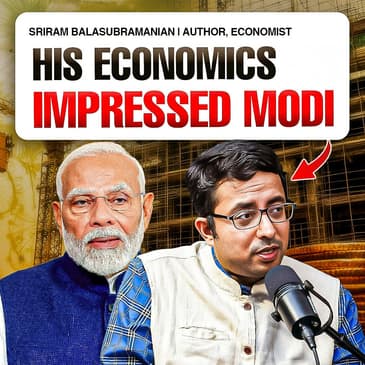
In this episode of the Bharatvaarta podcast, we sit down with Dr. Sriram Balasubramanian, a renowned economist and author, to discuss his latest book, 'Dharmanomics.' Dr. Balasubramanian delves into the historical role of temples as economic instruments and their impact on village ecosystems in India. He further explores ancient principles of Dharma and how they can guide modern economics towards sustainable growth. The conversation includes insights into the temple-based economies, the role of culture and norms in economic decision-making, and the influence of ancient economic models on contemporary policy. This discussion is a must-watch for anyone interested in understanding the intersection of India's rich cultural heritage and its economic framework.
00:00 Introduction
01:12 Exploring Dharmanomics
02:10 The Concept of Dharmic Capitalism
03:48 Historical Economic Frameworks
09:28 The Importance of Scholarly Research
13:57 Temple Economy in Bharat
17:38 Temple-Based Economic Models in Southeast Asia
19:27 The Role of Temples as Financial Institutions
20:07 Redistributive Functions of Temples
21:52 Liberating Temple Economies from State Control
24:26 Sustainability in a Dharmic Economy
25:05 Sustainability and Dharmic Economics
25:36 Prime Minister's Vision and Policies
26:51 Dharmic Responsibilities and Cleanliness
28:51 Historical Economic Interactions
30:14 Role of Corporate Guilds
31:56 Chola Dynasty's Geopolitical Influence
37:18 Policy and Dharmic Economic Model
46:17 Future Projects and Dharmic Nudges
50:01 Conclusion and Final Thoughts
Buy his book "Dharmanomics" here: https://amzn.in/d/4CAZTEB
[00:00:00] The temple has played an important role as an economic instrument. Most of the villages that we have in Bharat today, the single biggest institution that is a driver of economic activity in my view is the temple. It becomes a central ecosystem of a lot of these village entities. So if you take the past, Cholas, Indipallavas, Pandyas, you find this through and through.
[00:00:20] Sriram Balasubramanian is an economist and author with a deep interest in global economics, emerging markets and Indic culture. His new book, Dharma-nomics, explores how the ancient principles of Dharma can guide modern economics towards sustainable growth. Whether you like these books or not that I've written, one thing you would agree is that this content is intended to make you think.
[00:00:48] Namaste and welcome to Bharat Varta. My name is Kamal Madishetti, your host for today. Today we have with us a very special guest, a renowned economist and a best-selling author, Dr. Sriram Balasubramanian. He is somebody who's a familiar face when it comes to the field of Indic economics, somebody who's been on our platform before and has written some amazing books.
[00:01:12] And the book that we will be discussing today and the subjects that we will be discussing today are from his latest book, which is Dharma-nomics, Indigenous and Sustainable Economic Model. Namaste and welcome Sriram Ji. Thank you so much for joining us today. Namaste. Thanks a lot. It's great to be part of this conversation. Thanks, Kamal Ji. And of course, thanks to Roshan and Thiru Narayanan here for a wonderful studio which Bharat Varta has had.
[00:01:40] As being a sort of a supporter of Bharat Varta since its early days, I'm very happy that it's been a lot of progress. And lovely to be part of this show. Thank you. Thank you so much, Sriram Ji. And looking forward to our conversation. Sriram Ji, first of all, I wanted to ask you, I mean, a few years back you were on this platform. You spoke about your previous book which is focused on Cautillionomics. And now this is about Dharma-nomics. So why this book? What prompted you to, you know, write this book?
[00:02:10] Right. So I think like a lot of your listeners would have, you know, would remember my conversation on my previous book which is Cautillionomics for Modern Times. So what that book essentially did was to try to provide an economic framework to Cautillion's thinking, which of course is based on the Artha Shastra, which is a 3rd century BCE text.
[00:02:34] I pitched this idea called Dharmic Capitalism based on the idea of Cautillion's Artha Shastra. I believe that the idea of Dharma was foundational to Cautillion's thinking based on my understanding of the text and interactions with the variety of scholars on the subject. And I bring through the prism of ethics, responsibilities and social and economic harmony.
[00:02:58] I map all these into the role of a state, a rule enforcing but non-intrusive state, wealth creation via global outlook and sustainable growth and welfare. And then as your listeners would have known, you know, it's these ideas sort of map on to thematic areas in the Bharatiya economy on trade, on inequality, on labor contracts and a variety of other things in the Cautillion's book.
[00:03:26] So the attempt was always to sort of trace the past and then, but it also goes back to two sort of pertinent research questions, right? I mean, besides, I mean, my core, you know, bread and butter as a macroeconomist to deal with, you know, macro issues, international macro and things like that.
[00:03:47] But when I chanced upon, you know, economic history and Angus Madison's, you know, work on economic history, I realized that, you know, Bharat and China were the top sort of countries in the common era period. Right, right.
[00:04:06] Of course, there are, I also provide a perspective on how to sort of analyze Madison's data while focusing on the trends but less on the actual numbers, which is a different story. But what I'm trying to say is, I was of the view that, you know, there had to be some sort of an economic framework, some understanding, some basic philosophy, which was catalyzing this economic prospect. Absolutely. So that led me to Kautilya's Arthas Shastra.
[00:04:36] That was the first book. Yeah. And even in that first book, I talk about the first chapter with Professor Satish Deodor at IIM Ahmedabad, who is the Dean of Faculty, I believe now, we had co-authored a paper which talks about even the pre-Kautilyan period. Because Kautilya himself argues that, you know, scholars such as Brihaspati and Shukracharya had different views on such subjects.
[00:04:57] And even in the Arigveda, Mahavarta and Ramayana, there are indications of not just a spiritual realm, also a practical, in Tamil, we call laukik, which is more conventional or commercial, you know, lifestyle, which is also a concurrent reality. Right. So what I'm trying to say is as an extension of all this, I felt that these Dharma-based economic frameworks also extended to common era kingdoms.
[00:05:27] So my research, so I, we already had a sequel, I mean, it's a trilogy. So the first part is Kautilya's Arthas Shastra Kautilyanomics. Second part is Dharma-nomics, which we're talking about today. And third part is Dharma-based economic frameworks for Viksit Bharat. I mean, for the future, how do you apply a lot of these ideas? So in the second book, I deal with the Cholas, Pallavas, Pandyas, Kamboja Desa in Cambodia, Vietnam in Champa and Southeast Asian kingdoms.
[00:05:54] And through three sort of pillars, I approach this subject, right? Based on the evidence that I see. One is this Kautilyan Dharma capitalism, which I just mentioned, through the definition of Dharma and the role of the state and things like that. Second is what I call the Dharma ecosystem, the temple-based economies in a lot of these places.
[00:06:15] And third is on Shrinidharma, the role of Shrinis as, the Shrinis as a sort of a corporate guild, guilds who were like multinational corporations in those times. And they played a very, very important role, not just in the socioeconomic landscape, but they played a very important role in the geopolitical landscape as well. So these are three sort of, you know, competence, pillars that you see. And in these kingdoms, you see various iterations.
[00:06:44] Some of them have greater emphasis on the Dharmic ecosystem. Some of them have greater emphasis on the Kautilya's, you know, Dharmic capitalism. And some of them have an overarching influence on Shrinidharma. And I think these iterations are seen through the book.
[00:07:00] And, you know, the hope is to showcase to people that, lastly, one of the other aims, I spoke of one research question on what is the indigenous sort of Bharatiya economic model. The second question is, again, is the role of culture norms and narratives on economic decision making. Like, what is the influence of all cultural activities in our discretionary spending, which is a non-essential spending?
[00:07:29] A large section of it, in my view, even today, is governed by the way of life that you're talking about. You know, for example, the greatest amount of the largest UPI transactions in the calendar year this year is during the week of Diwali. Right. So, there is a reason why consumer behavior, especially folks in the advertisement world would agree with this, is largely linked to the cultural connotations of the place. So, this way of life is not, again, is a construct of thousands of years of experience.
[00:07:59] So, I draw linkages from this Dharmic model and showcase that this Dharmic way of life is an extension of all these things. And one hopes that, you know, in my next book, I try to showcase how in the present some of these ideas can be. So, this is broadly a sort of a summary of, you know, what works. Very, very interesting, Shri Ramji.
[00:08:18] I think it's almost a natural flow of thought that because we, I think, in India have been, I think, recognizing increasingly about the robust economy that we had in the common era. Be it, I mean, as evidenced in the Angus Madison report. So, it's wonderful that you've actually gone on and investigated, in a sense, about what is it that made that possible.
[00:08:42] So, that should be a very interesting sort of exploration for anybody who wants to understand what underpinned that economic prosperity that we had. I want to go into one of, like, each of those, some of the pillars that you laid out. But also, just quickly wanted to ask you why it becomes important to sometimes look at this from a scholarly perspective. Because sometimes we, when we talk about our way of life, it is a way of life.
[00:09:09] So, we live it, we experience it on a day-to-day basis. But why does it also become important to put down this in a scholarly manner so that, you know, we understand this in a more academic sense? So, what is the importance of that? See, academic sense is one part of it, right? My, where I think it is even more important is from a policy sense. Right. Right.
[00:09:36] So, most of the things that are obvious often need to be, I mean, most things in economics, frankly, are obvious. Right. Right. Right. But economics, whether you like it or not, plays a very overarching role compared to any other profession. Right. In how we sort of live our lives. Right. For a variety of reasons, right? Economic policy has sort of a confluence of politics and, you know, and mathematics.
[00:10:05] And an application of, and sociology itself. Yeah. All sort of rolled into one beast. So, it has, what I'm trying to say, it has a profound impact on how we live our lives. For example, post-1990 economic reforms. Yeah. You know how much transformation has taken place in how we live our lives.
[00:10:25] So, having said that, I think, you know, it is important in that sense, no matter how obvious it is, for us to create a rigorous framework. Because, you know, for my first book, I mean, for my first book in this series, I spent almost four to five years working on that. Right. There's a reason why I spent that time. Because you essentially have to derive a framework bottom up. Yeah.
[00:10:54] Which means you have to see the text, see the evidence, and then create a framework across thematic areas in various, you know, parts of the text. And then merge it into a framework. Right. Which is consistent across both. Yeah. And it's important because as policymakers, see, most people, you know, who need to be convinced are people who are in the middle end of the spectrum. In the sense, they aren't necessarily people who are exposed to all these ideas.
[00:11:21] Neither do they feel, you know, have an inherent bias against these ideas. That is the majority of the population. Right. I think getting a buy-in from that majority is very important. Right. Because, you know, that's when you bring about, unless you, you can only do that if there is rigorous research and sort of, you know, quality time spent on it. Right. Credibility is earned when there is, when there is hard work and there is commitment to a cause. Right.
[00:11:50] These two books, I could easily write five op-eds in any major publication. And then say, okay, I've done this work. Right. But that's not really the point. The point really is you want to have work which is, you know, which is critically reviewed. It's rigorous. It's, you spend a lot of time thinking and provide unique, I mean, provide fairly, you know, new content.
[00:12:17] I mean, whether you like these books or not that have written, one thing you would agree is that this is, this content is intended to make you think. And it is something which is not seen in other places. Right. It's something, you know, it's a, it's, it's a different perspective of things. So, what I'm trying to say is, I think credibility is earned only when you, when you, when you put in the rigor to, to produce, you know, things like this.
[00:12:44] And I think that's where I think it's very important to do quality research. Because only quality research will, will get you this, get these ideas mainstream and get a greater buy-in, buy-in from a wider section of the population and policymakers who aren't really attuned to some of these ideas on their own. So, eventually, I think gradual, I mean, more and more research on this subject will push the needle. And at some point, you know, there will be transformation.
[00:13:12] So, I think it's a lot of perseverance, but I think it's definitely worth it. I think that's why we should move towards. Absolutely. Absolutely. Sri Ramji, I think a lot of viewers, listeners, also, all of us recognize the need for us to look at the Indic knowledge systems. But as you mentioned, it's very important that the rigor is there because there are many ideas out there, sometimes almost floating for some time and then sort of disappearing.
[00:13:39] But unless there is a systematic study like the one you have conducted the second time now, you know, it would just not add value and also not add sort of relevance to policymakers in a sense. So, thanks for sharing those insights. I want to go to specifically the temple economy now. And that is a subject that you deal with in your book.
[00:14:03] So, why is the temple important from an economic standpoint in the context of Bharat? What role has it played in the Indian economy historically? See, if you really look at ancient Bharatiya history, especially southern Indian kingdoms or the kingdoms that I've covered here and in Southeast Asia, the temple has played an important role as an economic instrument.
[00:14:33] See, the temple as a religious and social-religious entity is a well-known fact. I mean, we all see that. And, you know, in the realm of spirituality and things like that, it's a very sacrosanct and very important component of our spiritual faith. Yes. Right? But for us, you know, appreciating, acknowledging and admiring this particular fact, I take a step back and view it through the lens of an economic instrument. Yeah.
[00:15:03] See, in most of the villages that we have in Bharat today, the single biggest institution that is a driver of economic activity, in my view, is the temple. Even today. Even today. Even today. If you go to Tamil Nadu, for example, there are thousands of temples. Right. You take any village. Right. Right? There will be a major one, major temple. Yeah. And there will be a lot of smaller temples around that area. Yeah. Right?
[00:15:27] The ecosystem that the temple provides, the economic ecosystem, which means, you know, the kirana shops outside the temple, you know, all the products that is required for, you know, the activities in the temple. You know, the tourism that benefits from the temple, the infrastructure development, which is required for people to move from one place to another because of the temple. Yeah.
[00:15:49] Because in purely economic terms, what you're seeing is a sort of a completely inelastic demand. Yeah. Because of the temple. Yeah. Right? Because of the bhakti and devotion, no matter what macroeconomic environment changes, you have a constant demand for the temple. Right? Yeah. In a sort of a materialistic sense. Yeah. Right? Yeah. Yeah.
[00:16:13] Which means that this ensures that there is constant demand for the ecosystem surrounding the temple. Exactly. Which is independent of other macro factors. So, let me try to simplify, right? Yeah. Yeah. Let's say you're going on a yatra or on a visit to a lot of these temples, right? And you're going with family and, you know, you're deciding to spend, say, 5-10 lakhs for a family of, say, 10 people. Yeah. You know, you're going for a one month yatra.
[00:16:43] No one would really go and look at the reserve bank's interest rate, you know, while going on the yatra, right? I mean, the yatra has expenditure. Yeah. Okay? And you do it. It has tourism. It has all these things. Irrespective of what the, you know, whether it is a recession or not, this discretionary expenditure that you're making is going to happen. Yeah.
[00:17:01] So, in a purely economic sense, it is a tool which is completely, it has inelastic demand, which means you, the ability to change this demand is very limited because of other external factors. Yeah. Right? So, it provides an ecosystem. What I'm trying to say is, so, it becomes a central ecosystem of a lot of these village entities, a lot of these cultural entities. So, I think that's an important point to observe. Right?
[00:17:30] So, if you take the past, similarly, you know, in the Cholas, in the Pallavas, Pandyas, you find this through and through. In fact, ironically enough, not ironically, surprisingly enough, if you look at Kambuja Desa, that is Cambodia and Vietnam, the temple-based economic model, especially between 6th century CE, 6th, 7th century CE, till about 13th century CE, was central. That was the core construct of their economy, more or less.
[00:18:00] You know, in the book, I try to deal with the various theories of these models. Of course, there are other views. I think Kenneth Hall's views on this subject, related to the temple-based and temple-network-based economies, in my view, is the closest to the reality. Okay. So, I argue that in these places, the temple, because of the fact that the temple had large sections of land. So, it played four major roles. Right? It is what I call a labor aggregator. Right.
[00:18:25] Which means it brought a lot of employment for people in that particular village, that particular area, for a variety of roles. Right? Two, more importantly, it was a financial sort of institution. Right. See, there is a reason why, if you really think about it, right? If you look at the major temples in Tamil Nadu, or Tamil Nadu, take even full of India, right? Full of Bharat. Especially in the coastal, you know, say the southern and the western areas. Right?
[00:18:54] You find that you will have most of the major temples within an hour's drive from the coast. So, let's take Somnath. Right? Let's take Padmanabha Swami temple. Yeah. Yeah. Yeah. Let's take even the, some of the Tanjavara temples. Except for probably Madurai Meenakshi temple, it's a bit inward. Tirchandur in, in, in, in near southern Tamil Nadu. Yeah. Even Puri Jagannath temple. Yeah.
[00:19:21] So, most of these temples are within an hour's or hour and a half drives from the coast. It's not some random, I, there is a, there's a logical reasoning behind it because the temple served as financial institutions. Yeah. They served as sort of financiers for a lot of the corporate guilds, the trainees, which I mentioned. Yeah. Where they would sort of finance them, give them interest loans for a particular amount of interest rate. Right.
[00:19:48] And then ensure that they also served as VC funds, venture capital funds. So, in the sense that for, for entrepreneurial networks around the temple ecosystem, they would be offering, you know, loans at reasonable rates. Yeah. And they served as financial institutions. So, that was another important role. Yeah. The third important role is that they served as huge redistributive functions. Right. You, you find this a lot in the Vijayanagara empire, where it is institutionalized quite a bit.
[00:20:15] Where, for example, in the Thirumala temple plates, you notice that the Vijayanagara empire, used the temples as a major redistributive center. So, what do I mean to redistribution? Right. So, if you take things like inequality, right? Yeah. You hear a lot about inequality. So, inequality in very simple terms is a gap between rich and poor. Yeah. So, the rich, when the gap increases, you say there is, you know, greater income inequality between people. Right.
[00:20:42] So, when, when, so in, in, in, in the Thirumala temple inscriptional evidence that you, what you see is that a large sections of say donors or, or rich people in that particular area put in money into an endowment fund. Right. Okay. This endowment sort of fund helps to finance the temple. Right. Okay. It puts an investment into the temple and things like that. And the temple gets financed.
[00:21:09] Obviously, it's rituals and it's the entire spiritual ecosystem that is required after the temple is taken care first. And then they ensure that there are food available for free for three times a day for anyone who comes to the temple. Right. So, which means the real poor, people below poverty line are getting free food for three times a day. Right. So, all your issues related to malharishment or whatever it is from lack of food are taken care by this setup.
[00:21:39] Yeah. And the transfer of wealth from the rich through these endowment funds is happening to the poor in a sense. So, redistribution happening at that level. Right. So, these are the side of roles that the temples play. Yeah. So, what I'm trying to say is that the temple based economy, I mean, much of the debate around the state and the control of the temples, they're all valid debates. Of course, you know, when you look back at first principles, obviously, the less the influence of the state, the better it is. Right.
[00:22:09] But that discussion is primarily on the revenue generated by the temple on its own. Yeah. But there is a temple based economy which is outside. Yeah. As a benefactor of this. Yes. So, liberating that from the shackles of the state is not a politically contentious issue. Right. Which can be easily done in a strategic, in a calibrated manner. Right. Right. So, I think there's a lot of scope in that front. And much of the, you know, multidimensionality of the temple as an instrument, as an economic
[00:22:37] instrument, is an area which a lot of our ancestors focused on. They saw a lot of, you know, merit in doing some of this. Right. And I think that also played an important role in sustainability of this prosperity. Yeah. Absolutely. Very interesting points there, Srinamji. I think you've highlighted the role of temple on multiple fronts. But also, the last point that you made, which is on liberating and, you know, sort of easing
[00:23:04] the sometimes regulatory restrictions that surround the temple and the economic activities around the temple. I think that is something that is hardly spoken about in a sense because we do have a much needed debate and discussion about, I think, the temple administration itself about what happens inside the temple. But there is also an ecosystem around it which has to be looked at. Thanks for highlighting that. Correct. Just one point right further. I'm not delegitimizing the case for temple liberation from the state. Yes, absolutely.
[00:23:34] I'm very much for it. But given the political nature of it, as we try to resolve that issue, I think there is the ecosystem that the temple creates, the economic ecosystem it creates, you know, because much of the 1990 economic reforms, for example, focused in various areas of the state. Right. Right? And we see the benefits. Yeah. One angle to explore is the economies of scale that are derived by this ecosystem. Yes.
[00:24:02] And how do you sort of liberalize this from, you know, create greater efficiencies, make it more strategic, make it a more sort of a, you know, a calibrated entity of economic opportunity for people. Right. And that's, I think, a point to ponder for people. Absolutely. Absolutely. Thanks for sharing that, Shidamji. Now, just moving on from the temple economy to something that you've also more recently
[00:24:32] spoken about, you know, on social media and elsewhere, and that is the debates and discussion around sustainability. The government in India has a certain framework, which is the life framework, capital L, small I, F-E, lifestyle for environment. You also deal with that in your book.
[00:24:54] So, what is the role of sustainability or rather what enables sustainability in a dharmic economy? Do we see evidence of that in the past? How do we think about sustainability from a dharmic economic standpoint? I think that's a very important question because sustainability inherently, in my view, is a behavioral problem. Right. All right.
[00:25:22] As individuals, if we have a buy-in on leading sustainable lives, then eventually, I think it will aggregate to a point where we live sustainable lives as a society together. Right. I think the Honorable Prime Minister's, you know, initiative is a very welcome step. I mean, I think it gives an indication of his vision, his enormous ability to understand this way of life that I'm talking about.
[00:25:52] Because of his vast experience on the ground. Yeah. And also, which I have again mentioned in earlier version of Bharatwarta itself. Right. One of the, you know, very underrated but extremely important observations of the Prime Minister is that he's probably the only Prime Minister after Lal Bhavadur Shastri who's experienced poverty. Yeah. Yeah. So, his ability to understand, you know, the power of, say, Ujhval Yojana, the power of having a roof on your head.
[00:26:22] Yeah. Yeah. Yeah. The power of lights, for example, in a village. Yeah. Yeah. Yeah. Yeah. Yeah. Yeah. And I think as an extension, his ability to understand this way of life is a good benchmark to understand how his policies are executed. Yeah. And in that context, I think this lifestyle for environment is a very, very important initiative.
[00:26:49] And I think it's inherently these behavioral choices that I'm talking about. Right. Where the role of Dharma plays an important role. Because inherently, the Dharmic way of life is sustainable. Right. Yeah. So, you know, the responsibilities that I spoke about in the definition of Dharma through Kautilya. Yeah. So, Kautilya himself talks about, you know, familial responsibilities, societal responsibilities, environmental responsibilities in 3rd century BC. Yeah. And the need for all of this. Yeah.
[00:27:17] So, I think among the definitions of Dharma, you also notice that there's a focus on Saucham, cleanliness, as one of the definitions. We're all inherently clean in our own societies. Yes. And we also need to, we also need to bring it through the neighborhood. Yeah. So, in fact, one person made an observation to me in Tamil Nadu, for example, in most of
[00:27:43] the villages, when they draw the kolam every morning, in a sense, you also ensure that your cleanliness is transferred to the outside area within your neighborhood. Yeah. In a very natural, organic manner. So, what I'm trying to say is a lot of the principles are based on Dharma, either through the prism of responsibilities or through the prism of some of the behavioral actions, are inherently sustainable. Yeah.
[00:28:10] So, the lifestyle that this movement is talking about is a form of way of life that is inherently sort of sustainable and it looks as sustainable practices, not because some state has imposed something on you. Right. But because that's how the nature of lifestyle has been for thousands of years. Yeah. So, I think that's a very important observation. I think it's something that one needs to flesh out more and sort of articulate in a coherent,
[00:28:38] research-driven manner for policymakers to pick up this more. Yeah. But this intrinsic nature, I think, is a very important one. Indeed. Indeed. Absolutely, Sriramji. When we speak of policy, the other area of policy is also when we look at, let's say, foreign policy. Of course, in modern times or in today's times, the way foreign policy, foreign relations is conducted is very different from what it was in ancient times or medieval times for that
[00:29:08] matter. And you're somebody who's lived in different parts of the world and have worked and lived. So, you understand sometimes these cultural differences that we see. How did India interact economically with its, let's say, neighboring spaces or far-off spaces, be it through trade or otherwise? Because you also mentioned about the role of Srinidharma in this.
[00:29:38] Can you tell us about that? Like, was one is, of course, how India interacted and how in terms of economic interactions with the rest of the world. And the other is also whether this model was also shared in a sense outside of what we today know as political boundaries of India. Because you mentioned that this is also something that was, let's say, in Cambodia. It was a similar model. So, what was the sort of international angle to this, if I may ask?
[00:30:07] Yeah, there's a lot of geopolitics, geo-economics politics, put it that way, in this. So, first of all, let me start with trainees, right? Right. These corporate guilds played a very important role, like what I mentioned. Yeah. And they were, you know, independent organizations. The state did not have much role in them. They were extremely egalitarian. They had people across caste, creed, communities. Okay. In fact, nationalities. There are even Jews who are part of some of these guilds. Wow.
[00:30:37] Foreigners are also part of these guilds. Okay. So, they had a sort of a very democratic process of choosing their leadership and things like that. And a very egalitarian system. Right. So, in fact, the first chapter, I sort of talk about this. And for those who are interested, Professor Vikramaditya Kanna, who is a good friend of mine, from Yume Shayanar, but he's done a brilliant paper on this, which can be googled, which talks a lot about the Srinis. Okay.
[00:31:08] I even extend this to some of the Saraswati Sindhu phase itself, based on my reputation. Okay. But what I'm trying to say is, if there is an institution which is extended for thousands of years, it's basically the Srinis. Right. And the Srinis had an important role in the socioeconomic prosperity that we're talking about. Right. And central to this socioeconomic prosperity, they were like multinational corporations. They had offices in various parts of Indonesia.
[00:31:34] They had people in Champa, in Vietnam, in Cambodia. And they were sort of, you know, traders, corporations, like organizations like FIKI, all rolled into one. Right. Right. And they also played an important role in financing a lot of these kingdoms, including the Cholas. And therefore, they also played a role in the geopolitics.
[00:32:00] So, for example, Rajendra Chorra, that is Rajendra Chorra's son. So, for people who are not aware, Rajendra Chorra was one of the famous kings. I mean, you see Pony and Selvan, which is the movie, which, you know, talks about the Cholas. So, Rajendra Chorra built the Bhradishra temple. Yes. Right. His son Rajendra Chorra was the one who conquered various parts of India as well as northern India. So, he conquered northern India.
[00:32:30] So, that's why in Tamil Nadu, you have a town called Gangaikunda Chorapuram. Okay. Which basically means Gangaikunda Chorapuram. The king, the Choran who went to Ganga conquered and came back. Okay. And so, he built a city just, you know, has a replica of the Bhradishra temple itself there. So, similarly, he also conquered Southeast Asia. You enter Keda and all these places. But there's a reason why they conquered, but they did not rule these places. Okay.
[00:32:59] Generally, when you cross these oceans, right? Yeah. You go all the way and you want to rule that place. Yeah. But that didn't really happen. Okay. The reason was, the reason for, one of the reasons for them to even make this journey was because of the Srinis. So, there was a guild called Ainurvan. Okay. It's called 500, a literal translation in Tamil. Okay. It is a very powerful, one of the biggest guilds in the common era. Okay.
[00:33:28] So, they were trading, you know, within Southeast Asia. And basically, the trading routes are like from Middle East. They go all the way to the states of Malacca. Okay. And then go under, say, Singapore. Okay. And then go towards China. Okay. Okay. So, while they were trading in the states of Malacca, the Shri Vijayak kingdom was the ones that they were in Java and Sumatra. Those are the areas where they were dominating.
[00:33:54] While they had decent relations with them, at some point, what had happened is they started stifling these guilds from functioning. Okay. Okay. So, this led them not to trade to China. And it affected their entire commerce or their economic, you know, financing structure. Right. So, and then in combination, the Cambodian king at that time had some issues apparently with the Shri Vijayak kingdom. Yeah.
[00:34:19] So, the Cholas, because of this reason, this is one of the reasons though, of course, for these type of events, you have many versions. Is that because of these two factors, the Cholas went and conquered to ensure that they liberated the guild so that they can function properly. And that's why once they conquered, they didn't really rule as long as this was sorted and then, you know, they did the right.
[00:34:43] So, this is a very good example of how a commercial entity has an important geopolitical influence. And then in terms of diplomacy also, right? So, the Cholas were also close to the Cambodian kings, the Cambodia kings, which is, you know, pretty like what I mentioned. On the other hand, Cambodia and Champa, Vietnam, had a sort of a hot and cold relationship. Because Vietnam had a very, has a very sort of a refined coast. Okay. Where many cities were there.
[00:35:13] In fact, these cities I mentioned in my book. Okay. They were called Panduranga. They were called Vijaya. They were all given Indic names. Okay. In all these, you know, cities, coastal cities. But they had a sort of always a hot and cold relationship because the Vietnamese ports were very lucrative for any Cambodian king. But despite that, the Cholas had equally good relations with both Cambodian and Cambodia as well as the Champa kingdoms. Right.
[00:35:43] And they established, you know, diplomatic, you know, negotiations with them and helped each of them in their own sort of, you know, geopolitical issues. Similarly, they also had, you know, interactions with the Chinese through the Chinese embassy notes. They sent missionaries to China. So, a lot of the, you know, diplomatic sort of maneuverings were all very common, you know, for, you know, they're all common parlance during this time.
[00:36:11] Only difference is obviously compared to today's time in terms of technology, in terms of the instancy, instant gratification. We talked about instant information that we get. That was obviously lacking during those times. But the conceptual need to have engagement with the rest of the countries and have geopolitical tie-ups in the rest of the countries and alliances were all quite common. So, these are some examples.
[00:36:34] In fact, Dr. Jayashankar mentioned in a couple of speeches before of this discovery of the 7th century Shiva temple in Vietnam. So, I also mentioned about it in my book. And those are some examples, you know, where geopolitics and, you know, economics were intertwined. Yeah, very interesting because, I mean, a lot of it actually echoes sometimes when you look at geopolitics of today as well.
[00:37:01] Where, you know, economic pathways or trade pathways, when they are blocked, become the center of geopolitics. So, it is very fascinating that this happened back then as well. And the Srinis actually were at the center of the spotlight, so to say. Sriramji, you know, I want to, we had discussed a little bit about, you know, regulations and, you know, the need to ease up, you know, economic activities around the temple.
[00:37:30] But beyond the temple as well, more generally, many of the aspects of a dharmic economic model are very much alive today. We see that everywhere in our society. However, there are, you know, systematic sort of obstacles for societies, for, you know, somebody who wants to pursue enterprise to actually, you know, see that to fruition.
[00:37:59] What is the role of policy then, in a sense? Because to actually tap into this potential, many of these institutions, temples are there in most parts of India. You still have that temple ecosystem. It is, in a way, sort of weighed down by the burden of regulations, weighed down by the burden of sometimes even politics. But it is there. It's surviving even now after, you know, centuries.
[00:38:25] How do we sort of rekindle the energy that there is by removing these obstacles that we frequently face? So, what would your sort of message be on the policymaking front to, you know, actually sort of tap into this potential? Yeah, I think it's important to, again, in these type of complex sort of, you know, complex ideas and years of research.
[00:38:57] Sometimes you need to sort of take a step back, right? Right. And look at the big picture of things. Yeah. I think that's how we need to approach this, right? Okay. So, coming back into the sort of two research questions I mentioned. Yeah. One is, what is the indigenous Bharatiya model, which we established through all these things, the qualitative frameworks? Two is, what is the role of culture norms narratives in economic decision making? Right.
[00:39:22] So, this provides you the framework for all these years. Right. And it leads, it doesn't just stop, right? Yeah. It leads us to where we are in terms of the way of life that we're talking about. Yeah. Right. Which, of course, which we, as you mentioned, it leads to economic choices that we're making. Right. And it plays an important role in economic decisions that we're making. Right. Not just at the individual level, but even at the corporate level. Right. Right. Let's take the top 15 companies in this country. Right.
[00:39:51] Almost 9 to 10 companies are all family-driven firms. Right. Right? Yeah. The 10 biggest companies in this country, most of them are family-driven firms. I mean, they won't be publicly listed, but they're predominantly run by a major family that runs the show. Yeah. Right? Most of these families make business choices. Right. Not bounded always on rationality. They make business choices, which is accumulation of factors of which their cultural upbringing,
[00:40:21] norms, narratives plays a very important role in their decision making. Right? Yeah. So what I'm trying to say is this way of life doesn't just affect individuals such as us. Yeah. But the way of life reflects also the sort of wealth creators of this country. Yeah. Right? That's how their choices are made. Right? Yeah. So its influence is significant. Yeah. Right? Anyone who sort of wants to underplay this is just being blind to the reality. Yeah. Right?
[00:40:50] Because whether you like it or not, this is the reality. Right? So once you're confronted with such a reality, it is important to acknowledge also the fact that these things did not emanate today. Yeah. Right? These things have been in this country for thousands of years. Yeah. Which means they are very difficult for policymakers, no matter how, you know, ingenious you think
[00:41:19] you are, for you to fundamentally change these things. Because they are beyond the construct of the material world. In the sense there is a way of life which has been inherently there for a long period of time. And that's how it is. Yeah. So what I'm trying to say is it would be prudent and it would be, you know, important for policymakers to understand this way of life and align policy to the way of life rather than the other way around.
[00:41:50] See, much of post-independent India for a variety of reasons, you know, we are a poor nation, we had to come out of poverty and we did a variety of things. But the underlying theme is that there was a bunch of people, most of them well-intentioned, who were extremely privileged from post-independent movement in terms of education, in terms of their background, in terms of society.
[00:42:17] And their Western sort of driven education thinking and models became sort of the numero, you know, sort of thing that the rest of the country has to do. Right. Right. But their exposure to and their worldview is limited to this elite consumption by and large. Right. So that post-economic reforms of 1990 has changed gradually but substantively. Right.
[00:42:47] So if you really think about it, you know, the generation of people who are in their 40s today are people who are probably in their early childhood during that time. So these are people of the aspirational class from the middle class who have raced through the economic ladder purely, you know, with the role of markets and role of reforms and things like that. Yeah.
[00:43:14] So there, and more importantly, these are people who are democratized, I mean, their views are sort of democratized across the board because they come from all walks of life. Right. Okay. Not restricted by geography or class or that creed. Yeah. So what I'm trying to say is most of the policy before used to be that there's a certain prescription of policy and then there's the way of life which keeps parallelly happening. Yeah.
[00:43:40] And in cases where there's a conflict, you know, the policy just doesn't become effective. Yeah. Right. So I think we are at a stage where it is important that people acknowledge this fact and design policy in a way it is aligned to the way of life so that it's far more effective. Yeah. So I gave the example of the PM's, you know, lifestyle movement. Similarly, Swachh Bharat is another example. Yeah.
[00:44:06] Where using this idea of Saocham and appealing to their sort of dharmi consciousness, put it that way. Yeah. And then taking this to the outer neighborhood and society. Yeah. It has become almost autopilot in especially in rural areas. Nowadays, if you go to even in Tamil Nadu or any major village in or any villages, most
[00:44:29] of the villages in India, you see that besides the main bazaar street, the rest of the streets are all fairly reasonably clean. And the Swachh Tha clinics have made a, you know, important contribution. But more than that, I think it has struck a chord with the people, especially in rural areas, on the need for them to be, you know, on the need for them to transfer their dharmi consciousness to the neighborhood. Yeah. Right.
[00:44:59] This is a very good example of effective public policy acknowledging people's way of life. Yeah. And I think if you want to really enhance the effectiveness and sort of take public policy in a way where it is beyond the pressures of the state and who's in power, I think acknowledging and appreciating this way of life is a very important, it's a very important tool for policymakers.
[00:45:24] And it helps to sort of move policymaking to the way of life rather than another way. Yeah. Very true, Sri Ramji. I think you've mentioned an important point that the policy cannot be in conflict or in rupturing the way of life, but rather when they are in alignment that leads to better outcomes. I mean, purely from an economic sense as well, in terms of efficiency and things like that, but also it's very much desirable from a societal standpoint.
[00:45:52] And even I think from the point of view of some of the global challenges that we are facing right now, because like you previously mentioned, there's a lot there for a global audience as well. So if somebody wants to really understand how Indians make economic choices or how they have been making economic choices, I think this is the best sort of illustration for that.
[00:46:18] I just want you to also just talk about your upcoming projects and because you mentioned that this book is going to be part of a trilogy. And so, yeah, what if you can just tell us a little bit about that and we, of course, look forward to your next book as well. Thank you. So, yeah, as I mentioned, right? So I dealt with, so you've dealt almost with 2,500 plus years in these two books.
[00:46:48] So how do you sort of get these ideas to contemporary Bharat? Where do you think, where does one thing, you know, these ideas can fit in? Yeah. So that's, I think, you know, the book that I'm working on. Right. And of course, you know, any wholesale change, especially in a democratic polity, is a pipe dream. So, you know, I think there are ways in which these ideas can make a contribution in nudging
[00:47:19] policy in a way where it can be far more effective. Yeah. So I handled a lot of examples. For example, I gave this concept of Dharmic nudges. Okay. Where you use some of these cultural connotations and cultural events and cultural activities and use that as a productive tool for economic policy, you know, implementation. Right. So how do you sort of do that? So these are some ideas which I focus on. Yeah. And then how do you sort of institutionally look at some of these trends, like how in terms
[00:47:46] of like the sustainability index, you know, how do you sort of look at a Dharmic sort of an index which can facilitate better policymaking. Right. So I try to focus on some of these ideas. Right. And expand more on the temple-based economies as well to look at more data and give more information and provide a perspective on some of the challenges that Bharat will have in the years to come. So you know, things like urbanization, right?
[00:48:14] You've reached a flexing, an inflection point where continuous urbanization is counterproductive. Right. So how do you create tier two, tier three centers of economic independence and how some of these things can play a role in that? Yeah. So these are some ideas which I'm working on in a new book. But of course, it's a new topic, you know, and you're exploring, you're researching. And it requires a lot of perseverance.
[00:48:43] I mean, you know, generally itself, you get pushback on a lot of these things. Yes. But I think I'm, you know, I'm inherently passionate and I strongly believe that if we are to be Viksit Bharat, you have to deal with both the informal economy and the way of life that I'm talking about, none of which are going to go away.
[00:49:08] And in this transformation, what is crucial is how do these stakeholders transform themselves in the process? And what does this transformation mean to these sections of people? Yeah. And are they on board with this transformation? Right. And how do you keep them on board? And I think answering these questions requires a lot more rigor, a lot more patience, a lot of open-mindedness. Yes.
[00:49:36] But eventually, I think it is important to know all this because that's when the sustainable, sustainability part will be taken care. And that's when, you know, we'll move to a more equitable and sustainable and indigenous sort of model that I refer to. Extremely critical questions that you have laid out for all of us who think about economic transformation, who think about economic growth.
[00:50:01] And I, like you mentioned, India being at the critical juncture that it is when we are talking about the Vikasit Bharat period, which is ahead of us, when we are talking about the need to improve people's lives through prosperity. Those, I think, are the questions that policymakers, media and all of us really as citizens of India should be asking.
[00:50:26] Thank you for, you know, very accurately and beautifully articulating that, of course, in the podcast, but the book as well, which I would highly encourage our viewers and listeners to check out. It is DharmaNomics. Thank you so much, Sriramji, for your time and sharing your insights with us. And most importantly, for making this scholarly contribution, which I think will go a long way in helping all of us
[00:50:52] understanding, you know, economic and contextualizing economic growth in the context of Bharat. Thank you. Namaste and thanks a lot for both Bharat Partha as well as to your listeners. Of course, please feel free to buy the book. It's right here. And it's available on Amazon and any other platform, Padiga India and other major platforms.
[00:51:19] You know, and please, you know, read it, review it, debate it. And, you know, if you have any thoughts, you can also reach out to me. But it's important that as readers, you encourage, you know, scholarship in these areas so that there's greater research on such areas. Once again, thanks to all of you. I appreciate it very much. Thank you so much. Thanks. Namaste. Thank you. Thank you.