
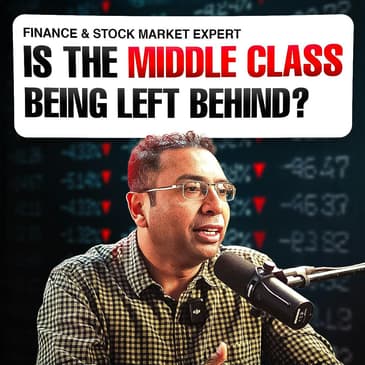

In this episode of Bharatvaarta, Roshan talks to Saurabh Mukherjea for an in-depth discussion on India's economic prospects, the transformative impacts of political and economic policies over the last two decades, and the rising number of new DMAT accounts. They explore the key themes from Saurabh's book 'Behold the Leviathan', touching on India's macroeconomy, market investing strategies, and the socio-economic shifts impacting the nation. The conversation delves into the consequences of educational and healthcare investments, the disparity between the North and South, and the evolving entrepreneurial ecosystem. Additionally, they discuss the impact of digital public infrastructure and direct benefit transfer schemes, and the future challenges and growth potential of India's middle class. Saurabh also provides valuable investing insights, shares personal anecdotes, and reflects on the importance of adaptability in the rapidly changing economic landscape.
Topics:
00:00 Sneak Peak
00:51 Introduction
01:53 Capitalism vs. Socialism in 1947
03:01 The Impact of Education and Policy Choices
05:54 Digital Public Infrastructure and Political Vision
07:40 The Rise of Women and Non-Elite Entrepreneurs
11:14 Challenges and Opportunities in the Indian Economy
17:27 Direct Benefit Transfers and Welfarism
21:58 Formalization and Access to Credit
26:02 Economic Growth and Income Inequality
34:30 Challenges to India's growth
39:30 Lessons from China and the Role of AI
46:33 Policy Interventions and Future Growth
49:39 Employment Linked Incentives (ELI)
50:37 Role of Conglomerates in India's Economy
53:17 Rise of Challenger Companies
57:23 Investing in the Indian Market
01:09:10 Principles of investing
01:18:42 Personal Insights and Reflections
[00:00:00] And I think the political class has figured out over the last 20 years or so how to cater to their vote banks to keep their electoral fortune sorted out. Will the South be happy with the fact that they have a quarter of the Lok Sabha seats? I think there might be some heat and controversy generated by that. I think 10 years hence, people will seat F21 as a similar watershed as 1991. I think like 90% of people with DMAT accounts in India don't make money. The message is loud and clear that trading per se is not a remunerative strategy. Trading is a hobby.
[00:00:29] If you're trading actively, that's by and large a hobby. 170 million DMAT accounts in India to have a recession. Four years ago, India had barely 30 million DMAT accounts. A lot of these people I think will end up losing their shirts in the ongoing economic downturn.
[00:00:43] Saurabh Mukherjee is one of India's finest financial minds. As the founder of Marcellus Investment Managers, he oversees a staggering 6000 fraud in assets under management.
[00:00:55] Known for his deep insights and razor sharp strategies, Saurabh has revolutionized the way Indians think about wealth creation and long-term investing.
[00:01:14] Hey Saurabh, thank you for being on Bharatwarta. Thank you also for letting us in your office and sorry for disrupting your Sunday morning.
[00:01:22] No, look, it's a privilege being on a show called Bharatwarta and Roshan, you've put in so much effort to pull this together.
[00:01:28] Least I can do is make myself available. The fact that it's a Sunday morning actually is a pleasant experience because discussions like this are best had.
[00:01:36] Sunday morning chats.
[00:01:37] Yeah, over a relaxed cup of coffee on Sunday morning.
[00:01:39] For sure. Thanks for the coffee as well.
[00:01:41] Our pleasure.
[00:01:42] So you've written a fabulous book, Behold the Leviathan and Leviathan, I should say, right?
[00:01:48] And it does a great job of kind of telling us like how we got here and what are those key winds of change blowing into the future, right?
[00:01:57] Indeed, there are many different things I want to talk about this.
[00:02:00] So we'll perhaps split the conversation into three or four parts.
[00:02:02] We'll talk about your views on the macroeconomy, right?
[00:02:05] With respect to India.
[00:02:07] And then of course, you know, people who are familiar with your work will not forgive me if I don't cover some of the more investing slash market perspectives of yours.
[00:02:18] So let's start with a juicy counterfactual, right?
[00:02:23] 1947, India becomes free.
[00:02:26] What if we had chosen capitalism slash market economy instead of going down the socialist route?
[00:02:34] There were other countries that became independent around the same time.
[00:02:37] South Korea, Philippines, you know, they chose, let's say, capitalism and they have had a dramatically different sort of an outcome.
[00:02:45] And there were others like China, Vietnam and us who, you know, moved more towards the communist slash socialist model.
[00:02:52] So I'm sure you have thought of this at some point of time, but I would love your perspective.
[00:02:57] So firstly, many thanks for reading Behold the Leviathan.
[00:03:00] And whilst I, the fact that the book's a bestseller pleases me greatly, my co-author Nandita and I still believe that whilst a lot of people are buying the book, perhaps not all of them are reading the book as carefully as you have.
[00:03:15] So just delighted that you read the book and looking forward to a stimulating conversation.
[00:03:19] So on this counterfactual business, Noroshan, I think there's two different aspects to the counterfactual.
[00:03:24] I would say if the first one is the question you posed, socialism versus capitalism in 47.
[00:03:29] But I think the second counterfactual to think about is our choices that we made specifically with regard to investments in education, right?
[00:03:36] And we focused on investing in higher education.
[00:03:40] Indian Institute of Science was created by the Tata's in 1913.
[00:03:44] But the whole IIT, IIM infrastructure, the heavy investment on creating an elite education infrastructure, as opposed to emphasizing primary education.
[00:03:54] I think that was a fateful decision.
[00:03:56] So back in 47, I don't think capitalism at the get go in 47 was a realistic choice, given that the world itself after Second World War was a decimated place.
[00:04:06] We were a desperately poor country.
[00:04:08] In the book, we've explained that not many people appreciate that at independence, at independence itself, we had half the per capita income of other Southeast Asian and East Asian countries.
[00:04:19] So at independence, we were way, way, way behind Southeast and East Asia.
[00:04:23] So a lot of people believe that falling behind East Asia is a recent phenomenon.
[00:04:27] It wasn't.
[00:04:28] At independence, we were already way behind.
[00:04:30] We were a desperately poor economy.
[00:04:32] And I think there was good, good argument for saying that we needed, say, maybe 10, 15 years of socialism to build the basics of an independent society before we got going as a capitalist economy.
[00:04:43] So I'm not so sure if I could go back into time and in 1947, I could be sitting in front of Pandit Nehru and advising him.
[00:04:52] I don't think I would have had the courage to say, let's go capitalist, given how desperately poor we were, how the world was smashed up and how partition had left us with deep scars in our psyche.
[00:05:03] But I think I would have had the foresight to say, had I been around in the 50s and 60s, to say we have to double down on private education.
[00:05:11] That deficit, I think, is still hurting us.
[00:05:14] We have 500 million people in the labor force.
[00:05:17] But as in the recent economic survey, the chief economic advisor has said, it seems that perhaps as many as half of those people are not really suitable for working in a modern economy.
[00:05:29] And I think that that outcome is has arisen, that unfortunate outcome has arisen because of a fateful call made 60, 70 years ago to focus on elite education rather than basic education.
[00:05:42] Right.
[00:05:42] Right.
[00:05:43] You know, we got talking about the different mindsets that we have, the aspirational India today.
[00:05:49] Right.
[00:05:50] And in your book, you mentioned these four eras.
[00:05:52] Yeah.
[00:05:52] Right.
[00:05:53] When you contrast the mindset of both the policymakers and the population.
[00:05:57] Right.
[00:05:57] How do you see that is kind of varied?
[00:06:01] And indeed, you can kind of think of it as a chicken egg.
[00:06:03] Right.
[00:06:03] I mean, the kind of mindset influences the policy and vice versa.
[00:06:07] How have you seen the attitudes and the mindsets of both the policymakers and the population change in the time?
[00:06:13] So let's start with the policymakers because that's very visible.
[00:06:16] You can see that.
[00:06:17] Right.
[00:06:17] So let's take something like Aadhaar.
[00:06:20] It was created in Bangalore.
[00:06:21] Nanda Nilekaneji had the vision 2009-10.
[00:06:25] The fact that across the political divide, right.
[00:06:28] So initially it was Nanda Nilekaneji and the UPA's idea to launch Aadhaar 2010-11-12.
[00:06:34] But then from 2014 onwards, NDA ran with Aadhaar.
[00:06:40] They added Jandhan to it.
[00:06:41] They added the whole mobile dimension.
[00:06:44] In fact, the late Arun Jaitli ji came up with the acronym Jandhan Aadhaar Mobile Jam.
[00:06:49] And then the whole ramp on digital public infrastructure has really been a cross-party initiative across the country.
[00:06:56] No political party ever goes to town saying DPI, Kharab hai, DPI mat karo.
[00:07:01] So the fact that our politicians in the space of what 15 years across the political divide have had both the vision and the clarity of thought to ramp on DPI, I think needs to be celebrated.
[00:07:12] Right.
[00:07:12] One of the things in Indian politics is that there's a lot of noise.
[00:07:15] And we as bystanders tend to buy into that noise without realizing on how much there is consensus.
[00:07:21] The fact that there is consensus on building a high-tech society with DPI, I think is a remarkable circumstance.
[00:07:29] We should celebrate that.
[00:07:31] That's in the political piece.
[00:07:34] Foresight, aggression, clarity of thought and outstanding outcomes in a very short space of time.
[00:07:39] Right.
[00:07:40] No other country in the world, including China, including East Asia, has been able to show this sort of ramp on digital public infrastructure.
[00:07:47] This is a uniquely Indian achievement driven by tech visionaries and by the political class.
[00:07:53] And it should be celebrated.
[00:07:54] But the even more interesting change in mindsets, I think, has been in the population.
[00:08:00] And in the book, we sort of were on three dimensions of it, so to speak.
[00:08:03] First is the rise of women.
[00:08:05] Right.
[00:08:05] Highly educated, better educated than men and increasingly better paid than men.
[00:08:10] Getting the best jobs, having more money in the bank.
[00:08:13] So RBI data clearly shows, Roshan, that in urban areas, women have more money in the bank than men.
[00:08:18] And increasingly data also shows that in the mutual fund, in the equity ecosystem, women have 25% more assets under management.
[00:08:26] Right.
[00:08:26] So the rise of women has been stratospheric.
[00:08:28] And in the book, we discuss some of the data on fertility rates, especially in South India.
[00:08:34] Precipitas decline in fertility rates in the last decade or so, which seems to suggest remarkable acceleration in economic opportunities and career advancement.
[00:08:42] I love how the chapter starts with those missing women.
[00:08:45] So the Laapata ladies, in a way, our Laapata ladies, it deliberately charts on a subversive note.
[00:08:53] Because I think a lot of India's rise actually has this subversive feeling.
[00:08:56] People who are hitherto left behind and are still perceived as left behind are really punching back and saying, we will push our way to the top.
[00:09:03] Whether other people like it or not is their headache.
[00:09:06] Right.
[00:09:06] So one is the women dimension.
[00:09:08] The second rise in aspiration is people who did not or have not received elite education.
[00:09:15] They haven't gone to IITs or IIMs.
[00:09:17] They haven't gone to Ivy League.
[00:09:18] But they are saying, you know what, who cares?
[00:09:21] I'm going to rise in the world anyway.
[00:09:22] Because courtesy my local BCOM or BSC education in whichever college I've gone to, I'm able to do three things.
[00:09:29] I'm able to understand basic technology and how to make it work for me.
[00:09:32] I'm able to spot economic opportunity as an entrepreneur and capitalize.
[00:09:36] And thirdly, from an early age, I've taught myself, these entrepreneurs are saying, from an early age, I've taught myself how to hire and manage diverse teams.
[00:09:44] Right.
[00:09:44] And the rise of the native, non-elite educated entrepreneur is something that is, I think, spectacular.
[00:09:50] It's evident in the income tax data.
[00:09:52] We've described the income tax data piece in chapter five of the book.
[00:09:55] How you can see the non-elite entrepreneur blasting through.
[00:09:59] And it's also evident in the corporate tax data.
[00:10:01] In the final chapter of the book on creative disruption, we're showing you how roughly 60,000 companies who are non-elite, what I call challenger franchises, are absolutely smashing through.
[00:10:12] And when you talk to these people or when I see them as clients and I also see them as companies I invest into, their confidence, their clarity of thought, their view of how they can conquer the world is actually nothing short of inspirational.
[00:10:28] And again, it's happened in the space of 15, 20 years.
[00:10:31] 20 years ago, India didn't have this.
[00:10:34] Right.
[00:10:34] And we've created this.
[00:10:35] You can also see reflections of this in sport, whether it's a fellow from a very humble background like Yasha Svijaswal blasting through or the South Indian chess whiz kids from middle class families with very modest means going on to conquer the world at age 17, 18, 19.
[00:10:51] Earth-shaking achievements from people with modest backgrounds.
[00:10:54] I think that's a kind of signature of Indian society now.
[00:10:57] Right.
[00:10:58] Yeah, I think, you know, if you look at Rishabh Pant batting, that perhaps signifies the India that we're dealing with at this point of time, right?
[00:11:06] The guy gets, you know, dropped off a catch and then doesn't mind hitting the next ball as well.
[00:11:11] And the same in business life.
[00:11:13] There are many Rishabh Pants in business life.
[00:11:15] Yeah.
[00:11:15] And I think that's truly to be celebrated.
[00:11:17] To find capable, intelligent people willing to take big risks in life is an extraordinary thing.
[00:11:24] Very difficult.
[00:11:25] It's not something that I've lived in the West.
[00:11:27] I didn't see this in the West.
[00:11:28] Capable young people willing to take big risks in life time and time again, even after setbacks.
[00:11:34] Right.
[00:11:34] That's a sign of a society on the ascent.
[00:11:37] Absolutely.
[00:11:38] I think one of the things, you know, when we talk about the macroeconomy and so on, and indeed there are a lot of these tailwinds and so on.
[00:11:45] But one of the underrated and perhaps less discussed aspect is the mindset of the people itself.
[00:11:49] I mean, I would say that Indians today, young Indians today are more optimistic than any other demographic anywhere in the world.
[00:11:56] You know, Europe is on the decline.
[00:11:59] Well, we've just had elections in the US and perhaps, I mean, there could be some kind of a, you know, exceptional, you know, typical American exceptionalism revival of that.
[00:12:08] But unanimously, when you talk to young Indians, they're aspirational.
[00:12:13] Right.
[00:12:13] Yeah.
[00:12:13] And it's a remarkable point that you make, right?
[00:12:16] Till 20 years ago, perhaps even 10 years ago.
[00:12:19] Yeah.
[00:12:19] The default was that, look, I need to get out of here.
[00:12:23] Somehow I need to migrate.
[00:12:24] Either I migrate to study something in Australia or New Zealand or Canada, or I study something here and get onto some, you know, MBA course somewhere.
[00:12:33] And if I can get a job in America or Canada, my life is made.
[00:12:37] Right.
[00:12:37] That was the default narrative till 10 years ago.
[00:12:39] I think that default narrative has changed.
[00:12:41] And what's remarkable, Roshan, is even though that default narrative has changed in spite of the fact that it's not as if there's an abundance of jobs for bright young people.
[00:12:50] Right.
[00:12:50] There isn't.
[00:12:51] But what there is an abundance of is confidence.
[00:12:53] And what that's resulting is increasingly younger people are saying that I, you know, yes, jobs are white collar, jobs are scarce.
[00:13:00] But I think I can make a living on my own.
[00:13:03] I can set up a business and make a living on my own.
[00:13:06] And thus the rise of both the gig economy and the startup ecosystem.
[00:13:10] Right.
[00:13:11] That's very unusual.
[00:13:12] That's very unusual that people are saying that even though there are not, there's not a proliferation of white collar jobs, I still want to give it a go and say till the age of 30, 35, I want to see whether I can push myself as an entrepreneur.
[00:13:24] Yesterday I was on a flight from Chennai to Mumbai and a Chennai airport, a young software engineer from Gujarat, but works in a company in Madras doing coding, works in a company in Chennai doing coding.
[00:13:38] So he came up to me and said, my dad is a Gujarati trader, grain trader.
[00:13:44] I deliberately have set myself not to be a grain trader.
[00:13:48] I work as a software engineer in Chennai and I want to push myself.
[00:13:52] His words exactly was, I want to push myself till my early 30s to see what I can achieve by myself.
[00:13:57] Right.
[00:13:58] And I said, Karna, what do you want to achieve in life?
[00:14:00] He said, can you tell me what business I should get into?
[00:14:03] Should I get into the stock market?
[00:14:05] I said, look, you're saying you're a coder and you come from a Gujarati trading background in grain trading.
[00:14:10] You're like genetically made for building a successful business.
[00:14:13] And I gave him a couple of business ideas.
[00:14:15] I gave him this book and the guy's brain started ticking over.
[00:14:19] By the time the flight landed, exiting the flight at Mumbai airport, he came up to me with a couple of ideas with which he could build a startup.
[00:14:27] And as we were walking out of the airport, I said, look, stay in your job in Chennai.
[00:14:31] Get the coding done in your evenings.
[00:14:33] Launch your app.
[00:14:35] Right.
[00:14:35] It's an app focused on small businesses that we were discussing.
[00:14:38] Launch your app.
[00:14:39] Get a couple of salespeople in Gujarat.
[00:14:42] Hire them sitting in Chennai.
[00:14:43] Get them to sell your app.
[00:14:44] And if the app takes off in Gujarat, quit your job, raise VC funding and build your company.
[00:14:49] Right.
[00:14:50] And you could see from the guy's face that this is going to be his life.
[00:14:53] He's not seeking some sort of linear path to the top.
[00:14:56] He wants to go non-linear.
[00:14:58] He wants to push himself, his words.
[00:15:00] And that mindset is very powerful.
[00:15:03] If you have a generation of youngsters coming through who are not seeking backstops, who are not seeking easy linear routes to the top, who are not seeking to chill.
[00:15:11] Generation of youngsters coming through who are going to push themselves to achieve outstanding outcomes.
[00:15:16] By definition, many of them will fail.
[00:15:18] But even if 5,000, 10,000 of them succeed, it will be utterly transformative for the country.
[00:15:24] That is remarkable.
[00:15:25] And I'm not a sociologist.
[00:15:27] I wish I was.
[00:15:28] I won't be able to tell you exactly why that's happened.
[00:15:30] But that's a remarkable outcome to have.
[00:15:32] No other country in the world has this.
[00:15:34] I'll give you another story.
[00:15:35] So, some months back, I interviewed this entrepreneur.
[00:15:40] You know, went to one of the premier engineering institutes, etc.
[00:15:45] Grew up in a very religious household.
[00:15:47] Right.
[00:15:48] And he missed doing the chadava for his gram devata.
[00:15:52] Okay.
[00:15:52] Okay.
[00:15:53] So, he builds an app.
[00:15:54] Right.
[00:15:55] Assuming that, you know, others may have the same problems.
[00:15:59] Right.
[00:15:59] 10 million plus downloads.
[00:16:01] Wow.
[00:16:01] Right.
[00:16:02] It's called a Shreemandir app.
[00:16:03] Wow.
[00:16:04] And you can, it's a digital mandir.
[00:16:06] Okay.
[00:16:07] Wow.
[00:16:07] You can pretty much do everything that you would via the app.
[00:16:12] So, you have everything from bhajans to, you know, shadava to donations to certain rituals and so on.
[00:16:20] And in such a way that, you know, you can actually like, there's a camera set up.
[00:16:23] You can actually see it on the app as well.
[00:16:24] And with the rise of AI, as AI becomes ubiquitous, as broadband becomes cheaper and AI becomes ubiquitous,
[00:16:31] I think you'll see an explosion of these mini use case, mini use case apps.
[00:16:35] And perhaps, you know, I'm not an expert in coding, but from what I understand from the folks in Bangalore,
[00:16:40] perhaps you won't even need to hire full-time coders to build the app because AI itself can perhaps build you the code for the app.
[00:16:47] And I think that rise of a kind of million small entrepreneurs.
[00:16:51] Right.
[00:16:52] Each with a useful product.
[00:16:55] Right.
[00:16:55] For a niche use case.
[00:16:57] For an acutely Indian use case.
[00:16:58] Acutely Indian and niche use case.
[00:17:00] Right.
[00:17:00] I think that will be the next phase of capitalism.
[00:17:03] What in turn it will do is it will democratize access to economic power and profits deep into Indian society,
[00:17:11] which I think in turn potentially generates another wave of entrepreneurialism and enterprise in our country.
[00:17:19] And again, I stress this is very Indian.
[00:17:22] There's no other country which has followed this path,
[00:17:24] which is why the subtitle of the book is The Unusual Rise of Modern India.
[00:17:28] Right.
[00:17:28] There is no other country that has followed our path to development,
[00:17:31] which is why the West is increasingly confounded by what's happening in our country.
[00:17:35] Indeed, our own economists in India are confounded by India's rise.
[00:17:39] Right.
[00:17:40] Let's shift tangents and talk about another phenomenon.
[00:17:43] Right.
[00:17:43] I mean, there are certain political constituencies and with, let's say, Aadhaar, DPI and so on,
[00:17:51] there are these direct benefit transfers that have become like very prevalent.
[00:17:55] Right.
[00:17:55] We're talking a day after the Maharashtra results.
[00:17:57] And the Ladli Bahena scheme or perhaps the equivalent of that in Maharashtra was a huge success.
[00:18:04] Right.
[00:18:04] Women voted in very large numbers for the party that proposed that.
[00:18:09] Right.
[00:18:09] And I come from Karnataka and we have the Shakti scheme as well,
[00:18:13] where, you know, bus fares are waved off and so on.
[00:18:16] Right.
[00:18:17] Do you see this sort of welfarism slash populism?
[00:18:22] Do you think that that is par for the course?
[00:18:24] I mean, that is something that, you know, we indeed have to do.
[00:18:27] Like, for example, you mentioned, you know, women as a rising demographic.
[00:18:31] Right.
[00:18:32] Do you think that there should be more education?
[00:18:34] There should be more incentives and so on and so forth in that regard?
[00:18:39] Or do you think, I mean, that could actually be like a hindrance if everyone were to sort of disperse money en masse?
[00:18:46] Sure.
[00:18:47] So I think let's dwell on two aspects of it.
[00:18:49] I think DBT, direct benefit transfer is the medium itself is an unquestioned positive.
[00:18:54] Yeah, of course.
[00:18:56] Between UPA and NDA, different parties did different things.
[00:19:01] But the total outcome of DBT is far better than the old system where leakage was ubiquitous
[00:19:06] and the middleman got rich at the expense of the ultimate beneficiary.
[00:19:11] So the DBTP is unquestioned positive.
[00:19:14] My reading is there's some more thinking that will get done in India
[00:19:17] on how to give the right people the right incentives at a point in time.
[00:19:22] Prima facie, it would look, it's the prima facie, the evidence just giving women money, DBT, is a good thing.
[00:19:29] Right.
[00:19:29] First off, if you look at the numbers, there are more women voting in India than men.
[00:19:33] So women are the primary moving political force in the country.
[00:19:36] And you can't blame the political class for saying, if more women are voting than men, let me gratify them.
[00:19:44] And then that creates almost a self-fulfilling cycle.
[00:19:46] That women vote, they get money, they vote more.
[00:19:49] And therefore, you're creating a very active, empowered women voting class.
[00:19:53] Secondly, there's reasonably good evidence to suggest that if you give women money,
[00:19:57] that's resulting in better outcomes, whether they become entrepreneurs.
[00:20:00] There's a big upsurge in women entrepreneurship.
[00:20:02] We've noted that in chapter four of the book.
[00:20:04] It also seems to result in better nutrition for their children, better educational outcomes.
[00:20:09] So I think there'll be more scholarship to emerge on.
[00:20:12] If you give DBT to man versus woman, where is the better outcome?
[00:20:15] And I think my reading of the data so far is giving money to women rather than men seems to be a better outcome.
[00:20:20] Then the third piece is, given the challenge that technology will pose for us,
[00:20:25] the challenge technology is posing for India is that because we are a high-tech country,
[00:20:30] automation of factories and offices is resulting in loss of jobs.
[00:20:34] Several people have spoken about it.
[00:20:36] Most recently, Rishad Premji of Wipro has spoken about it.
[00:20:40] And therefore, whether you're in the West or in the East,
[00:20:43] some form of universal basic income seems increasingly likely to become the norm
[00:20:47] where the haves in society get taxed.
[00:20:50] And that gets transferred to have-nots.
[00:20:52] That seems to be one way to deal with the fact that technology does provide a degree of inequality in outcomes.
[00:20:58] So on the UBI piece, UBI in India might be a huge challenge.
[00:21:03] Because you give money in a poor country to, at the moment,
[00:21:06] the government seems to be giving around $60 billion a year, 2% of GDP, central government alone.
[00:21:11] But if you make that 3-4% of GDP, potentially creates massively inflationary outcomes.
[00:21:17] So rather than UBI, I call it CBI, conditional basic income.
[00:21:21] That provided you do these basic things to participate in the job market,
[00:21:24] you either become self-employed or you do an REG at the very least.
[00:21:28] You do basic things to be eligible for a DBT.
[00:21:33] You should be getting DBT.
[00:21:35] And I think one of those eligibility conditions could be being a woman.
[00:21:40] If you're a woman with a family, a little bit more.
[00:21:43] If you're a woman with a family and you're doing an REG a little bit more.
[00:21:45] I think that CBI construct, conditional basic income,
[00:21:49] my reading will increasingly become the norm in the next decade or so.
[00:21:52] And the beautiful thing about DBT is you can set these conditions to trigger the money transfer
[00:21:58] from the government to the beneficiary.
[00:22:00] Right.
[00:22:01] You know, in the book, you talk about this formalization, right?
[00:22:03] Whether it is Aadhaar, whether it's GST, etc.
[00:22:06] And that has had a catapulting force in the economy as well.
[00:22:10] Earlier, I mean, formalization meant that, you know, the taxman is after you.
[00:22:15] But today, formalization means that maybe you have access to credit.
[00:22:19] Then maybe you have access to certain government schemes and so on and so forth.
[00:22:22] Can you talk about that and how that is spurring the economy?
[00:22:26] So, the use cases that I love to talk about are the use cases that, say,
[00:22:31] are easily visible to me in my life in Mumbai.
[00:22:34] So, for example, the tea stall where you bought your tea just outside a gate, right?
[00:22:38] That sort of person, till three years ago,
[00:22:41] wouldn't have had access to credit from the formal banking system.
[00:22:44] But now, you would have paid for the tea through UPI.
[00:22:48] He can go to any bank, any NBFC and show his full Yerka bank statement.
[00:22:52] And the bank and NBFC can literally see each cup of tea that he sold.
[00:22:55] And not only can they see the statement, they can also track it real time,
[00:22:59] provided through account aggregator, he gives them permission to hit up his accounts, right?
[00:23:04] So, access to credit for low-income people earning 2, 3, 4 lakhs who were hitherto charged usurious rates by the money lender,
[00:23:13] they're now charged anywhere between 8% to 15% by the formal financial system for either working capital credit or for buying a home, right?
[00:23:23] And I think that's an unquestioned positive, especially in Pradhan Mantri Awas.
[00:23:27] I think the outcome of this has been very positive, right?
[00:23:30] There's a whole ecosystem of affordable housing finance that has burgeoned.
[00:23:34] You can see they're providing good lending outcomes.
[00:23:38] And in spite of the economic downturn that we are going through, Roshan,
[00:23:41] the affordable housing finance companies, NPAs, haven't gone up.
[00:23:44] It's very interesting.
[00:23:45] This is the first economic downturn post the UPI-DBT era.
[00:23:50] And we're seeing the affordable housing companies who lend to some of the poorest people in India,
[00:23:54] their NPAs are not going up, right?
[00:23:56] So, that's the kind of positive use case.
[00:23:59] Where I'm a little perplexed by the lack of success of the UPI-DBT pieces or the UPI-India stack pieces is the unsecured lending space, right?
[00:24:14] Both microfinance and broader unsecured lending, that seems to have got pulverized in the last couple of years.
[00:24:19] And that seems to suggest that whoever is lending money is not using the data and the data that's coming through from UPI
[00:24:28] because the rapid rise in unsecured NPAs over the last 18 months or so,
[00:24:34] and the excessive lending RBIs also had to step into to jack up risk rates, to deter unsecured lending.
[00:24:41] That suggests to me that whoever is doing unsecured lending is a little oblivious to the data that's coming through
[00:24:47] from the rich UPI interface.
[00:24:51] And I think that's something that our lending ecosystem need to look at,
[00:24:56] that if their greed overpowers business common sense,
[00:25:01] then no amount of formalization is going to help you.
[00:25:03] You just go through a sort of conventional downturn that poor economic judgment results in.
[00:25:09] But it's a little more hedged because it's a consumer lending and not institutional lending.
[00:25:14] It's granular.
[00:25:15] It's granular.
[00:25:16] 2010 era-ish.
[00:25:17] So I agree with you.
[00:25:18] It's granular.
[00:25:19] And therefore, the chances of one big blow-up are low.
[00:25:23] But to the extent that there will be high correlation across many unsecured borrowers
[00:25:28] if they've been excessively lent to,
[00:25:31] it looks like there's been a degree of failure on the lender's side to exercise judgment.
[00:25:37] So as long ago as we're doing this in the closing months of 2025,
[00:25:42] I remember middle of 2024, firms like HDFC Bank throttled off unsecured.
[00:25:46] But many others kept going.
[00:25:48] And why they kept going?
[00:25:49] Given that the data was suggesting throttle off unsecured is a moot point.
[00:25:53] The RBI has stepped in.
[00:25:54] But it still doesn't seem to be enough.
[00:25:57] We're seeing some of the lenders who lend to the poorest echelons of society get their balance sheet blown up.
[00:26:04] And that's perplexed me.
[00:26:06] I thought that now that UPI is there and you can get so much data on low-income borrowers,
[00:26:12] lenders would avail of that and do something constructive.
[00:26:15] But it doesn't seem to have kicked in.
[00:26:18] Good news is the positive case study is affordable housing finance.
[00:26:21] I think the work-in-progress case study is this unsecured lending piece.
[00:26:25] Right.
[00:26:26] So one of the unique facets that I've noticed about the growth as well,
[00:26:30] and these were again further sort of reinforced by the Gini index numbers that came out,
[00:26:34] I think maybe about six months back or so,
[00:26:36] is that this growth has not had a large schism in terms of haves and have-nots.
[00:26:41] So roughly people seem to have the opportunity and the access to sort of move up the ladder per se.
[00:26:50] Do you see that continuing or do you see that like perhaps in the US,
[00:26:56] I mean, as we become more prosperous,
[00:26:58] this gap between the haves and the have-nots will increase
[00:27:03] and that could cause some social strife and so on.
[00:27:06] So what's interesting in this is that we seem to be creating a new elite, right?
[00:27:13] We discussed the fact that non-IIT, non-IM,
[00:27:17] non-overseech educated people are increasingly successful.
[00:27:20] In fact, in chapter five of the book,
[00:27:22] we show that the majority of the Nifty 50 companies are non-IIT, non-IM, non-overseech.
[00:27:27] So if creating a new elite, if you look at the income tax data,
[00:27:30] roughly 250,000 families, 2.5 lakh families,
[00:27:37] roughly say therefore a million individuals constitute this new elite, right?
[00:27:44] The underclass, the low-income segment,
[00:27:47] whilst they suffered post-COVID,
[00:27:49] they seem to be gradually recovering in the last month or last year or so, right?
[00:27:52] The FMCG volume data, the two-wheeler sales data suggests
[00:27:56] that after the COVID pounding,
[00:27:57] the underclass is also coming through.
[00:28:01] The recent political victories of the BJP in Haryana and Maharashtra also suggest
[00:28:06] that they've been able to figure out how to resurrect the fortunes of the underclass.
[00:28:12] The constituency that seems to be suffering is the middle class.
[00:28:16] And it's very interesting that the middle class is coming under the pump
[00:28:20] and it's evident, right?
[00:28:21] You can see flagging sales of FMCG.
[00:28:23] You can see flagging sales of entry-level cars.
[00:28:27] You can see that the IT services company's employment count is barely growing.
[00:28:31] And you can also see that many of the exiting class of India's top engineering colleges
[00:28:37] are not getting placed, right?
[00:28:38] This class, I think this middle-income class,
[00:28:41] the rise of automation, robotization, AI, I think is hitting them, right?
[00:28:46] And this has happened in the West as well.
[00:28:48] Between 1990 and 2020, the American middle class, for example, got pulverized
[00:28:53] as jobs moved to China, especially managerial jobs moved to China and India
[00:28:57] and technology disrupted them.
[00:29:00] It seems to be coming to India now.
[00:29:02] So the upper class, the elite, the million richest people are doing great.
[00:29:07] The underclass seems to be recovering after the ravages of COVID.
[00:29:11] I think the middle class is under the pump.
[00:29:12] And I think this requires a lot of thought on the part of both industry and the folks
[00:29:18] in New Delhi on how do we prevent AI from becoming a middle-class jobs killer?
[00:29:22] How can AI turn out to be a positive for the middle class rather than a negative?
[00:29:26] This requires, I think, mission mode thinking.
[00:29:28] In the final chapter of the book, in the epilogue of the book,
[00:29:31] we've given some ways to think about remedies and palliatives here.
[00:29:35] But I think this is an issue which requires very serious thought
[00:29:38] because the middle class clearly is under the pump.
[00:29:41] And they seem to be casualties of the automation of the workplace.
[00:29:44] Right.
[00:29:45] Yeah, I think that is perhaps the issue that we'll have to contend with.
[00:29:50] The fact that we're living in the AI era.
[00:29:52] Yes.
[00:29:53] And our demographic dividend per se might not turn out to be a dividend
[00:29:59] if it results in mass, this pulverization of the jobs.
[00:30:05] And if you think about it, the political class doesn't also have any great incentive
[00:30:08] to kill themselves thinking about the middle class.
[00:30:10] The big vote bank is the underclass.
[00:30:12] Correct.
[00:30:12] The underclass, the poorest people have been given roads,
[00:30:15] low-cost airlines, the whole DPI piece, direct benefit transfer.
[00:30:20] And I think the political class has figured out over the last 20 years or so
[00:30:24] how to cater to their vote banks to keep their electoral fortune sorted out.
[00:30:28] The middle class, in a way, is a little bit of an orphan child in that regard.
[00:30:31] They're not enough of a vote bank for politicians to lose too much sleep about them.
[00:30:37] But they're also potentially casualties of technological change.
[00:30:41] And I think this will require enlightened thinking by civil society
[00:30:45] and the political class to figure out how to prevent this from becoming a societal issue.
[00:30:50] Right.
[00:30:51] Right.
[00:30:51] So one of the things that you mention in the book is also this peninsular growth, right?
[00:30:56] And the divide between the South and the North in terms of just economic progress and so on.
[00:31:01] And we've heard similar sort of voices as well, even tending towards, let's say, subnationalism and so on.
[00:31:08] Do you see that this will be an important factor going forward?
[00:31:11] I mean, if you project out the next, like, let's say, 50 years forward,
[00:31:14] I mean, are we going to contend with, you know, I hate to say it, but let's say, like, a divided India per se?
[00:31:22] Look, I think balkanization of India has been a fear and a concern ever since the country was created in 47.
[00:31:28] Right.
[00:31:29] I'm not so sure the fear should be as real today as it perhaps was in the 60s, 70s and 80s.
[00:31:36] But we need to keep in mind that the gulf between the South and the North is growing rapidly.
[00:31:42] Right.
[00:31:42] So if you look at the data, the peninsular states account for a quarter of the population, half the GDP and two thirds of the GDP growth.
[00:31:50] So if a quarter of the population is bringing two thirds of the GDP growth and that part of the country population is now falling because fertility rates are below replacement.
[00:32:00] In fact, South India's fertility rates are almost European already because women are entering the labor force at such a rate.
[00:32:08] Because of the demographic and economic divergence between the North and the South, I think we need to take it seriously.
[00:32:15] And whether anybody likes it, whether I like it or not, 2026, the whole issue around what do we do about delimitation comes to the fore.
[00:32:24] It's constitutionally mandated in 26.
[00:32:26] Either India makes a call on this.
[00:32:28] So what is the moot point here?
[00:32:31] At the moment, the allocation of seats in the Lok Sabha was set in 1971 as per the 71 census, wherein the South got a third of the Lok Sabha seats.
[00:32:40] Because then in 71, they represented a third of the population.
[00:32:43] Right.
[00:32:44] And it was said that we would revisit this in 90s.
[00:32:47] So this was done in 71.
[00:32:49] I'm sorry.
[00:32:49] And it was said in 2001 it will be revisited.
[00:32:52] In 2001, Atal Vihari Vajpayee Saab kicked it down the road to 2026.
[00:32:56] So 25, it looks like there'll be a census.
[00:32:59] Right.
[00:33:00] I think next year we'll have a census.
[00:33:01] Basis which the 26, reallocation of seats in Lok Sabha.
[00:33:05] That's the delimitation.
[00:33:06] The reallocation of seats in Lok Sabha will take place.
[00:33:09] If the 25 census shows that the South's share of population is no longer one third, perhaps it's closer to a quarter, then naturally the South's Lok Sabha seat share drops.
[00:33:20] But given that the South accounts for half the GDP and two thirds of the growth, and therefore proportionately the bulk of India's tax revenues are coming from the South.
[00:33:28] Will the South be happy with the fact that they have a quarter of the Lok Sabha seats?
[00:33:33] I think there might be some heat and controversy generated by that.
[00:33:38] The heat and controversy is easy to see.
[00:33:41] Non-trivial solutions to this are not easy to see.
[00:33:44] Right.
[00:33:44] How do you deal with this?
[00:33:45] How do you tell the South that you boys carry on?
[00:33:48] You boys and girls carry on generating growth and tax revenues, whilst the political power will lie with the rest of the country.
[00:33:54] The rest of the country.
[00:33:55] I don't have an easy answer, but if you compromise on this and say we will give the South more seats, then you're taking away the whole premise of one man, one vote.
[00:34:03] Why should a Bihari vote carry less punch than a Tamil vote or a Kanadega vote?
[00:34:10] So 30 issues coming towards us.
[00:34:14] I don't have an answer to this, but I can guarantee those who are watching is that this will be an incredibly tough political problem over the next couple of years.
[00:34:22] So let's talk about some more of these problems.
[00:34:24] I mean, so we are poised to become the third largest economy in the world.
[00:34:28] The best performing economy and stock market for a while, but best performing economy post-COVID as well, comparatively in the world of some scale.
[00:34:38] Now, there is a saying that India disappoints both the optimists and the pessimists.
[00:34:43] Right.
[00:34:45] You know, what do you think will limit us?
[00:34:48] Right.
[00:34:48] What do you think are those, you know, the folks in the road, right, which will kind of detour our growth if, you know, if you were to sort of like look ahead?
[00:34:59] Sure.
[00:34:59] So first of all, I think we need to understand that this is a free market economy.
[00:35:03] Right.
[00:35:04] The government's role is increasingly limited.
[00:35:06] It's limited to things like DBT and building roads.
[00:35:09] Right.
[00:35:10] For whether we like it or not in the educational sphere, the government has increasingly pulled back.
[00:35:14] It's a tragedy, but it is what it is.
[00:35:16] Right.
[00:35:16] So the government's role is increasingly limited.
[00:35:19] Government spending as a percentage of GDP is just 15%.
[00:35:22] 85% is a free market economy.
[00:35:24] And like all free market economies, we'll go through economic cycles.
[00:35:28] Right.
[00:35:28] So we had, for example, three terrific years after COVID, 22, 23, 24.
[00:35:33] And now as we enter the closing stages of FI 25, we seem to be entering a cyclical downturn, which I think will last several quarters.
[00:35:42] Right.
[00:35:42] So the economic cycle, like in any other free market economy will exist.
[00:35:46] We need to sort of understand that rather than go into some wild political flap and wild individual panic every time an economic downturn comes.
[00:35:56] Right.
[00:35:56] So that's one factor we'll increasingly have to be resigned to.
[00:35:58] Because our parents grew up in a socialist India, most Indians who are of that socialist era, they find these downturns very unnerving.
[00:36:06] Right.
[00:36:06] Because it sort of throws them off kilter when they hear that relatives have lost their jobs and some small businesses have gone bust.
[00:36:12] It is, it is, there is a human suffering entailed in being a free market economy.
[00:36:17] But we have chosen that path as a country because socialism didn't deliver the desired results.
[00:36:21] Right.
[00:36:22] So that's the first piece to come to terms with.
[00:36:24] Then secondly, in terms of what will set us back, my reading is overall GDP growth will stay at the 6-7% mark for many years to come.
[00:36:32] There's enormous amount of spare capacity in this economy.
[00:36:36] There's plenty of human beings who need jobs.
[00:36:39] They might not get the jobs they desire, but they'll need some sort of employment to provide sustenance to themselves.
[00:36:44] And similarly, there's unfulfilled demand as well.
[00:36:46] If your supply side and your demand side remains unexploited, we'll have many years of 6-7% growth.
[00:36:53] Capital will increasingly be available because the financialization of household savings will produce something like $100 billion a year of savings,
[00:37:01] which will partly be taken by the government to finance their, the government debt.
[00:37:06] But there will be large flows of money between domestic and foreign investors.
[00:37:09] I think we'll have something like $50 billion of risk capital available every year for new businesses to be capitalized and started off.
[00:37:17] So capital is available.
[00:37:18] Supply and demand is there.
[00:37:21] And I think 6-7% growth will sustain.
[00:37:23] Where I think we have a challenge, and we brought this out as clearly as we could in Behold the Leviathan Roshan,
[00:37:28] the challenge will be that that growth will be spread very unevenly.
[00:37:32] It will grow the benefits of their growth will increasingly go to that top million richest Indians or the 250,000 richest families,
[00:37:43] 2.5 lakh families.
[00:37:44] They will be the biggest disproportionate beneficiaries.
[00:37:47] The growth will also increasingly go to the peninsular states,
[00:37:51] Maharashtra, Karnataka, Tamil Nadu, Telangana, Andhra, Kerala, Goa.
[00:37:57] And thirdly, the growth will increasingly go to people who have that entrepreneurial mindset.
[00:38:04] Elite education is no longer required, but an entrepreneurial mindset is required.
[00:38:07] So if you are southern, if you are peninsular, southern, peninsular,
[00:38:13] you are in that elite entrepreneurial ecosystem,
[00:38:17] and you have the mindset to use modern technology to your benefit,
[00:38:22] the next 10 years you will absolutely kill it.
[00:38:25] In contrast, if you are northern Indian, don't have anything more than class 10 education,
[00:38:32] and you're a northern Indian man with no more than class 10 education,
[00:38:36] I think the next 10 years could be very painful.
[00:38:39] I think that's the challenge we face.
[00:38:40] The divergence in outcomes will create challenges.
[00:38:44] Naturally, the losers, the people who fall behind,
[00:38:47] will shout louder than those who are winning,
[00:38:49] and that will create this perception that something unfortunate is happening,
[00:38:52] when in reality, we'll actually be progressing down a fairly decent path
[00:38:57] in terms of at the national level of economic growth and so on.
[00:39:01] And again, this is par for the course.
[00:39:02] This is how America developed.
[00:39:04] This is how Japan developed.
[00:39:06] This is how Korea, Taiwan developed.
[00:39:08] All the way up to $10,000 per capita income.
[00:39:10] We're at $2,500 today.
[00:39:11] All the way up to $10,000 per capita income.
[00:39:14] You tend to see this sort of growth outcomes where a tiny group of people
[00:39:21] get the disproportionate share of the rewards,
[00:39:23] and the vast majority don't participate in the action.
[00:39:26] This is called the power law.
[00:39:28] So this happens in sport as well.
[00:39:30] So in Wimbledon, the Wimbledon champion takes home 50x the prize money
[00:39:34] of the first round loser.
[00:39:36] And the power law will play out in India as it has done in every developing economy.
[00:39:40] So overall growth per se, I don't think will be a challenge.
[00:39:44] Cyclicality of the economic cycle notwithstanding.
[00:39:47] The challenge will be the distribution of the spoils,
[00:39:49] which will increasingly be unequal,
[00:39:51] and the top million individuals will cream it.
[00:39:54] Right.
[00:39:54] So when we look at China, for instance, right?
[00:39:58] And what they've done post the Deng Xiaoping era.
[00:40:02] Yeah.
[00:40:04] Lifting all of those millions of people out of poverty.
[00:40:07] And today, I mean, being at the forefront, like superpower level.
[00:40:11] Right.
[00:40:12] What are those things that we can learn from them?
[00:40:14] Although, I mean, societies are different.
[00:40:16] The political dispensation is clearly different.
[00:40:20] Right.
[00:40:22] What are those two or three things we can actually learn from the Chinese?
[00:40:25] I think the two spectacular things China pulled off,
[00:40:28] in spite of all the brutality of the Mao years, right?
[00:40:32] The cultural revolution, the Long March.
[00:40:35] Mao created a lot of pain and suffering.
[00:40:37] But two spectacular outcomes that were pulled off
[00:40:40] between the Mao and Deng Xiaoping era was firstly,
[00:40:43] mass education.
[00:40:44] We haven't got that sorted out.
[00:40:47] In many of our village schools, the teachers don't turn up.
[00:40:49] If you do literacy and numeracy tests for Indians who are 10 years,
[00:40:55] 12 years, 15 years old, we are amongst the worst in the world
[00:40:57] in mass education and providing basics of educational skill sets to Indians.
[00:41:03] I think that's a big lacunae.
[00:41:06] I don't know how this will be solved because whichever leader tries to solve it,
[00:41:10] it's a 10-year payback period at least.
[00:41:13] And as you know, our election cycles are five years.
[00:41:16] So it's not clear to me the political class will want to solve this
[00:41:18] because they'll say, what's in it for us?
[00:41:20] By the time the education problem is solved, I'll be long gone, says the leader.
[00:41:23] So that's a massive issue.
[00:41:25] And as economic life increasingly becomes about operating,
[00:41:30] at the very least, factory machinery,
[00:41:33] without a decent amount of education, it's not evident,
[00:41:35] this can be pulled off.
[00:41:36] I think the second aspect of what we'll need to come to terms with,
[00:41:40] and this I'm more optimistic,
[00:41:42] is the integration of AI with the India stack.
[00:41:46] So the India stack is roughly, say, 10-15 years old.
[00:41:49] It's given us the basic layer of identification,
[00:41:55] provision of credit, provision of direct benefit transfers.
[00:41:59] But it does, it sort of goes only so far.
[00:42:01] It gives you a degree of non-linearity in outcomes,
[00:42:04] as we have seen in the NPCI data on how quickly UPI is ramped up.
[00:42:08] But once you've sort of exhausted the first basic layer of getting every Indian in Aadhaar,
[00:42:14] their biometrics, getting them on digital payments,
[00:42:18] to now capitalize on India stack,
[00:42:21] we have to integrate that with UPI.
[00:42:24] Sorry, with API.
[00:42:25] So with AI, sorry.
[00:42:26] Now the integration of AI with India stack potentially creates India stack too.
[00:42:31] And in the epilogue of the book, we've given multiple use cases.
[00:42:34] The use case that sort of is the easiest to see the power of is skilling and education.
[00:42:40] So if you have, say, a 17-year-old class 12 student in Museram,
[00:42:44] and she wants to study, say, science at the Indian Institute of Science,
[00:42:49] she wants to study physics at the Indian Institute of Science,
[00:42:51] but she doesn't have the financial wherewithal to do it,
[00:42:54] can she speak into an AI system,
[00:42:58] which then puts her in touch with an employer in Bangalore,
[00:43:02] who says, I'll pay for university education,
[00:43:04] provided you do a four-year internship with me
[00:43:06] in my whatever physics lab or my engineering setup in Bangalore, right?
[00:43:12] That skilling and education network,
[00:43:14] I think AI is ideally placed to pull it together,
[00:43:16] because if you think about it,
[00:43:18] our bulk of our population is north and east.
[00:43:21] The jobs are down south.
[00:43:22] And there's a geographical mismatch.
[00:43:25] There's also potentially a skills mismatch.
[00:43:27] It's potentially possible that the south simply doesn't have
[00:43:30] the number of skilled people that it needs.
[00:43:33] The north and east might have that.
[00:43:34] We need to bring skills and we need to overcome the skill mismatch
[00:43:37] and the geographical mismatch.
[00:43:39] AI is ideally placed to do that.
[00:43:40] But if this is to be pulled off,
[00:43:42] somebody out there has to pay for the training of the bots
[00:43:45] in a multitude of languages,
[00:43:47] then they'll have to pay for the GPU burn
[00:43:50] that every time that Mizo girl speaks into her AI
[00:43:54] or the southern Indian employer seeks a candidate,
[00:43:57] the next GPU burns,
[00:43:58] somebody will have to pay for that.
[00:44:00] And thirdly, this will have to be marketed
[00:44:02] and sold to the whole population, right?
[00:44:04] Now, whether the government will do this or not,
[00:44:06] I'm not so sure.
[00:44:07] But clearly a philanthropist out there
[00:44:10] who wants to leave a legacy
[00:44:12] should be willing to put their hand up.
[00:44:14] And if they do so,
[00:44:15] they'll leave their mark for generations.
[00:44:17] Similar sort of construct in healthcare, right?
[00:44:19] It's reasonably clear that chronic health illnesses
[00:44:25] like hypertension, like diabetes are exploding in our country,
[00:44:30] especially in the poorer segments of society.
[00:44:32] Government hospital beds haven't really been added
[00:44:35] at any serious number in the last decade or so.
[00:44:37] And again, there's a supply mismatch,
[00:44:39] supply demand mismatch between those who need healthcare
[00:44:41] and those who can provide it.
[00:44:43] Again, can AI step in and provide the basics of healthcare
[00:44:48] to the majority of our people?
[00:44:50] And just to carry on like this,
[00:44:52] as we age over the next 20 years,
[00:44:54] we will age.
[00:44:55] Our median age is 28 today,
[00:44:57] but over the next 20 years, we'll age.
[00:44:59] Low-income people will need retirement saving solutions.
[00:45:02] Can again, AI be brought to play here?
[00:45:04] So the integration of AI with India stack,
[00:45:08] I think is a generational opportunity,
[00:45:10] but it's not going to be as easy
[00:45:12] and as cheap as India stack
[00:45:13] because of the bot training
[00:45:15] and the GPU burn aspect.
[00:45:17] It requires visionaries,
[00:45:19] it requires philanthropists to step in.
[00:45:21] But if we can pull this off,
[00:45:22] we'll be able to once again,
[00:45:24] once again in the next decade,
[00:45:25] we'll be able to provide population scale solutions
[00:45:27] to some of the most pressing problems of the nation.
[00:45:31] Right.
[00:45:32] Why do you think we spend so little
[00:45:34] on education and healthcare?
[00:45:35] You know, you did mention
[00:45:36] perhaps delayed political outcomes are a thing.
[00:45:41] But the reason it's a mystery,
[00:45:42] I think your question is valid is say,
[00:45:44] Bangladesh,
[00:45:44] Bangladesh is also a democracy, right?
[00:45:47] At least sort of a democracy.
[00:45:48] Right.
[00:45:49] But they seem to have higher levels of spend
[00:45:52] as a percentage of GDP.
[00:45:54] They're spending more than us
[00:45:55] on health and education.
[00:45:58] And even though their per capita income is similar,
[00:46:00] Bangladesh and India,
[00:46:01] per capita incomes are similar,
[00:46:03] but they're spending significantly more than us on.
[00:46:05] Health and education.
[00:46:07] I don't have an easy answer.
[00:46:09] I'm a little confounded by this.
[00:46:12] My sort of lazy answer to this is our political class
[00:46:15] thinks of five-year elections.
[00:46:16] And therefore,
[00:46:17] since the payback of health and education
[00:46:19] is longer term,
[00:46:20] they don't invest in health and education.
[00:46:23] But then other Asian democracies
[00:46:25] have done a better job than us.
[00:46:27] Why are we negligent in this regard?
[00:46:29] I don't have an easy answer.
[00:46:30] If it's any comfort,
[00:46:32] the peninsular states have clearly done a way better job
[00:46:35] in this regard than the North.
[00:46:38] That itself is also perplexing.
[00:46:41] That it's the same,
[00:46:42] we all became independent in 47.
[00:46:44] The same IIS officers run the country.
[00:46:47] Why is it that the same IIS officers
[00:46:49] deliver so much better
[00:46:50] in terms of health and education outcomes
[00:46:52] in the peninsula
[00:46:52] than they do in the North
[00:46:53] or the West of the country?
[00:46:55] I don't have an answer.
[00:46:56] You know,
[00:46:57] one of the things that you mentioned
[00:46:58] in the factors that are driving the change
[00:47:00] is the PLI scheme,
[00:47:02] for instance.
[00:47:03] Right?
[00:47:03] And you talk about
[00:47:04] how the mobile phone manufacturing
[00:47:06] ancillary industry
[00:47:07] has kind of built up.
[00:47:08] And you're saying that,
[00:47:10] you know,
[00:47:10] we need to do something similar
[00:47:11] in the medical equipment
[00:47:12] and so on.
[00:47:13] So what are some
[00:47:14] two or three policy interventions
[00:47:16] you feel will
[00:47:18] cause that growth spurt
[00:47:19] in these areas?
[00:47:20] How do we extend beyond PLI?
[00:47:22] Sure.
[00:47:22] So if you look at why
[00:47:24] PLI has been so successful
[00:47:25] in smartphones, right?
[00:47:27] Till three years ago,
[00:47:28] we were doing barely $2 billion
[00:47:29] and now we're approaching $30 billion
[00:47:30] with Apple being at the vanguard.
[00:47:32] And Apple's made no secret.
[00:47:33] I think Tim Cook
[00:47:34] has been very vocal in saying
[00:47:36] that very soon
[00:47:37] a third of their
[00:47:38] global production
[00:47:39] of roughly,
[00:47:40] I think it's $150 billion
[00:47:42] of phones and pads,
[00:47:44] a third of their global production
[00:47:45] will move to India, right?
[00:47:47] And beyond Apple,
[00:47:48] say even a firm like Dixon's
[00:47:49] has been reasonably successful
[00:47:50] in ramping up
[00:47:52] electronic manufacturing
[00:47:53] through PLI, right?
[00:47:54] Now, the reason it's
[00:47:55] I think so successful
[00:47:56] is anything which is
[00:47:59] knowledge intensive,
[00:48:00] right?
[00:48:00] Requires a high degree
[00:48:01] of skill and knowledge
[00:48:03] rather than being
[00:48:04] labor intensive,
[00:48:05] right?
[00:48:05] We seem to be
[00:48:06] reasonably good at it,
[00:48:07] right?
[00:48:07] So what we cannot,
[00:48:08] I think,
[00:48:10] create world-class levels
[00:48:12] of competitiveness
[00:48:12] in is something
[00:48:13] which is out and out
[00:48:14] just labor.
[00:48:15] So it's a fond dream
[00:48:17] of many political leaders,
[00:48:18] but I think we will struggle
[00:48:19] to build world-class
[00:48:21] competitiveness
[00:48:22] in textiles,
[00:48:23] in sports goods,
[00:48:24] in manufacturing trainers,
[00:48:26] right?
[00:48:27] So it's a fond dream
[00:48:28] of our political leaders
[00:48:29] because those are
[00:48:29] very labor intensive.
[00:48:30] They're also reasonably
[00:48:31] capital light
[00:48:32] and therefore,
[00:48:33] you know,
[00:48:33] they have this in my mind
[00:48:34] that if we could pull this off,
[00:48:36] we would be like Bangladesh
[00:48:37] or say Pakistan
[00:48:38] in sports goods
[00:48:39] or Vietnam
[00:48:39] in sports trainers,
[00:48:41] wind cheaters
[00:48:41] and so on.
[00:48:42] I don't think that's realistic
[00:48:43] given how high
[00:48:44] our labor costs are.
[00:48:46] So in Maharashtra,
[00:48:46] for example,
[00:48:47] Russian,
[00:48:48] minimum wages
[00:48:49] are 3x net of Bangladesh.
[00:48:51] Land prices in Maharashtra
[00:48:52] are significantly higher
[00:48:53] than Bangladesh
[00:48:54] or indeed Vietnam.
[00:48:55] The cost of working capital
[00:48:57] in our country
[00:48:57] is meaningfully higher
[00:48:58] than Vietnam or China.
[00:49:00] So if your land labor capital
[00:49:01] is expensive,
[00:49:02] for you to become
[00:49:03] a sweatshop type country
[00:49:04] is very tough.
[00:49:05] Whereas if you focus
[00:49:06] on knowledge intensive stuff,
[00:49:08] smartphones being the case in point,
[00:49:10] it works,
[00:49:10] it's worked successfully
[00:49:11] and that's why I think
[00:49:12] medical devices
[00:49:13] is going to be
[00:49:14] an obvious area
[00:49:15] to ramp in.
[00:49:16] We've made some investments
[00:49:18] in that space
[00:49:18] in medical device companies.
[00:49:19] They're absolutely booming.
[00:49:21] So the said company
[00:49:22] makes dialysers
[00:49:23] and dialysis machines.
[00:49:25] Again,
[00:49:26] it's a $400 billion
[00:49:27] global market.
[00:49:28] India barely makes
[00:49:29] $1 or $2 billion.
[00:49:29] Huge headway here.
[00:49:31] China makes a lot of it
[00:49:32] for similar reasons
[00:49:33] to Apple diversifying
[00:49:35] to India.
[00:49:36] I think Western manufacturers
[00:49:38] will want to reduce
[00:49:39] their dependence
[00:49:39] on China
[00:49:40] for critical medical devices.
[00:49:42] We should be able
[00:49:43] to slot in their
[00:49:44] knowledge intensive product.
[00:49:45] And similarly,
[00:49:46] active pharmaceutical ingredients
[00:49:48] is the critical part
[00:49:49] of medicines.
[00:49:51] So the PLI scheme,
[00:49:53] I think the government
[00:49:54] now knows how to make it work
[00:49:55] and my reading is
[00:49:56] they'll be able to ramp it
[00:49:57] in other sectors.
[00:49:59] The answer to mass scale
[00:50:00] job creation
[00:50:01] remains elusive.
[00:50:03] The government is trying
[00:50:04] ELI,
[00:50:05] Employment Linked Incentives.
[00:50:08] I think what they're
[00:50:09] talking about makes sense.
[00:50:11] We are yet to see
[00:50:12] the fruits on the ground
[00:50:13] but logically it makes sense
[00:50:15] that if you want
[00:50:17] to build a successful
[00:50:18] say sneakers
[00:50:21] or sports shoes industry
[00:50:22] since it's labor intensive,
[00:50:24] if you give the employer
[00:50:25] ELI
[00:50:26] to employ labor,
[00:50:27] he might be able
[00:50:28] to ramp on it.
[00:50:29] I think Tamil Nadu
[00:50:30] in Chennai
[00:50:30] is a specific case study
[00:50:32] to be looked at
[00:50:33] very carefully.
[00:50:34] Let's see in that
[00:50:38] industrial park
[00:50:39] outside Chennai
[00:50:40] where India is trying
[00:50:41] to build a shoe
[00:50:42] footwear manufacturing
[00:50:43] ecosystem.
[00:50:44] Will ELI work
[00:50:46] in that industrial park
[00:50:47] outside Chennai?
[00:50:48] Can we build a successful
[00:50:49] footwear manufacturing
[00:50:50] industry?
[00:50:51] If we can,
[00:50:52] that will then give us
[00:50:53] a model,
[00:50:54] smartphone-like
[00:50:55] to ramp ELI.
[00:50:56] But it remains,
[00:50:57] I think,
[00:50:58] work in progress,
[00:50:59] the ELI piece.
[00:51:00] Right.
[00:51:00] Do you think we need
[00:51:01] our own version
[00:51:02] of the Chai Bulls
[00:51:03] and the Zybertses
[00:51:04] and the large
[00:51:06] family conglomerates
[00:51:07] who are willing
[00:51:08] to invest
[00:51:09] a few billion dollars
[00:51:12] on some of these
[00:51:13] totally greenfield
[00:51:15] projects as such?
[00:51:16] I mean,
[00:51:16] do we need more
[00:51:17] Adanis,
[00:51:18] Ambani's
[00:51:19] and perhaps
[00:51:19] the next version
[00:51:21] of those?
[00:51:22] So I think
[00:51:22] for much the same
[00:51:23] reasons that Japan
[00:51:24] and Korea created
[00:51:25] the Chai Bulls
[00:51:26] and Jaivatsus,
[00:51:27] I think for much
[00:51:28] the same reason
[00:51:28] we do have
[00:51:29] the same version,
[00:51:30] right?
[00:51:30] We have this
[00:51:30] very similar version
[00:51:31] in the Reliances,
[00:51:34] the Adanis,
[00:51:35] the TVS group,
[00:51:36] the Tatas.
[00:51:37] The Murugappas,
[00:51:39] the Birlas,
[00:51:39] right?
[00:51:39] And the theory
[00:51:41] behind it is being
[00:51:41] in a high cost
[00:51:43] of capital country
[00:51:45] and in a low
[00:51:46] trust society.
[00:51:46] It's a high cost
[00:51:47] of capital country
[00:51:48] and it's a low
[00:51:48] trust society.
[00:51:50] A conglomerate
[00:51:50] is able to
[00:51:51] circumvent both
[00:51:52] of these issues
[00:51:53] around access
[00:51:53] to capital
[00:51:54] and around
[00:51:56] building trust
[00:51:56] across complex
[00:51:57] economic networks
[00:51:58] and a conglomerate
[00:51:59] therefore succeeds
[00:52:00] in the East Asian
[00:52:01] context.
[00:52:02] Even in Thailand
[00:52:02] and Indonesia,
[00:52:03] conglomerates
[00:52:04] have been successful
[00:52:04] and our large
[00:52:05] conglomerates
[00:52:06] have been fairly
[00:52:09] consistently successful
[00:52:09] since the early 90s,
[00:52:11] since liberalization
[00:52:12] came to India.
[00:52:13] Yes,
[00:52:14] a few conglomerates
[00:52:15] have faded away
[00:52:15] but that's because
[00:52:16] I think they were lazy
[00:52:17] in terms of not
[00:52:18] making forward-looking
[00:52:19] bets, right?
[00:52:19] And because that
[00:52:20] point of view
[00:52:21] is now well established
[00:52:22] that if you're a conglomerate
[00:52:23] and you don't make
[00:52:24] forward-looking bets,
[00:52:25] you're going to die.
[00:52:26] we are seeing
[00:52:27] I think a fair bit
[00:52:28] of risk-taking activity
[00:52:29] from the large
[00:52:30] conglomerates.
[00:52:31] So for example,
[00:52:32] Bajaj Finance
[00:52:32] being born out
[00:52:33] of Bajaj Auto,
[00:52:35] Bajaj Finance
[00:52:36] is runaway success
[00:52:36] as a fintech pioneer,
[00:52:39] the Murugappas
[00:52:39] or tube investments
[00:52:40] creating an EV ecosystem
[00:52:43] in semiconductors
[00:52:46] as well,
[00:52:46] nicely put.
[00:52:47] Right?
[00:52:47] And then
[00:52:48] Reliance
[00:52:49] building out
[00:52:49] the whole
[00:52:50] geo
[00:52:50] mobile broadband
[00:52:51] piece
[00:52:52] so that we
[00:52:52] as Indians
[00:52:53] get mobile broadband
[00:52:54] at 1 40th
[00:52:55] of the cost
[00:52:56] of what the rest
[00:52:56] of the world
[00:52:57] gets it at.
[00:52:58] I think those
[00:52:58] are good examples.
[00:52:59] Families
[00:53:00] who don't put
[00:53:01] risk capital
[00:53:01] at work,
[00:53:02] those conglomerates
[00:53:03] that don't put
[00:53:04] risk capital
[00:53:04] at work
[00:53:05] tend to get
[00:53:05] disrupted
[00:53:06] and fade away
[00:53:06] and therefore
[00:53:07] we are seeing
[00:53:08] a fair bit
[00:53:08] of risk-taking
[00:53:09] activity
[00:53:09] by the conglomerates
[00:53:10] especially since
[00:53:11] they probably
[00:53:11] have the
[00:53:13] conglomerates
[00:53:13] probably have
[00:53:14] the cheapest
[00:53:14] access to capital
[00:53:15] of anybody
[00:53:16] in our country.
[00:53:18] So it's
[00:53:18] a natural
[00:53:18] phenomenon.
[00:53:19] And I think
[00:53:19] it will sustain
[00:53:21] and long may it
[00:53:23] do so
[00:53:23] for exactly
[00:53:23] the reasons
[00:53:24] you mentioned
[00:53:24] in a poor
[00:53:25] country
[00:53:25] with a reasonably
[00:53:26] high cost
[00:53:27] of capital
[00:53:27] and low
[00:53:28] trust.
[00:53:29] A conglomerate
[00:53:30] is a natural
[00:53:31] way to circumvent
[00:53:33] those issues.
[00:53:34] One last
[00:53:35] question on
[00:53:36] this part
[00:53:36] of the
[00:53:36] section
[00:53:37] before we
[00:53:38] move on
[00:53:38] to the
[00:53:38] investing
[00:53:39] bit.
[00:53:40] You mentioned
[00:53:41] the challengers
[00:53:42] the companies
[00:53:44] that are under
[00:53:45] the top
[00:53:45] 10%
[00:53:46] and they
[00:53:48] seem to be
[00:53:48] doing extremely
[00:53:49] well growing
[00:53:49] faster than
[00:53:50] anyone else
[00:53:51] in India.
[00:53:52] What are
[00:53:53] those things
[00:53:54] that they
[00:53:54] are doing
[00:53:55] right that
[00:53:56] is causing
[00:53:56] that kind
[00:53:57] of growth?
[00:53:58] In chapter
[00:53:58] 9 of the
[00:53:59] book,
[00:53:59] the reason
[00:53:59] I'm opening
[00:54:00] it is I
[00:54:01] sometimes forget
[00:54:02] the numbers.
[00:54:02] In chapter
[00:54:03] 9 of the
[00:54:03] book,
[00:54:03] we have
[00:54:04] given the
[00:54:05] entire details
[00:54:06] on this.
[00:54:07] Effectively,
[00:54:07] what's happened
[00:54:08] is the top
[00:54:08] 900 companies
[00:54:10] Russian,
[00:54:10] they account
[00:54:11] for roughly
[00:54:11] two-thirds
[00:54:12] of India's
[00:54:12] PAT.
[00:54:13] These are the
[00:54:14] large,
[00:54:14] no-enlisted
[00:54:15] companies,
[00:54:15] the conglomerates
[00:54:16] that we discussed.
[00:54:16] But what's
[00:54:18] very interesting
[00:54:18] is somewhere
[00:54:19] around 2020,
[00:54:20] 2021,
[00:54:20] and I think
[00:54:21] that year
[00:54:22] is important.
[00:54:23] FY21,
[00:54:24] I think a
[00:54:25] decade from
[00:54:25] now,
[00:54:26] FY21 will
[00:54:27] be intensively
[00:54:28] studied as
[00:54:29] a year in
[00:54:29] which India
[00:54:30] broke away
[00:54:31] from other
[00:54:31] emerging markets.
[00:54:32] FY21 is a
[00:54:33] very interesting
[00:54:33] year.
[00:54:34] We break
[00:54:34] away from
[00:54:35] other EMs
[00:54:35] in terms of
[00:54:36] share price
[00:54:36] performance,
[00:54:37] and within
[00:54:38] our country,
[00:54:39] profitability
[00:54:39] trends diverts,
[00:54:40] and specifically
[00:54:41] the 6,000
[00:54:43] companies below
[00:54:43] the top
[00:54:44] 900,
[00:54:45] their PAT
[00:54:45] starts ramping
[00:54:46] faster than
[00:54:47] the top
[00:54:47] 900.
[00:54:48] Now,
[00:54:49] in the book,
[00:54:50] I've given
[00:54:50] the data
[00:54:50] that F21,
[00:54:52] my colleague
[00:54:52] Nandita
[00:54:53] absolutely tore
[00:54:53] up out the
[00:54:54] government data
[00:54:54] and provided
[00:54:55] mind-blowing
[00:54:55] insights on
[00:54:56] why F21
[00:54:57] is a year
[00:54:58] where the
[00:54:59] challenger
[00:54:59] franchises started
[00:55:00] growing significantly
[00:55:01] faster than
[00:55:02] the ruler
[00:55:02] franchises,
[00:55:03] the rulers
[00:55:03] being the
[00:55:03] top 900.
[00:55:05] Exactly why
[00:55:06] that's happened
[00:55:06] is still not
[00:55:08] 100% clear.
[00:55:08] We've given
[00:55:09] our theory as
[00:55:09] to why F21
[00:55:11] represents a
[00:55:11] breakout year
[00:55:12] for the
[00:55:12] challengers,
[00:55:13] and our
[00:55:13] theory is
[00:55:14] roughly as
[00:55:14] follows.
[00:55:15] By F21,
[00:55:17] we'd built
[00:55:18] four or
[00:55:19] five years
[00:55:19] post-GST,
[00:55:20] so it
[00:55:20] created a
[00:55:21] single
[00:55:21] integrated
[00:55:22] economy
[00:55:22] from tax
[00:55:23] purposes.
[00:55:23] The highway
[00:55:24] networks had
[00:55:25] been doubled
[00:55:25] in the
[00:55:25] preceding
[00:55:26] decade,
[00:55:27] airline
[00:55:27] networks
[00:55:28] had
[00:55:28] pentupled,
[00:55:29] UPI was
[00:55:30] the default
[00:55:30] mode of
[00:55:31] payment in
[00:55:31] the country,
[00:55:32] and therefore
[00:55:32] F21 was
[00:55:33] the first
[00:55:33] year where
[00:55:34] we were
[00:55:35] an integrated
[00:55:35] national
[00:55:36] economy,
[00:55:37] physically
[00:55:37] and
[00:55:37] digitally
[00:55:38] integrated.
[00:55:39] And for
[00:55:39] challenger
[00:55:40] franchises,
[00:55:41] this meant
[00:55:41] they were
[00:55:41] playing on a
[00:55:42] larger canvas,
[00:55:43] which they could
[00:55:43] hit up at
[00:55:44] low cost.
[00:55:45] Through social
[00:55:45] media,
[00:55:46] you could build
[00:55:47] a national
[00:55:47] brand at
[00:55:48] low cost.
[00:55:48] Through UPI,
[00:55:49] you could get
[00:55:50] paid for
[00:55:50] zero cost across
[00:55:51] the country.
[00:55:52] Through physical
[00:55:53] infrastructure,
[00:55:54] you could move
[00:55:54] your goods from
[00:55:55] say,
[00:55:56] Tirupur in
[00:55:56] South India
[00:55:57] to Ludhiana in
[00:55:57] two days flat.
[00:55:58] That journey
[00:55:59] used to take
[00:55:59] 12 days,
[00:56:00] by the way,
[00:56:00] 212 became
[00:56:01] two.
[00:56:01] And that
[00:56:02] gave a
[00:56:02] kind of,
[00:56:03] all of
[00:56:03] these gave
[00:56:04] tailwinds to
[00:56:05] the challenger
[00:56:05] franchises and
[00:56:06] thus they
[00:56:06] broke away.
[00:56:07] 25% profit
[00:56:09] post F21.
[00:56:10] And I think
[00:56:11] therefore that
[00:56:12] suggests if you
[00:56:12] take this line
[00:56:13] of thought and
[00:56:13] you extend it,
[00:56:15] I think that
[00:56:15] that suggests
[00:56:15] the next
[00:56:16] decade,
[00:56:17] the ruler
[00:56:17] franchises,
[00:56:18] 900 or so
[00:56:19] rulers,
[00:56:19] come under
[00:56:20] severe attack
[00:56:21] from the
[00:56:22] 6,000
[00:56:22] challengers
[00:56:23] because the
[00:56:23] structure of
[00:56:24] the economy
[00:56:24] has become
[00:56:25] more competitive,
[00:56:26] pan-India,
[00:56:28] low cost
[00:56:28] digital,
[00:56:29] low cost
[00:56:29] physical,
[00:56:29] and you
[00:56:30] therefore end
[00:56:31] up in a
[00:56:31] highly
[00:56:32] competitive
[00:56:32] society where
[00:56:33] return on
[00:56:33] capital comes
[00:56:34] under pressure
[00:56:35] from new
[00:56:36] sources of
[00:56:37] new types
[00:56:39] of companies.
[00:56:39] Challenger
[00:56:39] companies'
[00:56:40] profits tend
[00:56:41] to be between
[00:56:42] 50 crores
[00:56:43] to 500
[00:56:44] crores.
[00:56:44] The ruler
[00:56:45] companies are
[00:56:45] 500 crores
[00:56:46] plus profits.
[00:56:47] Challenger
[00:56:48] franchises are
[00:56:48] 50 crores
[00:56:49] to 500
[00:56:49] crores.
[00:56:50] So PE or
[00:56:51] venture capitalist
[00:56:52] dream is the
[00:56:53] scenario,
[00:56:53] 6,000
[00:56:54] companies.
[00:56:54] We as
[00:56:55] Marcellus would
[00:56:56] be at the
[00:56:56] lower end of
[00:56:57] the challengers.
[00:56:57] We're a
[00:56:57] chota challenger,
[00:56:58] small challenger.
[00:56:59] But 50 to
[00:57:00] 500 crores,
[00:57:01] these companies
[00:57:01] will ramp very
[00:57:02] aggressively in
[00:57:03] the next 10
[00:57:03] years.
[00:57:04] I gave you
[00:57:04] my reasons,
[00:57:05] but this will
[00:57:06] be a subject
[00:57:08] of intense
[00:57:08] study for
[00:57:09] many people.
[00:57:11] With the
[00:57:12] benefit of
[00:57:13] hindsight,
[00:57:15] I think 10
[00:57:15] years hence,
[00:57:16] people will
[00:57:16] see F21 as
[00:57:17] a similar
[00:57:18] watershed as
[00:57:19] 1991.
[00:57:20] You can see
[00:57:21] this very
[00:57:22] clearly in
[00:57:22] share price
[00:57:23] data.
[00:57:23] All other
[00:57:23] EMs fall
[00:57:24] off.
[00:57:25] China,
[00:57:26] Indonesia,
[00:57:27] Korea fall
[00:57:28] off post
[00:57:28] F21,
[00:57:29] MSCI,
[00:57:30] emerging markets
[00:57:31] fall off and
[00:57:32] India just
[00:57:32] breaks away
[00:57:33] decisively F21
[00:57:34] onwards.
[00:57:35] That break
[00:57:36] point I think
[00:57:36] is linked to
[00:57:37] the rise of
[00:57:37] the challenger,
[00:57:38] but why are
[00:57:39] the challengers
[00:57:39] rising so
[00:57:40] fast?
[00:57:40] I think will
[00:57:41] become a
[00:57:41] subject of
[00:57:42] deep study
[00:57:43] undeservedly
[00:57:44] so.
[00:57:45] Amazing.
[00:57:46] Amazing.
[00:57:46] So let's
[00:57:48] move on to
[00:57:48] some questions
[00:57:48] on investing
[00:57:49] and perhaps
[00:57:50] many who are
[00:57:51] viewing this
[00:57:52] podcast are
[00:57:52] relieved that
[00:57:54] finally we're
[00:57:55] getting down
[00:57:55] to speaking
[00:57:57] about some
[00:57:57] of this
[00:57:57] stuff.
[00:57:58] You've spoken
[00:57:59] about corporate
[00:57:59] profits slowing
[00:58:00] down in
[00:58:01] recent years.
[00:58:04] So by
[00:58:05] extension do
[00:58:05] you think the
[00:58:05] markets are
[00:58:06] overvalued at
[00:58:07] this point?
[00:58:07] So I think
[00:58:08] at the overall
[00:58:10] market level
[00:58:10] high quality
[00:58:11] large caps
[00:58:12] are I don't
[00:58:13] think are
[00:58:15] overvalued by
[00:58:15] any stretch of
[00:58:16] the imagination.
[00:58:17] The sort of
[00:58:17] large caps
[00:58:18] that Marcellus
[00:58:18] likes,
[00:58:19] firms like
[00:58:20] an HDFC
[00:58:21] bank or a
[00:58:22] large finance
[00:58:22] or indeed
[00:58:24] the Marugappa
[00:58:25] group of
[00:58:26] companies.
[00:58:26] I don't think
[00:58:27] there's a
[00:58:27] radical overvaluation
[00:58:28] there.
[00:58:29] And a quick
[00:58:30] disclaimer I
[00:58:30] am invested in
[00:58:31] these companies
[00:58:31] for my parents
[00:58:32] through our
[00:58:33] PMS and so
[00:58:34] are our 5000
[00:58:34] clients.
[00:58:35] Where I think
[00:58:36] there are clearly
[00:58:37] pockets of
[00:58:37] overvaluation are
[00:58:38] firstly the
[00:58:39] whole government
[00:58:41] owned and the
[00:58:42] contractor to the
[00:58:43] government owned
[00:58:44] ecosystem.
[00:58:44] So contractors
[00:58:45] to the government
[00:58:46] and the government
[00:58:47] on the PSU
[00:58:48] ecosystem,
[00:58:49] valuations there
[00:58:49] seem utterly
[00:58:50] out of sync
[00:58:51] with any
[00:58:51] understanding of
[00:58:52] the underlying
[00:58:53] ground realities
[00:58:54] of those
[00:58:54] companies.
[00:58:55] And the
[00:58:56] second piece
[00:58:56] where there is
[00:58:57] overvaluation is
[00:58:58] a range of
[00:58:59] mid cap
[00:58:59] companies whose
[00:59:01] share prices
[00:59:01] have gone up
[00:59:02] 30, 40, 50
[00:59:03] X in the last
[00:59:04] four years.
[00:59:05] So if you
[00:59:06] leave aside these
[00:59:07] two big chunks
[00:59:08] of the market
[00:59:08] roughly half
[00:59:11] the large caps
[00:59:12] will be this
[00:59:12] government owned
[00:59:13] or contractor
[00:59:14] ecosystem and
[00:59:15] then in the
[00:59:16] small cap
[00:59:17] ecosystem roughly
[00:59:17] again 50 to
[00:59:18] 70% will be
[00:59:19] these who
[00:59:21] are overvalued
[00:59:21] small caps.
[00:59:22] If you leave
[00:59:23] these two
[00:59:23] ecosystems aside
[00:59:24] you can find
[00:59:25] value.
[00:59:25] So for
[00:59:26] example a
[00:59:27] straightforward
[00:59:27] example of
[00:59:28] that would be
[00:59:28] HDFC Bank
[00:59:30] well capitalized
[00:59:31] bank growing
[00:59:32] both sides of
[00:59:33] the balance
[00:59:34] sheet at a
[00:59:34] CAGR of
[00:59:35] 17-18% over
[00:59:37] the last
[00:59:37] five six
[00:59:38] years.
[00:59:39] Had some
[00:59:39] teething issues
[00:59:40] post the
[00:59:40] merger but those
[00:59:41] seem to be
[00:59:41] largely behind
[00:59:42] us.
[00:59:43] And now once
[00:59:43] again HDFC
[00:59:44] Bank is
[00:59:44] pulling away
[00:59:45] market share
[00:59:46] on the
[00:59:46] liability side
[00:59:47] from the
[00:59:47] PSU banks
[00:59:48] this is
[00:59:48] business as
[00:59:49] usual for a
[00:59:50] year or so
[00:59:50] it had
[00:59:50] stopped but
[00:59:51] again HDFC
[00:59:52] Bank is
[00:59:52] pulling away
[00:59:53] liability market
[00:59:53] share from
[00:59:54] the PSU
[00:59:55] banks and
[00:59:56] it's available
[00:59:57] today at I
[00:59:57] think 13 or
[00:59:58] 14 times
[00:59:59] earnings.
[00:59:59] Straightforward
[01:00:00] example of a
[01:00:00] champion
[01:00:01] franchise
[01:00:01] classical
[01:00:02] Marcellus
[01:00:03] consistent
[01:00:03] compounder
[01:00:04] franchise
[01:00:05] is available
[01:00:06] at much the
[01:00:07] same share
[01:00:07] price today as
[01:00:08] it was three
[01:00:08] four years ago
[01:00:09] and if you
[01:00:09] take PE
[01:00:10] multiples they
[01:00:11] have barely
[01:00:11] moved for
[01:00:11] three four
[01:00:12] years right.
[01:00:13] So this is
[01:00:14] an easy
[01:00:14] example of
[01:00:14] where I think
[01:00:15] you can find
[01:00:15] value but at
[01:00:16] the market
[01:00:16] level given
[01:00:19] that a big
[01:00:19] chunk which
[01:00:20] is the
[01:00:20] government
[01:00:21] owned ecosystem
[01:00:21] and the
[01:00:22] small cap
[01:00:22] ecosystem has
[01:00:23] got overvalued
[01:00:24] and given
[01:00:24] that we are
[01:00:25] entering an
[01:00:26] economic downturn
[01:00:27] profit growth
[01:00:29] in the recent
[01:00:29] quarter was
[01:00:30] minus five
[01:00:30] percent right
[01:00:31] profits
[01:00:31] grew for
[01:00:32] India.
[01:00:33] The market
[01:00:34] level we do
[01:00:34] seem to be
[01:00:35] overvalued but
[01:00:36] if you are
[01:00:36] willing to put
[01:00:37] in the work
[01:00:37] you can find
[01:00:38] large blocks
[01:00:42] of undervaluation
[01:00:43] in the stock
[01:00:43] market.
[01:00:44] So one of
[01:00:45] the things
[01:00:46] that investors
[01:00:46] have realized
[01:00:47] over the last
[01:00:47] four years
[01:00:48] particularly and
[01:00:48] it could be a
[01:00:49] recent phenomena
[01:00:50] is that you
[01:00:52] know a good
[01:00:52] stock right I
[01:00:53] mean it's hard
[01:00:54] to buy it at
[01:00:54] the right price
[01:00:55] because you
[01:00:56] know people
[01:00:56] saw the
[01:00:56] competitors
[01:00:57] at you know
[01:00:58] 150 bucks
[01:00:58] 200 bucks
[01:00:59] and then you
[01:01:00] know what it
[01:01:00] is today right
[01:01:01] and similarly
[01:01:02] there are other
[01:01:02] stocks as well
[01:01:04] small mid cap
[01:01:05] as well that
[01:01:06] have just
[01:01:06] continued to
[01:01:07] appreciate right
[01:01:07] where people
[01:01:08] have sat on
[01:01:09] the sidelines
[01:01:09] and you know
[01:01:10] have thought that
[01:01:11] I'll buy it
[01:01:11] at a more
[01:01:11] reasonable valuation
[01:01:12] is there like a
[01:01:13] continuing trend
[01:01:14] of let's
[01:01:16] say a
[01:01:16] growing tide
[01:01:17] kind of lifts
[01:01:18] everything and
[01:01:18] there's a certain
[01:01:19] medium established
[01:01:20] and we have to
[01:01:21] revisit some of
[01:01:22] these assumptions
[01:01:23] we had about
[01:01:23] PE and so on
[01:01:24] or do you think
[01:01:26] that it's just a
[01:01:26] recent phenomena
[01:01:27] and then we'll be
[01:01:28] back to basics
[01:01:29] back to how
[01:01:30] things were.
[01:01:31] Sure I think
[01:01:32] PE per se I'm not
[01:01:33] so sure it's going to
[01:01:34] solve a lot of
[01:01:34] problems I don't
[01:01:35] think PE per se
[01:01:36] solves a lot of
[01:01:37] problems because
[01:01:38] as I've shown in
[01:01:39] my books and I've
[01:01:40] said in my
[01:01:41] public appearances
[01:01:42] that forward PE
[01:01:43] actually doesn't
[01:01:44] have that much
[01:01:44] predictive power.
[01:01:45] You can buy a
[01:01:46] stock like Trent
[01:01:47] as we did at a
[01:01:48] high forward PE
[01:01:49] and triple your
[01:01:50] money as we've
[01:01:51] done and by the
[01:01:52] same token you
[01:01:53] can buy a company
[01:01:53] like CMS Infosystems
[01:01:55] like we did at a
[01:01:56] low PE and still
[01:01:57] not make a lot of
[01:01:57] money out of it as
[01:01:58] we have seen over
[01:01:59] the last 12 months
[01:02:00] right so this whole
[01:02:01] obsession that PE
[01:02:02] will have give you a
[01:02:03] lot of answers
[01:02:03] unfortunately doesn't
[01:02:05] work out.
[01:02:07] To simplify this
[01:02:08] problem right here is
[01:02:09] what I would suggest
[01:02:10] if you have a
[01:02:10] company whose
[01:02:12] profit growth
[01:02:12] historically has
[01:02:13] been say 15 to
[01:02:15] 25 percent in that
[01:02:16] range and profits
[01:02:17] continue to grow at
[01:02:18] between 15 to 25
[01:02:19] percent but the
[01:02:20] share price takes
[01:02:21] off by 60, 70, 80,
[01:02:23] 90, 100 perhaps
[01:02:24] even more you
[01:02:25] clearly know you
[01:02:25] have a problem
[01:02:26] there because you
[01:02:27] have a company
[01:02:27] whose profit
[01:02:27] growth was reasonably
[01:02:28] linear good
[01:02:29] company 15 to 25
[01:02:31] percent is pretty
[01:02:31] healthy growth but
[01:02:33] that linear profit
[01:02:33] growth got
[01:02:34] discounted very
[01:02:35] aggressively by the
[01:02:36] market and the
[01:02:37] market punched up the
[01:02:38] share price by orders
[01:02:39] of magnitude.
[01:02:40] There you know
[01:02:41] you'll have a
[01:02:42] problem and there
[01:02:43] I think we or
[01:02:43] anybody else watching
[01:02:44] this needs to
[01:02:46] either pair down the
[01:02:47] position or perhaps
[01:02:48] completely exit right
[01:02:49] there's nothing wrong
[01:02:50] with the franchise per
[01:02:51] se it continues to
[01:02:52] compound profits at a
[01:02:53] linear rate but share
[01:02:55] price went through the
[01:02:56] roof and hence you
[01:02:57] pair back your
[01:02:59] position right so an
[01:03:00] example of this would
[01:03:01] be say an example of
[01:03:02] this in our portfolio
[01:03:03] would be say a great
[01:03:04] company like
[01:03:04] Pedalight.
[01:03:05] Pedalight I think has
[01:03:06] compounded 1000x over
[01:03:08] the last 20 years
[01:03:09] remains utterly
[01:03:09] dominant in
[01:03:10] adhesives and pretty
[01:03:12] dominant in
[01:03:12] waterproofing right
[01:03:14] when I travel around
[01:03:16] the country meeting
[01:03:17] adhesive dealers meeting
[01:03:19] carpenters it's clear
[01:03:21] that this is a very
[01:03:22] smart company it's
[01:03:23] constantly thinking
[01:03:23] two to three steps
[01:03:24] ahead but given that
[01:03:26] Pedalight has done so
[01:03:27] well far better than
[01:03:29] its profit growth would
[01:03:30] warrant should I
[01:03:31] pair back my position
[01:03:32] in Pedalight I think I
[01:03:33] should and we've done
[01:03:34] some and my colleagues
[01:03:34] have paired back our
[01:03:35] position in Pedalight even
[01:03:37] though it's a wonderful
[01:03:38] company right so great
[01:03:39] example of a super
[01:03:41] franchise linear
[01:03:42] compounding at a very
[01:03:43] impressive rate profit
[01:03:45] compounding for Pedalight
[01:03:46] will be in that 15 to
[01:03:47] 25 percent range I think
[01:03:49] now for the best part of
[01:03:50] a quarter of a century
[01:03:51] right but the share
[01:03:53] prices has got very
[01:03:54] excited by that we are
[01:03:56] in an economic downturn
[01:03:57] and therefore it makes
[01:03:58] sense to be be cautious
[01:04:00] there.
[01:04:01] Right how much has your
[01:04:02] investing approach
[01:04:03] changed since the
[01:04:05] coffee can days you
[01:04:06] know I mean because
[01:04:08] you know it used to be
[01:04:09] that okay find find
[01:04:11] companies that are that
[01:04:12] have decent revenue
[01:04:13] growth that have good
[01:04:15] return capital employed
[01:04:16] and are fairly transparent
[01:04:17] in their practices and so
[01:04:19] on right they have good
[01:04:20] governance and then sit
[01:04:22] on it right basically
[01:04:23] sit on it look at it as
[01:04:24] a decadal sort of a
[01:04:26] thing don't be busy
[01:04:27] trying to like trade
[01:04:28] those yeah right
[01:04:29] versus you know what
[01:04:31] we're seeing today right
[01:04:32] I mean where stocks
[01:04:33] jump up in the short
[01:04:34] term they tend to move
[01:04:36] sideways a lot
[01:04:38] so have you sort of
[01:04:39] changed your approach
[01:04:40] or are you sticking by
[01:04:41] what you said
[01:04:42] so there's two aspects
[01:04:44] to our approach right
[01:04:45] so if I look back at
[01:04:46] that first spate of
[01:04:48] books that we wrote
[01:04:48] 2015, 16, 17, 18
[01:04:50] which was unusual
[01:04:51] billionaires and
[01:04:52] coffee can investing
[01:04:54] we'd espouse sort of
[01:04:56] two layers of thinking
[01:04:56] one was as you said
[01:04:58] look for companies with
[01:04:59] double digit revenue
[01:05:00] growth pre-tax return
[01:05:02] on capital of 15% or
[01:05:03] better and buy them
[01:05:04] and stay invested for
[01:05:05] long periods of time
[01:05:06] but the other point of
[01:05:07] view we also gave in
[01:05:08] those books is look
[01:05:10] for clean companies
[01:05:11] where the books are
[01:05:11] believable corporate
[01:05:13] governance is good
[01:05:14] secondly where
[01:05:15] where capital allocation
[01:05:17] has been sensible over
[01:05:18] long periods of time
[01:05:19] and thirdly where you
[01:05:20] can clearly see it's a
[01:05:21] dominant franchise it
[01:05:22] has pricing power
[01:05:23] and therefore it can
[01:05:24] make a high return on
[01:05:25] capital over long
[01:05:26] periods of time right
[01:05:26] so of those two planks
[01:05:28] the plank where
[01:05:30] where we sort of
[01:05:31] just buy and
[01:05:32] sit forever
[01:05:33] then that piece
[01:05:34] clearly has been
[01:05:35] disrupted it's been
[01:05:36] disrupted for two
[01:05:37] different reasons
[01:05:37] firstly is the
[01:05:38] the dynamic we're
[01:05:39] discussing in the book
[01:05:40] that India seems to
[01:05:41] have changed
[01:05:42] in that in that
[01:05:44] years running up
[01:05:45] to especially up to
[01:05:45] 21 21 does seem
[01:05:47] to be a very
[01:05:47] interesting inflection
[01:05:48] point more
[01:05:49] competitive economy
[01:05:50] better connected
[01:05:53] more digital
[01:05:54] and the whole
[01:05:55] challenger wave
[01:05:56] of 6,000
[01:05:57] aggressive
[01:05:58] lean hungry
[01:05:59] companies coming
[01:06:00] through right
[01:06:00] that has a bearing
[01:06:01] on on the
[01:06:02] incumbents
[01:06:03] the incumbents
[01:06:03] the coffee can
[01:06:04] companies are
[01:06:04] fundamentally rulers
[01:06:05] right and the
[01:06:06] rulers therefore
[01:06:07] get attacked
[01:06:07] and and even
[01:06:09] though the pre-tax
[01:06:10] rookie might be
[01:06:10] above 15 so
[01:06:11] it satisfies the
[01:06:13] traditional coffee
[01:06:14] can criteria of
[01:06:15] good rookie
[01:06:15] that rookie is
[01:06:16] under pressure
[01:06:17] and I think over
[01:06:18] the last three
[01:06:18] years we've
[01:06:19] realized we need
[01:06:19] to take cognizance
[01:06:20] of that I think
[01:06:22] if I reflect
[01:06:23] Roshan in 2021
[01:06:24] had I caught
[01:06:25] on to this
[01:06:25] real time
[01:06:26] rather than
[01:06:27] with a two
[01:06:27] year lag I
[01:06:28] think we would
[01:06:28] have had a
[01:06:30] better outcome
[01:06:30] in 22 right so
[01:06:31] 22 was our
[01:06:32] worst year we
[01:06:33] suffered badly
[01:06:33] we got back
[01:06:34] on our feet in
[01:06:35] 23 but I
[01:06:36] didn't pick up
[01:06:37] the changes in
[01:06:38] 21 real time and
[01:06:39] we suffered
[01:06:39] therefore in
[01:06:40] 22 the fact
[01:06:41] that this assault
[01:06:42] is coming from
[01:06:43] 6,000 companies
[01:06:44] is not something
[01:06:44] we clocked real
[01:06:45] time it took us
[01:06:46] a couple of
[01:06:47] years to understand
[01:06:48] what was going
[01:06:48] on there but
[01:06:49] the piece which
[01:06:50] remains unchanged
[01:06:51] is those three
[01:06:52] planks around
[01:06:53] good governance
[01:06:53] you could be a
[01:06:55] challenger or
[01:06:55] ruler but if
[01:06:56] you're not
[01:06:56] clean if you
[01:06:57] are stealing
[01:06:57] money from
[01:06:58] shareholders it's
[01:06:59] difficult for us
[01:07:00] to make money
[01:07:00] with you
[01:07:01] secondly doesn't
[01:07:03] matter whether
[01:07:03] you're a
[01:07:03] challenger or
[01:07:04] ruler good
[01:07:05] capital allocation
[01:07:05] intelligent capital
[01:07:06] allocation remains
[01:07:07] the key skill
[01:07:09] job of the
[01:07:09] promoter or the
[01:07:10] CEO and if
[01:07:11] you do dumb
[01:07:12] capital allocation
[01:07:12] you can be a
[01:07:13] challenger you'll
[01:07:13] still be blown
[01:07:14] out of the
[01:07:14] water and
[01:07:15] thirdly using
[01:07:16] brains business
[01:07:17] processes and
[01:07:18] hard work to
[01:07:19] build dominance
[01:07:19] build pricing
[01:07:20] power remains a
[01:07:21] necessity so
[01:07:23] the good news
[01:07:24] about the
[01:07:24] countries in
[01:07:25] that 6000
[01:07:25] challengers even
[01:07:26] in the stock
[01:07:27] market we can
[01:07:28] find franchises
[01:07:30] which are coming
[01:07:30] through which
[01:07:31] satisfy these three
[01:07:32] criteria and
[01:07:33] they're on the
[01:07:34] ascent and we
[01:07:35] have over the
[01:07:36] last 18 months
[01:07:37] we've locked into
[01:07:38] them in our
[01:07:38] portfolios and
[01:07:39] profited from
[01:07:40] their rise right
[01:07:41] that's the sort of
[01:07:42] new development
[01:07:42] that we are
[01:07:44] seeing coming
[01:07:44] through in
[01:07:45] India so to
[01:07:45] give you an
[01:07:46] example of a
[01:07:47] company like this
[01:07:47] from South
[01:07:48] India called
[01:07:48] Rainbow Hospitals
[01:07:49] Hyderabad based
[01:07:51] hospital chain 17
[01:07:53] hospitals around
[01:07:54] 3000 beds
[01:07:55] catering to
[01:07:56] the gynec
[01:07:59] obstetrician
[01:08:00] pediatrician
[01:08:00] market very
[01:08:03] successful in
[01:08:04] that they're
[01:08:04] catering to
[01:08:05] busy women
[01:08:06] who are affluent
[01:08:07] doing high
[01:08:08] power jobs
[01:08:09] but want to
[01:08:09] have their
[01:08:10] babies in a
[01:08:11] high quality
[01:08:11] setting want
[01:08:12] pediatric care
[01:08:13] thereafter from
[01:08:13] the same
[01:08:14] hospital chain
[01:08:14] willing to pay
[01:08:16] for it
[01:08:16] therefore good
[01:08:17] profitability for
[01:08:17] Rainbow and
[01:08:18] three quarters of
[01:08:19] the shares
[01:08:19] outstanding owned
[01:08:20] by the
[01:08:21] pediatricians
[01:08:22] the obstetricians
[01:08:23] doctors owned
[01:08:24] three quarters of
[01:08:24] the shares
[01:08:24] outstanding so
[01:08:26] this is company
[01:08:26] was created in
[01:08:27] 2008 and
[01:08:29] in a markets
[01:08:30] like Hyderabad
[01:08:32] increasingly
[01:08:32] Bangalore on
[01:08:33] its way to
[01:08:34] building leadership
[01:08:34] in this specific
[01:08:35] niche so you
[01:08:36] can see right
[01:08:37] this is not an
[01:08:38] Apollo this is not
[01:08:39] a traditional
[01:08:40] leader new
[01:08:41] new generation
[01:08:42] company created by
[01:08:43] doctors in 2008
[01:08:44] and already
[01:08:45] building a
[01:08:46] dominance in
[01:08:46] niche markets
[01:08:47] very successfully
[01:08:48] by providing a
[01:08:49] service which has
[01:08:50] never been provided
[01:08:50] to working women
[01:08:52] in cities like
[01:08:53] Hyderabad
[01:08:54] Bangalore I
[01:08:55] think they're also
[01:08:55] coming to Pune
[01:08:56] and so on
[01:08:57] yeah no these
[01:08:58] companies catering
[01:09:00] to let's say
[01:09:00] fertility maternal
[01:09:01] care and so on
[01:09:02] I mean they're
[01:09:02] absolutely killing it
[01:09:04] yeah yeah
[01:09:05] more so now than
[01:09:07] ever yeah
[01:09:08] you know I
[01:09:09] first created a
[01:09:10] DMAT account in
[01:09:11] 2009 right
[01:09:12] lost a bit of
[01:09:13] money and then
[01:09:13] swore off markets
[01:09:14] okay right I
[01:09:15] said okay I
[01:09:15] mean you know
[01:09:16] this is not for
[01:09:17] me right
[01:09:19] four years ago
[01:09:20] during the
[01:09:21] COVID era I
[01:09:22] mean I thought
[01:09:23] okay let's
[01:09:23] let's do this
[01:09:24] right and
[01:09:25] similarly I
[01:09:26] mean you've
[01:09:26] seen record
[01:09:26] number of
[01:09:27] investors come
[01:09:27] into the
[01:09:28] market
[01:09:28] yeah in
[01:09:29] the over
[01:09:29] the last
[01:09:30] four years
[01:09:32] absolutely
[01:09:32] amazing we've
[01:09:34] talked about how
[01:09:34] India's wealth is
[01:09:36] often locked away
[01:09:36] in gold or real
[01:09:37] estate or some
[01:09:38] other asset and
[01:09:39] now you have
[01:09:40] like all of this
[01:09:41] getting financialized
[01:09:42] right but at
[01:09:43] the same time
[01:09:43] for these new
[01:09:44] set of investors
[01:09:46] how would you
[01:09:47] say they should
[01:09:47] think about
[01:09:48] picking stocks
[01:09:50] for the long
[01:09:50] term right there's
[01:09:51] so much let's
[01:09:52] say volatility
[01:09:53] there are there
[01:09:54] are things that
[01:09:55] we don't normally
[01:09:56] like factor in
[01:09:58] right let's
[01:09:58] say some you
[01:09:59] know there's
[01:09:59] some Russia
[01:10:00] Ukraine war going
[01:10:01] on and you
[01:10:02] know Israel
[01:10:03] Palestine etc
[01:10:03] etc there's just
[01:10:04] too much happening
[01:10:05] on the macro
[01:10:06] level that one
[01:10:06] can't focus on
[01:10:07] right so how do
[01:10:09] I pick a stock
[01:10:10] that I know will
[01:10:11] you know perform
[01:10:12] for the next
[01:10:13] five or ten
[01:10:13] years yeah so I
[01:10:14] think it's a
[01:10:15] temptation for all
[01:10:16] of us even us as
[01:10:16] institutional investors
[01:10:17] we tend to get
[01:10:18] very caught up that
[01:10:19] you know Trump has
[01:10:20] won what should we
[01:10:20] do after that or
[01:10:21] BJP has won
[01:10:23] Maharashtra what
[01:10:23] should we do after
[01:10:24] that and obviously
[01:10:25] the media plays to
[01:10:27] this right it gives
[01:10:28] the media plenty of
[01:10:29] order to hype up
[01:10:30] three stocks that
[01:10:31] we gain because
[01:10:32] exactly now as
[01:10:34] the as the the
[01:10:35] folks who build
[01:10:36] zero to have
[01:10:37] famously told the
[01:10:37] world that I think
[01:10:38] 98% of their
[01:10:39] clients don't make
[01:10:40] money and as
[01:10:41] multiple SEBI
[01:10:42] reports have shown
[01:10:44] I think like 90%
[01:10:46] of people with
[01:10:47] DMAT accounts in
[01:10:47] India don't make
[01:10:48] money right the
[01:10:49] the the message is
[01:10:51] loud and clear that
[01:10:52] trading per se is
[01:10:53] not a remunerative
[01:10:54] strategy trading is
[01:10:56] a hobby if you if
[01:10:57] you're trading
[01:10:57] actively that's by
[01:10:58] and large a hobby
[01:10:59] much as you want to
[01:11:00] kid yourself otherwise
[01:11:01] right now the
[01:11:02] question then is how
[01:11:03] do you become a
[01:11:04] long-term investor
[01:11:05] rather than a
[01:11:06] trader and I
[01:11:07] think that the
[01:11:08] answer from history
[01:11:09] is pretty clear
[01:11:10] focus on the
[01:11:11] company's specific
[01:11:12] fundamentals to the
[01:11:13] extent you can
[01:11:14] research them that
[01:11:14] the fellow the
[01:11:15] promoter is a clean
[01:11:16] guy he's not
[01:11:17] stealing money in
[01:11:19] diamonds in the
[01:11:19] dust we've given a
[01:11:20] reasonably simple
[01:11:21] checklist that you
[01:11:22] can do to
[01:11:23] establish in
[01:11:24] diamonds and dust
[01:11:24] chapters there's
[01:11:25] two lengthy chapters
[01:11:27] with forensic
[01:11:28] accounting case
[01:11:28] studies but there's
[01:11:29] a simple checklist
[01:11:30] you can follow to
[01:11:30] establish cleanliness
[01:11:32] secondly rationality
[01:11:33] in terms of
[01:11:34] in terms of
[01:11:35] capital allocation
[01:11:36] if you don't have
[01:11:37] time just use free
[01:11:38] software like screener
[01:11:39] and look at the
[01:11:40] historical pre-tax
[01:11:41] rookie if it's if
[01:11:43] it doesn't exceed
[01:11:44] 15% in most years
[01:11:45] then it's unlikely
[01:11:46] that this company's
[01:11:47] capital allocation
[01:11:48] has historically been
[01:11:49] managed well and
[01:11:50] the third place is
[01:11:51] dominance it's
[01:11:52] easiest to establish
[01:11:53] dominance where you
[01:11:54] yourself are using
[01:11:55] that company's
[01:11:55] products and you can
[01:11:56] see that you're
[01:11:57] willing to pay a
[01:11:58] premium to buy that
[01:11:59] company's products
[01:11:59] right so so for
[01:12:01] example my my
[01:12:02] workplace trousers
[01:12:03] are our west side
[01:12:05] trousers they're
[01:12:05] 999 and I ask
[01:12:07] myself a west side
[01:12:08] charge 1200 for
[01:12:09] them will I switch
[01:12:10] and I realize I
[01:12:10] won't switch right
[01:12:11] it's for me it's
[01:12:12] at 1200 as well
[01:12:14] it's value for money
[01:12:15] to get two decent
[01:12:16] workplace trousers
[01:12:17] which are robust
[01:12:17] they last for
[01:12:18] several years before
[01:12:19] they get tattered
[01:12:20] and I move on to
[01:12:21] the next one so
[01:12:22] so you can establish
[01:12:23] those three things
[01:12:24] if you can do so
[01:12:25] then focus on
[01:12:27] those rather than
[01:12:28] focusing on that
[01:12:29] look BJP one
[01:12:31] maharashtra what
[01:12:32] does it do to
[01:12:33] west side now is
[01:12:34] it one of the top
[01:12:34] three stocks to
[01:12:35] buy I would say
[01:12:36] that sort of
[01:12:37] activity is it
[01:12:38] should be a hobby
[01:12:39] it shouldn't be
[01:12:40] counted as serious
[01:12:40] investing right
[01:12:42] we have so many
[01:12:44] startups IPO
[01:12:45] right we just saw
[01:12:46] last week I think
[01:12:47] Swiggy went IPO
[01:12:48] Blackbuck went IPO
[01:12:50] you know there are
[01:12:51] as many as about
[01:12:52] 200 startups that
[01:12:54] are due to IPO
[01:12:55] over the next
[01:12:55] couple of years
[01:12:58] how should retail
[01:12:59] investors look at
[01:13:01] you know startup
[01:13:02] stocks as such
[01:13:03] and one of the
[01:13:04] things I notice is
[01:13:05] like the OFS
[01:13:06] as such the offer
[01:13:07] for sale seems to
[01:13:08] be pretty significant
[01:13:09] right and also
[01:13:11] there are things
[01:13:11] where you know
[01:13:12] just six months
[01:13:13] prior to listing
[01:13:14] or seven months
[01:13:15] prior to listing
[01:13:15] you have a
[01:13:17] pre-fundraise
[01:13:18] right a pre-listing
[01:13:19] fundraise where
[01:13:20] automatically the
[01:13:21] valuation goes up
[01:13:21] and so on
[01:13:22] right when I look
[01:13:24] at this and even
[01:13:24] as someone who has
[01:13:25] worked in startups
[01:13:26] for as long
[01:13:28] I feel like
[01:13:30] there's something
[01:13:30] amiss right
[01:13:31] I personally don't
[01:13:32] invest in a lot
[01:13:33] of startups
[01:13:33] I don't invest
[01:13:34] in any actually
[01:13:35] but how should
[01:13:36] retail investors
[01:13:37] look at startups
[01:13:38] as assets
[01:13:38] so look there's
[01:13:39] there's no data
[01:13:40] which suggests
[01:13:41] that the success
[01:13:42] rate of investors
[01:13:43] institutional or
[01:13:44] retail there is
[01:13:45] no data at all
[01:13:46] which suggests
[01:13:47] the success rate
[01:13:47] of investors
[01:13:48] in IPO investing
[01:13:50] is any better
[01:13:51] or worse than
[01:13:52] in ongoing
[01:13:53] stock market
[01:13:53] investing right
[01:13:54] and the success
[01:13:55] rate of investors
[01:13:56] in ongoing
[01:13:56] stock market
[01:13:57] investing actually
[01:13:57] is pretty poor
[01:13:58] and the reason
[01:13:59] for that is
[01:14:01] again the power
[01:14:02] law works at
[01:14:02] the stock market
[01:14:03] level
[01:14:03] no more than
[01:14:04] 3-4% of the
[01:14:05] companies that
[01:14:06] are listed in our
[01:14:07] country drive
[01:14:08] 80% of the
[01:14:09] of the compounding
[01:14:10] in the ecosystem
[01:14:11] this is true
[01:14:11] globally as well
[01:14:12] famous study by
[01:14:13] a academic
[01:14:14] called Henrik
[01:14:15] Besant Binder
[01:14:15] which shows
[01:14:16] that almost
[01:14:17] all the market
[01:14:18] cap in the
[01:14:18] world in the
[01:14:19] last 100 years
[01:14:20] has been created
[01:14:21] just by 2%
[01:14:22] of the companies
[01:14:22] whose stocks
[01:14:23] are listed right
[01:14:24] so the power
[01:14:24] law works
[01:14:25] in the listed
[01:14:25] market as
[01:14:26] well
[01:14:26] a small
[01:14:27] very small
[01:14:28] minority
[01:14:28] a few percentage
[01:14:29] points of the
[01:14:30] companies were
[01:14:30] listed
[01:14:30] will generate
[01:14:32] all the upside
[01:14:32] in the market
[01:14:33] right and
[01:14:34] therefore if
[01:14:35] if somebody
[01:14:36] believes that
[01:14:36] they will do
[01:14:37] trading in the
[01:14:37] listed companies
[01:14:38] or indeed
[01:14:38] trading in
[01:14:39] IPOs
[01:14:39] and make money
[01:14:41] they welcome
[01:14:42] to that delusion
[01:14:42] but the data
[01:14:43] doesn't support
[01:14:44] that right
[01:14:44] there's a
[01:14:45] further reason
[01:14:46] for for
[01:14:47] retail investors
[01:14:49] to avoid
[01:14:49] start IPO
[01:14:50] investing
[01:14:51] so as
[01:14:52] as is
[01:14:53] often seen
[01:14:53] right
[01:14:54] a lot of
[01:14:54] people want
[01:14:54] to watch
[01:14:55] a movie
[01:14:56] when a movie
[01:14:56] is released
[01:14:57] they have
[01:14:57] this mania
[01:14:59] that they
[01:15:00] want to
[01:15:00] watch first
[01:15:01] day first
[01:15:01] show
[01:15:01] right
[01:15:02] but just
[01:15:02] because you
[01:15:03] watch a movie
[01:15:03] first day
[01:15:04] first show
[01:15:04] doesn't make
[01:15:05] it a
[01:15:07] you've watched
[01:15:08] it because
[01:15:08] you're a
[01:15:08] movie buff
[01:15:09] right
[01:15:09] and you get
[01:15:10] a kick
[01:15:10] from watching
[01:15:11] first day
[01:15:11] first show
[01:15:12] but it
[01:15:12] doesn't mean
[01:15:12] it's going
[01:15:13] to be a
[01:15:13] the probability
[01:15:14] of it being
[01:15:14] a good movie
[01:15:15] is any higher
[01:15:15] just because
[01:15:16] you're watching
[01:15:16] it earlier
[01:15:17] very similar
[01:15:18] phenomenon
[01:15:19] with IPO
[01:15:20] investing
[01:15:20] you've invested
[01:15:21] first day
[01:15:21] first show
[01:15:22] because you
[01:15:22] love that
[01:15:23] sort of buzz
[01:15:23] but it
[01:15:24] doesn't give
[01:15:24] you any
[01:15:25] higher odds
[01:15:25] of getting
[01:15:26] that investment
[01:15:27] right
[01:15:27] than if you
[01:15:28] did a
[01:15:28] conventional
[01:15:29] investment
[01:15:29] in the
[01:15:30] stock market
[01:15:30] so 170
[01:15:32] million
[01:15:32] DMAT
[01:15:33] accounts
[01:15:33] in India
[01:15:33] to erosion
[01:15:34] four years
[01:15:35] ago
[01:15:35] India
[01:15:35] had barely
[01:15:36] 30
[01:15:36] million
[01:15:36] DMAT
[01:15:37] accounts
[01:15:37] implying
[01:15:38] that 140
[01:15:38] million
[01:15:39] DMAT
[01:15:39] accounts
[01:15:39] have been
[01:15:40] created
[01:15:40] in the
[01:15:40] last four
[01:15:41] years
[01:15:41] a lot
[01:15:42] of these
[01:15:43] people
[01:15:43] I think
[01:15:43] will end
[01:15:43] up losing
[01:15:44] their shirts
[01:15:44] in the
[01:15:45] ongoing
[01:15:46] economic
[01:15:47] downturn
[01:15:47] and such
[01:15:48] is the
[01:15:49] nature of
[01:15:49] free market
[01:15:49] economies
[01:15:50] right
[01:15:50] you get
[01:15:51] many hours
[01:15:51] people get
[01:15:52] worked up
[01:15:52] they said
[01:15:53] Karna has
[01:15:53] stock market
[01:15:54] may
[01:15:55] 14 crore
[01:15:56] people have
[01:15:56] opened their
[01:15:56] DMAT accounts
[01:15:57] this is going
[01:15:58] to be the
[01:15:58] first economic
[01:15:59] downturn for
[01:16:00] them and I
[01:16:00] think many of
[01:16:00] them will learn
[01:16:01] some of them
[01:16:01] will carry on
[01:16:02] investing
[01:16:02] others will
[01:16:03] leave the
[01:16:03] market and
[01:16:04] do something
[01:16:05] more interesting
[01:16:05] with their
[01:16:06] lives
[01:16:06] right
[01:16:07] I think we're
[01:16:08] going to
[01:16:08] realize how
[01:16:08] many of
[01:16:08] them have
[01:16:09] a real
[01:16:09] stomach
[01:16:09] for
[01:16:10] this
[01:16:11] yeah
[01:16:11] right
[01:16:11] yeah
[01:16:13] this whole
[01:16:14] SIP
[01:16:14] obsession
[01:16:15] also will
[01:16:15] create a
[01:16:16] reality check
[01:16:16] right
[01:16:17] when the
[01:16:17] market is
[01:16:18] grinding up
[01:16:18] it's very
[01:16:19] good to
[01:16:19] say every
[01:16:20] month throw
[01:16:20] some money
[01:16:21] in and
[01:16:21] average
[01:16:22] your entry
[01:16:23] price
[01:16:23] when the
[01:16:23] market
[01:16:24] grinds
[01:16:24] down
[01:16:25] for a
[01:16:26] few
[01:16:26] quarters
[01:16:27] will be
[01:16:28] an interesting
[01:16:29] reality check
[01:16:29] for SIPs
[01:16:30] as well
[01:16:30] right
[01:16:31] looking ahead
[01:16:32] from a
[01:16:32] market
[01:16:33] perspective
[01:16:33] what do
[01:16:34] you see
[01:16:34] happening
[01:16:34] what are
[01:16:35] you cautious
[01:16:35] about
[01:16:35] what are
[01:16:36] you optimistic
[01:16:37] about
[01:16:37] so look
[01:16:38] as I said
[01:16:39] we seem to
[01:16:40] be in the
[01:16:40] early stages
[01:16:40] of what
[01:16:41] looks like
[01:16:42] a multi
[01:16:42] quarter
[01:16:43] downturn
[01:16:44] if you
[01:16:45] look at
[01:16:45] the data
[01:16:46] and leave
[01:16:47] aside
[01:16:47] periods like
[01:16:48] Lehman
[01:16:49] and COVID
[01:16:50] India
[01:16:50] hasn't seen
[01:16:51] this sort
[01:16:52] of earnings
[01:16:52] downturn
[01:16:53] for many
[01:16:54] many years
[01:16:54] I would say
[01:16:54] for nearly
[01:16:55] two decades
[01:16:55] we haven't
[01:16:56] seen this
[01:16:56] sort of
[01:16:57] downturn
[01:16:57] a big
[01:16:58] part of
[01:16:59] this is
[01:16:59] household
[01:16:59] balance
[01:17:00] sheets
[01:17:00] are
[01:17:00] tattered
[01:17:00] as we
[01:17:01] discussed
[01:17:02] the middle
[01:17:02] class
[01:17:02] is in
[01:17:03] bad
[01:17:04] shape
[01:17:04] financially
[01:17:06] I don't
[01:17:06] see that
[01:17:07] being
[01:17:07] remediated
[01:17:07] very
[01:17:08] quickly
[01:17:08] I don't
[01:17:09] see the
[01:17:09] government
[01:17:10] coming to
[01:17:10] the middle
[01:17:10] class's
[01:17:11] rescue
[01:17:11] and say
[01:17:11] neither do
[01:17:13] I see
[01:17:13] a flurry
[01:17:14] of IT
[01:17:15] jobs
[01:17:15] or banking
[01:17:16] jobs
[01:17:16] being created
[01:17:17] it will
[01:17:17] take a
[01:17:18] few quarters
[01:17:19] for middle
[01:17:19] class
[01:17:20] balance
[01:17:20] sheets
[01:17:21] to be
[01:17:22] repaired
[01:17:22] if there
[01:17:23] is
[01:17:27] RBI
[01:17:27] cutting
[01:17:28] rates
[01:17:28] and in
[01:17:28] terms of
[01:17:29] the government
[01:17:29] doing sensible
[01:17:30] things in
[01:17:30] the budget
[01:17:31] in 2025
[01:17:33] we might
[01:17:33] see this
[01:17:34] being a
[01:17:34] few quarters
[01:17:35] issue
[01:17:35] I as
[01:17:36] investor
[01:17:36] hope
[01:17:36] this
[01:17:37] downturn
[01:17:37] will be
[01:17:37] a few
[01:17:38] quarters
[01:17:38] rather than
[01:17:38] a few
[01:17:39] years
[01:17:40] private sector
[01:17:40] capex is
[01:17:41] in decent
[01:17:41] shape
[01:17:42] corporate
[01:17:42] balance sheets
[01:17:43] are in
[01:17:43] their best
[01:17:43] shape
[01:17:44] ever
[01:17:44] banks
[01:17:45] have
[01:17:45] plenty
[01:17:45] of
[01:17:45] capital
[01:17:46] stock
[01:17:47] market
[01:17:47] is willing
[01:17:47] to finance
[01:17:48] private
[01:17:49] capex
[01:17:49] so private
[01:17:50] sector
[01:17:50] capital
[01:17:52] goods
[01:17:52] per se
[01:17:53] is in
[01:17:53] decent
[01:17:53] shape
[01:17:54] the export
[01:17:55] piece is
[01:17:56] picking up
[01:17:56] very nicely
[01:17:57] we do a lot
[01:17:57] of work
[01:17:58] on
[01:17:58] it's been a
[01:17:59] highlight
[01:17:59] for the last
[01:17:59] couple of
[01:18:00] years
[01:18:00] export
[01:18:01] piece is
[01:18:01] picking up
[01:18:02] private
[01:18:02] capex
[01:18:03] is in
[01:18:03] good
[01:18:03] shape
[01:18:03] but the
[01:18:04] big
[01:18:05] India
[01:18:05] middle
[01:18:05] class
[01:18:06] story
[01:18:06] I think
[01:18:06] that's
[01:18:07] punctured
[01:18:08] and that
[01:18:09] will take
[01:18:09] a bit of
[01:18:10] time to
[01:18:10] repair
[01:18:10] and therefore
[01:18:10] to the
[01:18:11] extent
[01:18:11] that
[01:18:11] interplays
[01:18:12] with the
[01:18:12] stock
[01:18:12] market
[01:18:13] in
[01:18:13] multiple
[01:18:13] ways
[01:18:13] remember
[01:18:14] the
[01:18:14] middle
[01:18:14] class
[01:18:14] is also
[01:18:15] the
[01:18:15] retail
[01:18:15] investor
[01:18:15] doing
[01:18:16] the
[01:18:16] SIP
[01:18:16] right
[01:18:17] so
[01:18:17] I think
[01:18:18] the
[01:18:18] India
[01:18:18] middle
[01:18:18] class
[01:18:19] story
[01:18:19] both
[01:18:19] in
[01:18:19] terms
[01:18:20] of
[01:18:20] stock
[01:18:20] market
[01:18:20] inflows
[01:18:21] and in
[01:18:22] terms
[01:18:22] of
[01:18:22] companies
[01:18:22] that
[01:18:24] require
[01:18:24] Indian
[01:18:25] middle
[01:18:25] class
[01:18:25] spending
[01:18:26] to do
[01:18:26] well
[01:18:26] I think
[01:18:27] there's
[01:18:27] going to
[01:18:27] be a
[01:18:27] serious
[01:18:28] challenge
[01:18:28] there
[01:18:28] therefore
[01:18:29] my
[01:18:29] suggestion
[01:18:29] to
[01:18:30] people
[01:18:30] who are
[01:18:30] watching
[01:18:30] this
[01:18:31] and
[01:18:31] they
[01:18:31] want
[01:18:31] to
[01:18:31] enter
[01:18:31] the
[01:18:32] stock
[01:18:32] market
[01:18:32] is
[01:18:32] be
[01:18:33] cautious
[01:18:34] I think
[01:18:35] for a few
[01:18:35] quarters
[01:18:36] be cautious
[01:18:37] my reading
[01:18:38] is there's
[01:18:38] more
[01:18:39] to run
[01:18:40] in this
[01:18:40] earnings
[01:18:40] downturn
[01:18:41] there's
[01:18:46] right
[01:18:47] cautiously
[01:18:48] optimistic
[01:18:49] you have
[01:18:49] to be
[01:18:50] optimistic
[01:18:50] because
[01:18:50] the
[01:18:50] broad
[01:18:51] narrative
[01:18:51] of
[01:18:51] India
[01:18:52] is
[01:18:52] positive
[01:18:53] right
[01:18:53] the
[01:18:54] trend
[01:18:54] line
[01:18:55] in
[01:18:55] terms
[01:18:55] of
[01:18:55] the
[01:18:55] economy
[01:18:56] progressing
[01:18:56] is
[01:18:56] pretty
[01:18:57] good
[01:18:57] but
[01:18:57] as I
[01:18:58] said
[01:18:58] this
[01:18:58] is
[01:18:59] an
[01:18:59] free
[01:18:59] market
[01:19:00] economy
[01:19:00] and
[01:19:01] we
[01:19:01] are
[01:19:01] bound
[01:19:01] to
[01:19:01] go
[01:19:01] through
[01:19:02] economic
[01:19:02] cycles
[01:19:02] within
[01:19:03] the
[01:19:03] early
[01:19:03] stages
[01:19:15] of
[01:19:16] one
[01:19:16] of
[01:19:16] the
[01:19:16] things
[01:19:17] I
[01:19:17] realized
[01:19:17] is
[01:19:18] as
[01:19:18] an
[01:19:18] investor
[01:19:19] you
[01:19:19] have
[01:19:19] so
[01:19:20] much
[01:19:20] contact
[01:19:20] with
[01:19:20] reality
[01:19:21] that
[01:19:21] it
[01:19:21] makes
[01:19:22] you
[01:19:22] so
[01:19:22] humble
[01:19:22] right
[01:19:22] I
[01:19:46] inclination
[01:19:46] to
[01:19:46] read
[01:19:46] and
[01:19:47] write
[01:19:47] that
[01:19:47] wasn't
[01:19:47] a
[01:19:47] problem
[01:19:48] right
[01:19:49] so
[01:19:49] that
[01:19:49] piece
[01:19:49] that
[01:19:50] reading
[01:19:50] plenty
[01:19:51] helps
[01:19:51] because
[01:19:51] it
[01:19:51] gives
[01:19:52] you
[01:19:52] a
[01:19:52] sense
[01:19:53] of
[01:19:53] how
[01:19:53] other
[01:19:54] people
[01:19:54] have
[01:19:54] lived
[01:19:54] how
[01:19:55] other
[01:19:55] investors
[01:19:55] have
[01:19:56] lived
[01:19:56] through
[01:19:56] other
[01:19:56] eras
[01:19:57] in
[01:19:57] other
[01:19:57] countries
[01:19:57] right
[01:19:58] you
[01:19:58] can
[01:19:58] almost
[01:19:58] if
[01:19:59] you
[01:19:59] read
[01:19:59] books
[01:20:00] on
[01:20:01] Warren
[01:20:01] Buffett
[01:20:01] say
[01:20:01] Roger
[01:20:02] Leuenstein's
[01:20:02] book
[01:20:02] Buffett
[01:20:03] the
[01:20:03] making
[01:20:03] of
[01:20:03] an
[01:20:04] American
[01:20:04] capitalist
[01:20:04] you
[01:20:05] can
[01:20:05] read
[01:20:05] how
[01:20:05] over
[01:20:06] a
[01:20:06] 50
[01:20:06] year
[01:20:06] period
[01:20:06] this
[01:20:07] man
[01:20:07] trained
[01:20:07] himself
[01:20:07] to
[01:20:08] become
[01:20:09] a
[01:20:09] great
[01:20:09] investor
[01:20:09] over
[01:20:10] that
[01:20:10] 50
[01:20:10] year
[01:20:10] period
[01:20:10] America
[01:20:11] went
[01:20:11] through
[01:20:11] ups
[01:20:11] and
[01:20:12] downs
[01:20:12] he
[01:20:12] also
[01:20:12] went
[01:20:12] through
[01:20:13] his
[01:20:13] ups
[01:20:13] and
[01:20:13] downs
[01:20:13] and
[01:20:14] he
[01:20:14] came
[01:20:14] through
[01:20:15] as
[01:20:15] a
[01:20:15] wiser
[01:20:16] rich
[01:20:16] incredibly
[01:20:19] articulate
[01:20:20] great
[01:20:20] investor
[01:20:21] right
[01:20:21] and
[01:20:21] you
[01:20:22] can
[01:20:22] read
[01:20:22] similar
[01:20:22] books
[01:20:23] on
[01:20:23] people
[01:20:23] like
[01:20:24] Howard
[01:20:24] Marx
[01:20:24] and
[01:20:25] so
[01:20:25] I
[01:20:26] think
[01:20:26] that's
[01:20:26] a
[01:20:26] very
[01:20:26] useful
[01:20:27] skill
[01:20:27] it
[01:20:27] allows
[01:20:28] you
[01:20:28] to
[01:20:29] benefit
[01:20:30] from
[01:20:30] decades
[01:20:31] of
[01:20:31] experience
[01:20:31] other
[01:20:32] people
[01:20:32] have
[01:20:32] had
[01:20:32] rather
[01:20:32] than
[01:20:34] build
[01:20:35] your
[01:20:35] knowledge
[01:20:36] completely
[01:20:37] from
[01:20:37] zero
[01:20:39] the
[01:20:39] piece
[01:20:40] that
[01:20:40] I
[01:20:40] think
[01:20:40] we
[01:20:40] benefited
[01:20:41] from
[01:20:41] a
[01:20:41] lot
[01:20:55] in
[01:21:02] wherever
[01:21:02] I
[01:21:02] go
[01:21:04] partly
[01:21:04] because
[01:21:04] it's
[01:21:04] an
[01:21:05] easy
[01:21:05] conversation
[01:21:05] that
[01:21:06] fellow
[01:21:06] is
[01:21:06] driving
[01:21:06] you
[01:21:06] to
[01:21:06] a
[01:21:06] destination
[01:21:07] he's
[01:21:08] also
[01:21:08] bored
[01:21:08] because
[01:21:09] he
[01:21:09] has
[01:21:09] to
[01:21:09] drive
[01:21:09] along
[01:21:09] all
[01:21:10] day
[01:21:10] you
[01:21:10] also
[01:21:10] want
[01:21:10] to
[01:21:10] learn
[01:21:12] talking
[01:21:12] to
[01:21:14] people
[01:21:14] who
[01:21:14] work
[01:21:15] in
[01:21:15] factories
[01:21:16] and
[01:21:17] one
[01:21:17] of
[01:21:17] the
[01:21:18] questions
[01:21:18] I
[01:21:32] to
[01:21:32] lie
[01:21:32] about
[01:21:33] their
[01:21:33] aspirations
[01:21:34] for
[01:21:34] their
[01:21:35] children
[01:21:35] it's
[01:21:35] one
[01:21:35] of
[01:21:35] the
[01:21:35] rawest
[01:21:36] subjects
[01:21:36] that
[01:21:37] a
[01:21:37] parent
[01:21:38] can
[01:21:38] be
[01:21:38] asked
[01:21:40] and
[01:21:40] that
[01:21:41] exploration
[01:21:42] of
[01:21:42] India
[01:21:42] is
[01:21:42] both
[01:21:44] gratifying
[01:21:45] I love
[01:21:45] this
[01:21:45] country
[01:21:46] I
[01:21:46] migrated
[01:21:46] here
[01:21:46] because
[01:21:47] I
[01:21:47] love
[01:21:47] this
[01:21:47] country
[01:21:47] it
[01:21:48] also
[01:21:48] helps
[01:21:49] us
[01:21:49] write
[01:21:49] books
[01:21:49] like
[01:21:49] this
[01:21:50] but
[01:21:50] it
[01:21:50] also
[01:21:51] gives
[01:21:51] us
[01:21:52] a
[01:21:52] sense
[01:21:53] of
[01:21:53] how
[01:21:53] much
[01:21:53] is
[01:22:02] exceptions
[01:22:02] about
[01:22:02] India
[01:22:03] that
[01:22:04] you
[01:22:04] did
[01:22:04] see
[01:22:04] even
[01:22:04] five
[01:22:04] years
[01:22:05] ago
[01:22:05] that
[01:22:06] piece
[01:22:06] is
[01:22:06] unique
[01:22:06] to
[01:22:07] India
[01:22:07] I
[01:22:07] used
[01:22:08] to
[01:22:08] live
[01:22:08] in
[01:22:08] Europe
[01:22:08] I
[01:22:08] used
[01:22:08] to
[01:22:09] travel
[01:22:09] but
[01:22:09] travel
[01:22:10] was
[01:22:10] neither
[01:22:10] as
[01:22:10] fun
[01:22:11] nor
[01:22:12] as
[01:22:12] revealing
[01:22:13] right
[01:22:13] and
[01:22:14] remember
[01:22:15] Europe
[01:22:15] we have
[01:22:16] the same
[01:22:16] language
[01:22:17] issues
[01:22:17] in
[01:22:17] Europe
[01:22:17] as
[01:22:17] we
[01:22:17] do
[01:22:18] in
[01:22:18] India
[01:22:18] but
[01:22:19] in
[01:22:19] India
[01:22:19] we
[01:22:19] been
[01:22:19] able
[01:22:19] to
[01:22:19] not
[01:22:20] just
[01:22:21] overcome
[01:22:21] the
[01:22:21] language
[01:22:22] issues
[01:22:22] but
[01:22:22] genuinely
[01:22:22] understand
[01:22:23] the
[01:22:23] country
[01:22:24] I
[01:22:24] think
[01:22:24] there's
[01:22:24] way
[01:22:32] road
[01:22:32] networks
[01:22:33] are
[01:22:33] good
[01:22:33] there's
[01:22:33] cheap
[01:22:34] decent
[01:22:35] accommodation
[01:22:35] available
[01:22:36] pretty much
[01:22:36] across the
[01:22:37] country
[01:22:37] I would
[01:22:37] encourage
[01:22:38] those who
[01:22:38] are
[01:22:38] watching
[01:22:39] to
[01:22:39] set
[01:22:40] out
[01:22:40] on
[01:22:40] their
[01:22:40] own
[01:22:40] exploration
[01:22:41] of this
[01:22:42] great
[01:22:42] country
[01:22:43] the
[01:22:43] third
[01:22:43] piece
[01:22:44] which
[01:22:44] helps
[01:22:45] is
[01:22:45] working
[01:22:45] with
[01:22:46] a
[01:22:47] group
[01:22:47] of
[01:22:47] people
[01:22:47] who
[01:22:48] are
[01:22:48] not
[01:22:49] all
[01:22:49] like
[01:22:50] minded
[01:22:50] you
[01:22:51] need
[01:22:51] a
[01:22:52] variety
[01:22:52] of
[01:22:52] individuals
[01:22:53] in
[01:22:53] your
[01:22:53] team
[01:22:54] to
[01:22:54] get
[01:22:54] challenged
[01:22:55] and
[01:22:55] say
[01:22:55] look
[01:22:55] what
[01:22:56] you're
[01:22:56] doing
[01:22:56] is
[01:22:56] wrong
[01:22:57] you're
[01:22:57] getting
[01:22:57] your
[01:22:58] logic
[01:22:59] is
[01:22:59] you need
[01:23:03] what
[01:23:03] you're
[01:23:03] doing
[01:23:03] is
[01:23:03] wrong
[01:23:04] for
[01:23:04] ABC
[01:23:04] reasons
[01:23:04] but
[01:23:05] here's
[01:23:05] the
[01:23:05] right
[01:23:05] direction
[01:23:06] you don't
[01:23:06] just
[01:23:07] want to
[01:23:07] be
[01:23:07] knocked
[01:23:07] down
[01:23:08] and
[01:23:08] said
[01:23:08] you've
[01:23:08] screwed
[01:23:09] this
[01:23:09] up
[01:23:09] you
[01:23:09] figure
[01:23:09] it
[01:23:32] in
[01:23:33] fact
[01:23:33] I've
[01:23:33] realized
[01:23:34] with
[01:23:34] the
[01:23:34] benefit
[01:23:34] of
[01:23:34] hindsight
[01:23:35] whenever
[01:23:35] you're
[01:23:36] on
[01:23:36] the
[01:23:36] same
[01:23:36] rut
[01:23:37] and
[01:23:37] you're
[01:23:37] doing
[01:23:37] the
[01:23:38] same
[01:23:38] thing
[01:23:38] again
[01:23:38] and
[01:23:38] again
[01:23:40] and
[01:23:40] expecting
[01:23:41] great
[01:23:41] results
[01:23:41] when
[01:23:42] you
[01:23:42] realize
[01:23:43] everybody
[01:23:43] is
[01:23:44] also
[01:23:44] doing
[01:23:44] the
[01:23:44] same
[01:23:44] thing
[01:23:45] that's
[01:23:46] when
[01:23:46] you
[01:23:46] realize
[01:23:47] you need
[01:23:48] to
[01:23:48] change
[01:23:48] tack
[01:23:49] because
[01:23:49] whatever
[01:23:50] your
[01:23:50] perception
[01:23:51] of the
[01:23:51] lived
[01:23:51] reality
[01:23:51] is
[01:23:52] is
[01:23:53] highly
[01:23:53] likely
[01:23:53] the
[01:23:53] lived
[01:23:54] reality
[01:23:54] has
[01:23:54] moved
[01:23:54] on
[01:23:55] and
[01:23:55] that's
[01:23:56] why
[01:23:56] I
[01:23:56] think
[01:23:56] this
[01:23:56] book
[01:23:56] for
[01:23:57] us
[01:23:57] was
[01:23:57] a
[01:23:57] watershed
[01:23:58] we
[01:23:58] thought
[01:23:59] about
[01:23:59] India
[01:23:59] from
[01:24:00] first
[01:24:00] principles
[01:24:00] to
[01:24:01] 2013
[01:24:01] 14
[01:24:01] 15
[01:24:02] 16
[01:24:02] 17
[01:24:02] which
[01:24:03] gave
[01:24:03] us
[01:24:03] that
[01:24:03] first
[01:24:03] flurry
[01:24:04] of
[01:24:04] books
[01:24:04] the
[01:24:05] core
[01:24:05] of
[01:24:05] the
[01:24:06] investment
[01:24:06] thesis
[01:24:06] around
[01:24:06] clean
[01:24:07] great
[01:24:07] companies
[01:24:08] unusual
[01:24:09] convenience
[01:24:09] coffee
[01:24:09] can
[01:24:10] investing
[01:24:10] and then
[01:24:10] diamonds
[01:24:11] in the
[01:24:11] dust
[01:24:12] I
[01:24:27] domestic
[01:24:27] travel
[01:24:27] has
[01:24:28] transformed
[01:24:30] so
[01:24:30] dramatically
[01:24:30] I
[01:24:31] started
[01:24:44] as a
[01:24:45] 300
[01:24:45] a
[01:24:46] night
[01:24:46] you
[01:24:47] barely
[01:24:48] have
[01:24:48] a
[01:24:48] bed
[01:24:48] and
[01:24:48] what
[01:24:48] not
[01:24:49] and
[01:24:49] train
[01:24:50] travel
[01:24:50] mostly
[01:24:50] because
[01:24:51] flights
[01:24:51] were
[01:24:52] expensive
[01:24:52] or
[01:24:52] not
[01:24:53] connected
[01:24:53] but
[01:24:54] today
[01:24:54] that's
[01:24:55] completely
[01:24:56] changed
[01:24:57] 5x
[01:24:58] growth
[01:24:58] in
[01:24:58] domestic
[01:24:58] air
[01:24:59] travel
[01:24:59] in
[01:25:00] I
[01:25:15] know
[01:25:15] that
[01:25:16] there
[01:25:16] will
[01:25:16] be
[01:25:16] an
[01:25:17] opportunity
[01:25:17] here
[01:25:17] and
[01:25:17] then
[01:25:18] you
[01:25:18] try
[01:25:18] to
[01:25:18] figure
[01:25:18] out
[01:25:18] how
[01:25:18] do
[01:25:19] I
[01:25:19] capitalize
[01:25:19] on
[01:25:20] that
[01:25:20] so
[01:25:21] affordable
[01:25:21] hotels
[01:25:23] for
[01:25:24] business
[01:25:24] travelers
[01:25:25] like
[01:25:25] you
[01:25:25] and
[01:25:25] me
[01:25:25] I
[01:25:26] think
[01:25:26] will
[01:25:27] be
[01:25:27] a
[01:25:27] massive
[01:25:28] area
[01:25:28] of
[01:25:28] opportunity
[01:25:28] and
[01:25:29] someone
[01:25:30] who
[01:25:30] can
[01:25:30] build
[01:25:30] that
[01:25:31] I
[01:25:31] think
[01:25:32] will
[01:25:32] be
[01:25:32] doing
[01:25:33] a
[01:25:33] great
[01:25:33] national
[01:25:34] service
[01:25:34] but
[01:25:34] will
[01:25:35] become
[01:25:35] very
[01:25:35] wealthy
[01:25:36] himself
[01:25:36] or
[01:25:36] herself
[01:25:36] absolutely
[01:25:37] absolutely
[01:25:38] you
[01:25:39] know
[01:25:39] you
[01:25:39] mentioned
[01:25:40] you
[01:25:40] moved
[01:25:41] from
[01:25:41] the
[01:25:41] UK
[01:25:49] people
[01:25:49] who
[01:25:50] moved
[01:25:50] to
[01:25:50] the
[01:25:50] US
[01:25:51] and
[01:25:51] so
[01:25:51] on
[01:25:51] about
[01:25:52] 15
[01:25:52] years
[01:25:52] back
[01:25:52] they're
[01:25:53] all
[01:25:53] at
[01:25:53] this
[01:25:54] sort
[01:25:54] of
[01:25:54] precipice
[01:25:55] where
[01:25:55] they're
[01:25:56] wondering
[01:25:56] if they
[01:25:57] should
[01:25:57] come
[01:25:58] back
[01:25:58] to
[01:25:58] India
[01:25:59] they've
[01:26:00] made
[01:26:00] a bit
[01:26:00] of
[01:26:00] money
[01:26:01] but
[01:26:01] they're
[01:26:02] unsure
[01:26:02] about
[01:26:02] how
[01:26:02] their
[01:26:02] career
[01:26:03] will
[01:26:03] span
[01:26:03] out
[01:26:03] and
[01:26:03] so
[01:26:03] on
[01:26:04] but
[01:26:04] I
[01:26:04] do
[01:26:04] see
[01:26:05] some
[01:26:05] sort
[01:26:05] of
[01:26:05] a
[01:26:06] reverse
[01:26:06] brain
[01:26:07] drain
[01:26:07] happening
[01:26:07] people
[01:26:08] who
[01:26:08] are
[01:26:15] what
[01:26:16] would
[01:26:16] you
[01:26:16] say
[01:26:16] to
[01:26:16] these
[01:26:16] people
[01:26:17] yeah
[01:26:17] so
[01:26:18] I
[01:26:18] think
[01:26:19] if
[01:26:19] you
[01:26:19] look
[01:26:19] at
[01:26:19] it
[01:26:20] in
[01:26:20] purely
[01:26:20] financial
[01:26:20] terms
[01:26:21] then
[01:26:25] it's
[01:26:25] still
[01:26:25] not
[01:26:25] obvious
[01:26:26] to
[01:26:26] me
[01:26:26] that
[01:26:27] if
[01:26:27] you're
[01:26:27] doing
[01:26:27] well
[01:26:27] in
[01:26:28] America
[01:26:28] if
[01:26:28] you
[01:26:28] come
[01:26:28] to
[01:26:28] India
[01:26:29] you'll
[01:26:29] make
[01:26:29] more
[01:26:29] money
[01:26:29] I'm
[01:26:30] not
[01:26:30] so
[01:26:30] sure
[01:26:30] it's
[01:26:30] as
[01:26:30] easy
[01:26:31] as
[01:26:31] that
[01:26:31] America
[01:26:32] and
[01:26:32] India
[01:26:32] remain
[01:26:33] the
[01:26:33] two
[01:26:33] big
[01:26:34] sources
[01:26:34] of
[01:26:34] wealth
[01:26:35] globally
[01:26:35] again
[01:26:36] in
[01:26:36] the
[01:26:36] book
[01:26:36] in
[01:26:37] chapter
[01:26:37] two
[01:26:37] we
[01:26:38] have
[01:26:38] shown
[01:26:38] you
[01:26:38] that
[01:26:38] barring
[01:26:39] America
[01:26:39] and
[01:26:39] India
[01:26:40] pretty
[01:26:40] much
[01:26:40] everywhere
[01:26:40] else
[01:26:41] in the
[01:26:42] world
[01:26:42] is a
[01:26:42] holiday
[01:26:43] destination
[01:26:43] and if
[01:26:44] you want
[01:26:45] to
[01:26:46] have
[01:26:46] fulfilling
[01:26:47] successful
[01:26:47] careers
[01:26:48] the
[01:26:49] two
[01:26:50] big
[01:26:51] free
[01:26:51] market
[01:26:51] democracies
[01:26:52] is where
[01:26:53] the best
[01:26:53] stock
[01:26:53] market
[01:26:54] returns
[01:26:54] have been
[01:26:54] for the
[01:26:54] last
[01:26:55] 10
[01:26:55] and
[01:26:55] 20
[01:26:55] years
[01:26:55] that's
[01:26:56] where
[01:26:56] the
[01:26:56] greatest
[01:26:56] innovation
[01:26:57] is
[01:26:57] bound
[01:26:57] to
[01:26:57] be
[01:26:57] in
[01:26:58] chaos
[01:26:58] lies
[01:26:59] opportunity
[01:26:59] in
[01:27:00] America
[01:27:00] and
[01:27:00] India
[01:27:00] large
[01:27:01] free
[01:27:01] market
[01:27:02] democracies
[01:27:02] are
[01:27:02] the
[01:27:02] definition
[01:27:03] of
[01:27:03] chaos
[01:27:04] right
[01:27:04] if
[01:27:05] you
[01:27:08] want
[01:27:09] to
[01:27:09] live
[01:27:09] in
[01:27:09] India
[01:27:09] work
[01:27:10] whether
[01:27:11] you're
[01:27:11] successful
[01:27:11] or
[01:27:12] not
[01:27:12] you
[01:27:12] have
[01:27:13] to
[01:27:13] be
[01:27:13] someone
[01:27:13] who
[01:27:14] enjoys
[01:27:14] chaos
[01:27:15] right
[01:27:16] I
[01:27:17] call
[01:27:17] it
[01:27:17] entropy
[01:27:17] entropy
[01:27:18] is
[01:27:18] things
[01:27:18] change
[01:27:19] dramatically
[01:27:19] those
[01:27:20] who
[01:27:21] enjoy
[01:27:21] living
[01:27:21] in
[01:27:22] India
[01:27:22] and
[01:27:22] a
[01:27:22] subset
[01:27:23] of
[01:27:23] them
[01:27:23] go
[01:27:23] on
[01:27:23] to
[01:27:23] thrive
[01:27:24] is
[01:27:24] people
[01:27:25] who
[01:27:25] enjoy
[01:27:25] entropy
[01:27:26] understand
[01:27:26] that
[01:27:27] in
[01:27:27] chaos
[01:27:27] lies
[01:27:28] opportunity
[01:27:28] right
[01:27:28] someone
[01:27:29] who
[01:27:29] aspires
[01:27:30] to
[01:27:30] a
[01:27:30] peaceful
[01:27:31] life
[01:27:31] I
[01:27:32] think
[01:27:32] really
[01:27:33] bad
[01:27:33] call
[01:27:33] for
[01:27:33] them
[01:27:34] to
[01:27:34] move
[01:27:34] back
[01:27:34] to
[01:27:34] India
[01:27:34] if
[01:27:35] you
[01:27:35] want
[01:27:35] to
[01:27:35] have
[01:27:35] a
[01:27:35] peaceful
[01:27:35] life
[01:27:36] then
[01:27:36] this
[01:27:36] is
[01:27:37] not
[01:27:37] the
[01:27:37] country
[01:27:37] to
[01:27:37] live
[01:27:38] in
[01:27:38] ideally
[01:27:39] for
[01:27:39] you
[01:27:39] work
[01:27:40] in
[01:27:40] some
[01:27:40] sort
[01:27:40] of
[01:27:40] public
[01:27:40] sector
[01:27:41] job
[01:27:41] in
[01:27:41] the
[01:27:41] western
[01:27:42] world
[01:27:42] or
[01:27:42] a
[01:27:42] lecturer
[01:27:43] post
[01:27:44] in
[01:27:44] a
[01:27:44] government
[01:27:45] funded
[01:27:45] university
[01:27:46] that
[01:27:46] will
[01:27:46] be
[01:27:46] a
[01:27:46] peaceful
[01:27:47] life
[01:27:47] India
[01:27:48] is
[01:27:48] not
[01:27:48] going
[01:27:48] to
[01:27:48] give
[01:27:48] you
[01:27:49] that
[01:27:49] to
[01:27:50] be
[01:27:50] fair
[01:27:50] most
[01:27:51] parts
[01:27:51] of
[01:27:51] corporate
[01:27:52] America
[01:27:52] is
[01:27:52] not
[01:27:52] exactly
[01:27:53] peaceful
[01:27:53] either
[01:27:54] if you
[01:27:54] work
[01:27:54] on Wall
[01:27:55] Street
[01:27:55] or
[01:27:55] Silicon
[01:27:55] Valley
[01:27:56] that's
[01:27:56] a
[01:27:57] pretty
[01:27:57] tough
[01:27:57] disruptive
[01:27:58] environment
[01:27:58] to
[01:27:59] work
[01:27:59] in
[01:27:59] but
[01:27:59] if
[01:27:59] you
[01:27:59] enjoy
[01:28:00] working
[01:28:00] in
[01:28:00] tough
[01:28:01] disruptive
[01:28:01] environments
[01:28:02] then
[01:28:02] I
[01:28:02] think
[01:28:03] you
[01:28:03] come
[01:28:03] to
[01:28:03] India
[01:28:03] you
[01:28:04] will
[01:28:04] thrive
[01:28:04] here
[01:28:05] right
[01:28:05] so
[01:28:05] this
[01:28:06] is
[01:28:06] a
[01:28:06] country
[01:28:06] which
[01:28:06] encourages
[01:28:07] which
[01:28:07] rewards
[01:28:08] merit
[01:28:08] nothing
[01:28:09] wrong
[01:28:09] with
[01:28:09] that
[01:28:09] but
[01:28:10] it's
[01:28:10] also
[01:28:10] a
[01:28:10] country
[01:28:11] where
[01:28:11] the
[01:28:12] payoff
[01:28:12] curve
[01:28:12] for
[01:28:12] you
[01:28:13] moves
[01:28:13] very
[01:28:14] quickly
[01:28:14] and
[01:28:15] if
[01:28:15] you
[01:28:15] are
[01:28:15] someone
[01:28:15] who
[01:28:15] struggles
[01:28:16] to
[01:28:16] sleep
[01:28:16] at
[01:28:17] night
[01:28:17] when
[01:28:17] the
[01:28:18] payoff
[01:28:18] curve
[01:28:18] moves
[01:28:18] against
[01:28:19] you
[01:28:19] and
[01:28:19] you
[01:28:19] fret
[01:28:19] about
[01:28:20] it
[01:28:20] then
[01:28:21] India
[01:28:21] will
[01:28:22] result
[01:28:22] in a
[01:28:22] lot
[01:28:23] of
[01:28:23] heartburn
[01:28:23] if
[01:28:24] you're
[01:28:24] someone
[01:28:24] who's
[01:28:25] very
[01:28:25] comfortable
[01:28:25] that
[01:28:26] the
[01:28:26] payoff
[01:28:26] curve
[01:28:26] will
[01:28:27] move
[01:28:27] dramatically
[01:28:27] for
[01:28:28] me
[01:28:28] and
[01:28:28] it's
[01:28:28] incumbent
[01:28:29] on
[01:28:29] me
[01:28:29] to
[01:28:29] swing
[01:28:30] the
[01:28:31] odds
[01:28:31] in
[01:28:31] my
[01:28:31] favor
[01:28:31] then
[01:28:32] this
[01:28:32] is
[01:28:32] a
[01:28:32] great
[01:28:33] country
[01:28:33] to
[01:28:33] live
[01:28:33] and
[01:28:33] work
[01:28:34] in
[01:28:34] right
[01:28:34] the
[01:28:34] data
[01:28:34] is
[01:28:35] clear
[01:28:35] that
[01:28:47] the
[01:28:47] personas
[01:28:47] that
[01:28:48] thrive
[01:28:48] are
[01:28:48] people
[01:28:49] who
[01:28:49] thrive
[01:28:49] in
[01:28:49] chaos
[01:28:50] thrive
[01:28:50] in
[01:28:51] high
[01:28:51] entropy
[01:28:51] environments
[01:28:52] to
[01:28:53] conclude
[01:28:53] this
[01:28:53] very
[01:28:54] engaging
[01:28:54] conversation
[01:28:55] we've
[01:28:55] touched
[01:28:55] upon
[01:28:55] plenty
[01:28:56] of
[01:28:56] different
[01:28:57] things
[01:28:57] you know
[01:28:57] from
[01:28:57] macroeconomy
[01:28:58] to
[01:28:58] India's
[01:28:59] prospects
[01:28:59] in the
[01:28:59] future
[01:29:00] to
[01:29:01] some
[01:29:01] of
[01:29:01] these
[01:29:01] investing
[01:29:02] lessons
[01:29:03] as well
[01:29:05] we have
[01:29:06] to have
[01:29:06] a rapid
[01:29:07] fire
[01:29:07] as is
[01:29:08] so
[01:29:10] one
[01:29:19] one
[01:29:19] sector
[01:29:20] that
[01:29:20] is
[01:29:20] over
[01:29:21] hyped
[01:29:21] now
[01:29:23] I
[01:29:24] think
[01:29:24] this
[01:29:25] home
[01:29:26] delivery
[01:29:26] of
[01:29:27] home
[01:29:28] delivery
[01:29:28] of
[01:29:28] stuff
[01:29:28] in
[01:29:29] you know
[01:29:29] 10
[01:29:30] seconds
[01:29:30] flat
[01:29:31] okay
[01:29:33] one
[01:29:34] book
[01:29:34] other than
[01:29:35] your own
[01:29:35] of course
[01:29:36] the three
[01:29:36] that you've
[01:29:36] written
[01:29:37] that
[01:29:37] every
[01:29:38] investor
[01:29:38] must
[01:29:39] read
[01:29:39] zero
[01:29:39] to
[01:29:39] one
[01:29:40] by
[01:29:40] Peter
[01:29:40] Thiel
[01:29:40] of course
[01:29:41] fantastic
[01:29:42] book
[01:29:43] if you
[01:29:44] had
[01:29:44] 10,000
[01:29:45] to invest
[01:29:45] today
[01:29:46] where would
[01:29:46] you put
[01:29:46] it
[01:29:47] 10,000
[01:29:48] rupees
[01:29:48] to invest
[01:29:49] today
[01:29:49] I'd put
[01:29:50] it half
[01:29:51] in the
[01:29:51] Indian
[01:29:51] market
[01:29:51] half
[01:29:52] in the
[01:29:52] American
[01:29:53] market
[01:29:53] we have
[01:29:53] a global
[01:29:54] compounders
[01:29:54] portfolio
[01:29:55] which invests
[01:29:55] primarily
[01:29:55] in America
[01:29:56] and North
[01:29:57] America
[01:29:57] so I'd
[01:29:58] put half
[01:29:58] there
[01:29:59] half
[01:29:59] here
[01:29:59] the
[01:30:00] North
[01:30:00] American
[01:30:00] portfolio
[01:30:02] will be
[01:30:02] tech heavy
[01:30:02] the Indian
[01:30:04] portfolio
[01:30:04] will be
[01:30:04] heavy on
[01:30:05] capital
[01:30:05] goods
[01:30:05] and
[01:30:05] export
[01:30:06] centric
[01:30:06] companies
[01:30:07] right
[01:30:07] wow
[01:30:09] your
[01:30:10] favorite
[01:30:10] Indian
[01:30:10] entrepreneur
[01:30:11] or business
[01:30:11] leader
[01:30:12] Nanda
[01:30:13] Nillikani
[01:30:14] remarkable
[01:30:14] man
[01:30:16] amazing
[01:30:17] inspirational
[01:30:17] life
[01:30:18] absolutely
[01:30:19] so on
[01:30:20] that note
[01:30:20] we come to
[01:30:21] the end
[01:30:21] of this
[01:30:22] podcast
[01:30:22] thank you
[01:30:23] so much
[01:30:24] it was
[01:30:24] a fascinating
[01:30:25] conversation
[01:30:26] something that
[01:30:27] I'll be
[01:30:27] reflecting upon
[01:30:28] in the
[01:30:29] time to
[01:30:29] come
[01:30:29] and your
[01:30:30] book
[01:30:31] you know
[01:30:31] one of the
[01:30:31] things that
[01:30:32] struck me
[01:30:32] is it has
[01:30:33] so much
[01:30:33] bang for
[01:30:34] the buck
[01:30:36] in about
[01:30:37] 180 pages
[01:30:37] flat
[01:30:38] you cover
[01:30:39] like a
[01:30:40] broad
[01:30:40] economic
[01:30:41] history of
[01:30:41] India
[01:30:41] you cover
[01:30:42] you know
[01:30:42] what are
[01:30:43] those things
[01:30:43] that are
[01:30:44] driving the
[01:30:45] change going
[01:30:45] forward
[01:30:45] and I
[01:30:46] always feel
[01:30:47] like a
[01:30:47] good book
[01:30:48] or a
[01:30:48] good podcast
[01:30:49] even is
[01:30:50] one of those
[01:30:51] things that
[01:30:51] plants plenty
[01:30:52] of these
[01:30:53] rabbit holes
[01:30:53] in you
[01:30:54] right
[01:30:54] I mean
[01:30:54] later you
[01:30:55] can go
[01:30:55] and explore
[01:30:56] plenty of
[01:30:57] things
[01:30:57] right
[01:30:58] I want
[01:30:58] to for
[01:30:58] sure
[01:30:59] look at
[01:30:59] some of
[01:30:59] these
[01:31:00] challenger
[01:31:00] companies
[01:31:00] that you
[01:31:04] so fantastic
[01:31:05] fantastic book
[01:31:07] thank you so
[01:31:07] much for
[01:31:08] writing this
[01:31:08] and thank
[01:31:09] you for
[01:31:09] spending your
[01:31:09] Sunday with
[01:31:10] us
[01:31:10] I think
[01:31:10] I'd also
[01:31:11] like to
[01:31:11] conclude by
[01:31:11] saying my
[01:31:12] colleague
[01:31:12] Nandita
[01:31:12] she's our
[01:31:13] economist
[01:31:15] her
[01:31:16] explorations
[01:31:16] of how
[01:31:17] women have
[01:31:18] changed their
[01:31:19] perceptions of
[01:31:19] India
[01:31:20] her exploration
[01:31:21] of government
[01:31:21] economic data
[01:31:22] and how she
[01:31:23] tore apart the
[01:31:23] government economic
[01:31:24] data
[01:31:24] contributed a
[01:31:25] lot to the
[01:31:26] book
[01:31:26] but we've
[01:31:27] tried to make
[01:31:27] it a multi
[01:31:28] layered book
[01:31:28] rather than
[01:31:29] just saying
[01:31:29] here's what's
[01:31:30] going to
[01:31:30] happen in
[01:31:30] India
[01:31:31] why we
[01:31:32] will become
[01:31:32] Vixith in
[01:31:34] 20 years
[01:31:34] we've spoken
[01:31:35] about the
[01:31:36] social change
[01:31:36] and tried to
[01:31:37] make it a
[01:31:38] enriching read
[01:31:39] I'm glad you
[01:31:39] enjoyed it
[01:31:40] Roshan
[01:31:40] yeah
[01:31:40] fantastic book
[01:31:41] thank you so
[01:31:41] much
[01:31:42] and folks
[01:31:42] if you're
[01:31:43] listening
[01:31:43] do get
[01:31:44] the book
[01:31:44] it's
[01:31:45] an amazing
[01:31:46] read
[01:31:46] you won't
[01:31:46] regret it
[01:31:47] thank you
[01:31:48] thank you
[01:31:48] thank you