
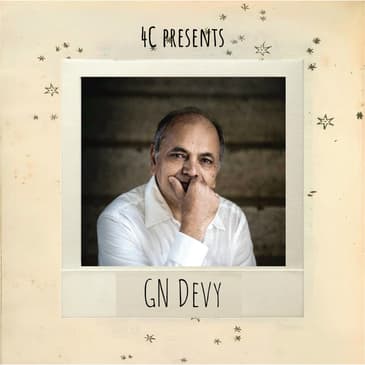
Renowned linguist and scholar Prof. G. N. Devy joins us at Media Meet 2026, where he delivered the keynote on indigenous knowledge in the age of digital ecosystems. The episode features excerpts from his interview and keynote, exploring language, indigenous knowledge, technology, and cultural preservation.
Credits: This episode was edited by Guru Aditya and illustrated by Vernika Singh. Interviewed by Steffy and hosted by Simran. Signature tune by Prof Ananthu.
Learn more about your ad choices. Visit megaphone.fm/adchoices
[00:00:16] Welcome to 4C Radio. We are broadcasting from the central campus of Christ University, Bengaluru. 4C Radio is brought to you by the Department of Media Studies, Christ University. For all those who are looking for a platform that focuses on communities, commons, climate and communication, this is the place to be. What's more, this station is run by a diverse community of students and dedicated faculty members.
[00:00:45] Tune in to experience hard-hitting interviews, fact-checks, myth-busting on-ground stories, campus news and more. German philosopher Ludwig Wittgenstein famously said, The limits of my language are the limits of my world. India then has limitless potential thanks to the diversity of languages we have.
[00:01:14] This week's episode is dedicated to the person who undertook the largest linguistic survey India had ever seen, G N Devy. Professor G N Devy, one of India's most influential scholars of literature, language and culture. A literary critic, linguist, educator and cultural activist. Professor Devy has spent decades asking questions like, what do we lose when a language disappears?
[00:01:45] How do we view language beyond the rules of grammar and oration? In his own words. Language is stored by people who speak it. And language does not mean words or sentences. Language means communication. See there is sign language, which has no spoken words, but it has meaning.
[00:02:10] So anything that carries meaning is language. And when we use words, there are many other things we use. For instance, you are nodding. So that is language. Your eyes are saying something. That is language. Language needs human practitioners. And so long as human practitioners are there, a language remains there.
[00:02:41] His grammar may change, his words may change, sentences may change. After a distinguished career as professor of English at Maharaja Saiyajirav University of Baroda, Devy chose to move beyond the university and work closely with Adivasi denotified and nomadic communities. He founded the Bhasa Research and Publication Centre and the Adivasi Academy at Tejgarh.
[00:03:08] Institutions dedicated to documenting and sustaining India's diverse linguistic and cultural traditions. He is perhaps best known for Conceiving the People's Linguistic Survey of India, a remarkable community-led effort that documented hundreds of India's living languages and brought attention to linguistic communities often absent from official accounts.
[00:03:34] He also shed light on other social, economic and cultural factors that influence the survival or demise of a language. Structuring of meaning, transaction of meaning is language. And therefore, in order to have the transaction, you need a human community. When communities break down, languages disappear. There is a lot of migration now.
[00:04:03] And if you look at Bangalore, you will find that more than 40% people have come to Bangalore from other places. So there is work-related migration. Sometimes there is forced migration. Sometimes there is desperate migration because there is natural calamity or too much of poverty. So when people move to another area, the language they used to speak slowly starts crumbling down.
[00:04:30] And when there are no longer people who speak a language, even if the words are there on paper or recorded somewhere, they don't circulate as language. So basically, you need a human society, community, community of speakers for a language to be alive. When that community breaks down, then the language, as we say, the language is dead. It does not mean the words have gone.
[00:04:59] Professor Devi has authored several books, including After Amnesia, A Nomad Called Thief, and India as a Linguistic Civilization. His work has consistently challenged us to think of languages not simply as a means of communication, but as a repository of memory, knowledge, identity, and ways of seeing the world.
[00:05:25] He has received, among other honors, the Sahitya Academy Award, the Prince Claus Award, the Linguepox Award, and the Purgma Shri. In today's episode, we present a lecture by Professor Devi that he delivered as a part of Media Meet 2026. The conference theme was End Digital, a look at how indigenous knowledge in the time of digital ecosystems. Over to Dr. Devi.
[00:05:56] Before I move to placing my ideas before you, may I mention that Media, as in the Greek mythology, is an extremely attractive, a very clever, very resourceful, intelligent woman.
[00:06:24] I am sure, I was told that there are more girls, more ladies, start doing media now, and I am sure they would like to know this. Media is a feminist legacy. She was so attractive, she had descended from gods in the Greek means.
[00:06:51] And you will get to know about her a lot. If you were to go to a fifth century before Christ play by Unipidus, called Media, do read it. Now, why I mention it is, in that play, after having rescued a king out of great difficulties.
[00:07:16] That's one of the rules that media does. Media rescues truth from getting besieged. Truth under siege is rescued by media.
[00:07:37] So, having rescued a king from a great difficulty, having married to that king, later that king discurses Media. And then she marries once again. So, media does not have ideological, media does not have, I'll say, an ideological imprisonment.
[00:08:02] Media needs to seek, look for, interpret, and present to the world truth beyond ideologies. And that's what the Greek myth says. Do read Eurypides, that famous play, and I hope someday, maybe in the next media meet, you will have a performance of that play.
[00:08:27] Because it defines what media is, for once and for all tribes. Now, you asked me to speak on how the indigenous cultures can be reimagined in the age of new media. So, since that is a challenge you place before me, let me also say what I understand by imagination.
[00:08:58] During the 1960s, lots of Indian scholars trying to revive what they call Indian knowledge tradition. They are trying to figure out if there is an exact parallel to the English word imagination in any Sanskrit poetics. Sanskrit texts on literary interpretation. And they came up with Kalpana Shakti.
[00:09:26] But Kalpana Shakti was not exactly imagination as understood in the English language. So, they concluded that there is no exact parallel to the term imagination in any of the Indian languages. There are close words which are close to the term imagination, but not the very imagination. Now, what is this the very imagination in the English tradition?
[00:09:54] That is tradition derived from Latin and partly from Greek. This term comes from the Greek, Imagon or Imagon, which means a shadow. Not the thing, but a shadow of the thing. Not substance, but the shadow of the substance.
[00:10:19] Now, I have been repeating the term shadow precisely because there is a huge deal of philosophical thought devoted to this idea of image. In Plato, in Plato's Republic, there is a description of a caveman. This caveman, the Plato's caveman, one day having lived in a dark cave and never seen light before,
[00:10:49] one day comes close to the mouth of the cave. The sunlight is coming in and he finds that there is a very long shadow of this man, person falling inside the cave. He called it image. His image. His image. And then he was, this is Plato's interpretation.
[00:11:16] And Plato says, is the image the man? The answer is no. The next question is, is not the image the man? The answer is yes. The image is both that person as well as not that person. So imagination is not something which is divorced from reality, but it represents reality.
[00:11:43] On the basis of this idea of image, on which further, you know, in future, the idea of imagination emerged in Western philosophy. Aristotle built his entire idea of what is beauty, what is literature. Since a lot many students are present here, it may not be a bad idea for me to actually say how Aristotle constructed this idea of imagination.
[00:12:15] For Aristotle and the Greeks of his time, this whole world was constructed in the shape of a box. Today, we know it is not like a box. But at that time, you know, a square box, like a shoe box or any box, like this hall for instance.
[00:12:39] And they felt, the Greeks of that time felt that there are holes in the ceiling, top of that box. Like, you know, those lights you see, ceiling lights here. And through those holes, light purples down into our world. Because at night, we see this, what we think are stars.
[00:13:06] They thought that when we have darkness in this world, there is still light above us. And therefore, they concluded that there is a world, which is above this world, which is filled with light. And it's perennial light. It never fades. It is unfailing light. Then they asked a question. I mean, these are Greek scientists of that time.
[00:13:32] They asked this question. Why does not light percolate from the bottom of that box? That is, why does it not come from the earth? Why are there no holes, bales of light coming up? They concluded that there is an area there, which is constantly filled with darkness. That is the word of dis, D-I-S, dis. This is the word of light. And we are in between.
[00:14:01] And it is because the light and the darkness, rays of light and darkness constantly mix. Humans notice that they can never divorce themselves from their shadows. If there had not been this interplay between light and darkness, there would never have been any shadows. And so the Greeks felt that the shadow is an essential part of being human.
[00:14:31] Shadow is an essential part of being anything, anything. Aristotle's Poetic says that if the human mind can create an object without a shadow, it would be as pure as the objects up there. The Greeks felt that, you know, in this world there is death. Things perish.
[00:15:00] But in the world above, because there is everlasting light, things will not perish. They will be everlasting. Therefore they won't need hundreds of tables. They will have only one table. They won't have hundreds of chairs. These are the examples given. Hundreds of chairs, but only one chair. So just the idea of the chair, the idea of the table, the idea of a boy, the idea of a child, the idea of a tree, the idea of a dog, the idea of a horse. That world is filled with ideas.
[00:15:30] And to capture those ideas is to imagine, to capture the images of the essential of the things, the essence of the things. So the term imagination, in their understanding, did not mean having some fantasy. We say that we don't have to do this. They were not doing this.
[00:15:58] They were trying to capture the very essence, imagination. Now, reimagining. That is, in the Greek terminology of Aristotle and Plato, to imagine was to capture truth. To reimagine would mean to recapture truth. I said that the business of media was to seek truth, to protect truth beyond ideologies.
[00:16:28] And the word imagination also means to capture truth. So really, imagination and media for the Greek people, they're fairly close. But for our times, reimagining the situation of Indian cultures, so indigenous cultures, and to think about them in terms of new media, digital media.
[00:16:52] We have to understand that as the question of understanding the truth of the essence of the indigenous.
[00:17:02] And not just the propaganda or false framed scenes from their lives, not to understand, not to worry about the indigenous people who are forced to go to Delhi on 15th August or 26th January in Mead to Dharams. No, we are not thinking of those. We are thinking of the indigenous of the world.
[00:17:29] Who are the indigenous people of the world? I mean, if you were to ask Mr. Gukal, one of the bad habits we acquired over these years, or some chat GPT or whatever, those folks will tell you that the indigenous, there are about 36 crores indigenous in the world, of which roughly 14 crores are in India.
[00:17:59] And the rest are spread all over the world. The same way, if you were to ask question to, you know, chat GPT, what is folk culture, etc. It will say it's the culture of the, you know, culture of the people in rural areas, culture of the people in lower social strata and so on. Those answers are not correct answers.
[00:18:26] Please throw them out of your thoughts completely. I will comment on both these terms, folk, folk culture and the indigenous at the same time, because they overlap, these two overlap in essence, in truth, in reality.
[00:18:45] The term folk in English comes into circulation sometime in the 18th century towards the end of the 17th century derived from a German term called Wok.
[00:19:06] Wok. Who was this Wok or folk? He or she was a person displaced from a village. Why was he or she displaced from the village? And mobs of such people, they were called in collectivity, the folk.
[00:19:29] Now, who were these folk, the folk or who were these groups of people? What, what constituted, what made these groups, groups to be called as folk? These were the groups which got displaced from the villages because the kings at that time had changed their taxation pattern.
[00:19:52] This is rather strange. The taxation pattern was changed because prior, in earlier times, the kings used to borrow soldiers from barons, from sardars. Kings themselves did not have their own armies. They had personal guards, but not their own armies.
[00:20:17] The barons used to lend soldiers. And when did these barons lend soldiers to the kings to fight their wars? When this season of cultivation was over, when people were free in rural areas, they were partly doing agriculture. And for the remaining time, they were actually supplied to the king for fighting the wars between France and England.
[00:20:43] France and what used to be for Prussia, now Germany or Austria and sometimes Italy. The kings felt that they needed permanent army. They did not want to depend on these barons. But they required revenue for that purpose. If you have to employ soldiers, you have to pay them.
[00:21:10] And therefore, the kings in Europe decided to levy taxation differently. This is rather disturbing but also interesting. I mean, how cruel kings can be? How cruel state can be? How cruel any authority can be? Just think of, not just kings, but every kind of mega-authority, large-scale authority tends to become ruthless and cruel for its own benefit.
[00:21:35] Here is an example. And media has to fight those authorities. That is the essential primary role of media. The king said, let the tax come not from the crop in the field. Because these crops can vary. In a good year when there are rains, there will be good crop. When there are no rains, there won't be any crop.
[00:22:01] So there won't be any taxes. So they change it from the amount of yield in the farm to the area of the farm. The area does not change. If you have 5 acres or 50 acres, they remain 5 acres or 50 acres, the taxation is fixed. And therefore, the revenue can be estimated on the basis of those estimates. You can definitely engage a certain number of soldiers and plan your wars, win them or lose them.
[00:22:27] So once the taxation change, in bad years, farmers had no income and they had to sell their land. And in search of work, start going to cities. And that's how large cities like say Manchester or Birmingham or Liverpool started coming back.
[00:22:53] All through the 18th century, you have in Europe, this scene of hordes of people. I don't know how old you were. This is for students, I'm saying, when Corona started in our country. And suddenly, like some mad decision, crazy decision by government, shut down. And you saw thousands of them walking without any food, without any help and many of them died.
[00:23:24] Something of that kind happened in Europe. And these mobs were walking to cities in search of, they were moving to cities in search of work. Those mobs were described by the Germans at that time Austria, Austria and Prussia. In Austrian Prussia, these mobs were described by the use of the term work.
[00:23:55] In English, they are described as folk. And their culture became a subject of research by the end of the 18th century, beginning of the 19th century. In England, suddenly the study of folk culture started. Why did that study start at the beginning of the 19th century in England?
[00:24:19] If some of you have studied English literature, you will remember, even if you have not studied English literature, let me share. People like poets like Wordsworth, Wordsworth and Kolerich, they had based their poetry, simple words, very easy words, simple lines. And like in the poem Daphogins, 10,000 I saw them dance, sprightly dance, etc.
[00:24:49] Simple words, simple rhymes, simple meters. Why? Because there was a tremendous tension arising between the urban people and the people who were moving out. That's not. In 10 years.
[00:25:11] So, this tension between the urban and the poor, urban rich people and the poor village people, created an idea of the folk. And in order to keep the order in the cities, the rich wanted to study folk traditions.
[00:25:41] Folk culture study, folklore study is a pastime of the 19th century in order to keep the hungry mobs of villages walking into the cities. In India, at that time, we did not have any system like folk culture, folklore, etc. Those concepts. We imbibe them from the British.
[00:26:09] And we thought that whatever exists in oral traditions is our folk tradition. And most of our languages were oral languages till then. Because printing, non-printed languages, even if they were written on paper. By the beginning of the 19th century, only four or five languages were in print. Such as Bangla, Marathi, Tamil, Kannada, etc.
[00:26:35] Slowly, Hindi also got coined as a language, which earlier was not a language, but it was named Hindi by bringing many streams of languages to Jodha. And so all the other things that existed became some kind of folk literature for us. That notion has changed over the last century, many decades.
[00:27:04] We no longer have the same idea of what rural India is. Our idea of rural India has changed. Our idea of what is oral tradition has changed. Now, in media, how do they get represented? Because offices of most of the newspapers were only in the cities.
[00:27:26] News about the rural life, rural culture rarely received attention except in some Sunday supplement on one column or half a column or as entertainment. But this new media, digital media, which started emerging in the world beginning 1940s, but had come into its life by 1960s with digital displays.
[00:27:56] Boards doing, you know, like shop sign boards and so on, digital displays. And much later getting help from the TV medium, now the mobile, computer and so on. The big wall between the village and the city has broken. People in the villages use your mobile as much as you do in the cities.
[00:28:25] They talk about their lives. There are many small newspapers, magazines, people are making films, documents and so on, documentaries and so on. Not just in the cities, but in the villages. And therefore we will actually have to re-imagine the idea of the folk.
[00:28:45] There was a time when there used to be festivals, India, festival of India, where, you know, they brought some, some dance from Orissa, some dance from Bengal, some Garba from Gujarat, some Bhangda from Punjab, some Tamasha from Maharashtra. And they said, no, this is cultural display. No. Please remember that in India today, more than 60% of Indian habitats are urbanized. And those which are not technically urbanized are mentally urbanized.
[00:29:15] The folk is over. The unemployed people from the villages were moving to the cities at one time in Europe are now everywhere in the cities, in the villages, everywhere. So in a way, all of us have become folk.
[00:29:33] I feel very sad in saying this, that in our own state, Karnata, out of 9 lakh students who appeared for SSLC 10 standards, 7 lakh could not go to Pius. 7 lakh. That's the kind of genocide, I mean, of brain. So many, so many get excluded, so many get excluded. And even those who study have no jobs.
[00:29:59] I mean, let me ask many of you, I'm sure I wish for you and I pray God that every one of you gets a very good job once you exit from this college. But you know in your heart that there are no jobs outside. We have all become urban folks. In the new media that you're using, perhaps this media, I mean, how do you re-improve? Imagine folk traditions in new media.
[00:30:25] The best way to reimagine folk tradition in new media is to use this media to change the situation. Which means you'll have to ask very difficult questions to governments. You'll have to be more political than all earlier generations in the past. I mean, Gen Z is only one example. But you'll have to go even beyond that. You'll have to ask difficult questions about inequalities in the country.
[00:30:53] You'll have to ask difficult questions about injustice in the country. And you'll have to, how many minutes, madam? So that I'm, five minutes. Very graceful, thank you. You'll have to, you'll have to, thank you. You'll have to ask very difficult question about what is nation.
[00:31:12] Pardon me for saying this, that despite our having earned independence, where each one of you from your generation should have got your rights, those rights are being denied. Perhaps many of you know that this FCRA law has come to crush Christian institutions. Christ won't be an exception.
[00:31:40] Muslim institutions, they won't be an exception. I mean, normally you will say, why is this keynote fellow speaking about these things because these are unpleasant things. Media job is to speak unpleasant things, tell truth to power. While the constitution imagines all of us to be equal citizens. There is an ideology which imagines only some kind of people as being primary citizens and others as suspect citizens.
[00:32:08] That needs to be questioned by reuse of new media to reimagine folk tradition because our folk tradition is of assimilation, of tolerance, of bringing everybody together. I, if there's somebody from Maharashtra, I don't know, there's Varik, you know, going to Pundit, everybody joins. In Orissa, Jagannath, everybody joins. Here, when you go to, you know, any, any Yatra, everybody joins.
[00:32:38] Assimilation, tolerance, Bhai Chara, this is the folk tradition, great folk tradition. We must bring it to our cities, we must bring it to the center of our nation and we must, making use of new media, if we are to reimagine folk traditions in India, we have to state loud and clear that all Indians are all Indians.
[00:33:06] Every Indian is Indian, fully Indian. And every Indian is fully Indian not because everybody is similar but because everybody is dissimilar. Each one of us wants the right to be dissimilar, to be unique.
[00:33:21] That is the right that new media gives to you to restate, reimagine folk tradition because the business of media was to tell truth beyond ideology. And the business of being folk was to go from a place of darkness to a place of light.
[00:33:45] I wish and pray for all of you that when you come out of this great institution, you will show light to this nation. And if you notice any injustice anywhere, any inequality anywhere, if you see any harassment, gender harassment or caste harassment or religious harassment, you will stand up even if you are alone. Raise your voice and say the truth.
[00:34:12] That is the great tradition of media to which you are swearing by being a student of media, not just to get a salary or to wear a tie when you are asked to wear it. You are here because you are swearing by media to say truth when the need is to say truth. And if you do it, you will be remembered.
[00:34:35] Like Euripides' media is remembered for 3500 years, you shall be remembered for another 3500 years if you play your role to question when questioning is necessary, to say truth when truth is necessary and be tolerant and understanding beyond any ideologies. Thank you so much. I am sure that will keep your mind running for a week.
[00:35:05] Thank you for listening to this podcast. As always, stay curious and tune in for more. This episode was hosted by our student reporter, Sinjan V. Dr. Devi's interview by Steffi. Edited by Guru Aditya. And demonstrated by Vannika Singh. Please write to us and follow us on X and Instagram.