



Imagine the Indian fintech industry as a Bollywood dance sequence. It begins in the early 2000s, with a few enthusiastic background dancers, mainly startups like Paytm and ItzCash, shaking to the primitive rhythms of dial-up internet. The choreography was less "smooth moonwalk" and more "clunky robot dance," but the spirit? Unmatchable!
As the beat of technology quickened, so did the steps. By the 2010s, the stage was ablaze with newcomers, each adding their own flair to the routine—swiping, tapping, and clicking their way into the hearts of millions. Mobile wallets, digital banking, and e-commerce platforms pirouetted around the traditional banking giants, who were still trying to tie their shoelaces and join the routine.
Today, the Indian fintech dance floor is crowded. It's a vibrant, chaotic medley—part traditional garba, part trendy hip-hop, and entirely enthralling.
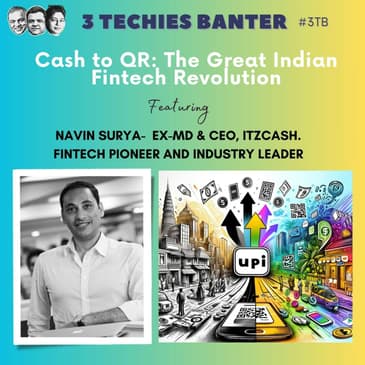
In this episode, Navin Surya, ex-MD and CEO of ItzCash joins us to help us understand the fintech medley of motion.
Learn more about your ad choices. Visit megaphone.fm/adchoices
[00:00:00] Hi, I'm Samiran. Hi, I'm Nilesh. Hi, I'm Sheetal and you're listening to 3TB. 3 Techies
[00:00:09] Banter.
[00:00:10] Hi everyone. Good morning. Good afternoon. Good evening. Depending on wherever you are
[00:00:17] tuning in to listen to our podcast. Sheetal Nilesh and I tend to kind of talk about
[00:00:24] technology in a interesting and fun way, make it more relatable. We cover a wide variety of topics,
[00:00:32] you know, whether it's blockchain, artificial intelligence, food technology, clothes technology.
[00:00:38] One of the most fascinating areas which catches everyone's interest, maybe also because it's
[00:00:44] made probably made the maximum unicorns a billion as is fintech. And while we've covered it in
[00:00:50] different ways, we thought it would be really, really interesting to kind of really get someone
[00:00:55] who's kind of lived and breathed that space in India. Someone who's been part of its evolution,
[00:01:02] you know, from nothing to where it is today. We were really, really fortunate to have
[00:01:08] Navin Surya with us. Navin has been part of the fintech industry in kind of a very
[00:01:15] multi-dimensional way. While most people kind of straddle a couple of them, not everybody is there.
[00:01:21] I don't think of many, many people who are there and also most people have worked in the
[00:01:25] fintech space, you know, that check mark, you know, Navin's done that. Some people have a
[00:01:30] fintech startup, you know, check that very few make successful fintech startups which
[00:01:36] Navin has done. Then of course some people also move on to the investor side, you know,
[00:01:40] which is okay, you know, you kind of do well and then you kind of invest in others.
[00:01:45] But the other side, you know, Navin actually is one of the very, very few people I know who's
[00:01:50] actually been part of the whole industry process of growing the ecosystem. You know,
[00:01:56] that's a true give back, you know, not many people kind of go and step back and say,
[00:02:00] you know, now I'm going to do something to grow the entire ecosystem, you know,
[00:02:05] make fintech regulation better, you know, work with the RBI, work with Sabi and all that. So I think
[00:02:11] he's done a lot of that. And of course, his interests have evolved over time, but he's kind
[00:02:16] of stayed close to fintech today is more of an active investor. He mentors a lot of startups.
[00:02:22] And he is of course someone who's very, very closely associated with technology and takes
[00:02:29] fun in the small things about technology. And just to illustrate that point before
[00:02:33] we kind of call Navinon is that he very recently, I think on February 28th,
[00:02:38] Navin posted this very interesting thing on LinkedIn, which about his IWC watch and which
[00:02:45] kind of, you know, change the date of the leap year. And the fascinating thing that as he pointed
[00:02:51] out was that here is this piece of technology that, you know, there is this one aspect
[00:02:56] or feature of it, which comes to life once in four years and works seamlessly.
[00:03:01] You know, so I mean, I think he takes pleasure in the small things of technology.
[00:03:05] And we hope to kind of have a very, very interesting chat with Navin and learn
[00:03:12] tons and tons from him. So thank you once again, for kind of joining us. And we look forward to
[00:03:18] a great conversation with him. I actually, I mean, I'm the type of jump straight into
[00:03:24] the conversation. So can I please jump in with my first question to you? So 17 years ago,
[00:03:30] you did things which changed and revolutionized the electronic payment system in India cut to today
[00:03:39] when FinTech is a buzzword, everybody's talking about different technologies in the space of
[00:03:43] FinTech. I just want to get a sense of what has it been in the last 17 years? So what are
[00:03:50] the key highlights for you of the last 17 years? Not as a personal journey, but as an
[00:03:55] industry is what I want to get a sense of. So just one correction before that, Sita,
[00:04:00] it's 24 years. I started my entrepreneurial journey in 2000. Oh, okay. I somehow thought of
[00:04:07] 2007. That's you're absolutely right for one of the business which I've obviously become famous
[00:04:13] and everybody associated me with HCAS which Scott founded somewhere around 2004-2005.
[00:04:17] So you're right in that way. But my entrepreneurial journey and very few people know
[00:04:21] that I actually know Samir and since my management training days in PCS and I've learned a lot from
[00:04:27] him by the way. I mean he just talks less but the immense kind of leadership stature he had when
[00:04:33] I was in PCS and kind of work we were doing together. I worked with him under him also some
[00:04:38] projects. So first thanks for that Samir and nice meeting you today Sita. So yeah, 2000 was
[00:04:44] the official entrepreneur journey you could say. I mean come from a business family so that way
[00:04:48] it's been lifelong already except three, four years when I was in TCS doing work for others
[00:04:53] which I think you've also changed now working for yourself. So industry milestone for payment
[00:04:59] industry which I think my first business itself was a financial services. It was exchange
[00:05:04] which had element of payment but more B2B in nature. In fact very few people know it was
[00:05:09] more like a virtual currency which got accepted in between the platforms sorry between the members
[00:05:14] on the platform and that time there was no blockchain there was no crypto but we had invented it in
[00:05:19] year 2000 itself without that technology. Then the retail part of it began in 2004-5 with HKS but
[00:05:28] while we were doing it and like you rightly said about the industry I remember somewhere around
[00:05:32] 2004-5 RBI and ministry started working on first formal you could say fintech segment
[00:05:41] which was payments also started setting up the department of payment and settlement systems
[00:05:46] and this was all around one bill that came which was a payment and settlement system that
[00:05:50] which actually was birthed because of 9-11 in the US they wanted to trail financial
[00:05:55] transactions that they thought were strong. Everybody said that we need to make sure
[00:06:00] that the money trail is maintained is controlled and therefore the government has to know
[00:06:04] what is happening in payment system. So 2011 is when finally the bill got approved and it
[00:06:10] became an act the department was already there in RBI in fact I had already started a
[00:06:15] payments business in 2004-5 so you are watching this journey very closely and this was the time
[00:06:21] we realized that we have to work as an industry to deal with the government and the regulator
[00:06:26] which is RBI industry even today RBI is the sole regulator when it comes to money and the payments.
[00:06:33] So if you see at that stage I think the digital payment in country from let's say literally
[00:06:38] zero other than the credit card I can't say zero but let's say something that was happening very
[00:06:43] miniscule. Early days estimate was somewhere around 2% of the entire spends in the country.
[00:06:49] Today if you talk about you easily talking about 25 to 30% of that and if you take 2011
[00:06:56] to now I think these are like what decade and a half not too many years less than that actually.
[00:07:01] So this is a journey that India has made and this was the first big milestone
[00:07:06] and this is the bigger achievement that put India on the whole you could say the fintech map.
[00:07:12] In fact even today within the fintech obviously payments contribute a lot followed by lending
[00:07:16] and now the other space is getting hotter and hotter be it insurance be it the wealth.
[00:07:22] So every companies have grown especially around COVID time so on the payments milestone one
[00:07:27] was the outcome from 3% to now close to 25-30%. Again setting up the bill coming after
[00:07:34] that the department getting set if you see from the department from the first license for a non-bank
[00:07:40] ever other than the NBFC in the RBI who only used to dealing with banks. This was the first of its
[00:07:45] kind with the intervention of technology and financial services where they agreed to license
[00:07:50] a non-bank entity as a payment PPI as as is to care called prepared issuers right. So that
[00:07:56] was the first guidelines that came. If you again see from there to today
[00:08:01] you had multiple licenses emerging out of that department after PPI today you also have account
[00:08:06] aggregator. You also had somewhere in between I think some other licenses also BBPOU and BBPS
[00:08:15] the entire billing payment system the entire NPCI creation that again happened after this.
[00:08:20] So if you see from in terms of milestones one is outcome but the number of licenses that were
[00:08:24] enabled by RBI within the payment system in that brief span of time is many. The number of
[00:08:30] entities again within the Fintech ecosystem is one of the largest almost one-third entities within
[00:08:35] Fintech ecosystem while the number keeps changing from 7000 to 12,000 will always be
[00:08:40] largest number in terms of payments so that number continuously grow. So if you see from
[00:08:45] our department and again let's not forget the bigger milestone of payments bank which
[00:08:48] again got created around similar time. So in last decade and a half you have seen all this
[00:08:54] kind of outcome and most importantly NPCI creating world's biggest success story for the fast payment
[00:09:02] starting with IMPS moving to UPI and today UPI is a known story so I don't want to spend more time but
[00:09:07] that is what again sealed the India's stature in the whole world that
[00:09:11] then it's no longer somebody who's legard we could do our own technology we could do
[00:09:16] our own ideas and we could be much bigger and bigger than all the countries in the world
[00:09:21] and again as I said fast payments India is the leader today in the country and of course very
[00:09:25] recently what you saw CBDC which is where RBA is acting as a start-up itself right. So CBDC is
[00:09:32] again the next game changer my personal belief is the success you've seen with UPI the potential
[00:09:37] of CBDC is actually literally 10 to 100x more why do I say so because payment systems work
[00:09:44] with the existing payment instrument which are not currency CBDC is actually a form of currency
[00:09:49] in a virtual so where you have a physical currency where it doesn't work in digital right the physical
[00:09:55] people know doesn't work in virtual so you had a need of money especially in electronic form debit
[00:09:59] card credit card pps wallets all those instruments but the moment you have your currency which also
[00:10:05] is in a form of digital your transaction the finality of transaction and for an example there's
[00:10:10] no payment and settlement lag there is payment and settlement the settlement finality is at the
[00:10:15] same time right as you exchange your money so there are game changing things that are possible
[00:10:19] and again within CBDC there are all kind of possibility India just started with the retail
[00:10:23] P2P and P2M you will see a lot more happening again on a wholesale side you will see again
[00:10:28] a lot more happening in a global side so all kind of things are happening I think it's just
[00:10:32] the start also keep in mind economy has grown from like 910 to 5th and aspiring to be third
[00:10:39] and I think we'll be there spends are increasing and the overall growth in the country the way
[00:10:44] it's going at the same time cash is still growing so the potential for the payment is still very very
[00:10:50] large that is interesting but so in fact a couple of things Navin that you really touched upon
[00:10:58] one is the this role of the regulator and I think we've kind of heard it in forums but
[00:11:05] you know normally a regulator has seen as someone who is constraining and you know
[00:11:11] controlling but I think in our case the RBI has been a very very forward thinking organization
[00:11:19] in most parts so I think maybe you know a little bit of because of your proximity to
[00:11:25] how this happened you know little thinking on that and number two is this the other point
[00:11:30] that you mentioned is that in this highly competitive kind of world you know you know
[00:11:35] how did you manage to get everybody or how did this industry kind of speak in one voice because
[00:11:41] that is also the reason why it's like that whole thing like you know we are together market will
[00:11:46] grow but normally people you know selfish interests say that I will take a bigger pie of bigger
[00:11:51] share of the small pipe but in this case y'all grew the pie so big that everybody got a bigger
[00:11:56] share of it so two parts with one I think initial days it was lot easier obviously things
[00:12:03] are a lot more complex because the association the payment council of India which I started with my
[00:12:08] other industriically friend Viswas Patel who's running CC Avenue that time so if you see there were only
[00:12:14] three or four entities three large one us as a it's case on the payment issuance site
[00:12:19] two on acquiring side builders Vasu Ajay and Viswas Patel who was running CC Avenue
[00:12:25] Viswas had already working on a small committee within IMI and there was aspiration to grow
[00:12:31] that and as the regulation came in while they were not getting regulated at that time
[00:12:35] because Arbe said that initially we're not looking at account aggregators or payment
[00:12:40] gateways sorry payment gateways and payment aggregators not account aggregators it's a
[00:12:44] different term so the focus was on PPI and the PPI that time were handful and some of us
[00:12:50] were in business about seven eight and everybody knew that RBI does not understand this community
[00:12:58] this is a new experience for them and unless we all behave ourselves and unless we all work together
[00:13:04] to really align what are the larger industry goal and what are the best practices that we will have
[00:13:09] to adhere to and what are the let's say male practices we will have to ourselves curve if
[00:13:15] you want to grow this industry and it was also easier because all the founders were very clearly
[00:13:21] focused on the growth but in a regulated and let's say what he call is a sustainable
[00:13:26] growth that was the thought process so it was a lot easier that that state so we all came together
[00:13:32] it was a critical need even RBI was very clear that we don't want to talk to all of you while
[00:13:36] we can always if there are specific issue pertaining to our entity but it's always
[00:13:41] easier that if you talk in one voice what do you want what we want from you so it became by
[00:13:46] default the small committee becoming a payment council of India I chaired it for 12 years again
[00:13:50] as a voluntary role the industry was huge support everybody worked very closely and from
[00:13:56] there today like I said each of these license holders committees even remittances global domestic
[00:14:01] all of them are part of it yeah the environment has got complex but the base things have not
[00:14:07] changed that industry has to work with the regulators regulators and industry both know
[00:14:11] that ultimately we exist for the end consumers and the at the interests of the country's
[00:14:17] those two are kind of paramount principles as long as anything that we talk and anything
[00:14:22] that are brings on those two principles there's no way that you can actually keep it away
[00:14:26] you have to follow that and yes there has been hits and misses it's not that it has always
[00:14:31] been a very smooth journey like any startup it has always been or like any industry that evolves
[00:14:37] it's always a kind of spiral thing right keeps going up and down but keeps moving
[00:14:42] gradually right so there has been a kind of different licenses different policies sometimes
[00:14:47] good sometimes bad but good part is the dialogue was continuously happening I do remember one time
[00:14:52] all the all the PPI's compulsory KYC was to happen then for some reason it kind of
[00:14:58] was not accepted that there should be relaxation later on some relaxation were brought back
[00:15:02] so again each of these consultations helped sometimes there is a time mismatch as to what
[00:15:07] industry want and what Arbe wants but again Arbe has a much bigger role to play right
[00:15:11] but ultimately everybody agreed that while we don't want to make the country cashless
[00:15:16] but we want less cash in the system the only way less cash can happen in the country is when the
[00:15:21] ecosystem with guidance of regulator work together and support of the government policies and let's
[00:15:26] not forget India is unique with the very successful digital public intra model right
[00:15:32] so that also started coming in so again it's a three-way approach where the collaboration has
[00:15:37] worked so Navina slightly different question but you know one of the things and you speak
[00:15:43] about self-regulation so in the fintech space it was obviously something that you
[00:15:49] y'all agree to do but what happens in the world of technology is that there is always this debate
[00:15:55] about technology companies not self-regulating in in alignment with what is known as the greater
[00:16:03] good or the betterment of the consumer it's always greed and profit oriented and that's
[00:16:08] something that is typically what everybody talks about what is it that the world of technology can
[00:16:14] learn from the world of finance from that perspective of self-regulation working with regulatory bodies
[00:16:20] and working with policy makers in order to ensure that the industry per se grows and
[00:16:27] it's not just one organization which is profiting or you know a couple of organizations which
[00:16:34] in the profit space I mean very good question two things first I want to clarify see there is two
[00:16:38] kind of self-regulation one that industry does voluntarily right which is what has been happening
[00:16:43] so far and one at a stage it becomes more formalized it becomes more governance oriented and even
[00:16:49] let's say authorized and controlled through regulators so actually the country is now
[00:16:55] evolving and moving into the next phase where all these industry bodies are moving into
[00:16:59] a different phase where they will be some of them if not all of them will be authorized by RBI to
[00:17:04] act as a formal asset like we have a die like we have empty right so that's a phase we are now here
[00:17:10] the role and responsibility of our industry ecosystem again changes a lot more from this
[00:17:15] merely like you said group focused from merely increasing the let's say merely
[00:17:20] negotiating on the policies for your benefit and and let's say betterment it's actually
[00:17:26] almost like a quasi-regulatory role similar to what our base is going to play and again it has
[00:17:31] to be balanced with all the ecosystem play it can't be just the industry body it has to be consumer
[00:17:35] it has to be merchant so that's the role that's the transition we are in now coming to tech and I
[00:17:40] think you're probably talking about big techs I would say fortunately while some of those issues
[00:17:46] exist and I don't think globally anybody has solved it this issue is not I mean I was
[00:17:50] just looking at SORA today and I mean we already know what's happening with the
[00:17:54] chat gpd the problem or I don't know whether it's a problem or other the challenge is that because
[00:18:00] the things are moving so fast by the time you it's like you're you're tempting a target you're
[00:18:05] suiting by the time the target is met so that's the challenge with most of the governments
[00:18:09] and by the time let's say you regulate what is happening on app probably you'll move to AI apps
[00:18:13] right so that's the challenge that remains but so one is that it's a moving problem but
[00:18:18] I would say that we still are relatively fortunate that India it has been well balanced
[00:18:23] if you see from a fintech perspective the regulator and government is very clear that's a finance first
[00:18:29] approach is a customer first approach in fact customer the foremost foremost I would say priority
[00:18:34] there are any customer protection angles slightly coming to risk they immediately tell you
[00:18:39] so India model in that way is slightly different if you see while we do have a big tech players
[00:18:44] they're all playing a role in the ecosystem but they know that India is slightly different we
[00:18:48] can't do whatever we want here the rules here are a lot stricter when it comes to financial
[00:18:52] regulations right so compliance and those who are taking a do our chances or advantages or maybe
[00:18:58] they got three years window of the covid period because the attention was somewhere else we're
[00:19:03] already seeing those things now getting corrected sometimes as we say that in the correction
[00:19:09] sometimes even certain good people also suffer but let's say this is a phase where the correction
[00:19:12] will happen and you'll have a again sustainable organized development the growth is still very
[00:19:18] high in the industry on the big tech I think so by the way one thing we didn't touch while
[00:19:23] we focus on payments that's not the way payments got involved today are big also for last two
[00:19:28] three years have a dedicated department for fintech called fintech departments again this is great
[00:19:33] thing because rba knows that any new subject we need a dedicated team we need dedicated resources
[00:19:38] and they need to give full attention to the sector which is evolving so that exists now
[00:19:43] and I do know that they have looked at the subject of a big tech how they operate what
[00:19:47] they do and they have certain plans I can't talk about it because it's part of a committee but
[00:19:51] all I could say that the government here and the regulator here and the industry ecosystem
[00:19:56] are working very closely they know the potential risks you know the potential misuse but they also
[00:20:01] know the benefits see the reality is also that sometimes you could draw a scale with their
[00:20:05] Spartan sex so trying to balance and I think appropriate framework would immerse similar
[00:20:11] to asaro which is a next level formal framework and that is in works so we'll see it in next
[00:20:16] six to 18 months all of that emerging so I mean just again kind of switching gears a little bit
[00:20:23] here is that for someone who comes into this sector maybe today you know you look at you know
[00:20:30] lot of companies solving lot of problems but for a I don't know maybe a young
[00:20:36] entrepreneur maybe a startup or whatever you know what are the big problems that you think that
[00:20:42] still need solving I mean in terms of you know what are the things that people can work on and what
[00:20:47] are you know are things out there that are attracting interest more from the consumer as well as from
[00:20:53] the investor I mean like you know typically when you look at the ocean what will I do
[00:20:57] there's so many payment gateways there are so many there's no space for me
[00:21:01] So two three things Amir first this whole growth is driven because of the very
[00:21:07] low penetration of financial services in India if you look at the data right overall
[00:21:12] banking is probably 50 plus idle population you talk about payments which is now moved
[00:21:17] brought rapidly around 30 percent 25 30 it keeps fluctuating but like I said that cash is still
[00:21:22] growing parallel right so the portion it is still exists if you look at everything else
[00:21:26] after that they're all in single visit of the growth of penetration right you talk
[00:21:30] insurance you're talking about an average across all the insurances three to four percent
[00:21:34] you talk about lending you compare China from a GDP ratios you're 10 times behind
[00:21:39] so if you take any sector and then you go deeper and I mean I can't go into specifics because that's
[00:21:45] like a two detail and then specific opportunity but the reality is another simple example right
[00:21:49] take credit card for an example so many years so many companies let's say if in our credit
[00:21:55] bureaus we have about 700 800 million consumers who would have taken loans sometime all the
[00:22:01] credit card companies put together would have issued about 150 million so again right there
[00:22:06] there is a gap of four to five acts now I understand all of them may not be carded or not
[00:22:12] card worthy or credit worthy when I say card didn't necessarily mean a physical format but
[00:22:16] fundamentally if you are a credit worthy you should have a credit card or a wallet whatever
[00:22:20] you want to call it right so the reality is that gap exists again fundamentally there was
[00:22:26] a time when there was an issue about the business model and the cost and the feasibility
[00:22:30] as the economy is growing as pens are growing as the technology this whole
[00:22:34] dpi infra that has kind of worked with us the potential to adopt and by the way one data
[00:22:40] point the adoption rate in India 64 percent in print tag is one of the largest in the world
[00:22:46] so with the customer readiness increasing if you combine this factor the growth is very high
[00:22:50] so any smart person if he goes identify a right let's say use case stick to it stay focused
[00:22:57] execute it's a hard work and also keep a balance between that is not just the tech way it's also a
[00:23:03] finance business you know that's what people are learning in last two three years with regulators
[00:23:08] so finance first approach compliance first approach technology as an advantage you're
[00:23:12] going to be a winner very interesting I mean I think you've kind of given lots of pointers
[00:23:17] in terms of I mean you just need to look at the whole landscape and you while on the one
[00:23:22] side there is huge growth there is a lot of other things that are lagging I mean I see 20 to 25 percent
[00:23:27] no reason that India shouldn't grow between a very high two digit two three digit growth
[00:23:33] within the let's say overall ecosystem of financial services come from tech
[00:23:37] considering the penetration levels right that's and the economy growth and when you combine those
[00:23:42] two to talk about women right because while a lot of the world and the country talks about
[00:23:48] print tech and finance and inclusion and inclusivity and all of that I think somewhere in the entire
[00:23:54] conversation as a woman I feel a woman kind of gets very ignored and case in point I remember I had
[00:24:02] called up a company and asked them to come and meet me for some investments and they sent some
[00:24:09] representation and representative and the representative had the entire conversation with
[00:24:14] my husband okay decided to completely ignore me in that conversation and they called called back
[00:24:22] the next day and said you know what is your decision and I said I'm absolutely nowhere
[00:24:26] investing with you because I called you it was about my money and you decided that it's only
[00:24:32] my husband you will have the conversation with so forget it it's not happening but not just that
[00:24:37] you know there are so many women who are earning not necessarily very large sums of money
[00:24:44] but there is a whole ecosystem of women who are women entrepreneurs work from home women
[00:24:48] they come into the system because now everybody's taking their salaries
[00:24:52] into bank accounts or from GP etc but it's it's a large community which is completely
[00:24:58] ignored by the world of finance which I'm just trying to understand what are the barriers that
[00:25:05] exist in the world of finance for them not to want to speak to it
[00:25:08] your statement reminds me of a frequent case study right if you want to see a opportunity
[00:25:14] or you want to see glass half puller and by the way I'm associated with two companies both are
[00:25:18] women driven and focused on women Luxby is one which is run by Prithvirati they exactly they
[00:25:24] see this as a huge opportunity that there is and I mean even we discuss very often right very
[00:25:30] simple thing that there are so many credit cards some of them even talk about women
[00:25:36] but is there a genuine differentiation between them let's say if you want to go and do certain
[00:25:41] things which are women specific let's say maybe cosmetics we even get a very specific deal the
[00:25:46] reality is no the answer is no which means everybody's doing a lip service there's no
[00:25:50] proper customization and this is by the way Seethal when I think financial services is one of
[00:25:55] the large employer of a woman I'm not saying they are the best ratios but relatively better
[00:26:01] so I would say time is to take charge in your hands right so all your fellow
[00:26:05] women entrepreneurs need to start saying that we want to build for women and by the way it's
[00:26:10] not easy I even heard some entrepreneurs saying that we're not sure whether investors also like
[00:26:15] just the woman but I've seen mixed experience I've seen Luxby which is doing well I've seen
[00:26:20] few other companies are struggling but I'm saying there is an opportunity and I agree
[00:26:25] with you that there is this is a genuine problem and I think the world has changed and
[00:26:29] people in the existing system needs to realize that the financial decisions are now equally
[00:26:34] taken by women in fact maybe I live in a household where in fact my decision is also taken by my
[00:26:40] household let's say my bhabhi is the smartest manager in my with my dad my mom used to be a
[00:26:46] smarter money manager so I've seen the reverse examples also the question is how do we use
[00:26:51] that energy bring it out of the front so I'm 100% agreeing with your point that this is a
[00:26:56] issue that exists question is do we keep talking about it or we see it as an opportunity and more
[00:27:01] entrepreneurs come and start focusing on this and start delivering it's not easy obviously when
[00:27:06] you focus on one segment you also have to kind of be true loyal to it expanded sometimes it's
[00:27:12] also about women that sometimes they think that's too focused on us so are they big enough
[00:27:16] I mean should we work with two needs a player who's just focused on us so it's also other
[00:27:21] way issue that our customers also comfortable that's another feedback that we got in one of the
[00:27:25] companies that that sometimes women consumer thought that okay they're too focused on us will
[00:27:30] they be large enough it's also insecurity within the segment so I'm saying it's a balancing thing
[00:27:35] but good part is more and more women becoming financial independent taking their own decisions
[00:27:40] I think more they demand and some of them actually again taking the entrepreneur path
[00:27:44] we'll solve it probably next five to seven years things definitely will improve I don't think
[00:27:49] we'll be able to fully solve it but it will improve as long as we solve a little bit
[00:27:54] the needy needs to shift so that way there are a lot of entrepreneurs now working
[00:27:57] and as long as we keep this noise off they would be by the way this issue
[00:28:01] exists even at the top so take an example gff when we hosting for last two years I don't
[00:28:07] know about this year but last two years there was a parameter that how do we get women
[00:28:11] speakers contribution high and we had attempted various ratios and while we did a reasonable
[00:28:17] job of it but I think we were struggling literally to get the right speakers
[00:28:20] and getting them to agree to come or travel them and getting them to kind of participate
[00:28:24] and even find the right numbers so while there exists but we couldn't go beyond let's say about
[00:28:29] 200 women speakers of the 700 list ideally we wanted it to be like a much better ratio
[00:28:34] so in fact she did very strangely you know it's it reverses also to in which like
[00:28:40] my wife I mean she used to head UBS well in Indian gap and along the book
[00:28:46] and she says that when she's to go for customer calls and she's to go with a junior guy
[00:28:51] the client used to talk to the that guy and see that you don't like he's constantly talking to
[00:28:56] that fellow she's like she's the head of the business and this is no he's not talking to me
[00:29:05] and they you can't yeah this gender bias is not necessarily in a male
[00:29:08] alone it's in a female as well and both will have to work together to solve it
[00:29:13] I think we are at a stage where that is getting much more
[00:29:16] things are getting much greater and again thanks to the education level the work culture
[00:29:21] I think everything is changing so I'm quite optimistic I think financial independence also
[00:29:26] no I think this whole thing is like with more money in the bank so the other thing I think
[00:29:32] the other side of this is that while there is the great opportunity and there is lack this thing
[00:29:36] the need for more penetration I think the RBI and the governments have toyed with this idea of
[00:29:43] giving new licenses new banks you know digital banks and stuff like that but I think there we've
[00:29:48] not got too much success here I mean it still seems to be this I mean after that one wave of
[00:29:54] few banks that came up we've not seen more of that I mean so is it more of a
[00:29:59] wait and watch by the government is it consolidation or they are kind of waiting for some other
[00:30:04] triggers or some benchmarks to be hit before they kind of say okay you know now we're going to have
[00:30:10] more maybe digital only banks or things which will kind of help grow this thing or you know
[00:30:15] there'll be more last mile penetration or stuff like this I mean that's very interesting and
[00:30:20] I mean sorry but also globally this is a challenge right new banks globally also have
[00:30:25] struggled because somewhere there is are they finance and should they be regulated by finance
[00:30:30] ade technology should they be regulated by technology and that debates it doesn't seem to
[00:30:35] come to some conclusions so true the answer is that today the number of
[00:30:39] financial services institution and I'm adding fintech in there the numbers are already large
[00:30:44] and one side is also challenged at how do you manage and regulate them because there are all
[00:30:48] kind of issues it also results into right because when you have a larger ecosystem you'll always
[00:30:52] have all kind of players behaving not behaving some in between right so you also have to look
[00:30:58] at the overall bandwidth and the overall economic priorities so I would say that the experiment
[00:31:04] is continuously on the number of innovative ideas that are coming in I still hide obviously
[00:31:10] ultimately RBI is a regulator with a mandate of running the monetary policy as a central banker
[00:31:15] running the regulation and the support so the focus will always be that the room for error
[00:31:20] in Arbe's mind will always have to be you know in a very tolerant in their tolerance
[00:31:25] probably less than 10 20 basis point so somewhere let's say that remains a issue but
[00:31:31] I would say overall the number of institutions that we have are already large I think time to time
[00:31:36] the number of entities including banks that have been added are quite high but at the same
[00:31:39] time I think there's also consolidation going on in the ecosystem right so they're also trying
[00:31:43] to watch the somewhere we also to see that we all know that eventually financial services
[00:31:48] business run on scale you can't purely work on this right and beyond the point it has to be
[00:31:53] also profitable it also has to work on a certain economics and globally no regulator not just Arbe
[00:32:00] I mean whether it's a CB whether it's IID all of them are very clear that they also monitor
[00:32:04] companies growth and profitability beyond a certain scale it to be in a control you would
[00:32:09] not want you to fleece too much of a let's say revenues and profits just for your shareholders
[00:32:13] benefit because ultimately these are systemically important institutions for the economy so from
[00:32:18] that perspective I think they also understand that if we have to achieve our economic goal
[00:32:22] we also need larger institutions consolidation is equally important and there has been experimentation
[00:32:29] also I think sometimes we get impatience we I mean we forget that I am PS to UPI and today's UPI
[00:32:35] is also about 10 years early right so many of these systems that we've started we need to give a 10
[00:32:41] to 15 year window payments bank mixed back but small finance bank has relatively been successful
[00:32:47] there are already number of private banks they're already consolidating digital bank the
[00:32:52] reality is that you do have a model right of a new bank in the country you also have a payments
[00:32:56] bank where again there's not much of a concept of a branch yeah there are some gaps there which has
[00:33:00] been continuously under discussion but they're also looking at the number of players left here
[00:33:04] what can happen what is already existing in the ecosystem so yes it's an opportunity but
[00:33:09] I would say on the whole the approach is generally positive on the other hand you see
[00:33:13] again IFSC and a gift city model there's some very unique and new opportunities right and
[00:33:19] some of these might even come in there for not just India but for the entire world to go to
[00:33:24] with that whole focus on also export side of the entities from India right and again you see
[00:33:30] something like NPCI international which is again going global with the fast payment
[00:33:34] so it's a balancing act I mean obviously in isolation one of those two specific milestone
[00:33:40] may look slightly behind but I think as a overall ecosystem if you're growing continuously
[00:33:44] as a benchmark I think they're in a right direction so maybe I don't know enough about this but the
[00:33:51] other thing which I thought would really kind of take off because of the last mile advantage it has
[00:33:56] is the post office you know that the India post the bank you know that they so maybe it's very
[00:34:02] good in the rural areas or whatever because I think some 150,000 you know post offices are
[00:34:07] there which literally are branches of banks but I mean do you have any sense where that
[00:34:12] is going because I think there was I mean at least on paper it seems to be like a great thing for
[00:34:19] last mile connectivity inclusion and all the great things that you know we
[00:34:24] personally but last I checked I think their numbers were impressive and they continue to grow
[00:34:29] and as we also understand and as you have done many projects early you know that
[00:34:33] at the places where post office is and what kind of challenges they face right
[00:34:37] and we've also seen that as the connectivity has improved in the remote areas we've seen changes
[00:34:43] we've also seen continuous new policies coming and not just from RBI but other regulators also
[00:34:48] that more and more offline transaction though digital can also be experimented can be planned if you
[00:34:53] see a lot of these sandbox experiments are around it if you see also RBI which is a research
[00:34:59] arm or innovation arm of RBI based in Bangalore headed by Rajesh they're again working on
[00:35:05] multiple models including things like frictionless credit again IDACM so if you see the number of
[00:35:11] initiatives that are on and all of them are at least growing working obviously because in our
[00:35:15] day to day life we don't connect with that institution much so we don't realize it we
[00:35:19] don't see it so much the reality is growing true true even look at number of NBFCs right
[00:35:25] I mean look at the sometimes I also say that we debate a lot and we talk a lot about
[00:35:30] probably all digital but we also forget that in between there are a lot of contribution by other
[00:35:35] entities like NBFC I mean look at a gold loan process I mean which where in the world in two
[00:35:40] minutes you put your gold and you get your money mutation whatever it is it's a technology process
[00:35:45] whatever you call it but that has helped probably Indians a lot more right so again vehicle loans
[00:35:50] so there are a lot of such initiatives that have happened against store in-store credits
[00:35:55] whether it's a bazaar or whoever is doing it you're standing at the counter you need a
[00:35:59] a kind of let's say on-demand credit it's available to you now how many countries have all of these
[00:36:05] solutions are at this scale the India everything is also about scale economics and speed right all
[00:36:12] three things have to be there so it's not just one factor right and for a lower ticket size at
[00:36:17] times so in that sense there are a lot of all kind of things continuously happening
[00:36:21] which is a lot of time we don't see it because in our circle of discussion it doesn't come up
[00:36:27] I mean so I know we can go on with this conversation with you for another couple of hours but
[00:36:32] to bring it to a slightly more personal space what do you enjoy most about the work that you do
[00:36:38] what makes you wake up every morning with full enthusiasm to say back into the space
[00:36:43] so there are two or three things I learned about myself as a person one if I have to create
[00:36:47] something which doesn't exist it excites me a lot and if you see everything that I've done in my
[00:36:52] life at least right from the entrepreneur's earning of 2000 a big business says with the concepts
[00:36:58] they were not kind of existing in the country whether it was a prepaid wallet the whole multi-purpose
[00:37:04] prepaid wallet even before the regulation before anything else happened we had created it
[00:37:08] with the first one to even allow your money to move from SMS from IVRS right from your internet
[00:37:14] I mean before that it was only internet which where the only credit card was working so anything
[00:37:19] which is I mean this is slightly different but I also saw myself as a convergence generation right
[00:37:25] I'm sure Samiran can relate to it we read a lot of those white papers together right
[00:37:30] so you know it became a natural vision in my mind that and in a way I had created a personal
[00:37:35] diagram which actually started with the with the convergence of our technology which was the
[00:37:40] ICT right information communication technology to ultimate converging economy level that what
[00:37:46] all can happen and I was trying to see that what are the major gaps one obviously was payments
[00:37:51] another one was whole channel where all you can sell the another one was the currency itself
[00:37:55] there is a currency which exists right so like this there were multiple components so
[00:38:01] I always got excited when there are long-term future visionary things that don't exist and need
[00:38:06] to exist and if I get an opportunity to create it secondly I've always worked with the ecosystem
[00:38:11] so whether it's a payment council of India where I could get the whole industry to work
[00:38:14] with us and obviously all of them have worked very closely with us and the whole credit goes to them
[00:38:19] also so anywhere where you are to create platformization right for an example even in our business
[00:38:24] at its gas there was no ecosystem of merchant there was no ecosystem of customers there was
[00:38:30] no merchant integration api tools were just the starting time so we had to create a lot of
[00:38:35] ecosystems so this this is ingrained if you're to bring diverse set of stakeholders
[00:38:40] together it was a natural I would say ability and excitement for me that I get to meet a different
[00:38:46] set of people understand their problems and marry all these different stakeholder problems with
[00:38:51] one simpler solution so whether it's a PCI for industry solutions whether it's later after my
[00:38:56] exit with the with the fintech convergence council which we set up again in our chair
[00:39:00] for the last six years was about rest of the fintech beyond payments again the same
[00:39:05] thesis that how do we bring these different stakeholders idea was that whatever we've gone
[00:39:11] through in our journey in a digital payments evolution of the industry the same needs for the
[00:39:15] rest of the fintech ecosystem be it landing be it into into wealth be it into insure tech
[00:39:21] so we wanted to leverage that knowledge and work with the ecosystem to bring them together
[00:39:25] and later on something like gff right so innovative first time stakeholders ability
[00:39:32] to kind of bring different stakeholders so these are some of the component that always drove me excited
[00:39:38] me to do something including zfm last which was again a very diverse set of partners right from
[00:39:43] regulators to industry to let's say different country partners to different governments
[00:39:48] everybody coming together so they're always excited me to do something so maybe one just
[00:39:53] one last question for kind of wrap this up so what does what does navine do for fun
[00:39:58] what like when you're busy doing all of these things then whatever little downtime you get
[00:40:05] so what do you what do you do to get a rejuvenate and get back to doing all this other stuff great
[00:40:11] stuff that you do so thankfully post my exit from hkc in 2017 I mean I have reached if I'm
[00:40:18] able to control my time and how I want to use it I mean obviously I lost a little bit control
[00:40:23] in between and I was setting up gff for the industry right but unfortunately enough to say
[00:40:28] that on an average I do get three to four hours of my me time in a day so which wasn't really a
[00:40:34] possible most days not all days but most days so yes I have a lot of let's say hobbies whether
[00:40:40] you can talk music so most of the time music is always in the background and all kinds right
[00:40:46] from I think early days rock of with Floyd to scorpions to guns and roses to a current ones
[00:40:54] new age like the weekend to Travis Scott to all kinds so I can listen to any kind of music
[00:41:00] it's all mixed up I watched a lot of content by the way but not probably our industry but
[00:41:05] different kinds on YouTube by the way so I'm a big YouTube consumer but one thing that again
[00:41:11] excites me a lot is two things rather one is the travel and second is the whole idea about
[00:41:17] spending time with yourself around spiritual spirituality aspect of it so again that's another
[00:41:23] thing so I make sure that I go out at least seven to ten days every year where it's just me
[00:41:29] and nature probably around and you really do spend good amount of time with yourself as to
[00:41:35] what exactly is going on in your head and what is going on around you and how do you want to
[00:41:39] impact and contribute to that right not necessarily in a commercial way but in our healthier ecosystem
[00:41:45] universal way everything like we say the purpose of life right so it gives me so I should think of
[00:41:51] this way right that as we grow in our life there's certain places we get data point then we
[00:41:56] convert into information and we convert into knowledge by practicing yet but ultimately over
[00:42:02] a time continuously practicing it you also reach a place where you have a wisdom of certain
[00:42:06] things can we spend time to generate that wisdom and say with others to an extent that we can not
[00:42:12] that you can do it every time but can we use this time to convert in certain areas not all the areas
[00:42:17] and other areas probably go and meet similar people of this wisdom that's another way to acquire
[00:42:22] that wisdom so that's where I kind of I like to spend time and do as much and yeah life is
[00:42:27] good and have if there's time then meet friends like you interact with in whether in these
[00:42:32] sessions offline wherever so so that's fun that's my idea of fun and I forgot about the
[00:42:39] watches but maybe one session on watches that's something I mean I got into it for like 15 years
[00:42:46] now but like you said right it's about it's not just about doing a calculation on calculator
[00:42:53] versus you knowing why it has right how's two and two become four it's about that right
[00:42:58] your digital watch would have done that four-year thing automatically through a chip but this
[00:43:02] watch doing it which would have even stopped in between on after that fourth year something in that
[00:43:08] in the mechanical mechanism doing that after four years even if your watch has stopped in
[00:43:13] between multiple times but still on that accurate time doing it is amazing so that's like real
[00:43:18] wisdom and knowing right that kind of a knowledge I wish I had that kind of a knowledge
[00:43:23] a lot more areas so now when we do an episode on time tech we'll invite you back to talk about
[00:43:28] watches and time as technology because we're always looking for new areas which people are not talking
[00:43:36] about in the space of technology so time tech is one of them and we'll just call you back for
[00:43:42] one of those episodes where it's not about money but it's all about time on that note thank you
[00:43:48] very much for spending and giving us this time and you know coming and explaining a lot of things here
[00:43:55] but we'd love to have you on the show once again so thank you for your time